YouTube
Why Your Amazon AI Seller Prompts Leave $ on the Table
Summary
Why Your Amazon AI Seller Prompts Leave $ on the Table - Date: February 19th, 2026 Summary: Kevin King discusses why Amazon sellers should stop writing AI p...
Transcript
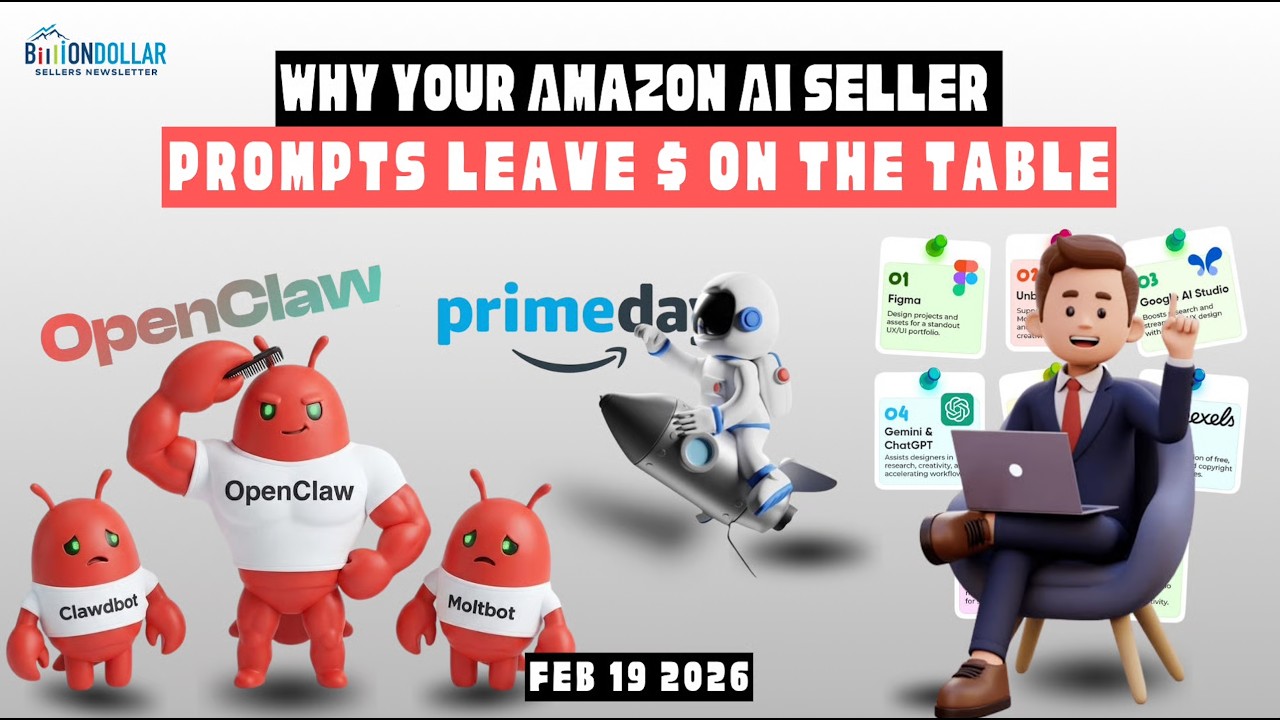
This This is the Billiondollar Sellers podcast, your go-to source for cutting edge strategies and success stories from the world of Amazon and e-commerce. Buckle up and get ready to take your Amazon business to new heights. Don't forget to subscribe to the Billiondoll Sellers Newsletter. Welcome your host. >> Welcome your host, Kevin King. >> Hey everyone, welcome to the Billiondollar Sellers podcast. I'm your host, Kevin King, and today is Thursday, February 19th, 2026. We've got a packed show today, including some gamechanging AI strategies and a wild story about an open- source project that just got snapped up by Open AI. But first, a quick announcement. This April, I'm putting together something big in Nashville. It's called Ecom Mastery AI, running April 8th through 12th. This is where e-commerce and AI converge. You can save 20% with coupon code Nashville. Head over to Ecom Mastery AI for all the details and that link is in the show notes. All right, here's your Stump Bezos question for today. Back in 2023, Amazon was basically breaking even on selling physical products. All their profit was coming from ads, AWS, and other services, but by late 2025, that had changed. What was Amazon's margin on selling physical products by late that year? Think it through and I'll give you the answer at the end of the show. Let's kick things off with something that could completely change how you use AI in your Amazon business. For the past couple years, most Amazon sellers have been using AI the same way. They type a quick question, get a mediocre answer, tweak it manually, and wonder why the output always feels generic. There's a better way, and once you see it, you can't unsee it. The shift is simple. Stop writing prompts and start writing briefs. A prompt is a question. A brief is an assignment. It's the same kind of detailed instructions you'd hand to a new employee or freelancer on day one. The difference in output quality isn't incremental. It's transformational, especially with the latest models like Cloud Opus or Summit 4.6. Let me show you what a brief actually looks like in practice. One of my Dragonfish team members tested this on a full email funnel audit, a project that would normally take 2 to 3 days. She uploaded everything to Claude, the sales page, every email in a sequence, performance data, brand voice guidelines, and top performing examples. Uh then instead of typing a prompt, she wrote a brief business context, clear objective, constraints, reference material, specific deliverable format. Two hours later, she had a complete audit with specific line by line rewrites, pattern analysis across more than 40 pieces of content, and a prioritized action list ranked by estimated conversion impact, including insights a human reader would have missed entirely. That's what briefs unlock. And so, here are the five parts of a brief that actually works. Number one, context. What's the business, the product, the customer, the price point, what's working and what isn't. The richer the context, the less generic the output. Number two, objective. Be specific. Instead of help me with my listing, use audit my main image and top five bullets and tell me the three highest impact changes I can make this week to improve conversion. Number three, constraints. Brand voice rules, word limits, what to focus on, what to ignore. Using constraints turn AI output from something you have to fix into something you can actually use. Number four, reference material. This is the biggest lever most sellers aren't using. Upload your best performing listing, a competitor page you want to beat, your brand style guide. Show it what good looks like. And number five, deliverable formats. Tell it exactly what you want back. A rewritten listing, a comparison between your current bullets and improved versions, a prioritized checklist. Specify the shape of the output or you'll spend your time reformatting instead of implementing. Here's an example. any Amazon seller can steal right now. Say you're selling a premium stainless steel water bottle in crowded category. Instead of typing, rewrite my Amazon listing, you hand AI a brief like this. I sell a 40 oz insulated stainless steel water bottle priced at $35 on Amazon. My main competitors are Stanley and Hydro Flask. My listing is currently converting at 8%. I believe the bullets are too feature heavy and not benefit driven enough. I'm uploading my current title, bullets, and A+ content, my top competitors listing, three customer reviews that mention the exact reasons buyers chose this, and my brand voice guide. I need you to rewrite my title and all five bullets using a benefit first approach that speaks directly to the outdoor enthusiast who's tired of overpriced trendy bottles. Match our brand voice. Keep the title under 200 characters. For each bullet, show me the before and after side by side with a oneline note on why you made the change. That brief takes 5 minutes to write. The output you get back is something you can actually upload, not something you have to spend an hour untangling. Most sellers are typing one to two sentences and hoping for magic. The ones pulling away from the competition are handing AI a full folder of context and a precise assignment. Your listing, your emails, your PPC strategy, your product launch plan, all of it gets sharper when you make this one shift. Stop prompting. Start briefing. Speaking of getting better results, if you want a second set of eyes on your PPC, there's a free audit available from my friend Chris Rawlings. It shows you exactly where your ad spend is being wasted and what campaign structure changes to make. No matter who's running your Amazon PPC right now, it's always good to get another perspective. Check the show notes to book yours. All right, next up. You got to see this. If you're still skipping sponsored brand video because it seems complicated or too expensive to produce, this one's for you. Turns out that you already have everything you need. Your existing product images, Amazon Creative Studio and Canva can turn them into scroll stopping video ads for free. No agencies, no video editors, no expensive software licenses. There is a great tutorial from Mindful Goods that walks through how to animate your product images inside Amazon Creative Studio. Pull those assets into Canva to build out the full video and set up sponsored brand campaigns that actually converge. You can even repurpose your existing A+ content banners. So, if you've already invested in quality creative, you're not starting from scratch. There's a link for that tutorial in the show notes. Now, for some interesting stats, I've been looking at Amazon's estimated worldwide gross merchandise value over the years, and the trajectory is striking. Back in 2018, total Amazon GMV was about $277 billion. By 2025, that number hit 830 billion. But here's what really stands out. The split between first party and third party sales. In 2018, first party sales were $17 billion and third party was $160 billion. Fast forward to 2025 and first party is 255 billion while third party has exploded to 575 billion. Third party sellers now account for almost 70% of Amazon's total GMV. The marketplace has more than tripled in 7 years while Amazon's own retail has barely doubled. That's a massive shift in who's actually driving sales on the platform. Next, here's a quick shout out to Get Reviews. They've helped hundreds of Amazon sellers worldwide collect real, honest reviews by designing review funnels, and generating unique QR codes for package inserts. You add these inserts to your packaging to get customers to leave genuine reviews. You also offer giveaways like warranties, promo codes, e gift cards, or digital products. Use code BDS-15 to get 15% off your first three months. Uh links in the show notes. Now, let me tell you about something that's been blowing up in the tech world and it's going to change how Amazon sellers operates. It's called Open Claw and it has a wild origin story. Peter Steinberger, an Austrian software developer who spent 13 years building and running a tech company, decided to just play around with AI agents as a side project. In November 2025, he launched something called Clawbot, named as a nod to Anthropic's Claude AI Mall. That name didn't last long. Anthropic sent him a cease and desist letter, giving him days to rename it. So, it became Mobileot. Then, he liked a new name better, asked Sam Almond directly if it was okay, and landed on Open Claw. Three names in a few months, and it kept growing. Anyway, it was reportedly costing Steinberger 10 to $20,000 a month just to keep it running. Then this past Sunday, Sam Alman announced that Steinberg is joining OpenAI, calling him a genius and saying his work will quickly become core to OpenAI's product offerings. Open Claw itself will live on as an open source foundation that OpenAI sponsors, free for anyone to use and build on. Okay, but what actually is it? Imagine you hire a super smart helper at work. Most AI tools like chat GPT are like asking that helper a question and getting an answer. You still have to do the thing yourself. Open Claw is different. It's like giving that helper a to-do list, the keys to your computer, access to your email, your seller central account, your spreadsheets, and then walking away. It does the work. It doesn't just answer, it acts. Here's the simple version. Regular AI talks, OpenCloud does. What made it different from earlier attempts like AutoGBT back in 2023 is that it combined tool access, the ability to run code, persistent memory, and easy integration with messaging apps like Telegram, WhatsApp, and Discord all in one package. and it can run multiple agents at once, like a little team of robot workers that talk to each other to get a job done. Here's where it gets exciting for Amazon sellers. Think about all the repetitive stuff your VA do right now. For listing optimization, an agent can monitor your listings, identify keyword gaps versus competitors, and rewrite copy automatically. When it comes to review monitoring, an agent watches for new reviews, flags negative ones, and drafts responses for approval or sends them automatically. And for PPC adjustment, an agent pulls performance data, compares it against your rules, and adjust bids on a schedule. They can also check competitor prices, alert you when someone goes below your floor, and repric within your set parameters. Unlike traditional chat bots that respond to prompts, and forget previous interactions, open claw agents execute commands, interact with external services, and operate with broad system level permissions, they keep working even when you're not watching. On Tuesday this week, Andrew Ericson hosted an Open Claw session for BSS WhatsApp group members and other industry first movers. More than 100 sellers logged in and started geeking out on how they're using it. Because Open Claw is open source, anyone can build on it, customize it, share their setups, and create pre-built agent behaviors for others to use. Imagine if one person figures out how to automate AMC audience creation, shares the setup, and the entire group has it working by end of day. There's a real early adopter edge here. The sellers who figure out how to run an AI ops team right now while everyone else is still hiring VAS are going to have a serious cost and speed advantage as Steinberger himself signed off his announcement. The claw is the law. Now for today's software tool of the days 13 speaker Jay Margaliad is running a 5-day AI brand ambassador challenge starting Monday, February 23rd. It helps you stop renting creators and start owning a UGC system. In 5 days, you build an identity locked AI character, a custom GPT for hooks and scripts in your brand voice, and your first publish ready UGC style video. It's $97 for early access with lifetime access included. Check the show notes to join. All right, here's some news that might affect your planning for the year. The rumors that Prime Day may be moving to June this year. Industry insiders are speculating Amazon is targeting June 23rd through 26, 2026. That would be only the second time Prime Day happened in June. The first was 2021. Why might Amazon make the switch? The last two Prime Days underperform expectations. Moving to June pulls revenue into Q2, making quarterly numbers look stronger. It creates better separation from Prime big deal days in October and Black Friday, Cyber Monday. And it distances Amazon from competitors like Walmart Plus and Target Circle 360 who've copied the July playbook. What does this mean for sellers? Inbound deadlines move up four to six weeks, so ocean freight purchase orders may need to be placed in Q1 instead of Q2. Promotional spend shifts from Q3 into Q2. Start planning creatives ad budgets now. Lock in inbound cut offs early. Rebuild your deal and coupon calendar and make sure your listings are conversion ready before the traffic surge. Nothing officially confirmed yet, but smart seller should start scenario planning now. A June Prime Day rewards whoever prepares earliest. Before we wrap up, here are a few more hot picks. Tik Tok wants your Amazon listings. You can now list products directly using your Amazon URL. Shopify says they're best positioned for AI shopping. A reminder that Amazon flat file templates expire next week and review velocity is now more important than total number of reviews uh for Amazon ranking. Links to all these stories are in the show notes. And here's your parting shot for today from Charles Darwin. It is not the strongest of the species that survives, nor the most intelligent, but the one most responsive to change. Oh, and remember that Stump Bezos question I asked at the beginning? By late 2025, Amazon's margin on selling physical products was close to 7%. That's a huge turnaround from breaking even just 2 years earlier. That's all for today, folks. Have a great weekend and I'll see you again on Monday. This is Kevin King signing off from the Billiondollar Sellers Podcast.
This transcript page is part of the Billion Dollar Sellers Content Hub. Explore more content →