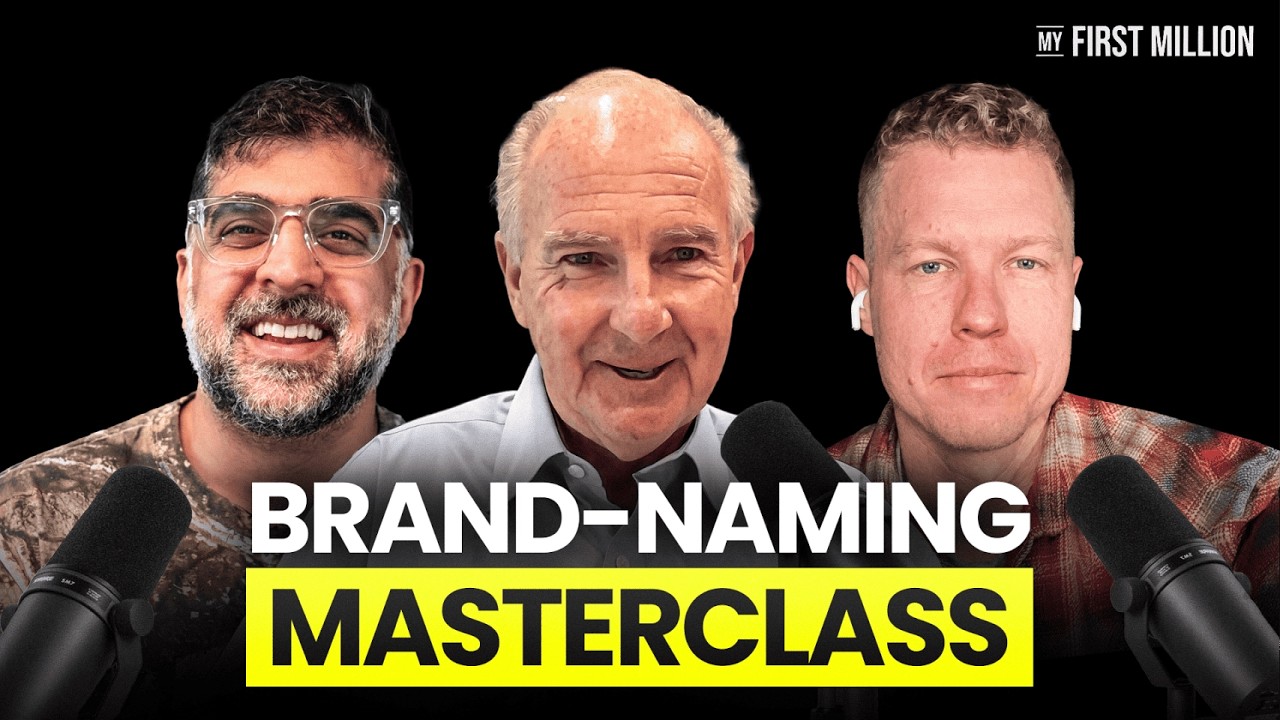
Ecom Podcast
We named a billion dollar “startup” with the guy that named BlackBerry, Febreeze and Swiffer.
Summary
My First Million shares actionable Amazon selling tactics and market insights.
Full Content
We named a billion dollar “startup” with the guy that named BlackBerry, Febreeze and Swiffer.
Speaker 1:
So, listen, David, here's the deal. I don't believe that naming your company is that important. And over the next hour, I want you to convince me why I'm incredibly wrong,
why picking a good name is going to help me build a billion-dollar startup, and how to name a startup effectively.
Speaker 2:
I love right behind you, you have, for people who are just listening on audio, they can't see this, but if you're on YouTube, you see this. Right behind you, you have a bunch of almost like a music artist would have platinum records.
You have platinum records of names that you've created. So the Impossible Burger, BlackBerry, Swiffer, Vercel, Windsurf. You've had, I remember the Intel Pentium processor, Febreze, Sonos.
Speaker 1:
Sonos is crazy.
Speaker 2:
The hits go on and on. SlimFast, oh my god, SlimFast, that is one of the greatest names ever. You know, Microsoft Azure, you've done all these incredible names and so how lucky are we, we get to hear from you today because I suck at naming.
I've always sucked at naming and it's bothered me because if you're going to pour your sweat and tears into something for five years, You kind of want to have a name that you like, that you feel proud of,
that gives you the best shot at success. And so I guess to Sam's initial question, which we said at the beginning here, which is he's like, I'm not sure that names are that important. Change my mind. Tell me I'm wrong.
Speaker 3:
Well, let me start off with this. First off, nothing that you will do in your brand will be used more often or for longer than your name. And it's not so much, you know, is one good name better than another good name?
It's getting the right name. And that's really what our success has been built on or based on is you got to think through what the right name can do for you.
Because if you get it right, first off, it's the highest frequency leverage, you know, something that happens all the time. That's leverage for you. And the name compounds over time.
So the difference between an OK name and the right name that actually creates a strategic advantage, we our goal is to always create asymmetric advantage. Impossible does that. Swiffer does that. I'll give you a very recent example.
We changed Codium to Windsurf. Now, nobody knew about Codium, really. No one knew how to spell it. They couldn't search it. Their SEO was bad. We worked with him over a six-week period, changed it to Windsurf.
I mean, there's a story behind that, but we don't need to get into that now. And boom, that brand took off. Now, that's an example of the power of a name. It doesn't do everything, but the right name can launch something.
It does really three things for you. First off, You have to get attention. I mean you had to get attention 50 years ago, but now it's almost impossible to do that. You got to hold their attention. Here's a kind of a $10 phrase.
It has to be processing fluent. In other words, not only can I sort of pronounce it, but there's something in it that I can understand.
And the third thing is, and this is what most people get wrong and why we have so many poor or okay names, has to be surprising, not comfortable, not popular. There's something unexpected about it.
Speaker 1:
I want to ask you about the comfort of things because that's amazing. But can you set the stakes here? Can you give an example? Like, you know, it's crazy. You have Febreze up here.
So like you've been doing this for a long time and you've had some amazing outcomes it seems like. Are there examples? Can you kind of give us like the price of success here where the product was the same,
the team was the same, and you changed the name and there was a different outcome?
Speaker 3:
Look, Procter & Gamble came to us, right? They said, you know, we were really disappointed. We wanted ProMop. We can't have it legally and we want you to work with us on this.
Speaker 1:
They had a mop, I guess, and they wanted to call it ProMop.
Speaker 3:
That's exactly right.
Speaker 1:
Okay.
Speaker 3:
So they sent out samples to us and the first thing we said was, first off, this isn't a mop. There's no stringy cotton on it. It was really easy to use. We did some research and we found out, it turns out, Whether you're a man or a woman,
in housekeeping chores, there are things people really like to do. Some people love to polish their furniture. Other people love washing windows. Nobody wants to mop. It's dirty. It's inefficient.
So we went back to P&G and said, look, Let's bring this alive. Let's put some fun in this. It also had some materials and a little bit of magic so it picked things up so it's more efficient. So boom, Swiffer, right?
Speaker 1:
So you changed ProMop to Swiffer.
Speaker 3:
Yeah, that's right.
Speaker 1:
Great decision.
Speaker 3:
Almost the same time, the Clorox company came out with ReadyMop. Now, that's a comfortable name. Okay, that's probably a popular name. It probably did well in research because people said, what do you think this is? Well, I think it's a mop.
Okay, we got it. We nailed it. Swiffer is a five billion-dollar brand. I think that Clorox's ReadyMop is a couple hundred million dollars.
Speaker 1:
What percentage of the difference do you think was the name?
Speaker 3:
I think the name makes all the difference in that first, I'm going to say, 90 to 120 to the first 12 months because that's where you're getting interest. You're holding people's interest for a while.
You're generating interest with retailers, right? They had to get into stores and say, hey, we're changing this business of cleaning floors. It's not a mop. It's a Swiffer, right?
And so now after that, All the other marketplace dynamics come into gear, but our whole thing here is to provide value, to create value, and we want it to be instant value. Swiffer does that. Impossible.
Look at the press Impossible got when they launched that, right? And that was something where we started with, they really wanted something sort of,
you know, kind of crunchy, hippie, something that fits into Whole Foods environment and that psyche. And we said, you're just going to fit in. You can't do that. You have to make a claim here that you're better than the other guys.
And we did it.
Speaker 2:
Hey, I got something pretty cool to share with you guys. So if you're like me, you listen to podcasts or YouTube videos, you like to take notes, you're here to learn, and that's a lot of effort.
Sometimes you're on the go and you can't do it. And so the folks at Hubspot who are sponsoring the podcast have done something pretty cool for you. They have created the MFM Vault.
It's a place to go find notes and resources that they pull from the different episodes that we do. So if we have a guest on that shares their five-point framework,
they write down those five points with the examples that the guest gave and they put the notes there for you. So if you want to access the vault, it's totally free.
All you got to do is click the link in the description below and you can access all the notes and the stuff in the vault. We're going to keep adding to this trying to make it better over time. Thank you to Hubspot.
This is a very cool way for them to sponsor the podcast, but by instead of telling you to go buy their stuff, they're actually giving you something instead. I like it. So you kind of hinted at two things just now.
You said a good name versus a, and instead of saying great name, you said the right name. So I picked up on that. Sounds like you have some distinction there.
And then you also said, you know, what I would normally ask is, what are the biggest mistakes founders, companies make when it comes to their name? And it sounds like what you're saying is they choose something that's safe and comfortable.
Which causes them to be lost in the sea of sameness with everybody else. Is that the right way of thinking about it? Can you talk about those two things, the right name versus just saying a great name?
Speaker 3:
Yeah, so let me address the founder thing because I think that there's a sequence that people end up with relatively comfortable names. A very common response when we ask the question, well,
how did you get this name that you have right now? They'll say, well, you know, our attorney called and they said, listen, we've got to put these documents together. We need a name. You guys got to figure this out.
So we spent a few hours doing this and there it is. And now they're spending the time, the money to do it again. For your first question about, you know, what's the difference between a right name and a good name or an okay name?
Right names always do three things. First, they're original, you know, in the category, in the context. That doesn't mean they have to be original like a Pentium, something that's coined.
And that begins that sort of you're on a slippery slope if you want something comfortable or popular because things that are original are humans like comfort for sure.
Second thing is you really do have to know something about linguistics and how the brain processes information. That's this processing fluency thing. That is, there's something familiar and yet something surprising.
And that's our creative strategy here is to really develop names that are surprisingly familiar. Because our brains are a little lazy, if you will. This is going to be easy for me to process, but oh, there's something interesting here.
That's where you get that attention. So those are those two things. And then I mentioned this before. You have to be unexpected, right? And an unexpected word can be something different for one company versus another.
Azure for Microsoft that typically has very descriptive and not so interesting words in their portfolio. Azure got people's attention.
If we had given that to Google, It wouldn't have been that attention-getting because people would expect that from them.
Speaker 2:
Can we play a game to make this sort of real? So I'm a founder. I'm listening to this. Presumably, if I'm listening to this because I want to be better at naming a company.
And we could talk generally about how to do it or we talk specifically. I like specifics. Okay. So let's pretend I came to you, David. And I said, hey, I've got this great fiber brand. I want to bring a new fiber brand to market.
And if you look at the fiber market today, there's, what is it, Metamucil, which I think is an all-time worst name. There's, what are the other big fiber brands?
Speaker 1:
Fiber One, is that one?
Speaker 2:
Yeah, Fiber One. Which is a very ready mop, bed of fiber. That's what my mom's drinking, bed of fiber. It's got some benefits to fiber, I guess. And I say, David, we can disrupt this market. We have something so much better, right?
Speaker 3:
Yes.
Speaker 2:
Step one, what are we going to do?
Speaker 3:
Okay. Our process is driven really by two things. It's a combination thing. We call it, or I call it, creative curiosity. So the first thing we would do for you is we'd say, okay, well, let's look at the category. What's out there?
What's the landscape? We would find a lot of fiber this or something fiber and we would say that's not the way to go. Generally speaking, that would be our first hypotheses about this.
Speaker 1:
You look at the landscape and you put everything into a bucket and you say, we just have to make sure that we aren't like that or we aren't that.
Speaker 2:
We don't know where we're going, but we know we're not going there.
Speaker 3:
We know we're not going there. We may go back to that once we find out more about what your product is. So we would look now hard at your product, right? And we would have a list, right, of those things that you have.
Then we would look to the consumers, right? Well, why are they doing this? What is their need? What's their expectations? We'd go up that ladder of what's the ultimate benefit, right? Okay. Then we would step back from that.
That's just kind of logical, practical stuff, right? Then we'd say, okay, we go through a little series of questions that there's almost no exception to this. It pays off greatly. First we say, okay, How do you define winning here?
Now, if you get in a room with six clients and you ask that question, I will tell you that every client will have a different definition. Then we say, well, what do you have to win?
And you would start talking about how your fiber is made, how it's ground differently, those types of things. Then we say, okay, what do you need to win? Well, we've got to break through, right?
We've got to communicate to people that fiber done this way is better for you than fiber done this way. I'm making this stuff up because we're playing a game here. And then, well, what do we need to say? That's the last sequence of questions.
And so from there, we begin to articulate with you a strategy for the name, because your fiber is going to do something on its own. Your packaging, things like that, along the way will do other stuff.
But we have to understand what you need to say.
Speaker 1:
Shaan, do you know enough about fiber to go through this exercise with him?
Speaker 2:
We could try. Actually, I think it's kind of almost funny to assume that you don't have a magic bullet in the product. Let's say that it's like most commodity products on the shelves where we think we're better,
we have clean ingredients, we're going to have cool packaging, we're going to be great at go-to-market, we're going to try to do all those things. So let's assume for a second I don't have a absolute innovative novel solution.
I have a very good solution but I'm looking to break into the park. Just to increase the level of difficulty here and say I didn't have some totally new out-of-left-field angle because I think that does happen a lot.
Most people are not coming out with a Absolute groundbreaking approach. Now, we might find something in the process that, you know, what's the old Mad Men thing, like our cigarettes are toasted or whatever. It's like a version of that.
But let's assume for a second I don't have a magic bullet feature that nobody else has of efficacy or anything else.
Speaker 3:
All right. So, the second hypothesis of mine would be that Everybody there is describing that they have fiber in this package, right? And they're making the assumption that people know that fiber is good for them and has certain benefits.
So I would say we're going to move away from that and we're going to talk about the ultimate benefit of that. So then let's just play the game here, Shaan.
So what do you think is the ultimate benefit of me taking fiber on a daily or a weekly basis?
Speaker 2:
You know, there's a couple ways to do it. Some people would say gut health. Okay, you have a clean gut. Somebody would say, you know, regular bowel movements or, you know, fix your bowel movements.
There might even just be an argument that like, I think, there's not a person I know on earth that doesn't want to have better metabolism. You know, just like have high metabolism. Wow, wouldn't that be great?
And so maybe there's some way we could go there that this is a metabolism booster, that this helps you process digestive food better.
Speaker 3:
So one of the things as you were talking I was thinking about is I think one of the real benefits here would be it's lighter. You feel lighter. Okay. That's a rich area there, I think. And so we would go down that category.
Speaker 2:
How good is he? I didn't even say the word light. You just saw my posture change and I did an upward motion and he's like, So what you're saying is after all that the real ultimate benefit would be you feel lighter.
Speaker 1:
Great.
Speaker 3:
So then we would explore that and we would look for and we have databases here and we have software that helps us. And there's some really tactical things that we would do just because this is really for us a treasure hunt.
You need to look at all the possibilities of that, right? Have you ever read the book Ship of Gold in the Deep Blue Sea?
Speaker 2:
No.
Speaker 3:
Oh, you guys would love it. So very quickly, a ship left San Francisco loaded with gold, gold coins, right, from the gold rush. So this is in the 1850s.
It sank off the coast of Southern California, estimated at over a billion dollars of gold. Of course, everybody tries to find it. One guy who's a scientist develops, takes some sonar booms and he goes, everybody is getting excited.
They find a shipwreck down there and there's a lot of shipwrecks because of the storms off the coast. And then they spend all their money on that shipwreck because I am going to map out the entire area here.
I'm going to make some decisions about what pays off, and then I'm going to dive. He found a ship of gold in the deep blue sea. Okay. Now, same thing happens here. We're going to go, okay, what are Greek word units for Lightness, you know,
for air, for less volume, for, you know, anti-gravity things, you know, those types of things. We're going to look at expressions around I'm feeling light, I'm feeling better. We're looking at aerodynamics.
We would have someone for 15 minutes look at what makes an airplane lift up. And along the way, we would have all this stuff. We typically internally call that trash. It's just things, just concepts. And we would start eliminating things.
Speaker 2:
And along the way, you're calling it trash, but you're not like disparaging it. You're like, this is necessary. It's the necessary things or why trash?
Speaker 3:
Because in this business, and it's very counterintuitive. Quantity leads to quality. Quantity leads to quality. Often we will get a list from a client saying, you know, we're really stuck now.
And I'll say, OK, well, how many names do you generate? We will get back a list of 50 or 100 names. And that's where they got stuck and they stopped. Right. We can't do that. We're looking at Maybe 2,000 names, right?
Again, these aren't all the right names. They aren't even good names.
Speaker 1:
Like 2,000 written down. So, for example, pre-AI, it sounds like you have multiple categories where you go treasure hunting. So, Greek names is one. I have one where it's like streets in my hometown. I look at all the streets in my hometown.
I'm sure you have, which I actually do want to ask you, what are the all categories? And you go through all of them and you would literally sit there in a group and write them down.
Speaker 3:
Yes, well, they're either written in a small, we work in small two-person teams here. We don't use brainstorming sessions.
Speaker 2:
Oh, I like it. What's the problem with brainstorming?
Speaker 3:
Well, first up, you have, you know, in the classic ones, you have peer pressure, right? So, and then stopping that cascade of evaluation when you have, you know, four or five or six people,
let alone ten people, it's just, it's a slow, slow grind. And we really documented that, and this is going back now 30 years ago, doing research, because we used to do brainstorming here. And we used to have freelancers, right?
And so the combination of that and over an 18-month period, I mean, we just asked, you know, it's always in life the questions you ask, right? And we said, where are our names really coming from, right?
And at the end of that 18 months, even though the collection was a little sloppy and a little crude, we said, this is really interesting. First off, it doesn't come from freelancers.
Not because they're not creative, it's just they're not inside. They don't have that esprit de corps. It's not coming from brainstorming sessions. It's coming from individuals or people working in two-person teams.
And so we stopped all that brainstorming, never hired a freelancer again, and we work in three teams now. So usually, it depends on the budget and the timing. One team knows everything about your fiber product, right?
Next team We're still in fiber, but now with that team, we're going to say we're adding an ingredient to this. It's got energy in it. Well, what happens there?
It changes their perspective and their names are going to be completely different than that first list. And the third team, we're not even talking about Fiverr. We're talking about probably something, an athletic performance.
Now we've got three distinct types of names that we're generating.
Speaker 2:
This is searching the deep blue sea, searching the whole ocean of possibilities.
Speaker 3:
That's right. We're looking for more.
Speaker 2:
I'm sorry, that second one was what? So they know it's Fiverr, they know everything about our product, and then you add Something unrelated?
Speaker 3:
Yeah, and it would have been like energy. You know, this now has its fibers, so it's digestion. Pus is going to give you some energy. It might be a package of minerals.
I mean, these things, I call it the blueprint for a program, what we're going to do. And then we try these things out. And, you know, there's a lot of failure in creativity. And, you know, everybody here has complete permission to fail.
If we're not failing here, we're not doing our job, right? Because it's, again, you're looking for that ship in the deep blue sea. And so along the way, you know, we're going to uncover something like, you know, well, what's about lightness?
How do you feel light? Well, feather. All right. So then we'd say, well, what would this what would this feel like if I walked into Walgreens and there's Fiber Plus and there's Metamucil and now in a new package,
there's a brand called Feather, right? And now there's got to be copy that supports it, right? So you've got to figure out, can we create a sentence or a little phrase where people get it, I get it.
It's going to have fiber on the label, okay? So, you know, It could be Feather, the lightweight fiber you need or something like that. All right, I got it, right? You know, consumers aren't stupid, right?
Speaker 2:
This is like the Swiffer. Swiffer, it's not called a mop, but it's the quicker picker upper.
Speaker 3:
Exactly. So we would go through that drill and eventually we would have, you know, a list of 10, sometimes 15 names. Now it goes to our trademark group here, which we have paralegals and a trademark attorney.
And they're looking at, I'm going to stick with feather for now, is feather available? Probably would be in this category, right? And so now what do we have? We have something original.
We have something that's easy to process because it's a real word and it's familiar, but all of a sudden in Fiverr it becomes surprising.
Speaker 2:
Today's episode is brought to you by Hubspot. Did you know that most businesses only use 20% of their data? That's like reading a book but then tearing out four-fifths of the pages. Point is, you miss a lot.
And unless you're using Hubspot, the customer platform that gives you access to the data you need to grow your business, the insights that are trapped in emails, call logs, transcripts,
all that unstructured data makes all the difference because when you know more, you grow more. And so, if you want to read the whole book instead of just reading part of it, visit Hubspot.com.
Speaker 1:
Right away, you said, you know, You said light and we both lit up and you were like, now let's look at the Greek words for light. You said that very quickly as if this is just one of the many places where you go treasure hunting.
What are the other handful of places that you'd like to dig?
Speaker 3:
Yeah, so in terms of databases that anybody would have access to, we do look at Latin roots, Greek roots, Roman mythology, Greek mythology. Those really basic things, which sometimes yield things. I mean, Pentium came out of, you know,
we have a database not only of the periodic table, but lots of information about the periodic table.
Speaker 1:
You said lots of those basic things. They're not basic to us. You know, we're dummies. We're a few brain cells away from being just talking monkeys. So, like, what are some of the, what are the other few, what are the other simple databases?
Speaker 3:
Yeah, okay. So there's your periodic table, but you got to go, you have to have databases where we have built them out. It's not anybody can just, you know, okay, I'm going to go and look at the The periodic table,
we've taken that table and then we've loaded it up with other articles and information about it. So now it's a richer base of words relating to that periodic table. And that's where kind of the gold can be.
Then what we've done is when we have an assignment Let's say it's a small car for Nissan. All those names go into a database not called small cars, but small things. And a processor for Intel, that's small, that would go into that.
So now what's happening is that gives us, I'm a real believer in the synchronicity. The connecting of seemingly irrelevant things, right? That's the fundamental layer of creativity.
Impossible is seemingly irrelevant to what they're doing, but look how it performs in the marketplace, right?
Speaker 2:
What would have been the comfortable name for the Impossible Burger?
Speaker 3:
It would have been like when we came to the client and they said, yeah, we want to fit into Whole Foods. It would be something like Natural Farms.
Speaker 2:
I don't know if you still come up with names yourself or you're the king of the kingdom and you let the scribes do that, but how do you get in flow? Let's say it's a name day and you need to get into a creative mindset, flow.
Do you do anything in your routine?
Speaker 3:
It's more difficult to keep in the flow because of Because of interruptions here, right? But what I really try to do is I first sit down with a pad and a pen and I just start kind of free associating thoughts about where to go with this.
You know, I sometimes might draw a treasure map with a grid and put ideas down there. And, you know, we use the, I mean, everybody's addicted somehow to the web.
I'll use, I mean, we use all the AI things, Claude, Cowork, you know, ChatGPT, you know, all these things. And I'll start asking questions. I don't ask it for names, but I'll ask about different things relative, in your case, to fiber.
And I'll get stuff like that. And then at a certain point, This is really like a 20-minute kind of thing, so it's not, you know, very arduous for me.
So I'll just start generating names and I'll write down other directions and then I'll pursue that. It might be okay. I think this, I think Greek would be a good thing to look at.
I think aviation and aircraft for things that are lighter, right? I would go and I would look at other words for light and then that would lead to sunshine and soul and SOL, things like that. And then I just start crafting names.
Speaker 1:
So my guess is that I'm just, we've only talked to you for 30 minutes and I've already gleaned from you that A, you're probably just incredibly talented at this, but You seem very process-driven.
You seem like you were creative and then you've made this into a skill, which implies it's somewhat teachable. When Shaan and I are trying to manage, we both have companies,
when we're trying to manage creative people to come up with these bits of brilliance, whether it's just a name or it's anything else that's creative, you seem really good at this because you just seem like you know what you're doing.
What mistakes do you think that we are making with our team or a lot of our listeners are making with their employees on managing people when you're asking them to come up with something unique or creative or dangerous a little bit,
you know, things like that?
Speaker 3:
It's a little bit of search for the holy grail of how to manage creative people and that's where your kind of first mistake is or clients make this mistake is I try to lead everybody here And I really try to encourage people.
And, you know, the root word of encouragement is courage, right? And so it may be that you're not giving the people you're asking these things to do, that you're not actually letting them just flow free.
I mean, here when people develop a list, And they give it to me, right, because I'm still a creative director here and I still generate names every week.
They know that I'm not going to look at that harshly, that I'm not going to evaluate it. I'm going to speculate with it, right? And now, eventually, we do have to evaluate things. We're working for clients.
We've got to do the right thing for them. But go back and look at how you're communicating with your team and see if you can't move it from leading versus managing and encouragement.
Speaker 2:
It seems like one important part of having people have courage is to not get smacked down on their first bad idea. You talked about separating when you judge an idea versus when you're generating an idea and doing both at the same time.
Everything I've read about creativity tells you that basically that's one of the most key things you could do. I think Disney had three different rooms in his office.
One to dream ideas, one to plan out which ideas to do, and then one to judge. The result at the end. You don't judge when you're in the dreaming room, right? Because that would sort of kill the creative flow.
Do you guys do something similar or do you have any rules around when you judge? And then also, how do you judge? Like, how do we know if Feather's a good name? How are we going to know?
Is it just, we just go on our gut or do we have some testing?
Speaker 3:
We do have testing. I'll talk about that in a moment, but going back to your issue with your creatives, there's two things that we do, and these are kind of magical phrases. I mean, just trust me on this. I know you don't know me very well.
I'll coach people to say, listen, when you have trouble, when you feel yourself leaning into the urge to say, that's too expensive or that'll never pass legal, say something like, I wish we could make that so it wasn't expensive.
Or how do we, how do we modify that word so it's legally available? What you've done there is you've given someone a problem-solving proposition. You haven't slammed a name down.
You're getting people to think about, okay, well, let me think about, because humans love to solve problems. We do. That's in our DNA. It's how we survive. And so try those things.
Someone comes to you with an idea and go, you know, It's an interesting idea. That's the first thing I say. Okay. It's interesting. Or I'll say, I would not have thought of that. Okay. Which is just being honest.
Speaker 2:
Which is code for... I, as a smart person, would not have thought of that.
Speaker 1:
The other day I was... I met this guy at a conference and he was making his argument about why AI, we've peaked. And I was like, well, I understand your argument. I'm not low IQ, so I don't agree with you, but I totally get your argument.
Speaker 2:
You don't do that. You just say, you give them credit. I wouldn't have thought of that. And then you sort of redirect towards the problem.
Speaker 3:
Yeah, we try to redirect. And then there's a certain point where you do start just eliminating things, but you have to give, there's a moment, there's a period where things just live in our system, right? And then we start paring them down.
And, of course, Trademark pairs things down automatically. It's very precise, right?
Speaker 2:
When you're going to switch gears, like, do you tell the team or you wait till tomorrow and you say, okay, now we're going to narrow down? Or, like, how do you switch gears from the divergent phase to maybe converging on an idea?
Speaker 3:
Yeah, we, in our process, we're going through a cycle. There's an initial cycle. We're just trying to figure out, were these assignments right? Did we get anything out of fiber plus energy?
Did we get anything out of this sports medicine thing that we had over here? Should we redial? But after we've gone through really about two cycles, which is a two, two and a half week period,
because people are working not on this one project for two and a half weeks. They might have three or four things that they're working on. Then it's time to really look and say, where are we?
Of course, we go back and we look now at the objectives. We call it the creative framework. And there's a reason for that because we want more of a window for people to walk through and create as opposed to conform to these five things.
So we'll look at that creative framework and we'll say, hey, I think we're getting there. Let's ship this off to legal. Most of our products are projects We have to do with two or three or four or five markets that our clients want to do,
you know, global in a sense, right? And so we have linguists that work for us around the world and we're shipping those out.
We also have software that we built here that takes certain language principles and certain cognitive science principles and that's all been in there into software and now it's AI-powered.
So that I can put a name in and it will come back and it will talk about processing fluency, memorability. The famous thing is CVCV, constant vowel, constant vowel. That's how children Learn language.
That's the only thing a child will pronounce. That's like mama. You got it. That's it. He'll never hear anything until about a little bit past the age of two.
Unknown Speaker:
That's like Sonos.
Speaker 2:
What are the other like power letters? Aren't there some letters that have like, you know, just like, you know, not all letters are created equal. You know, if all the letters are in a bar and one letter walks in every day.
Speaker 1:
Who's the alpha?
Unknown Speaker:
He's here?
Speaker 1:
Okay.
Speaker 2:
Oh, my God. What are the key letters?
Speaker 3:
Yeah. Well, you're really talking about an area that we know a lot about, which is sound symbolism. And so you just said K, and that actually is one of the power letters. So I don't know. Maybe you want to work for us at some point.
But so those letters that are strong, I mean, this is in many ways just intuitive. But think about it. You can call them plosives. There's other technical terms. You talked about P and K and B.
Those sounds are, if you want something reliable and fast, you're going to at least formulate that into your names. So in our software now, I mean, we used to do this hand-eye coordination,
but now We just say, you know, to our platform, which is called Predict, we say, OK, for this project, this name has to move fast. Sort these 10 names out as to which one's faster. Right.
And it's looking at all of the research we've done on sound symbolism. And it's going, well, D is fast. P is fast. Z is really fast. And it's looking for those letters.
It's not It's not commenting really on the semantics of the word or even on the project. It's just saying, okay, this is faster than that. And that's really helpful to us.
Speaker 2:
Today's podcast is brought to you by my friends at Mercury. They make the world's best banking product. I think you know this already. I use Mercury for all of my businesses. I think I have like maybe seven or eight businesses.
We use Mercury as our business banking across all of them. And now they actually just launched a personal banking account. So I have my personal account there. I moved off of Wells Fargo and Chase. I'm just all in on Mercury.
Speaker 1:
Why?
Speaker 2:
I like products that are easy to use. I like products that get me and the problems that I have. So like, very easy to make a joint account with my wife. Very easy to spin up virtual cards. One click and I get savings yield.
It just has all the stuff that I need in one place. So if you're looking for the best banking product on the market, it's definitely Mercury. I will fist fight anybody who disagrees with me on that.
Go to mercury.com slash personal and learn more. Mercury is a fintech, not an FDIC insured bank. Banking services are provided through Choice Financial Group and Column NA, members FDIC.
Speaker 1:
So, I'm a self-taught copywriter, which means I'm pretty good, but I'm not world-class. But I have a process, and I would like to explain my process to you,
and then maybe you can give me a process that I can use at home to be a better namer. So, when I write, up top, I have general knowledge, which means I'm reading books constantly,
and they're on any topic that I like, and I'm generally learning. Then, when I have a project, I get specific knowledge, so I dive deep on that one thing, so I can learn.
Then I get my draft out and my draft I know it's gonna be horrible and I just I say I don't care I'm just gonna like just get horribleness out there. Then I do what's called the incubation period. So I drop it, and I go for a walk.
It could be a one-hour walk, or it could be a 24 hours, or I could come back to it in a week. But some amount of period. Because that's like when those weird shower thoughts happen. And I think there's a reason for those shower thoughts.
And then finally, I'll do the edit. And the edit is where brilliance comes up. And this process I just stole. I think I stole from David Ogilvie, where he said, like, I'm not even a good writer, but I'm a world-class editor.
Is there a process, let's say I have a new company, I have a fiber company, is there a process that I could do in five days that you could like bullet point out of like, if you do this, this, this and this,
you'll be 80% ahead of where most people are. You may not be as good as me, but you'll be pretty good.
Speaker 3:
Okay, yeah. There's at least one thing I would add, maybe two, and I'll go back to what I said earlier. Real believer in synchronicity, right? You know, looking for connections from things that are seemingly irrelevant.
So, as you get to, before you go to that final draft, and if this was, you know, we'll stick with, if this is helpful, Fiber for you, writing this article on Fiber.
I would go to a bookstore and I would either get a book or it'd be easier to get a couple magazines that you never have read before, right?
And I would spend 30 minutes on those two magazines just looking for connections that might be moved into your article. And I guarantee you that at least 30% of the time by doing that,
You will find a new perspective or you'll put a new spin on that article that you're writing or a new insight that will be in the article because you've gone out and you've suspended,
you got to suspend logic and evaluation and just speculate. What could these two magazines or what, you know, I've never read a book on Thomas Edison, so what can he teach me about this particular project? Does that make sense to you?
Speaker 2:
I love that, yeah.
Speaker 1:
What names did you present to clients that they turned down because they were fearful of that you think was a big miss?
Speaker 3:
Every name behind me has been rejected by clients. Every single one.
Speaker 1:
So I see BlackBerry, Impossible, Sonos, Toro, Febreze, Swiffer. They all were turned down at first?
Speaker 2:
BlackBerry is an interesting one. Is there a good BlackBerry story?
Speaker 3:
Yes, there is. So when we named BlackBerry, so we're in Sausalito. You may or may not know this, but during World War II, Sausalito was a shipbuilding area.
I mean, lots of people worked here and we were in another naval building built by the U.S. Navy and part of our office was in a vault where they stored the plans for these ships. So these Canadians come from Waterloo, Canada.
And they're sitting down in a vault. So right away, they're going like, what? God, we're here in Sausalito. We're in California. And then we present to them Blackberry, okay?
And one of the clients, I can't even remember his name, just said, he goes, man, this is something else. I'm here in a vault, I'm in Sausalito, there's no windows, and I'm looking at Blackberry. And so that was off the table, right?
But one of the things I said there in that conference room, Hold on. Let's take it off the table for now, but I'm going to bring it back because there's things in this that are of real value.
It was just fortuitous for us, our first wave of research on sound symbolism, where we went out and we did testing in about six different languages, six different countries, by the way. It wasn't inexpensive.
I said I can tell you that B is one of the most reliable sounds in the English alphabet. That's number one. Two, black is going to be, you know, recognized across multiple languages. And not all, but some people will recognize berry, right?
And a blackberry is kind of a delightful thing. And I said, there's one other quality here. And their arms were crossed. They were kind of listening, but not. I said, your current competitors.
Who are all big companies would never have the courage to put BlackBerry on a device. Then the arms dropped and you could see people going, okay, maybe this guy knows something I don't know. And then I had to fly to Waterloo,
Canada a couple times just for Extra sessions and talked to them about this and then finally they went with BlackBerry, which was the best decision that they ever made. I mean, talk about a name that just took off, right?
Speaker 2:
Can we play a little game where I give you the name of current tech companies and I want you to give me a 1 to 10 score as the naming guy. Just your gut reaction. You love the name, it's a 10. You hate the name, it's a 1, all right?
Here's the rule. One more rule. No sevens. No sevens. Sevens are for wimps.
Speaker 3:
Okay. All right. I'll give you one rule. I don't know anything about these companies, so it's just going to be sort of based on it's arbitrary and on my creative judgment. Yeah. Fire away.
Speaker 2:
All right. Open AI.
Speaker 3:
Okay, that's a four.
Speaker 2:
Okay, good. Anthropic.
Speaker 3:
Well, it's better than OpenAI. Let me start there, okay? So we're making progress. At a moment in time when that was out, I'm going to give that an eight. I'm going to give it an eight. Okay.
Speaker 2:
Eight, that's a strong score. I like it. Grok.
Speaker 3:
That's a four. Maybe a three.
Speaker 2:
Okay.
Speaker 3:
Very unpleasant. Very unpleasant.
Speaker 1:
Agreed.
Speaker 2:
SpaceX.
Speaker 3:
Oh, okay. That's a 10. 10. All right.
Speaker 2:
Why is that one a 10? Do you want to give us a little quick why on that one?
Speaker 3:
Totally expected. They make spaceships and rockets, space, but boom. Now I know something about the letter X, right? Okay. And X always says innovation to people. You put it in a car, you put it on a tech device, whatever.
So that's a 10. That is a 10. So now we're going to compare to you.
Speaker 2:
Tell me which name you like better. X.com or the old name, Twitter.
Speaker 3:
Yeah. I get that question a lot. The setup is always, don't you think Elon Musk made a mistake? And I always say, I don't know what he was thinking. So I can't say he's making a mistake.
But I'm going to say that Twitter was probably the better choice to stick with. Right.
Speaker 1:
How about our podcast, My First Million?
Speaker 3:
Oh, I think it's a good name. And I'm not saying that because I'm on your show. It's just intriguing. Right. It's a good title for something. Right.
Speaker 1:
Shaan named it. Thanks.
Speaker 2:
We hate it. All right. Here we go. Hubspot.
Speaker 3:
I'm going to give it an eight because there's alliteration there. Hubspot. It's memorable.
Speaker 2:
What are names that you were jealous of that you didn't get to name? You saw it, you're like, ah, well done, perfect.
Speaker 3:
Yeah, well, there's two really. DreamWorks, the film entertainment. I think that's a beautiful name, right?
Speaker 1:
Yeah.
Speaker 3:
And I think the car, Lexus, is a perfect structure. That X in the middle, there's that X again. So yeah, they did a fabulous job.
Speaker 1:
You know how, so like in our internet world, there's like this niche of person. Shaan and I have a bunch of these buddies where they will acquire domain names and sometimes jokingly, but not always jokingly, sometimes they actually do it,
they'll start a company just around a domain name. Do you have a list of names where you're like, You should start a company just around this name. Shaan and I had this guy named Eric Ryan on the podcast, and he started Ollie,
wait, is it Ollie Band-Aids? Is that what it's called, Shaan?
Speaker 2:
Ollie Gummies, Wellie Band-Aids.
Speaker 1:
Yeah, Wellie Band-Aids and Ollie Gummies, and then he had three more amazing companies. Method Soap is one of them, and he was like, I'll start companies just around what form of the bottle I can get the soap bottle.
Method Soap's a famous bottle. Are there names where you think are company-worthy?
Speaker 3:
Well, I'll tell you one that we had, and we now have a small little venture, just an LLC, where we make investments with our clients. And we had phase change, which is a lovely, you know, phase change, water to ice,
ice to water, those types of things, and boom, we used that. Yeah, it is a cool name, yeah.
Speaker 2:
You had this cool slide in one of your decks that I really liked, which was that you don't just give the clients like a list of names. You know, here's 40 things on a spreadsheet. Pick your favorite. You kind of present it in context.
You show it, I don't know, is this what you actually, you show it in a news headline or on a shirt or like in motion on a bus somewhere and that gives you the feel for it very differently? Is that right?
Speaker 3:
Yeah, we call that a proof of concept, right? We look at this internally. Before we would show it to a client, we would look at this, two or three of us, and we would say, and there's just really one rule, which is, okay, is that believable?
Because that's really the most important thing. In that first less than a second, they have to lean towards, wow, I think I believe this, right? I think Microsoft could have a brand called Azure for clouds.
I think there's something interesting and believable. So we're typically putting it in things like the Wall Street Journal. We'll take a famous actor or a tennis Famous tennis player and in a kind of beautiful photograph,
black and white, will say, you know, companies that run well run on blank. And there's this, you know, so there's a sponsor, if you will. And then if we say, yeah, that's believable, then we show it to the clients.
And there's a psychological reason for doing it. Most of the people we work with don't have a lot of practice in making creative decisions and so you have to make these things come alive, right?
You have to give them an advantage to sort these things out.
Speaker 1:
I want to ask you about this. This was like the most brilliant slide because I'm pretty obsessed right now with, at my company, getting people to be creative because a lot of times the founder is the creative person.
That doesn't particularly scale past a certain size. You need to empower others. You have this really cool slide and you call it the Comfort Trap. And it basically says, there's the tension zone.
This is where half the team hates what you're doing or hates the name. The energy is high, but it's very polarizing.
And then below that, when things get incredibly familiar but have very little distinctiveness, that's when things get invisible. You're in the invisible zone. There's a lot of consensus. It's a safe choice.
And basically, it's not remarkable at all. This makes a lot of sense. How do you A, convince people just to go with it? Like, I know you think this is a bad idea because it's dangerous or it's different, but just go with it.
And how do you convince yourself maybe to like release things that are polarizing?
Speaker 3:
I will never forget, I learned a lot from working with Andy Grove on the Pentium project and Xeon and, you know, other things.
Speaker 1:
Andy Grove being the former CEO of Intel and he, like, wrote the book on, like, management.
Speaker 3:
Yeah, he did. Still used his Stanford GSB and he wrote the book, Only the Paranoid Survive. I was in a meeting with them. Now, there's another thing. It was not ProMop, but ProChip, the engineers at Intel.
You know, hey, they're engineers and they want to... What is this? It's a professional chip. It's got more power. You know, what's the deal? And Andy, he had me present what we'd found and why Pentium worked.
And we'd done a lot of research with consumers on this. And he said, listen, this is a good name because it is so polarizing. That means it has energy to it. There's energy inside. And I remember thinking, man, that guy is so smart.
And that's where I began this kind of the value of, and we encourage people, we say, listen, This is polarizing for your organization. That's good.
You may not decide to use it, but let's really think about what's going on in that word that's creating that kind of energy.
Speaker 2:
What do you say to a founder who kind of wakes up and realizes, we don't love our name, but obviously switching is a dangerous thing. It's a time-consuming thing. It's an expensive thing to re-educate the market sometimes.
You're taking some personal risk doing it. I mean, do you have a framework for kind of the when to do it, when to not do it in terms of changing your name?
Speaker 3:
Well, the simple answer is, and you heard this from me earlier, you know, the advantage of the right name is its compounds, right? Names give you cumulative advantage.
The longer it's in the marketplace, the more advantage you will have because it becomes familiar with people. That's why it's really important to get it right from the very beginning, not just,
you know, have that Friday afternoon session and do it. But when people come to us and we spend time making sure they should change their name, like, you know, now if they're being sued, okay, it's a simple decision,
but we'll figure out the pluses and minuses. We don't want to work on a project where they're just kind of, I really want to keep this name. I want to keep it. And so at that point,
This is really counterintuitive because the biggest reason people don't change their name is they think they're going to lose whatever equities they have and they're going to lose momentum.
We have never seen that as evidence in the marketplace. Never. I want to emphasize that.
Provided that their launch is done with enthusiasm and they have a story to tell that we were here and now we're going this way and the benefits for you are A, B and C.
People know that they're not losing that technology or the software they're using. The name is changing and they're going to add stuff to it. Rather than struggle with something, bad names create friction. They just do.
Why put up with that friction when over a six-month period or a nine-month period you have to devote extra resources, particularly if it's a young company in a series A or B? It's not traumatic. If you're Coca-Cola, that's a different story.
And then you really have to have a compelling reason to change your name.
Speaker 1:
If you were to run for president, do you think that you could take your naming ability and come up with cool slogans? And do you think that those slogans could meaningly impact the outcome of an election?
Speaker 3:
Yes, without any hesitancy.
Speaker 1:
Can you give an example of this done well? Or an example of a candidate that could have done it better had they tightened up some of their stuff?
Speaker 3:
Well, the slogan that I think is the best slogan, certainly in American politics, is written and developed by Hal Reiney here in San Francisco. It's Mourning in America, the Reagan campaign. I mean,
in a world where There was a lot of negativity in the stock market and fuel costs and all that sort of stuff. He gave people, not false hope, real hope. It's morning in America. Tremendous commercial.
Speaker 2:
If we wanted to go down the rabbit hole and learn this stuff, what would be the couple of books you would point people to to really start to master the art of marketing and positioning and thinking differently?
What are the best books that would get us going?
Speaker 3:
One, David Ogilvie on advertising is a simple book. It's just good. I mean, you can read it over, well, maybe a couple glasses of wine or something like that, but there's a lot of great principle in there.
I mean, he truly was an advertising genius.
Speaker 1:
I love his second book, Confessions of an Adman, I think is equally as good. Have you read that one, Shaan?
Speaker 3:
Yeah. I have, for sure.
Speaker 1:
Yeah, it's brilliant.
Speaker 3:
Then I'll switch, and I would recommend, simply because it's about creative curiosity, and it's the book on Leonardo da Vinci, written by the famous guy that wrote the one on Steve Jobs. I think that's a great book, and it really is.
Creativity takes a lot of persistence and tenacity. You have to keep going, right? And that's exactly what Da Vinci did. And the third, from a marketing standpoint, I like reading the books by Roger Martin.
He wrote a book called New Ways to Think. I am familiar with him because we've done so much work at Procter & Gamble. And he, you know, I don't know if he still is, but he was a very close consultant to A.G.
Lafley, who was, you know, one of their great presidents. He's written two or three books, one of them with Laughly, which is called Playing to Win. I think those are really good. They're very direct. There's no BS about them.
There's no word salad throughout his books. There's a lot of marketing books out there that it's just a bunch of word salad spun different ways.
Speaker 1:
Are you happy or angry at the rise of AI? Is there any type of thing where you're like, this is going to put us out of business or are you thinking this helps us so much?
Speaker 3:
I'm happy about it for a couple reasons. One, it does, I mean, anybody now can generate 200, 300 names using chat or Claude. So it does move our competitive advantage to our ability to judge names,
to separate the right names from the good names and the okay names because we have a lot of data that we've invested in and that software which is now, you know, we spent the last 16 months integrating AI into that.
So that's the first reason. Second reason is, you know, we have We have 12 projects in here now or 13. Six of them are AI driven, you know, and I mean, we. We are seeing the future, and some of this future is really very, very positive.
Speaker 1:
How much does it cost to work with you?
Speaker 3:
There's a range of things. It really depends. Most of our projects are somewhere between a low of $75 to a high of about $150. Big corporate name will go to maybe $200.
Speaker 1:
And when you give the name, you gave it to Swiffer, you said, all right, here you go. Have at it. Or are they like asking you for further slogans and things like that?
Speaker 3:
Yeah, sometimes we'll do what's called the nomenclature around it. You know, what is this? How do you define it? What's the positioning line? We'll help them write a short story. We'll do Yeah, commonly called tracking research.
So, you know, we'll look at how it's going over the next 90 days, 120 days, small quantitative study. We have a small research group here that does that. So, but basically it's, you know, we're giving them the name,
which is one of their most valuable things they will ever have. And now I know I've convinced you of that.
Speaker 1:
You have.
Speaker 2:
Yeah, Sam, you changed your mind?
Speaker 1:
Yeah, man, you've convinced me that I would love to be your friend if you would be okay with being friends with me. Yeah, man, I totally am bought in. Yeah, I mean, my premise was always that a bad name is no excuse to fail.
But yeah, you've convinced me to take way more thought into this process.
Speaker 3:
By the way, happy to be your friend, happy to talk more about your creative process and if we can make it better, I certainly will. There's a little chart. Just draw a line on it and on one side put bizarre, absurd,
illegal ideas and on the other side put safe, workable ideas, right? In the middle, write the word approximate thinking, right? And if you show that to your teams who are doing creative work for you and say,
you know what, as we start this thing, You can move from bizarre through approximate. Let's just stop there. Let's look at these approximate ideas. They're not baked out. They're not full. They may be bad.
If you give people permission to do that, you will see that your creativity will spike. Wow.
Speaker 2:
I like that. Wonderful. David, thank you for coming on.
Speaker 3:
You're very welcome. It's been my pleasure, really. It's really been a privilege, to be totally honest.
Speaker 2:
And ours, too. We learned a lot today.
Speaker 1:
Yeah, man. You're just wonderful. Thank you so much. And we appreciate you. All right. That's it. That's the pod. If you made it this far, then you're going to love what I'm about to tell you. So there's this amazing entrepreneur.
His name is Neil Patel. He's been on MFM. He's one of our favorite guests, and he has a podcast. It's called Marketing School, and it's brought to you by the Hubspot Podcast Network.
Marketing School brings you daily actionable digital marketing lessons learned from years and years of being in the trenches. They have over 100 million downloads and over 2,500 episodes.
Marketing School gives you bite-sized marketing wisdom that you can implement immediately, whether you have a new website or you already have this huge established business.
You're going to learn about the latest SEO, content marketing, social media, email marketing, conversion optimization, and general online marketing strategies that work today. You can get Marketing School wherever you get your podcasts.
This transcript page is part of the Billion Dollar Sellers Content Hub. Explore more content →