YouTube
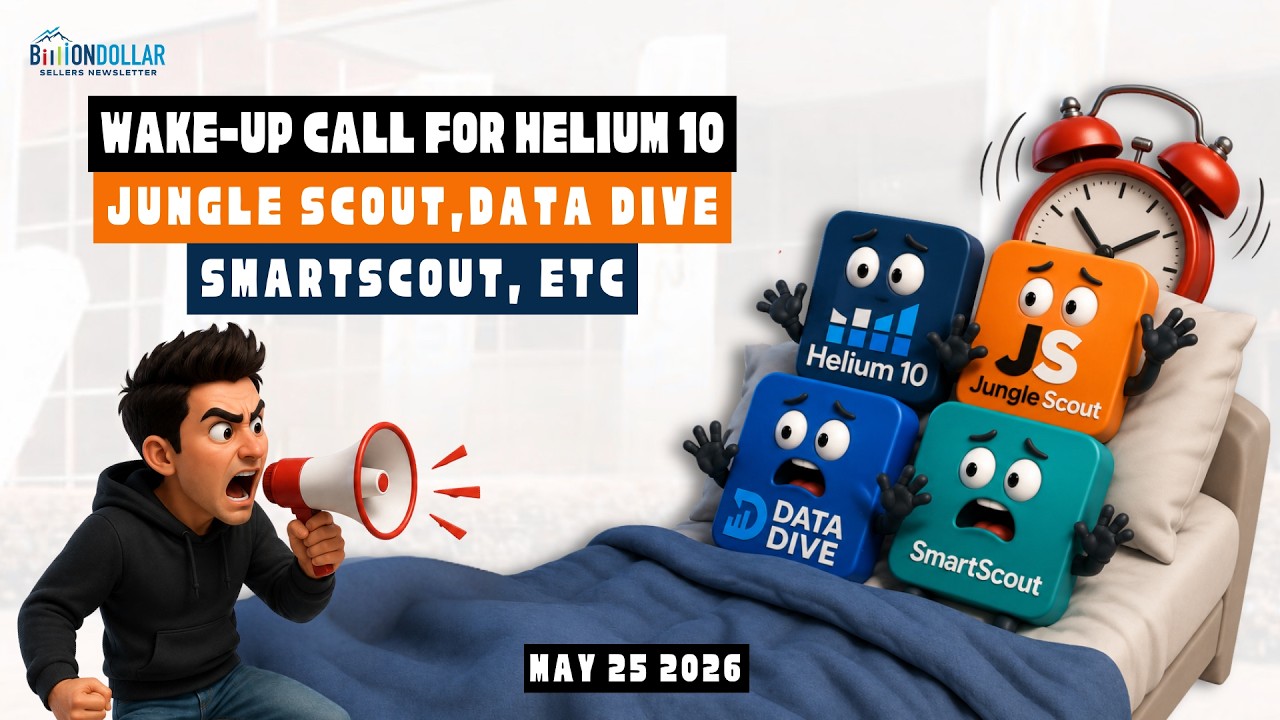
Wake-Up Call for Helium 10, Jungle Scout, Data Dive, SmartScout, and the Rest
Summary
"Pattern Group's launch of Pattern Intelligence (Pi) is a game-changer, automating marketplace management across 70+ platforms. With a data moat of 77 trillion points, it's a wake-up call for every Amazon SaaS tool. Plus, Google's Universal Cart might bypass Amazon, and Florence offers free AI data analysis for sellers. Don't miss Jo Lambadjieva's 30-minute AI product launch blueprint."
Transcript
This This is the Billiondoll Sellers podcast. Your go-to source for cutting edge strategies and success stories from the world of Amazon and e-commerce. Buckle up and get ready to take your Amazon business to new heights. Don't forget to subscribe to the Billiondoll Sellers Newsletter. Welcome your host. >> Welcome your host, Kevin King. >> Hey everyone, welcome to the Billiondollar Sellers podcast. I'm your host, Kevin King, and today is May 25th, 2026. We've got a packed show for you today. So, let's get into it. The big story today is Pattern Group just launched an AI that basically runs your marketplaces for you. And it's really a wakeup call for Helium 10, Jungle Scout, Smart Scout, and all the other SAS tools out there. We've also got a deep dive on why AI is now shopping before your buyer even wakes up. uh Google's brand new universal cart that could bypass Amazon entirely, a free AI data analyst tool called Florence, and a 30-minute product launch blueprint that will blow your mind. Plus, me and Norfer have a big webinar this Thursday you don't want to miss. All right, but first, here's your Stump Bezos question for today. Last year, 307 million items were sold during Prime Day. So, what percentage of US households ordered two or more items during that event? Think about that and I'll give you the answer at the end of the show. Oh, and before we jump in real quick, uh, this Thursday, May 28th, at 2 p.m. Eastern, me and Nor are hosting AI for ECOM 2.0. It's 75 minutes, nine handpicked experts, and these are tactical AI playbooks that are working right now in real businesses. Not theory, not hype, but stuff you can actually run in your business this week. There's a link to register in the show notes, and uh, I'd love to see you there. All right, let's get into it. So, the largest seller on Amazon, Pattern Group, uh they flipped the switch on something called pattern intelligence or PI at their Salt Lake City conference last week. And this is not another dashboard. This is another analytics tool you log into and stare at charts. PI is what they call an autonomous execution engine. And uh basically what that means is it watches your featured offer, your ads, your content, pricing, inventory across Amazon, Walmart, Tik Tok shop, eBay, and more than 70 other marketplaces. And when something moves, Pi acts. No meeting, no ticket, no slack thread. It just fixes it. So you lose the buy box overnight. Pi grabs it back. Competitor starts drifting on price. Pi adjusts. Your listing copy gets nuked. Pi rewrites it and pushes it live. And the stuff that actually needs a human call gets routed to your team as an action item. Everything else, Pi just does it on its own and timestamps it in a searchable log. Now, here's the number that matters. 77 trillion proprietary data points growing by 800 billion per week. That's every pricing move, every offer recovery, every content edit that pattern has made for hundreds of brands over 13 years. And their whole pitch is that Chad GPT can't touch this data set because it was never on the open web. And since they started rolling PI out, they say it's already taken millions of automated actions. So this isn't a beta. It's already running on live brands. So what's in the box? Um, they've got a daily brief with a written and audio summary of your last seven days. A chat to data feature where you ask questions in plain English and get answers from patterns data. They have pre-built automations called PI skills for workflows you'd otherwise pay a VA for. A knowledge management system where you upload your brand voice and rules so PI acts like you, not a robot. And here's the one that caught my eye. They've got GEO and Alexa for shopping scorecard. So you can see how Alexa, Sparky, Chat GPT, and Google AI mode rank your products in Gentic Search. They even got a Chrome extension. And Pi is in the Chat GPT app directory now with more platforms coming. Now, Pattern is an agency, not a SAS tool you can sign up for tonight. PI is only available to their brand partners. But the playbook is the signal here. There's three things to pay attention to. First, the execution layer is a new battleground. Insights are a commodity. Now actions the product. Every tool in your stack should be moving toward actually doing the thing, not just showing you a chart. MCP is the new table stakes for SAS companies. Number two, proprietary data is the moat. Pattern is saying out loud what Helium 10, Jungle Scout, Smart Scout, and the rest are all racing toward. Whoever has the most behavioral seller data, not scraped Amazon data, wins the AI race. And third, go scoring is now a product feature. When a public agency adds a scorecard for how you rank in Alexa, Sparty, Chad GPT in Google AI mode, that means clients are asking for it. If you're not optimizing for agentic shopping yet, your competitors agencies already are. So, expect Helium 10, Jungle Scout, and the rest to ship their own autonomous execution features inside the next 12 months. The dashboard's only era is over. MCPN autonomous execution is here. You can check it out at pattern.com/pie and there's a link in the show notes. All right, let's talk about some interesting stats. So, McKenzie put out a report in April on how much of marketing execution, Agentic AI could take over, and the numbers are uh pretty eye opening. Content creation, execution, and optimization are both sitting at 70%. E-commerce and web experiences at 60%, analytics and data foundations also 60%, and even strategy at 50%. So, if you're sitting there thinking AI is just for Ryan listing copy, you're missing the bigger picture. AI is eating marketing execution across the board and it's only going to accelerate from here. All right, so this next section is probably the most important thing in today's newsletter. I want you to really pay attention to this. Three signals dropped in the past 10 days and are all pointing in the same direction. Marley Jax's take on Google Marketing Live, Amazon's official Alexa for shopping product update, and Andrew Bell's deep dive into the patent architecture underneath it all. And when you stack them together, the picture gets real blunt. You are no longer marketing just to humans. You are marketing to the AI agents that prefilter the short list before a human ever sees it. And the thing is that the agent doesn't even need to buy anything to wreck your funnel. All it's got to do is narrow the list from 50 products down to three and you're either on that short list or you're not. So what's actually happening under the hood here? Alexa for shopping is not a chatbot bolted on to search. It's an orchestration engine. I shopper or type something like Christmas gifts for my kids and Alexa runs many simultaneous searches underneath that one conversation. Marvel Legos, age appropriated sets, cruelty-free lipstick, products under $50, Prime eligible options, all retrieved and ranked against the shopper's actual context. The customer types one thing and the system runs dozens of queries, so you have to win across all of them. And there's three modes operating at once. Direct shopping where the shopper names a product. Then guided shopping where they have a problem and need help converting that into a product. And finally, action shopping where they want something done like reorder or set a price alert or subscribe. Now, here's where it gets really interesting. Andrew Bell looked at 659 carted result sets and his data blows up the assumption that highest rating wins. Position one had the highest feature and title overlap with the query in 94.4% 4% of result sets, but is only the highest rated in 40% of them. Most reviewed about 30% and cheapest in only about 21%. So, a fivestar product with 18 reviews loses to a 4.1 star product with 26,000 reviews. Review depth functions as a trust multiplier. And Bell's threshold is roughly 300 plus reviews for most items, 500 plus for daily use products. The ranking is not indifferent to rating. It's indifferent to rating alone. That's a huge distinction. So, what wins now? Uh, a few things. Brand clarity is now an algorithm requirement. AI can't pattern match a brand that contradicts itself across your listings, Shopify sites, social profiles, and reviews. Inconsistency went from being a brand problem to being a discoverability problem. Specificity beats reach. Premium kitchenware for serious home cooks beats highquality kitchen products for everyone. Generic positioning gets filtered before a human ever sees it. Your listing is now basically a structured evidence database. Every claim Alexa makes about your product, price, compatibility, materials, dimensions, noise level traces back to a field somewhere in your listing. And blank fields equal silence when shoppers ask that question. Reviews are now trained data, not just social proof. The AI zeros in on consistent signals across the open web, and recent review deterioration drops your rank, even if your average star rating holds steady. And the open web is your training set. Now, Reddit threads, YouTube reviews, comparison articles, substack mentions. If you're invisible off Amazon, you're invisible to the agent recommending products on Amazon. So, here's three things to do this week. Number one, audit your brand for contradiction. Pull up your Amazon listing, your Shopify site, your top three social profiles, and your last five reviews. Read them back to back. If the brand promise and customer and product description don't match across all five services, an AI agent can't pattern match you. Pick the sharpest version and rewrite the rest to match. Number two, get specific on who you are not for. Write down the exact buyer your product is wrong for and make sure your listing reflects that confidence. Big brands will lose to specific ones every time an agent search. And number three, fill every empty field in your listing. Walk through your detail page. Find what's blank. Materials, dimensions, compatibility, certifications, noise level, dishwasher safety, intended use. Each empty field is a question Alexa can't answer about your product, which means a recommendation they can't make. And the bigger picture here is this. A9 taught sellers to optimize for the search bar. Rufus taught them to optimize for conversational intent. And Alexa for shopping is the next phase where the shopper's mission gets translated into many machine generated queries. And the winning product is the one easiest for the AI to retrieve, verify, compare, explain, personalize, and act on. Marketing used to be about interrupting a scroll long enough to create desire. Now it's about being the obvious answer before the desire even fors. Optimize for the bot that shops before your buyer wakes up. All right. Now software tool of the day. So this one's called Florence and it's at meet Florence.ai. It's a free open-source AI chief data analyst built specifically for Amazon sellers. It runs endtoend inside cloud co-work. No SAS, no subscription, no vendor lock in. You just download the zip file, drop it into a co-work project, type ready and you're wired in about 18 minutes. It was built by Matt Costan from Productinian Dorian Gorski from Keplo and they launched it at Solar Sessions London 2026. So the whole thesis behind Florence is that most CRO work today is a graveyard of one-off props. You've got Mjourney for images, Chad GPT for copy, a spreadsheet here, a notion page there. Nothing knows your brand. Nothing remembers last week. You start from zero every time. Florence flips that. It's a connected system where your brand context, products, goals, and voice rules all sit in one file. It travels with every task. It's got 62 advanced skills for power users. Things like main image pipeline, lifestyle stack generator, A+ premium build, objection killer, CVR, leak fix, keyword rank tracker, and a lot more. And it's not a black box. Every skill is a markdown file you can open and read. The methodology stack includes more than 100 hours of distilled CRO work, a 13-step creative flow, and a 52 tactic main image library. And all connectors are userowned. Nothing leaves your co-work unless you send it. This is exactly the MCP connected system shift playing out in real time. SAS tools that don't talk to your brain are about to feel really old. Florence is one of the first public examples of a forkityour yourself CRO system built on Claude. Definitely worth a look, even if you don't end up running it. The architecture itself is the lesson. There's a download link in the show notes. All right. So, Jolva just dropped a framework that uh should make every consultant nervous. She generated a complete product launch blueprint for Amazon, Shopify, and Tik Tok shop in 30 minutes with one AI prompt sequence. The kind of deliverable McKenzie charges $15,000 for now $0 and half an hour. The output ran 35 pages of actual executable strategies. We're talking TAM Samsung with 5-year projections, customer personas with purchase triggers, competitor pricing matrices across every channel, manufacturing sourcing with MOQ breakdowns, platform specific marketing playbooks, real unit economics, plus top 20 Amazon competitors with BSR data, Tik Tok shop, trending products in the niche, regulatory road maps for FDA, FTC, CPSC, hidden opportunity gaps, competitors missed, a week-by-eek launch calendar, risk matrices with mitigation strategies, and a 90-day execution checklist. But here's Joe's actual point, and it's the one most sellers will miss. It's not about the AI. It's about the sequence of questions. Most people prompt like amateurs. One question, one answer, move on. This framework prompts like a strategist. Context first, then constraints, then reason, then output. AI is the same. The thinking is what changed. If you're still treating Claude or Chad GBT like a fancy search bar, you're leaving 95% of the leverage on the table. The sellers who win the next 18 months won't be the ones with the best tools. They'll be the ones who know how to ask. There's a link to Joe's SOP in the show notes. Grab it. You can thank me and her later. All right. Next up, uh Google's Universal Cart. And so at Google IO on May 19th, Google unveiled something called Universal Cart. And it's an agent commerce tool that lets shoppers add products from multiple retailers into a single cart and check out in one shot. Think of it as a metacart that lives inside Google itself. It runs on the universal commerce protocol or UCP which is the open standard Google co-developed with Shopify earlier this year and it works across search Gemini YouTube and Gmail. So you're watching a YouTube review, reading a promo email, asking Gemini for recommendations, doing a regular search and every one of those services feeds into the same cart. Launch partners include Nike, Target, Alta Beauty, Walmart, Wayfair, Sephora, and Shopify brands like Fenty and Steve Madden. Now, the AI layer is where it gets interesting. Once an item hits the cart, Gemini works in the background hunting deals and price drops, surfacing price history, alerting on restocks, flagging incompatibilities, and pulling in your Google wallet data so it knows your credit card perks, loyalty status, and merchant offers. And checkout is dual path. either pay with Google Pay in a few taps and never leave Google or transfer the cart to the merchants on site to finish there. Roll out is search and Gemini app in the US this summer, YouTube and Gmail to follow. So why is this matter for Amazon sellers? Google just built a Shopify friendly answer to Amazon's buy box. Every conversations happening on search, Gemini, and YouTube can now end in a purchase that bypasses Amazon entirely. The sellers wearing here will be the ones with strong DTC product feeds, Shopify storefronts plugged into the UCP, and content visible inside Google surfaces. If you're Amazon only, you're invisible to this whole funnel. But if you're multi-channel with a real DTC presence, you just got handed a brand new top offunnel pipeline that Amazon can't intersect. Oh, and real quick, if you're in the Austin or San Antonio metro area, uh you're invited to join me, Athena Seavari, a bunch of other brilliant ecom mines this Friday, May 29th at the Thompson and Austin for drinks and dinner. It's totally free to come. There's a link for details in the show notes. All right, before we wrap up, few more hot picks for you. Helium 10 put out a Prime Day checklist. Always good to get a head start on that. Walmart e-commerce revenue is now 23% of their total revenue. That's a big number. And Amazon just cut affiliate commissions up to 50%. So if you've been relying on affiliate traffic, uh, that's something to watch. Links to all of those are in the show notes. And here's your parting shot for today. This one's from Steve Jobs. He said, "You can't just ask customers what they want and then try to give that to them. By the time you get it built, they'll want something new." And, you know, I think that it's especially true right now seeing how fast AI is moving. By the time you build the thing customers said they wanted last quarter, the whole game has changed. You got to be ahead of the curve, not chasing it. And finally, about that stunt Bezos question from the beginning. What percentage of US households ordered two or more items during Prime Day last year? Uh, the answer is 63%. 63% of US households ordered two or more items. Holy cow, that's a lot of shopping. All right, that's all for today, folks. Um, I'll see you again on Thursday. This is Kevin Kane signing off from the Billiondollar Sellers podcast.
This transcript page is part of the Billion Dollar Sellers Content Hub. Explore more content →