YouTube
This Type of Discount Boosts Conversions
Summary
This Type of Discount Boosts Conversions - Date: March 26th, 2026 Summary: Kevin King discusses why many sellers never launch their best produ...
Transcript
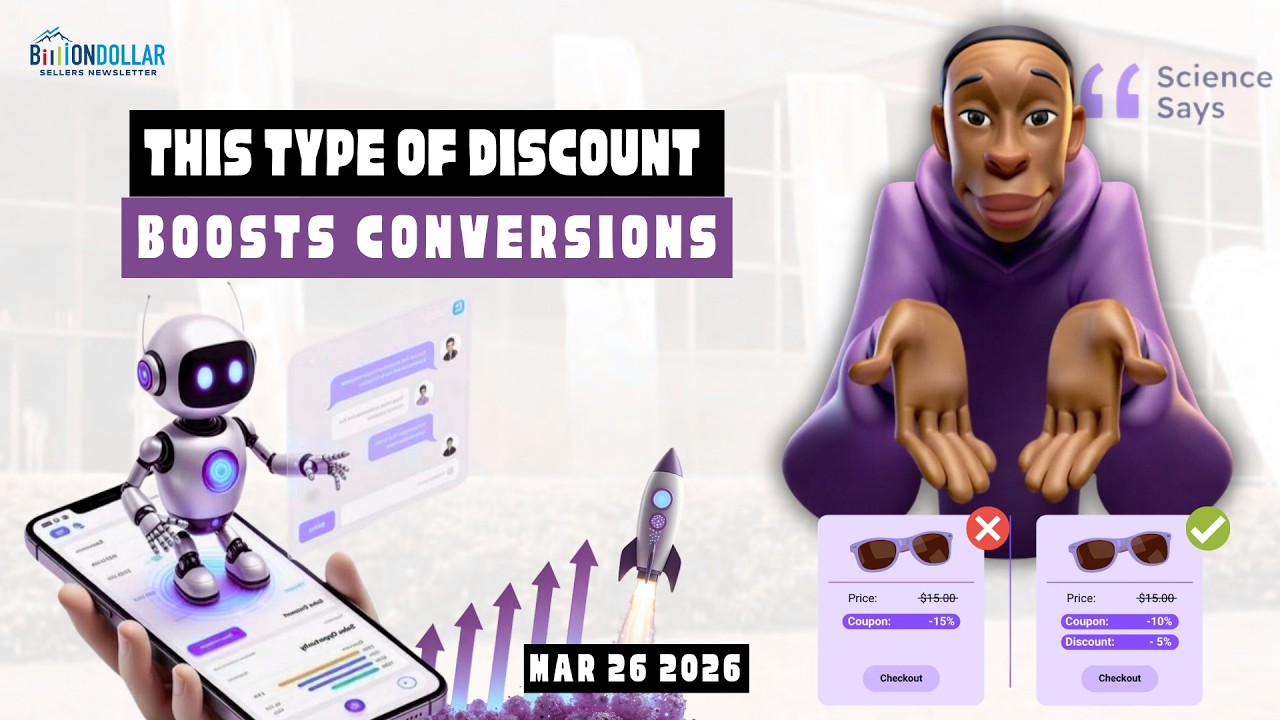
This This is the Billiondollar Sellers podcast, your go-to source for cutting edge strategies and success stories from the world of Amazon and e-commerce. Buckle up and get ready to take your Amazon business to new heights. Don't forget to subscribe to the Billiondoll Sellers Newsletter. Welcome your host. Welcome your host, Kevin King. >> Hey everyone, welcome to the Billiondollar Sellers podcast. I'm your host Kevin King and today is March 26, 2026. We've got a really packed show today. The big one is about why some of the smartest sellers I know never actually launched their best product ideas and what to do about it. Plus, we got some fascinating research on stack discounts, the shift from SEO to answer engines and a bunch of other cool stuff. So, let's get into it. But first, let me hit you with today's stunt Bezos question. So, at Shot Talk in Las Vegas this week, reps from AWS were on stage and they made a pretty bold prediction about the future of Amazon search. The question is, what percent of Amazon search does Amazon expect to be AIdriven by 2029? Think about that one. I'll give you the answer at the end of the show. Before we jump in, quick heads up about Nashville. If you've been thinking about coming to the event in a couple weeks, uh Amy Whis, Athena Sey, Mark Don, and I, plus a stack panel of speakers and sponsors, just did a live session on Tuesday covering what to actually expect. We're talking more than 500 sellers, 100 creators, 41 speakers. They got into the agenda, how to meet a creator who might generate $500,000 next month for you. Uh how the stages are broken up, how to get one-on-one time with the speakers, the whole thing. And here's a tip. bring product samples because they're actually going to be selling products live on Amazon during the show. Oh, and there's an AI space cowboy party with, I kid you not, Cir to Sole type characters. So, plan your outfit accordingly. Plus, there's apparently a surprise on opening morning that's going to blow everybody's mind. If you're not there, the social media FOMO is going to be real. I'm just telling you now. There's a link to the full session in the show notes, and I also gave away six free tickets during it, so check that out. All right, so let's get into the big one today. This is something I've been thinking about for a while and it's a pattern I see constantly. After working with thousands of ecom sellers, I realize that every success story really comes down to two variables. The first one is momentum, which is basically your marketing, your visibility in the market. When you have momentum, growth gets easier, the algorithm favors you, customers leave reviews, organic traffic starts compounding. Sellers with zero momentum, they often haven't given their product the best chance of standing out and getting discovered. Think of it as a flywheel, right? Keyword searches lead to purchases. Purchases build sales velocity. Velocity drives higher rankings. Rankings bring organic traffic. And organic traffic feeds more keyword searches. Once that flywheel is spinning, momentum compounds on itself. But it's not random spikes either. It's steady movement. You know, a product ranking number 137 for a keyword climbs to 68, then 22, then six over 21 days. No tricks, just consistent upward pressure. And once you hit page one, the clicks come easier, the conversions come cheaper, the reviews start stacking. But here's the thing most sellers miss. None of that can start if the product never launches. And that brings us to the second variable, which is innovation, or what I call insanely valuable products. These are the products that make customers say, "Why didn't this exist before?" They solve a real problem, save people time, deliver a noticeably better experience, or they hit a niche so perfectly that word of mouth does the heavy lifting. It's the difference between another meto garlic press and something where the customer is like, "I just told three friends about this thing." So, what is a hidden genius? A hidden genius is a seller who spends weeks, months, sometimes years researching a product idea, perfecting the design, sourcing better materials, engineering real differentiations, but never launches it. Maybe they get samples made. Maybe they even get inventory shipped to FBA, but they never optimize the listing, never run ads, never tell anyone. It just sits there collecting storage fees. And I see this constantly. So many sellers have genuinely great product instincts. They spot gaps in the market that nobody else sees, but they're so focused on perfecting the product itself that they completely neglect the other half, which is actually getting in front of buyers. So why does this happen? There's a few layers here. I'll call out three of them, but I think about 90% of it boils down to this first one. Fear. Fear of a bad review on day one. Fear of a competitor copying you the second you go live. Fear of spending $5,000 on PPC and getting nothing back. Fear of picking the wrong product after months of research and having 2,000 units sitting in a warehouse. Fear of this thing you're so invested in and so excited about just flopping publicly. You see those horror stories in Facebook groups about hijackers and account suspensions and race to the bottom pricing and you think, "Can I handle that? Can I survive someone tanking my listing after I pour everything into this product?" And look, fear comes in many shapes and sizes. I'm not going to pretend this whole thing isn't scary cuz it is. The second one is perfectionism. And this is a sneaky one because if you get sharp product instincts, you can spot exactly what's wrong with every competitor's listing. You know what great looks like and it becomes painful how far your current version is from that standard. But that's the name of the game. You know, Ira Glass, the host of This American Life, said something in an interview years ago that I think is one of the most profound things I've ever heard on this topic. He basically said that all of us who do creative work, we got into it because we have good taste, but there's this gap where for the first couple years, what you're making isn't that good yet, but your taste is still killer. So, you can tell that what you're making is kind of a disappointment to you. And that applies directly to product development. You see the gap between your V1 and what you know it could be. So, you keep tweaking another sample round, another packaging revision, another delay. And that perfectionism plays a huge role in keeping sellers from ever hitting go live. Even if you get past the fear of the perfectionism, there's another layer. I call it the moral objection to playing the game. A lot of sellers, especially the ones who generally care about quality, they have this visceral reaction to anything that feels like gaming the system. You see the black hat tactics, the fake reviews, the keyword stuff titles, the race to the bottom, and you want no part of it, and I get that. But by avoiding all promotion optimization, you're handicapping your own growth and making it exponentially harder for any customer to find your product. And sadly, it's usually the products the market needs the most. If your product is genuinely better, you're doing a disservice to the customers who need it by not getting it in front of them. You've got this incredible product that could actually make someone's life easier, and you're not pushing it cuz you don't want to play the Amazon game. If you're not making any effort to optimize your listing, run ads, build your brand, and get reviews rolling, you're going to have a really hard time gaining traction. And most importantly, you won't make enough money to keep developing the next product. And this reminds me of Van Gogh. The man never saw his work take off in his lifetime. He sold one painting while he was alive. Just one. His genius was only discovered after he was gone. And how his sister-in-law Johanna Van Goonger became his promoter. She organized exhibitions. She loaned paintings to galleries and hustled relentlessly to get his work out there. She spent decades doing this and eventually it worked. Van Go became one of the most recognized artists in history. But it took someone actively, relentlessly promoting his work to make that happen. And if she hadn't done that, his incredible work would have died with him. Even Van Go, one of the greatest painters who ever lived, needed someone to promote him. His genius alone wasn't enough. And your product is no different. And if you're just waiting for the algorithm to discover you, you might be waiting forever. Most of us don't have a Johan, so we have to be our own. That means writing the listing copy, running the ads, building the brand story, and getting the product into the hands of people who will talk about it. And here's where it becomes a vicious cycle. You spend months on product research and development, but you're scared. So, you don't launch, or you launch quietly with a bare bones listing and zero promotion. Nobody sees it. You don't get sales, but you don't get bad reviews either. And then you move on to researching the next product idea and you don't watch that one either. No customer feedback, no data, just you living in your head thinking you got a winner without really knowing. Now you're stuck in a cycle where your best product ideas, the ones you spent the most time on, never reach a single customer. You're not getting feedback. You don't know if your pricing is off, your images are weak, or your product actually solves the problem you think it does. You might think a category is your thing until you actually start selling it and realize, "Nope, I hate dealing with these customers and these margins, but without launching, you never figure that out." And honestly, sometimes the reason a product stays on the shelf is because it hasn't been tested yet. Customer feedback turns a good V1 into a great V2. So, the biggest shift is this. Stop thinking in tactics, start thinking in systems. Not how do I get more clicks, but how do I trigger momentum? Because once momentum is there, everything else becomes easier. The flywheel does the work, but that flywheel can't spin if there's no product on the listing. It can't compound if you never gave it the initial push. Your job isn't to be perfect on day one. Your job is to get the wheel turning. The market needs fewer hidden geniuses sitting on great ideas and more sellers brave enough to put their products in front of real customers. Don't let a warehouse shelf be the only place that gets to see your best work. All right, real quick. If you're an Amazon seller and cash flow is what's holding up your inventory, check out 8 fig Capital's liquid inventory. It's a revolving credit line tied directly to your inventory value. You only pay interest on the funds you actually use. It's flexible for Prime Day Q4 unexpected spikes, and the credit grows with your inventory in real time. One seller, Luke Sutherland from Product Movement Technologies said they doubled sales from 2025 and February, and they're expecting 100% revenue growth in 2026. If stockouts are killing your listings, there's a link in the show notes. Okay, so here's something you have to check out. On the Marketing Mist podcast, Nor and I sat down with DTC consultant and behavioral science expert Sarah Levener, and they got into the dark psychology of Gen Z buyers. The big takeaway is that traditional marketing frameworks are failing with younger consumers because you can't use old school hype to sell to a generation that's operating from a baseline of hopelessness. They cover why Gen Z believes they'll never be wealthy, something called self-discre theory, and the three psychological selves that control why a customer clicks by, but also why AI tools like Claude and Chat GPT are psychologically hooking us by opening conversational loops our brains can't close, and why the AI framework is basically dead. They also get into how brands like Budweiser and Jaguar completely alienated their core audiences by trying to hack cultural conversations they had no business being in. If you want to understand the real subconscious matrix of consumerism, this one's a master class. There's a link in the show notes. All right. Now, here's a fun stat for you. Amazon's third party seller share keeps climbing globally. We're now at about 67% of all GMBB worldwide, coming from 3P sellers, up from about 66% in 2023. In the Americas, it's around 63%. Europe is around 68%. But the wild one is Asia, where 3P sellers account for almost 84% of Amazon's GMBB. So the trend is clear. Amazon is becoming more and more of a 3P marketplace. And if you're a third party seller, you know, the platform is working in your direction. Now, let's talk about something that I think is going to affect every single seller listening to this. Are you playing the ranking game or the answer game? Most sellers are still playing the rankings game. You know, keyword, blog post, rank, get clicks. That's the playbook. And that playbook isn't dead yet, but it's losing ground fast because the way people search is fundamentally changing. They're getting more and more answers directly from AI without ever clicking a link. Google's AI overviews, chat, GPT, Perplexity. These tools pull answers from content and serve them up on the spot. So now there's actually three games to play. SEO, which is the old game, optimize your pages to rank and get clicks. AEO, which stands for answer engine optimization, where you structure your content so search engines can pull direct answers from it. And GEO, generative engine optimization, where you optimize so AI systems actually site your brands when they generate responses. The difference matters because rankings get you on the page, but being the answer gets you in front of the customer before they ever see your competitors. And the numbers show why this shift is accelerating. Somewhere between 60% and 65% of Google searches now end with zero clicks. AI generated answers typically only site two to five sources per response. And conversational queries, the kind people type into AI tools, run three to five times longer than traditional searches. So, what are you doing to become the answer? And here's a prompt you can use for this. Take 10 customer reviews for your product. paste them into your favorite AI tool and say, "Pull out the most common words and phrases customers use to describe the problem it solves, the result it delivers, and how they describe it to a friend." That gives you the actual language your customers are using, which is exactly what you want to put in your content if you want AI systems pulling answers from your stuff. All right. Uh, today's BSN software tool of the day is an Amazon catalog auditor. Ever wonder why some of your listings are underperforming or getting suppressed? This free tool gives you a fast health check on your entire Amazon catalog. You download your category listing report from seller central. Upload it to the tool and within minutes you get an audit covering five areas. Missing required attributes that are getting your listing suppressed, prohibited characters triggering policy violations, missing recommended attributes hurting your search ranking, tile policy violations, and bulletoint quality issues. You get a skew level breakdown showing exactly which products have issues, what the problems are, and how to fix them. And you can export everything to CSV. No API keys, no Amazon credentials, no account needed, and your data is processed on the server and never shared with third parties. It's completely free to run. There's a link in the show notes. Okay, so this next one is a really cool piece of research. It's one of those things where you hear it and you're like, "Oh yeah, that makes total sense." So imagine you're browsing for sunglasses and you see the same pair on two sites. Site A offers 35% off. Site B offers 15% off plus a 10% daily deal plus a 10% newsletter signup discount. Same total discount. Research from Bentley University published to summer 2025 across six experiments and more than 9,000 deal posts found that stack discounts crush single discounts of the same value. We're talking about 16% higher purchase intent when 25% discount was split into four stackable parts. 66% more views on stack deals. 53% more up votes. 52% more comments. Shoppers rated stack deals as 33% more unique and felt 21% smarter for finding them. It works because stacking feels rare. You know, when you combine a coupon from email with a sale price and a credit card perk, your brain tells you that you unlock something special, and that drives urgency. The effort matters, too. Just like people are more likely to redeem a coupon they had to do a small task to get, the act of building your own discount makes you value it more. So, how do you use this on Amazon and DTC? put your promotions into pieces. Instead of 25% off, try something like 15% sale plus a 5% coupon plus a $5 credit for new subscribers. The math is the same, but the psychology hits different. Uh, a few things to keep in mind, though. The effect is weaker when the total discount is already huge, like 65% off. So, if you're already giving a massive deal, stacking doesn't add much. But for moderate discounts in the 15 to 35% range, this is a no-brainer. It also falls apart if stacking is too much work. So, apply some of the discounts automatically and make the steps dead simple for the rest. If people have to jump through hoops, they'll bail. And the type of discount didn't matter. Percentage off, dollar off, store credits, all works. Just split it up and let customers feel like they're building their own deal. Think about it for your next lightning deal or coupon stack on Amazon or on your Shopify store. Break that 20% welcome offer into a 10% first purchase discount plus a 10% email signup code. Same cost to you, more conversions. Before we go, here are a few more hot picks. Amazon is ending combing next week, which affects how your inventory gets mixed with other sellers. So, pay attention to that. There's an Amazon AI listing creation blueprint that's worth checking out. Pacu, which owns Helium 10, is now working with Reddit ads. Amazon launched something called Interest AI, which is new, and eBay is going all in on live streaming. Links to all those in the show notes. And here's your parting shot for today. Knowledge isn't your moat anymore. Every seller has access to the same data, the same tools, the same AI. Your real edge now. Branding and relationships. Those are the two things algorithms still can't fake. Oh, and remember that stump Bezos question from the beginning? What percent of Amazon search does Amazon expect to be AIdriven by 2029? The answer is 50%. Amazon expects half of all search on their platform to be AIdriven by 2029. So that's only 3 years away. That's all for today, folks. Have a great weekend and I'll see you again on Monday. This is Kevin King signing off from the Billiondollar Solar Podcast.
This transcript page is part of the Billion Dollar Sellers Content Hub. Explore more content →