YouTube
This hidden keyword field prints sales
Summary
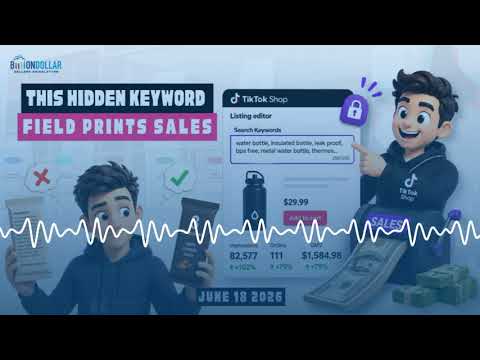
TikTok Shop's hidden search keywords field can skyrocket your sales by leveraging Amazon's existing data! Alina from AZ Rank boosted her GMV by 79% just by dropping 3 proven Amazon keywords into one listing, skyrocketing impressions by 102% and items sold by 75%. Use Brand Analytics SQP to pull high click-share and conversion-share terms, cross-reference with Product Opportunity Explorer, and unlock a whole new sales channel with 15-20 keywords in the TikTok Seller Center.
Transcript
This This is the Billiondoll Sellers podcast. Your go-to source for cutting edge strategies and success stories from the world of Amazon and e-commerce. Buckle up and get ready to take your Amazon business to new heights. Don't forget to subscribe to the Billiondoll Sellers newsletter. Welcome your host. >> Welcome your host, Kevin King. >> Hey everyone, and welcome to the Billiondoll Sellers podcast. I'm your host Kevin King and today is Wednesday, June 18th, 2026. We got a lot to cover today, so uh let's jump right in. We're going to talk about a Tik Tok shop keyword hack that's printing sales using Amazon data you already have, which is pretty cool. Then we've got a Prime Day checklist from Helium 10. Some really eyeopening data on AI shoppers and why they're worth more than regular visitors. Uh, Cloud is now showing product cards, some Father's Day spending stats, the PPC stack most brands are missing, and a really interesting study on why fewer ingredients actually sells more product. Plus, we got a new episode of the Marketing Misfits out this week. Links in the show notes if you want to check that out. All right, here's your Stump Bezos question for today. So, the CEO of Cloudflare just announced that bots have passed human traffic for the first time in the internet's history. So, the question is, what percent of web traffic is now bots? think about that and I'll give you the answer at the end of the show. All right, let's get into it. So, this first one's really cool and uh credit to Elena from AZ Rank who ran this test and published it in her ranking pill newsletter. She's also going to be one of the experts at BDSS Market Masters for this August 20th through 24th in Austin, flying all the way in from Romania. So, that's going to be awesome. So, here's the deal. Tik Tok Shop has this search keywords filled in your listing editor. 250 characters, comma separated, almost nobody fills it in. And her hypothesis was keywords that already convert on Amazon should work on Tik Tok shop too because purchase intent doesn't really change between platforms, right? If somebody's searching for the same thing, they're searching for the same thing. Doesn't matter whe they're typing it. So she took one product, one listing, pulled three keywords straight from Amazon data. We're talking SQP, product opportunity explorer, existing intent research, and dropped them into the Tik Tok listing search keywords field. No guessing what Tik Tok shoppers might type. just used what she already knew works from Amazon. Everything else in the shop was left untouched as a control. And the results, uh, holy cow, at the product level compared to the prior period, the GMBB jumped 79%. Impressions more than doubled, up 102%, and items sold went up 75%. On the product card channel alone, she did almost $1,600 in card GMV, 111 orders, and about 93% GMV growth. And looking at the search file, about 82,000 impressions turned into about 1,600 clicks, which turned into 111 orders. And that's a click to order rate of almost 7%. That's insane. And here's the kicker. The three keywords that got purchases outrank the two control keywords that didn't get any purchases. And if you've been selling on Amazon for a while, you already know this flywheel. You put the right keywords in, algorithm picks it up, your car starts showing on more, people buy, your rank climbs, and then it just feeds on itself. Same exact gain just on Tik Tok now. So if you sell on both platforms, here's what to do this week. Go into brand analytics, pull up search query performance for your top asens and grab the keywords with high click share and high conversion share. Cross reference niche signals and target opportunity explorer. Build a list of 15 to 20 keywords that fit your product on both platforms. Then go to Tik Tok seller center, open your product listing, find the search keywords field, paste them in comma separated, 250 characters max, save it, and then wait about 30 days and watch the card metrics. And if you're Amazon only right now, pocket this. The day you launch on Tik Tok shop, the playbook's already built. All right, so Prime Day is next week. And uh I think this is one of those things where you're either ready or you're not at this point. The brands that win Prime Day didn't start prepping this week. They started 6 to 10 weeks ago. keyword testing, ad tuning, inventory math, all locked in before the surge hits. And that's the gap. The rankings you earn during Prime Day can stick for weeks after, but only if you set up right. And here are a few numbers worth sitting with. Prime Day 2025 drove 24.1 billion in sales. 307 million items moved. 63% of US households ordered two or more times, and 2026 is expected to top all of it. Done wrong, Prime Day is a short spike that fades by the weekend. done right. It lists your organic rankings, brings in new buyers and builds momentum that outlasts the event. So BSS Dream and Hunter member Dain Wishon teamed up with Carrie Miller of Helium 10 to put together a practical checklist that walks through everything you should be reviewing before the big day. Inventory planning, listing optimizations, advertising strategy, external traffic, historical trend analysis, postprime day momentum, all of it. It pulls tactics from some of the most trusted voices in Amazon and there's a personal worksheet included so you can run your own plan against it. It's free and there's a link in the show notes, so grab it before next week. All right. Now, this next section is one I think everybody needs to pay attention to because uh two things happened this week that should change how you think about where your next sale comes from. So, first the data. Adobe Analytics ran the numbers on AI referred shoppers in May and the people who land on a retail site after asking chat GPT or Gemini or another large language model for a recommendation. They're not tire kickers, they are buyers. AI referred shoppers generated 53% more revenue per visit than nonAI traffic. They converted their rate 54% higher and they spent 53% more time on site and viewed more pages. And AI traffic to retail sites jumped 138% year-over-year. That's the highest share of total retail visits since Adobe started tracking back in October 2024. And uh 12 months ago, nonAI visits were worth 128% more than AI visits. That gap hasn't just closed, it's fully inverted. AI referred visits now command a substantial premium. That's a complete flip in one year. And it's not plateauing. As these AI assistants get better at surfacing relevant products to higher intent shoppers, the revenue gap keeps widening. This isn't junk traffic. The AI sends you a shopper who already did the research, already narrowed the field, and shows up ready to spend. Another Adobe data this week says, "Agentic shopping is cutting returns by as much as 69%. So fewer returns on higher converting traffic. That math fixes a P&L." But here's the catch, and this is the part that should make Amazon sellers uncomfortable. Most of this traffic is flowing to brandowned websites, not to Amazon. When a shopper asks an AI for the best magnesium glycinate or the best cast iron skillet, the model sends them to the brand's own site to close. If your entire business lives inside Amazon, you're watching the highest converting traffic on the internet land on the doorstep of sellers who built a presence outside the box. And so that's one side of it, but uh there's another thing that happened this week that ties right into this. Claude, Anthropics AI now has product cards. This week, monitoring agents at Refi by caught Claude serving product cars for the first time. Electronics, cut, fashion, beauty across categories, not just in one test corner. They're rough right now. Clearly a first version, but the direction is not subtle. Analyst Scott Wingo moved Claude up his agentic commerce autonomy tracker from research to find and moved Perplexity down because Perplexity actually yanked its product cards and buy button out entirely. So, one major AI is backing away from shopping while another just walked in the front door. How cool is that? Anthropic has been meeting with merchants since at least the NRF show in January, and Claude has said out loud that it wants to act on a shopper's behalf to handle a purchase. New retail features tend to ship in summer and ramp into the holidays. Windows open question is whether Claude goes from research to find to buy in time for holiday 2026. And uh I'd plan as if the answer is yes. So, what does this mean for you? You now have a third surface deciding whether your product gets recommended and you don't control it the way you control your Amazon listing. The old game was ranking on Amazon search. The new game runs in parallel. It's whether an AI model knows your product exists, trusts it, and serves it up when a shopper asks. Call it AEO, answer engine optimization, or go, whatever you want to call it. The models pull from structured product data, third party reviews, editorial coverage, and authoritative content. If you're invisible to the crawler, you're invisible in the answer. Period. So, here's what I would do right now. First, get off Amazon only. Stand up a clean, fast, machine readable brand sites. The AI traffic converts higher and it needs somewhere to send people. Right now, that somewhere is rarely an Amazon detail page. Second, make your product data readable. Clear specs, structured data, straight answers to the questions buyers actually ask. The AI can't recommend what it can't parse. Third, build authority off your own site. reviews, comparison content, mentions on the sites the models already trust. That's your ticket into the recommendation set. And fourth, watch the cards. Run shopping prompts and claude chat GPT and Gemini for your category every week. Track whether you show up and how you get described. If a competitor appears and you don't, you found your homework. The shoppers coming through AI are worth more and they're growing fast. The platforms are racing to own the checkout. Sellers who treat this like the early days of Amazon search and move before it's obvious, they're going to own the next few years. The ones who wait for it to be obvious, they'll be buying ads to win back customers and algorithm already handed to someone else. All right, let's talk about some interesting stats real quick. So, according to the NRF, Father's Day spending hit a record 27.9 billion in 2026. That's up from 24 billion last year. And the average person spent $227, which is also a record, up from $199 the year before. So that's a pretty big jump. The top gifts by total spending were special outings at $4.8 billion, clothing at $4.1 billion, gift cards at $3.3 billion, electronics at 3.1 billion, personal care at $2.3 billion. But by percent purchasing, green cards still at 60%, followed by clothing at 58%, special outings at 55%, gift cards at 52%, and personal care at 40%. So if you're selling in any of those categories, you know, that's a nice tailwind to keep in mind for next year's planning. All right. Now, the software tool of the day, and this is more of a framework than a single tool. So Adam put this out, and he says, "Everyone wants to scale Amazon PPC, but almost nobody has the plumbing to do it. Most brands are still duct taping disconnected tools together and calling it a strategy. Messy workflows, daily living in five different places, bids managed on vibes. And he says the pattern that separates the winners is top sellers don't hunt for one magic PPC tool. They build a stack. Every tool has one job inside the growth engine. So he breaks into five layers. Layer one is research. This is where winning campaigns are won before a single ad goes live. Tools like Helium 10 for keyword research, Jungle Scout for product and niche validation, data dive for keyword clustering. Better inputs mean less wasted spend later. Garbage in, garbage spend, right? Layer two is campaign management. Amazon ads console for core campaign stuff. Perpetual for automation and bid optimization. Pack VU for advanced retail media. Launching campaigns is easy, but controlling bids, budgets, and profit at scale, that's the whole game. Layer three is optimization, and this is where most brands fall short. Tools like take a metrics for profit focused automation. Cortile for AIdriven scaling. Ad badger for search term and bid work. A few points of a cost across thousands of keywords adds up really fast. Then layer four is analytics. You can't scale what you can't see. Amazon marketing cloud for customer journey data. Amazon marketing stream for real-time campaign signals. Amazon attribution for external traffic. Best operators decide from data everybody else guesses and hopes. And layer five is conversion because traffic without conversion is just expensive visibility. Pick food to validate creatives and listings. Manage your experiments to AB test. Canva for visuals that earn a click. Elect your conversion rate and every PPC dollar works harder automatically. And here's the shift. Most sellers think PPC is about ads. It's really about building a connected system where research, bidding, optimization, analytics, and conversion all talk to each other. The smartest brands don't run campaigns. They engineer profitable ecosystems. All right, this next one's really cool and it's backed by science, which I love. So, according to science says, framing your product as having just a few ingredients instead of many can make shoppers up to 22% more likely to pick it. So, say you launched an organic electrolyte drink mix. It's clean, tastes great, and only has four ingredients. Problem is, everybody on Amazon now claims organic and all natural. So, those words stop meaning, right? But here's the edge. Just tell people your product has few ingredients. That alone moves the needle. And if you spell out what makes your brand sustainable, like ingredients sourced local and organic, shoppers read sustainable as higher quality. And then the data across 19 experiments was really compelling. Shoppers chose an identical granola bar about 22% more often when it was described as having fewer ingredients. They were about 16% more likely to buy a juice, about 67% more likely to say they'd buy a peanut butter. And meta ads pull up to 44% more clicks. Same exact ingredient list, just different framing. Holy cow. And the reason it works is more ingredients reads as more processed and less healthy. Fewer ingredients reads as natural. We lean toward those because they feel safer and healthier. Now, there's an exception. If your product is bought for pleasure, like a rich dark chocolate bar, or for a nutritional variety like vitamins and supplements, then more ingredients can actually signal more flavor or more benefit. So, the effect flips there. But if your product has few ingredients, say so. Put it in your title, your bullets, your A+ content on the package itself. And use the digit like the number three, not the word three. Digit cell. They even called out lesser evil as an example. Their Himalayan pink salt popcorn has only three ingredients, but they say it nowhere on the listing of the bag. That's a miss. Put that front and center and you're going to see a difference. All right, before we wrap up, few more hot picks for you. Amazon's testing an unpaid discovery module on some brands. They also quietly rolled out a 5-year purchase data set in AMC, which uh that's a big deal for analytics people. Amazon sellers are feeling better about Prime Day, but watching margins closely. And Walmart's website is taking its marketplace cross border to Mexico. Links to all of those are in the show notes. And here's your parting shot for today. This one's from Moish Pabry. The purpose of business is not to make money. The only reason to start a business is to deliver some product or service to humanity that makes their life better. Uh, I love that. Think about that one. And finally, about that Stump Basos question from the beginning. What percent of web traffic is now bots? The answer is 57.4%. More than half of all internet traffic is bots. Holy cow. All right, that's all for today, folks. Have a great weekend and I'll see you again on Monday. This is Kevin King signing off from the Billiondollar Solar Podcast.
This transcript page is part of the Billion Dollar Sellers Content Hub. Explore more content →