YouTube
These Amazon pricing dead zones are costing you $
Summary
These Amazon pricing dead zones are costing you $ - Date: January 29th, 2026 Summary: Kevin King covers the AI shopping revolution happening inside Cha...
Transcript
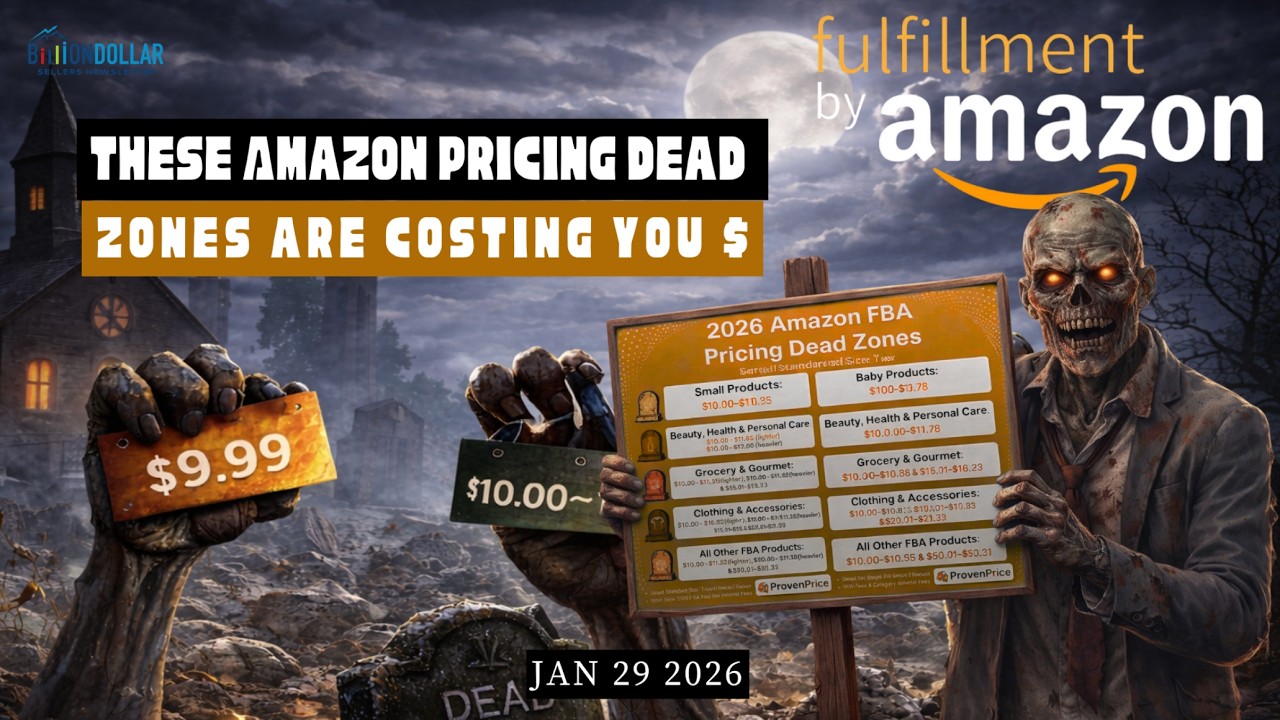
This This is the Billiondollar Sellers podcast, your go-to source for cutting edge strategies and success stories from the world of Amazon and e-commerce. Buckle up and get ready to take your Amazon business to new heights. Don't forget to subscribe to the Billiondoll Sellers Newsletter. Welcome your host. >> Welcome your host, Kevin King. >> Hey everyone, welcome to the Billiondollar Sellers podcast. I'm your host Kevin King and today is Thursday, January 29th, 2026. We got a lot to cover, so let's jump right in. First off, I've got a question for you. Last year, how much did Meta earn from its ability to turn eyeballs into cash? Think about it, and I'll give you the answer at the end of the show. First, let's talk about something happening right now that could fundamentally change how we sell products online. People are buying products directly inside Chad GPT. product cards, checkout, no Amazon, and no Google. Just a conversation with AI that ends with your order is confirmed. This isn't coming. It's already here. And by holiday 2026, experts predict Chad GPT could be at parody with Amazon as a shopping channel. The question isn't whether this affects your business. It's whether your brand will be the one AI recommends or your competitor. Today, at 2 p.m. Eastern, Norm Farrar and I are hosting a free live webinar. I'll show you exactly how to position your brand for this new AI shopping era and become the answer when AI recommends products to buyers. Here's the reality. This is the biggest shift since the birth of Amazon Marketplace in 2006. The brands that optimize now will be the ones AI recommends for years to come. The ones that wait will be invisible. You can find a link to register for that webinar in the show notes. And spots are limited, so don't get left behind in the AI shopping revolution. If you're listening to this after the webinar has happened, check the webinar tab on our website. And as a bonus for live attendees, I'll be sharing a complete Reddit playbook. It includes a secret reveal on how to get your brand mentioned and be the answer in AI. It's a complete SOP that you won't want to miss. Now, let's talk about unlocking Amazon's $35 billion business opportunity. Robert Prime at Mr. Prime says, "Most sellers are ignoring a massive revenue channel right under their nose. So, here's how to tap into it. The numbers should get your attention. 74% more units per order, 42% lower return rates, three times higher conversion rates, and access to more than 8 million business customers, including 97 of the Fortune 100 companies. So, let me walk you through the six buttons to press on Amazon. Start with business pricing and quantity discounts. The impact here is a 10% sales lift from business pricing alone and a 20% sales lift plus 25% more units when you add quantity discounts. Head over to B2B Central and Seller Central and set up tiered pricing. You must start around 5% off for small orders of 5 to 9 units, then scale it up from there. From there, the discounts keep climbing with order size. You might do 10% for medium orders, 15 to 20% for larger ones, and go all the way to 25% off for 100 units or more. Don't be timid with these discounts because business buyers compare aggressively. Next up is case packs and pallets, which deliver 16% faster growth than single units. Identify products suitable for bulk buying. Create a package hierarchy linking singles to case packs to pallets. And use one product page for all configurations. Now, here's where things get really interesting with B2B advertising. We're talking 219% more impressions, 156% more clicks, and 120% more sales. Create Amazon business exclusive campaigns. Set bid adjustments up to 900% for B2B placements only. And use B2B specific keywords like bulk, wholesale, and business supply. Then you got seller certifications, which give you 3x more customer views and access to more than $300 million in procurement spend. Head to business profile in seller central and add whatever certifications apply to you, whether that's small business, diversity credentials, veteranowned, or similar. After that, enable request for quotes gives you access to Fortune 500 bulk orders worth $10,000 or more and orders of more than 1,000. After you turn it on, respond to quote requests within 24 hours and use this to build long-term supplier relationships. And finally, set up business only offers which let you target B2B buyers without affecting your retail pricing. Create offers visible only to register business customers. Use this for products designed for commercial use and maintain a separate pricing strategy from B toC. Here's your four-week action plan. Start by setting up your business account, completing your profile, and adding certifications. The following week, configure business pricing and quantity discounts for your top 10 products. Week three is when you launch your first B2B exclusive ad campaign with bid adjustments. Then wrap it up by analyzing results, optimizing pricing and bids, and scaling the winners. While competitors fight for retail customers, smart sellers are capturing high-v value business buyers with bigger orders, fewer returns, and repeat purchasing. The setup takes four weeks, but the revenue boost is permanent. Speaking of building your brand, here's something you've got to see. There's a new video from the marketing misfits about what Amazon sellers get wrong about Shopify. Whether you're on Amazon, Shopify, or selling direct to consumer, this episode gives you a blueprint for building real brand equity and long-term growth. Amazon sellers are waking up to a reality shift. They're realizing they need to own their customer data, build lifetime value, and control their own email and retention. And with AI search and agent commerce changing how people shop, Shopify's advantages are becoming clear. In this episode, Shopify expert Scott Cunningham breaks down why Amazon sellers are moving to Shopify. He talks about building a real brand instead of chasing products and how storytelling ad position drives sustainable growth. We get into Shopify versus Amazon, email as an ATM, lifetime value economics, and ad testing frameworks, plus AI powered copywriting, AEO optimization, and the future of e-commerce discovery. That video is linked in today's show notes. Now, let's look at some interesting stats around marketplace fees. When you compare the major marketplaces, the fee structures are quite revealing. Amazon and Walmart both sit at about 15% for referral fees in most categories. Tik Tok Shot comes in around 11% with about 8% being the referral fee and roughly 3% for payment processing. Etsy is sitting at about 9.5% total when you combine their fees. But here's what's interesting. Chad GPT is coming in around 7% total with roughly 4% as a referral fee and about 3% for payment processing. That's well below the traditional marketplaces. And as Chad GPT's shopping features keep growing, that fee difference could be a real draw for sellers looking to diversify. Now, if you missed BDSS 13 last week, you missed a lot. BDSS Dream 100 member Mansour Narusi created an incredible dashboard to watch the replays and extract all the key nuggets. The summit featured 31 speaker sessions, 19 Q&A sessions, more than 50 tools mentioned, and more than 200 actionable insights. Some eyeopening themes emerged. First, the AI revolution is truly here. Chad GBT is now the number two product discovery platform with about 105 million visitors per day. 38% of Amazon shoppers already use Rufus, which is way higher than predicted. Rufus users are 60% more likely to purchase, representing about 10 billion in incremental sales. By 2030, we're looking at 3 to5 billion Aentic AI market, uh, representing 15 to 25% of US commerce. And get this, there are about 60 million e-commerce queries on Chad GPT daily. Another major theme was that AEO is the new SEO. Only 7.8% of Google's top three results are cited by Chad GPT and Chad GPT pulls 90% of citations from outside Google's top 10. You need to lead with the answer because the first two to three sentences must contain it. You want to create an LLN.txt file. Think of it as the AI equivalent of a robots file. And the conversion rate from AI referrals versus traditional search is 3.5 times higher. Finally, the theme of building command centers came through strongly. Stop being the human API and connect all your tools with AI. Clog code is more productive than an entire VA team and is around $200 per month. Skills added to Bootstrap files maintain context across conversations. What took more than 40 hours now takes minutes with Claude co-work. and never employ anyone who refuses to learn Claude because they become bottlenecks. As Max Sinclair said at the summit, this is a similar inflection point to the rise of Google in the early 2000s. Tripadvisor won by understanding page rank, and the same opportunity exists now for brands that understand AEO. You can purchase the replays for instant access to all the BDSS 13 content and the dashboard. You'll get the full tactical playbooks, screen shares, prompts, tools, and step-by-step workflows from every talk. or there's the insider deal. Join the billiond dollar seller club for just $9 and you'll find a link to grab the BDSS13 replays for $249. You can find a link to BDSC in the show notes. Now, speaking of AI and shopping, researchers at some Rush have confirmed something critical about how Google Shopping just became more important for AI. Chat GPT doesn't just search the web when recommending products. It specifically queries Google Shopping to build its product carousels. When someone asks chat GPT for product recommendations, it runs two separate searches. It uses regular web searches to write the conversational answer and encoded Google Shopping queries to populate the actual product recommendations. The data is striking. 75% of the time, Chad GBT's top product recommendation comes from Google Shopping's top three results. Despite ChatGpt's efforts to build independent shopping features like the recent Etsy integration, they still rely heavily on Google Shopping's massive ecosystem. They need that accurate pricing, reviews, and product data, especially during high stakes events like Black Friday. So, here are your action items. Optimize your Google Shopping feed immediately because it's now a gateway to both Google and chat GPT visibility. Keep product listings, prices, and inventory data current across all feeds. Don't neglect Google Shopping performance metrics and keep an eye on what's next. Google's universal commerce protocol is paving the way for buying directly inside chat. Your Google Shopping optimization strategy just became twice as valuable. Beyond just reaching Google shoppers anymore, you're feeding the AI systems that millions of users are starting to trust for product recommendations. Next up is the BDSN software tool of the day. Matthew at EC Catalyst has created a handy tool that costs you nothing to check your images. You can see what Amazon sees when it scans your images. Use it for compliance checks and understand exactly what Amazon's AI detects. This tool lets you understand your images like never before. You can see exactly what Amazon recognition detects. Analyze both main gallery and A+ content images and get detailed face insights including age, gender, emotions, and expressions. You can also find text that Amazon reads from your infographics identify any moderation concerns before they cause issues. The kitchen brand used this last week and found one of their images was being classified as a weapon. That's useful stuff to know before it causes problems. There's a link to check it out in the show notes and there's no charge. Up next, let's talk about how Amazon pricing dead zones could be costing you money right now. A pricing dead zone is a price range where increasing your product price actually decreases your gross profit due to Amazon's fee structure changes. These dead zones happen because of FBA fulfillment fee tier jumps and category referral fee percentage cliffs. Here's how to read these ranges. When you see a dead zone listed as $10 to $178, that means $9.99 is the last price that maximizes profit. Anything from $10 up to 1178 is the danger zone. That means you make the same profit or less. you need to jump all the way to 1179 before you're making more money again. Let me walk you through the 2026 dead zones by category. Baby products, beauty, health, and personal care all have an 8% to 15% referral fee jump plus an FBA tier change. The dead zone runs from $10 to about 1178 for large standard products. For small standard, it stretches a bit further from $1.85 up to 12 bucks depending on weight. It's even further for small standard anywhere from $1.85 85 up to $12 depending on the weight. Grocery and gourmet is a bit tighter since the referral fee stays flat at 8%. You're looking at dead zones from $10 to around 1088 for large standard and up to about $ 1109 for heavier small standard items and up to $119 for heavier small standard items. But watch out for the referral cliff at $15 where the fee jumps from 8% to 15% creating another dead zone up to 1623. Clothing and accessories has the most cliffs to watch. The FBA jump creates a dead zone from $10 to around 10.85 for large standard and up to 1105 for small standard. Then you hit a referral cliff at $15 where the fee jumps from 5% to 10% extending to 1583. There's another jump from 10% to 17% at 20 bucks that goes all the way to 21.69. For everything else with a standard 15% referral fee, the dead zone runs from $10 to $10.95 for large standard and 1118 for small standard. There's also a sneaky one at the $50 mark where the FBA fee jumps, creating a time dead zone from $501 to 5031. Small standard size tiers show weight ranges because FBA fee jumps vary by weight while large standard fees are fixed across the tier. Your action item is to run your current pricing through these ranges. If you're sitting in a dead zone, you could be leaving money on the table by pricing just a few cents differently. Credit to Mason Murhoff for his LinkedIn post and Max Scott and Tyler Wallace for bringing attention to this critical pricing issue. Before we wrap up, here are a few more hot picks for you. Amazon plans to cut 16,000 jobs. Chad GPT is looking to charge Super Bowl level ad rates at $60 CPM. Amazon seller central now integrates with QuickBooks. eBay bans agentic shopping bots from its platform and Shopify launches its agentic plan for non-Shify brands. You can find links to all these articles in our written newsletter at billiondollers.com. And here's your parting shot for today from James Clear. The more you create, the more powerful you become. The more you consume, the more powerful others become. And remember that question I asked you at the beginning? Well, the answer is that Meta earned $813 billion in ad revenue in 2025. Pretty incredible, right? That's all for today, folks. Have a great weekend and I'll see you again on Monday. This is Kevin King signing off from the Billiondollar Sellers podcast.
This transcript page is part of the Billion Dollar Sellers Content Hub. Explore more content →