YouTube
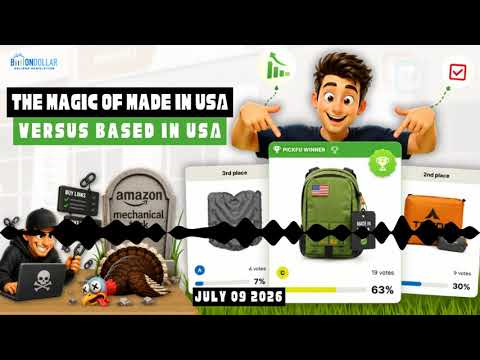
The magic of Made in USA versus Based in USA
Summary
A tiny "US Owned" flag badge on product images boosts trust, grabbing 63% of votes in a PickFu poll—not for patriotism but for signaling a real, accountable company. "US Owned" is legally safer than "Made in USA" since the FTC demands "all or virtually all" domestic production for the latter. Plus, Amazon's Mechanical Turk is shutting down as AI replaces its black-hat ranking history.
Transcript
This This is the Billiondoll Sellers podcast. Your go-to source for cutting edge strategies and success stories from the world of Amazon and e-commerce. Buckle up and get ready to take your Amazon business to new heights. Don't forget to subscribe to the Billiondoll Sellers Newsletter. Welcome your host. >> Welcome your host, Kevin King. >> Hey everyone, welcome to the Billiondollar Sellers podcast. I'm your host, Kevin King, and today is Thursday, July 9th, 2026. got a lot to cover, so let's jump right in. On today's show, we're going to get into the magic of made in USA versus based in USA and why a tiny flag badge on your main image is doing way more than you think. I'll also tell you about the death of Mechanical Turk, the AI before AI that quietly powered a whole generation of ranking tricks. And we got a fire sale over at Carbon 6 that every seller should be paying attention to, plus some interesting stats on where e-commerce is heading and a whole lot more. So, let's get into it. Before we do, I've got a little something to celebrate. It's the birthday of the billion-dollar sellers community, and to mark it, I'm doing a live webinar this Thursday, July 9th, at 2:00 p.m. Eastern, 11:00 a.m. Pacific, and calling it 24 hacks from the billion dollar vault. These are the real plays that top Amazon sellers are using in 2026. And someone who attends is going to win a free Market Masters 4 ticket. I've put a link in our show notes so you can register now. All right, now for today's Stump Bezos question. Amazon says that 20% of shoppers who interact with a sponsored prompt continue that conversation after the interaction. So, here's a question. What increase in conversions does that lead to? Think about it and I'll give you the answer at the end of the show. Now, let's talk about something that might change how you think about your main image. Because the US flag on a main image is not about patriotism. Here's a setup. A portable seat cushion and 30 prime shoppers. Just one image took 63% of the vote in a fiveway test. The winner had a small US flag badge in the corner, but not one shopper mentioned patriotism. Here's a number that should stop you cold. In a fiveway main image test, one image took 63% of first choice votes. 19 of 30 shoppers picked the same one. That's five options on the table and one pulled six times more than the runner up. Fiveway tests almost never break that hard. And when one does, you want to know exactly why. This test comes from Dianiela Boldsman who's been mining hundreds of PFU poles over in her social proof newsletter. She ran the test on 30 US Amazon Prime shoppers on a portable inflatable seat cushion. Same product in every image. What changed was the angle, the badges, and the eye image copy. The winning image had three things the others didn't. Color swatches, a weight capacity badge, and a small US-owned uh flag in the top corner. And when the comments came back, roughly a third of the panel brought up that flag on their own. Nobody asked them to. They just kept circling back to it. Then came the part that matters. Nobody mentioned patriotism. You read the reason shoppers gave and you expect flag waving, but you don't get it. You get trust. One shopper wrote that US-owned signals quality and safety. Another said told him a real company stood behind the product. And a third just like saying it front and center because it mattered to him. Notice what's missing. No pride. No by American, no allegiance to anything. These shoppers weren't voting their politics. They were answering a completely different question. Is this a real business or a drop shipper? And that's the whole game. So why does this flag do the heavy lifting? Well, on Amazon, a shopper makes a snap call with almost nothing to go on. They can't hold the product. They can't ask a question. They can't tell a real brand from a listing that got spun up last Tuesday. So they hunt for shortcuts. Anything I answer is, can I trust this without making them stop and read? And the flag badge is one of the fastest shortcuts there is. It tells the shopper nothing factual, but it registers in half a second as this one's probably legit. It stands in for a real company with real accountability, someone you could actually reach if the thing showed up broken. That's why it converts. But that's exactly why it can turn on you. Here's a trip wire. Quiet reads as trust, but loud reads as suspicion. This is where most sellers blow it. They see that the flag won the test and they crank it to 11 with made in USA written boldly across the image. But that version loses. The small corner badge says a real brand stands behind this product. But a hammered in flag says a company that's trying way too hard to convince you of something. That us versus them framing the jab at another country. It pushed real buyers away in testing. Shoppers called it try hard and insincere. And here's the kicker. The words on the badge were identical. The only thing I changed was the volume and the framing around them. Quiet won and loud lost. Now, there's one more thing worth flagging because it can really bite you. USowned is not made in USA and that matters. The winning badge said US owned, not made in USA. And that's not a small distinction. The FTC requires anything labeled made in USA to be, and I'm quoting here, all or virtually all produced in the US. That's a high bar and it comes with real penalties for brands that claim it without backing it up. And it's a bar plenty of American icons can't clear. Levis, Rawlings baseballs, Harley-Davidson, names built on Americana with plenty of production happening overseas, but US-owned, US-based, or found in Austin makes a claim about the company, not about the origin of every last component. You get most of the trust signal with far less exposure. So, if your product isn't generally all or virtually all domestic, do not put made in USA on the image. Pick the claim you can actually defend. So, how do you actually use this? Treat the flag as a trust cue. Keep it small. A corner badge sitting right next to your weight capacity badge, your certifications, your real proof. It should read as one more spec, not a bumper sticker. Contrast on quality, never on nationality. Rigorously tested to US safety standards. beats not made in China every single time with real buyers. Match the claim to the truth. Say US owned if that's true and say made in USA only if you can actually back it. And test flag on versus flag off in your own category because this one a fitness and outdoor cushion test. Yours may read differently. Run the poll and watch the comments for insincere or try hard. Those words are your warning lights. The flag isn't a patriotism play. It's a firm trust signal in badge form. When it's small, it tells a shopper a real company is behind the product. But if it's loud, it tells them that this company needs you to believe it. I had tipped to Daniellea Boltzman and her social proof newsletter for the test data. Now, before we move on, there's something you got to see. I recorded an episode of Marketing Misfits with Nor about the dark side of 7ig success. Building a massive e-commerce empire sounds like the ultimate dream until you realize that your friends and family have absolutely no idea what it feels like to lose an $80,000 shipment or have a top selling Amazon listing suspended overnight. In this deeply authentic episode, Norman and I sit down with Drew Little John's, an e-commerce veteran who went from being homeless and living in a church basement to running 8 figureure brands. He pulls back the curtain on a hyperaggressive optimization culture of e-commerce that often leads to severe anxiety, isolation, and addiction. Plus, we get into the future of Amazon SEO and why the Dunning Krueger effect in AI is making sellers dangerously overconfident. If you're feeling the burnout of the Amazon grind or you just want to know where the future of AIdriven product discovery is heading, you can't miss this episode. And while you're at it, go subscribe to the Marketing Misfits newsletter, too. You'll find a link to all of that in the show notes. All right, let's take a look at some interesting stats. Asia's e-commerce league is turning into a $3.7 trillion moat. If you look at e-commerce revenue by world region, comparing 2025 to the 2029 forecast, Asia is just running away with it. Uh, Asia sits at about $2.7 trillion today and it's projected to grow 38% to 3.7 trillion by 2029. North America comes in second, going from just over 1.2 trillion to about 1.6 trillion, which is a a 31% jump. And Africa, while it's the smallest, is actually growing the fastest at 70%, going from about 20 billion to around 33 billion. There's a link to the full graphic in today's show notes. Now, here's a story that every old school seller is going to appreciate. The Turk is dead. This was the AI before AI, and it got used for ranking. Amazon is shutting down Mechanical Turk. For 20 years, it quietly powered your favorite research tools. And before that, it ran a whole generation of black hat ranking tricks. On June 30th, a small notice went up on the Mechanical Turk website. As of July 30th, 2026, the service closes to new customers, but existing users can keep going for now. Now, most sellers reading this never logged into Mechanical Turk in their life, but you almost certainly use it without knowing. And if you were selling in the early days, some of your rankings were built on it. So, here's the story. Amazon launched Mechanical Turk in November 2005, a year before AWS became the cloud giant it is today. And the idea was simple. Some jobs are easy for humans and hard for computers. Tagging an image or transcribing audio, judging whether a sentence sounds happy or angry. So, Amazon built a marketplace where companies posted the tasks and regular people around the world did them for pennies. Amazon call it artificial artificial intelligence. The work looked automated to the buyer, but a human sat behind the curtain. And that name is a joke with history. The original mechanical Turk was a 18th century chess machine that beat real players and amaze royalty across Europe. But it was a fraud. A human chess master hid inside the box and worked the levers. So Amazon named its service after a famous hoax about a machine secretly run by hidden humans and then built a business doing exactly that. Each task was called a hit, short for human intelligence task, and the workers called themselves Turkers. Pay ran from a penny to a few dollars. The Turk predated Fiverr, Upwork, and the whole gig economy. Now, here's where it touches you. Think about how Pikfu works. You upload two main images, but you get back real human opinions in minutes with written comments. Feels like magic. Well, for years, part of that magic ran on mechanical Turk. Pikfu operated as a Turker. So, some of those real shoppers reacting to your hero image were actually Turkers picking up a hit for a few cents. Now, Pikfu has since moved to professional consumer panels, the same providers big CPG brands use. But the early version of that whole category leaned on the Turk, saying for a long list of survey tools that promised quick opinions from real people. So, the next time a tool hands you fast human feedback, just remember there's always a human somewhere and that human costs money. And that's a big part of why this is dying. Now, here's the part every old school seller remembers. The black hat era. Before Amazon got smart, the Turk was a weapon. Sellers and the shady services they hired posted hits that had nothing to do with honest research. Search a keyword, scroll past the competitors, find this exact product, then buy it. That was search find, and the algorithm treated those keyword-driven purchases as proof that shoppers wanted your product for that term. Other hits told workers to add to cart, add to wish list, sit on a listing, then come back and buy days later to fake a shopping journey. And then there were the reviews. Buy through a noral looking Turk purchase, get reimbursed, leave a glowing five-star review that now counted as verified. Multiply that across a crowd and you launched a product with a review wall that looked organic and was anything but. And this was not a rumor. A well-known Stern School study found that more than 40% of Turk tasks were spam. The flagged categories read like a black hat menu. Fake ratings, fake reviews, real humans doing fake things, which is exactly why the spam filters of the day missed it. But Amazon caught on. It rewrote the terms, purged reviews by the tens of millions, built detection, and sued the fake review brokers. The tricks that built empires in 2014 became a suspension in one email. Um, so that's the history, not a how-to. Run these plays today and you'll lose the account. So why is it finally dying? Mechanical Turk existed because computers couldn't do human tasks cheaply, but AI can now do most of them for a cheap API call. And it gets worse. A 2023 analysis found that somewhere between 33 and 46% of Turk workers were using large language models to do their tasks. So companies paid humans for human data while those humans secretly use AI to make it. But tool built a fake AI with real humans filled up with humans faking their humanity with AI. The sake ate its own tail. Add years of bots, fraud, and silent bans, and the platform was already a ghost town. Amazon also has replacements it would rather sell you, like Sage Maker Ground Truth. The Turk is not needed anymore, and Amazon rarely keeps what it doesn't need. So, Amazon just retired, a 20-year-old service that shaped an entire era of selling with a oneline notice and zero explanation. And that is exactly how it operates. Uh, The Turk was born as a story about a machine secretly run by hidden humans. And 20 years later, machines are to killing it because they no longer need the humans at all. So build on what you control. The rest is on borrowed time. Now, speaking of building on something powerful, let me tell you about today's software tool of the day. Here's the quick version of what Titan AI actually is. It's not a chatbot. It's not a robot VA clicking around your account. And it's not another dashboard you have to stare at. Titan AI sets a strategy for your Amazon business, then executes it, and every single move gets your approval first. And here's why it's the most powerful in the industry. It's trained on 10 years of real operator decisions behind billions in member sales. Not help guides, not YouTube tutorials, and not Facebook group folklore. It sees network data that other tools can't. It's passed two Amazon security audits and a human, that's you, approves every move. And it's built just for Amazon with Tik Tok shop coming next. There's a link to check it out in the show notes. All right. Now, here's a story that's a bro cautionary tale about the tools you depend on. SPS just sold the Amazon seller side of Carbon 6 for pennies. 16 months ago, SPS Commerce paid $210 million for Carbon 6. And last week, it sold the third party seller piece of that business for 9.5 million. 210 million in uh 9.5 million outs and it booked a $20 million loss on the sale. That is not a typo. That is a fire sale. So what actually happened on June 30th? SPS Commerce announced it completed the sale of its 3P revenue recovery business. That's the part of Carbon 6 built for third party Amazon sellers. Thank seller investigators, the FBA reimbursement tool that files claims for you and takes 15 to 25% of whatever it recovers. Now SPS kept the one P side, that's Charge Guard, which helps vendors selling wholesale to Amazon find invoice deductions. It also kept Supply Pike, the Walmart deduction tool it bought back in 2024. So, who bought the 3P business? Well, SPS did not name them. Right now, nobody knows who owns the solar facing reimbursement business. Uh, CEO Chad Collins framed the whole thing as focus. His line was that dropping the 3P portion lets SPS0 on one piece suppliers who trade with multiple retailers. But the translation is this. The Amazon seller tools were never the real prize. It was the wholesale supplier network. SPS only talked about the 3P revenue recovery business, so the status of those other tools is a big question mark. If your operation runs on any of them, watch your inbox. Don't wait for a surprise email. And this, folks, is the aggregator model breaking in real time. Carbon 6 raised $66 million and snapped up more than a dozen software companies to build an all-in-one suite for Amazon sellers. It was the Thrasio playbook applied to tools instead of brands. Buy everything, bolt it together, sell a bundle. SPS bought the whole thing in early 2025. In late June, Reuters reported the company hired Morgan Stanway to explore a sale of the entire business. Activist investors Anson Funds and Iran Capital have been pushing for it. The stock is down roughly 60% over the past year, and revenue growth slowed from 18% 2025 to a guide 6 to 7% in 2026. So, the seller tools some of you depend on now sit inside a chain of owners who are all selling. Nobody's coming to save your tool stack. So own your leverage. Keep a running list of every third party tool your business relies on. Know who owns each one today. Know how to export your data and have a backup for anything critical, especially reimbursements and inventory. The lesson from Carbon 6 is simple. Software companies get bought, bundled, and dumps. Your business does not run on their road map. It runs on yours. Before we wrap up, here are a few more hot picks for you. First, the post office is busting shippers for wrong weights and sizes. Second, New Jersey has become the third state to ban dynamic surveillance pricing. Third, OpenAI is now generating chat GPT image ads for advertisers. And finally, Google is testing YouTube shopping links in Southeast Asia. You can find the links to all these articles in our written newsletter at billiondollarellers.com. And here's your parting shot for today from Steve Jobs. The only way to do great work is to love what you do. If you haven't found it yet, keep looking. Don't settle. Oh, and remember that question I asked you at the beginning? Well, the answer is that adding prompts to sponsored brands jumps conversion by 6%. Pretty interesting, right? That's all for today, folks. Have a great weekend and I'll see you again on Monday. This is Kevin King signing off from the Billiondollar Sellers podcast.
This transcript page is part of the Billion Dollar Sellers Content Hub. Explore more content →