Ecom Podcast
The AI That Lets You Talk to Your Amazon Business | Jakob Wolitzki
Summary
"AI tools like Datado are transforming Amazon selling by acting as co-pilots that analyze data for smarter decision-making, with Jakob Wolitzki highlighting how sellers can leverage these systems to enhance marketing, sales, and strategy for better business outcomes."
Full Content
The AI That Lets You Talk to Your Amazon Business | Jakob Wolitzki
Speaker 2:
For the past five years, Jakob Wolitzki has been building automation tools for Amazon sellers, decoding what works and what breaks. But what he's seeing now is unlike anything before.
AI agents and LLMs are reshaping how software is built, how sellers are making decisions, and what the future of eCommerce looks like. In this episode,
Jakob shares what he's learned from the front lines and why the next wave of Amazon success won't come from tools, but from systems that think.
Our guest is the co-founder of Delta Logic and a creator of Datado, the AI co-pilot for marketplace sellers. He's an expert in Amazon SP API and Ads API, author of the world's first Amazon SP API course,
and an active educator with over 600,000 YouTube views. His mission, to help sellers and brands scale smarter with AI-driven insights in automation. This is a return guest, Jakob Wolitzki. Now, let's have a word from our sponsor.
First of all, we want to thank AZ Rank and AMZ One Step, Sophie's Society, Titan Network and Connect Cash. Without our sponsors, this podcast could not be anything. We wouldn't be here now. Sit back, relax.
If you have any comments or questions, throw them in the comments section and welcome Jakob.
Speaker 1:
Hi everyone. Hi Norm. How are you?
Speaker 2:
Hey, good, good. Is this your second or third time on the podcast?
Speaker 1:
It's a second time, second time. I don't know, like when was it? Probably two or three years.
Speaker 2:
It was a long time ago. I know the last time we had a really interesting conversation because you were just talking about a world that I love, but I am definitely not an expert in. And today we're going to do the exact same thing.
We're going to be talking about a lot of AI driven initiatives and automation. And I can't wait. So by the way, I checked out DataDoe before I came on here and I also did some research. And I don't usually do that.
I usually just, you know, come on five minutes beforehand. And I like doing that. But the topic today I thought was so interesting that I wanted to check it out and I went to the site and you had a six minute instruction.
It's just a video and holy crap. I was really impressed. In fact, like I got to talk to you after the podcast because, you know, I want to check this out.
And by the way, if you listen to the end, we got something special that Jakob is offering. So I think you'll take advantage of it after you hear what Jakob has to say. But why don't we talk about that first?
I don't usually leave them with these types of questions about apps. But tell us about DataDoe.
Speaker 1:
Yeah, I mean, that's super nice that you've done the research also. This website that we've pulled out, it's already like a few months old, so we are going to release a new one soon. Also, the videos and the app itself.
That was in the video itself, like that's the past. Now we have a lot of different new features, like we are actually developing it pretty much every day now. So, yeah, I mean, let's maybe go a little bit back.
I mean, overall, like the data, there was the AI Copilot for Amazon sellers. Marketplace sellers will be talking about it today a lot. But maybe let me just give you a little bit of context,
like why did it happen and like what was the origin? So I've been using LLM since the beginning, ChatGPT, Gemini and like all of the other tools. And I'm using them to run our main business, DeltaLogic, like in various ways of marketing,
sales, project management, accounting, like lots of different things to plan this strategy and so on. And over the time, you could actually, like those LLMs,
like ChatGPT started adding features like projects where you can add your context, when you can add your files. And once they added this, like it completely changed the game.
Like suddenly the AI could understand your business and help you really plan it ahead. Then I'm following a lot Y Combinator. This is an accelerator in the,
I think it's in San Francisco and pretty much they are doing a lot of I'm giving fundings for AI startups right now. And one of my friends from Berlin, they got there with their tool called LangDoc. And basically what it is,
is tool in the ChatGPT style where you can choose your model and also like add your files and add extra connectors to various apps. So pretty much at this point, AI has 24-7 context to your business.
And when I saw it, I was like, Wow, this is the future. Nothing like this exists in the marketplaces yet. We got to build this. So that was pretty much like the origin, the beginnings.
This year at Prosper Show, we've actually wanted to go with our main company, Delta Logic, but I was like, Let's just check it out. Like, let's see what sellers think about it, what brands think about it.
And one, like, three days before Prosper Show, we've actually printed the new booth with huge text. What if you could just talk with your marketplace data? And it was wild because, you know, like at Prosper Show, there are Helium 10,
Jungle Scout, Carbon 6, like those huge players. And that was in, like, March this... I think it was in March this year. Like, by then, no one had it. So people were going nuts, like they were asking like, when is it live?
I want to try it out. Can I connect more accounts than Amazon? Can I connect TikTok shops? So that was pretty much the idea. We went back to Poland after this and I said, shit, now we really need to move.
Speaker 2:
Now, that's great. That first company you were talking about, what was that again?
Speaker 1:
Delta Logic.
Speaker 2:
No, no. The company that blew your mind.
Speaker 1:
No, no, no. I mean, oh yeah, you mean LangDoc. Yeah, that's the company.
Speaker 2:
LangDoc. OK, I got to check that one out too. So with your app, so you can just have a conversation with it on an ongoing basis?
Speaker 1:
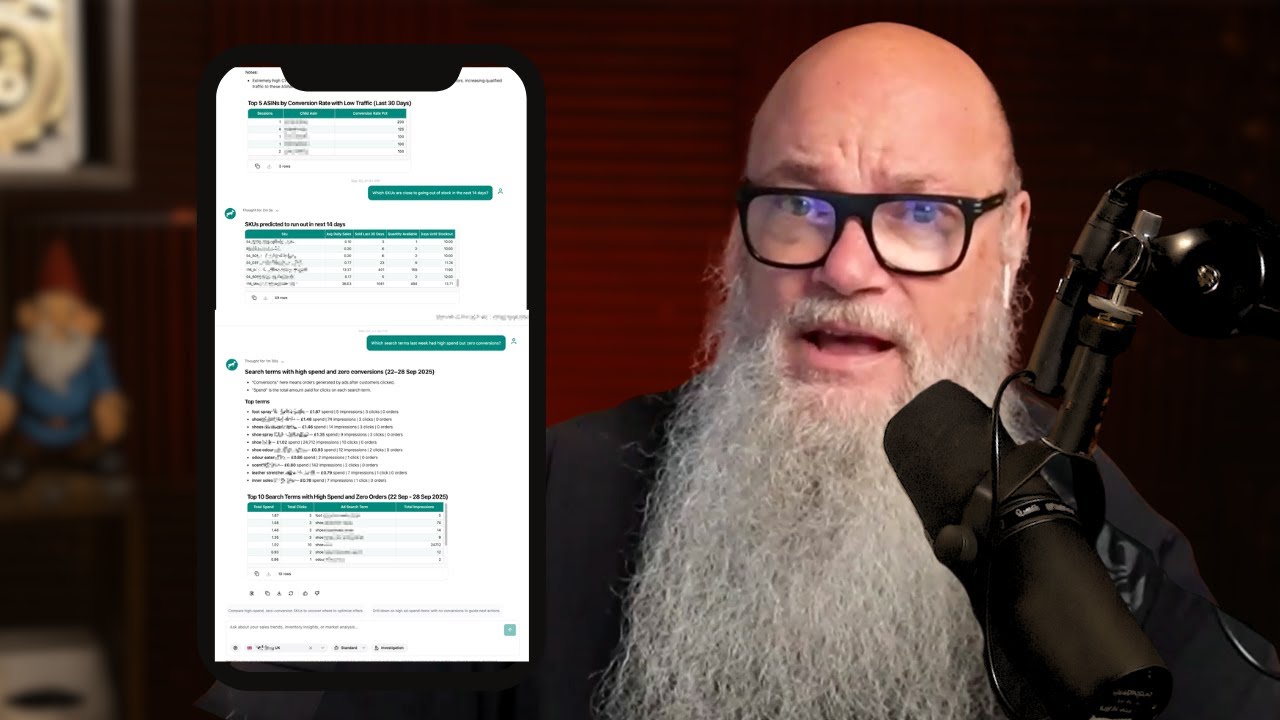
Yeah, exactly. I mean, this is pretty much like the first iteration of it when we just started. We are saying that this is literally a ChatGPT but with your Amazon context.
So you can connect your Amazon account or multiple accounts both from Seller Central and Ad Console. It will pull up all of your data from like reports, like tons of different APIs pretty much.
It will also store your historical data and then you can just start chatting with it.
Speaker 2:
What about free agencies and safer agencies?
Speaker 1:
Actually, like they also started using it. Actually, it sounds like we already see like the little bit differences between both. I just actually started using it more for reporting to the clients, but also like when we released this tool,
to be fair, I'm always saying this, I'm transparent, like we are not disillusioned. We've been in Amazon tech for the last five years. We've learned a lot about the industry and that was same with this.
When we only knew how to build it, but we didn't know what it is capable of. So now we are actually learning from users like, what they can do with it and we are really blown away.
Speaker 2:
One of the things, again, I was so interested in this and anybody who's listened to this podcast knows that out of 100 episodes, we might talk about an app once.
And I got so interested, I started checking out your YouTube and the other video that was really interesting, and this is for every Amazon seller. I don't care who you are, watch this video.
Speaker 1:
And worldwide, actually. Like all of the marketplaces.
Speaker 2:
Yeah. But the one on Amazon fees.
Speaker 1:
What do you mean?
Speaker 2:
You had a video out there saying...
Speaker 1:
Yeah, yeah, yeah, yeah.
Speaker 2:
And I thought that was really interesting because, you know, we think we know our Amazon fees, but this can just pull in the information like that, telling you exactly, exactly what every Amazon fee is,
how, you know, it was very interesting.
Speaker 1:
Trust me, just building this one freaking feature took us like a hundred hours because we had to reverse engineer also what tools like Sellerboard are doing with the settlements report and trust me,
settlement reports like report is not the one. It's not easy to work with. So just as one feature, we've put a hundred hours into that.
Speaker 2:
All right. So now let's get into it. Let's talk about Amazon and how it's changed over the last five years. What are your thoughts on that?
Speaker 1:
Amazon itself, I mean, you know, like there are a couple of topics here. Like from me, you can definitely hear the technical stuff about Amazon, right?
Like not really like from the seller perspective, but also like I'm going a lot to conferences. So, of course, I have a little bit information about what I see about Amazon. I mean, it's constantly getting harder and harder.
Also, one thing that I actually been a speaker last week in one conference here in Poland about like multi-marketplaces. And we've seen this trend also going like even at US like at conferences like Prosper Show,
you can see already like Walmart is pushing hard. Amazon sellers are saying, hey, Amazon game is getting harder and harder. They want to start scaling to other marketplaces.
So this is like definitely one thing I can say here that, yeah, it's getting more and more competitive. Same with the tools. Like, okay, that's great that there are tons of different tools and they are helping,
but at the same time, it's much harder to compete with others because now everyone is actually armed with those tools. So that's like regarding the sellers.
Now regarding tech, Amazon is actually like started pushing different tech solutions to like Seller Central. We've been seeing this. We've been seeing Amazon Marketing Cloud being released. Also used tons by agencies.
Also regarding the SPAPI, I think their team also improved a lot over the last years. I mean, first of all, even talking about the old API, which was MWS before SPAPI, that was hell. No one could integrate.
Then with the SPAPI, this is pretty much when our business started to really like skyrocket. We've been seeing that they were also adding tons of different tutorials, improving documentation, helping you out as a support.
They even did one crazy change that pretty much helped a lot overall developers around the world, but at the same time kind of took our business a lot. The hardest part with the integration to API was the authentication.
They were using like the very technical thing, like the signature. So every time you wanted to make a request, you had to sign it. And that was very hard to do it technically. No one could actually do it.
They were all reaching out to our agency. We are helping with this. But then suddenly they actually listened and they took it off. So now you can just get your tokens and do the request.
So that's like, you know, a good thing because there are More and more tools also being developed. So that's what I've been seeing over the last five years, pretty much.
Speaker 2:
Want more unfiltered tips from top eCommerce experts? Well, hit subscribe and you'll never miss a Lunch With Norm episode. Wow, things have changed. And like you were talking about, Amazon is getting to be a tougher marketplace,
but as long as you're on top of it with We're going to be talking about cutting-edge tools and just keeping your ear to the grindstone. You know what I'm saying. But as long as you're continuing to learn, then you should be okay.
There's a concept that on the Marketing Misfits podcast with Kevin and I, Kevin brought up an interesting concept, strategy that he learned at some party that he went to in Austin. It happens every month.
The Internet Marketers Party, I think it's called. And it was called Red Ocean, Blue Ocean, where you can go into a very competitive niche And even though it's ultra competitive, it's not saturated. There has to be some niches.
So that's your blue ocean. So you can go into a red Environment red ocean environment but go into the sub niche and that's what the people right now are taking advantage of and the other thing I think it's the.
Shiny object syndrome now for AI everybody is god like there's thousands of these coming up every every week every month. And where do you focus on? And I remember this back, and I don't know if you were back in Amazon back in 2013, 14, 15.
At around 2016 and 17, all of a sudden, you had all these overlapping tools and you had to have one to have the other. They were all doing the same thing, but everyone offered something a little bit different.
All of a sudden, you had all these tools that you're paying quite a bit of money for. And it was just total confusion and I don't know about you, but now we use, you know, three or four primary tools. That's it. We've got.
Cut out all the shiny objects. I can't do that. I know like I'm trying to understand AI. I'm trying to learn it more and more. We're going to get into AI agents in a second, but I get caught up in that.
So how do you not, how do you know what shiny objects to pay attention to and what just to cut loose?
Speaker 1:
That's a very interesting question, actually. I think I've also caught up myself, like, you know, always chasing a new shiny object. Like, for sure, like, I'm a big fan of trying new tech, new tools.
But, like, regarding the Amazon, I think, regarding what you said, like, that there are tons of different tools. I've done a huge research on this because one also think we are also fundraising right now for DataDoe.
We also want to like really develop a great tool like in a quite short period of time because this landscape is also getting quite competitive. But I've done a huge research on different tools and also, I mean, with DeltaLogic pretty much,
we had a lot of requests such as, hey, can you just build me a Jungle Scout? Can you just build me Helium 10?
We've been like, you know, building a lot of copies also of the tools that already exist because someone always wanted something different. But when I'm going with it, I think what you should be definitely like,
not curious, but maybe think about, especially right now, is this AI thing. Now, of course, I think we are getting into like kind of the AI bubble, and we already see it also in the Amazon landscape.
All of the tools, if you just go right now to like Jungle Scout, Helium 10, or like any other less popular tools, you will see like AI something. Like everyone is just pushing AI.
So now, of course, you're like watching or listening to this episode. It's like, oh, no, another AI tool. But like, there's one like What is the difference?
Most of those companies, they actually had their existing tools and they are just adding the AI layer on top, just with one particular functionality. Not that many people actually understand the true power of the AI,
which is having the all context and let the AI actually get to multiple places and this is where the true value is. So we've actually turned this concept a little bit upside down.
We didn't start it with the features, but rather we started with the data and created the AI engine on top of it. So this is something that is a completely new concept. I've seen companies intent-wise going into this direction.
There are also a few. You should definitely see the difference. I know it's very hard, especially if you're not technical, but I'm just saying that there will be a lot of AI tools,
but not so many of them that will give you this crazy improvement, especially to win with your competitors.
Speaker 2:
So let's talk a little bit about the LLMs and how an LLM presently is just redefining software as we know it.
Speaker 1:
I'm pretty sure that for everyone who is listening, you are currently using different LLMs like OpenAI ones, ChatGPT, right? We have one from Google, Gemini, and yeah, there are like searches like Perplex City,
and I can go on and on with this list. Now, how the LLMs are really redefining the landscape in the future? I've already said about like this having the context and so on about the business.
So like this is one thing, like just LLM itself, it's good, but it's trained on like broad data around the internet, right? Like even OpenAI I think admit that they actually trained their models on like YouTube and Reddit and so on.
Like there are tons of different charts online. But now regarding your private information about your business, right? Like you definitely need the integration with it. Now I want to tell about one thing that LLMs are good with.
They are very good with text documents. So regarding those integrations with like Google Drive, like the OpenAI has right now, this is perfect. LLMs suck when it comes to data analysis.
I know a lot of sellers and agencies, they try to download huge Amazon report, put it to ChatGPT and then it just started hallucinating. They didn't give them the good answer. The math behind it is bad. And yeah, that's basically the thing.
LLMs, they're good with text, but they are bad with data. Sorry, with the numbers and especially with like large numbers like your Amazon account. Like if you're running a seven, eight figure store, you're having gigabytes of information.
So there is no way of really I'm teaching AI or like giving it a context of your Amazon business. Now, there are quite a few different tools, but again, I haven't seen any of them in the Amazon landscape yet.
They are building engines around that. So you need this translation layer. So you have the LLM here, which can understand the context, but you just need to give it a little bit of the context that it can actually operate.
Then you have this engine, That is getting the data and doing something with it. This is usually through the Python code or SQL for all of the databases funds, right? And then you have the database. So once you actually combine those,
this is where the true magic happens because suddenly you have the AI that can actually go very deep with multiple data sources with gigabytes of information and give you the information and action plans.
So yeah, I think like the whole software industry is about to change right now.
Speaker 2:
So I'm going to either sound smart or really stupid, but on the last podcast, we had a person on talking about, I was talking about hallucinations and consistency,
and they were talking about using, and they said it wasn't too tough to set up, and I'd been looking into it, but rag databases, where everything can then be consistent. Is that what you're using?
Speaker 1:
We racked the databases. This is still for the text, right? So like, yeah, that's true. You need those databases to run the text, but here it's still like, if you want to use like database,
like BigQuery with tons of like, I don't know, hundreds of gigabytes, then you just need like a special translation layer, which right now, like there are not so many of them.
And again, none of the official like huge LLMs, they have those. So we just build it one for ourselves.
Speaker 2:
Okay. Yeah. So I didn't look too stupid there, huh?
Speaker 1:
No, I mean, you know, that's right. Like the rack databases are super important, but they are still for text documents.
Speaker 2:
All right. Let's go back. And I just want to talk about, you know, some of the current issues that sellers face with automation and these tools. I just want to restate that there's so many of these objects out there.
But they hear all this input coming in from all different sources. What are they looking at?
What are the issues that they're finding trying to build up their own automation or trying to create their own tools or using somebody else's and integrating these automations?
Speaker 1:
Yes, I mean, so maybe let's split it into two. So like right now, let's talk about maybe problems around the tools and like current struggles of the sellers when they are selling on Amazon and trying to use different tools.
When it comes to the current landscape of the tools, you have like single channel SaaS platforms. Those are usually the tools like just a repricing solution or just a PPC tool,
just a reporting tool, or maybe Some tool that helps you with stock optimization, right? Those are the tools that they are very good, but they are just good in solving one particular problem.
So that's where your monthly spending goes very high because then you need like four or five different tools to really run your business.
Or you have companies like Helium 10 that they are pretty much the aggregator of different solutions like Carbo 6, right? Like they wanted to be just One place to go for a seller, so they started acquiring tons of different tools.
Then you have tools which are going more broad and you can pretty much, they claim to do a lot of different things. They claim to, so you can connect multiple marketplaces.
But then we've checked some of those tools and yeah, even though like especially just reporting solutions. Yes, you may connect multiple marketplaces to monitor your business, but yeah, you cannot really cross the data.
You cannot really check the actual spikes in your business or issues. You still need to hire like the data analysis to actually interpret this data. So this is like the current, let's say, problem with the tools.
Also, like a lot of those tools are reactive, meaning, yes, they can give you some information, but still you need to interpret it and then you need to actually apply them to Amazon.
Of course, there are some of the proactive tools like reprices, like they can just reprice your items automatically, which is perfect. And this is what definitely sellers want. We've even got this feedback on DataDoe. It's great.
You can start chatting with it, go to different crazy root cause analysis, but you still need to then Do something on your own on Amazon and sellers are lazy. They don't want to do things, right?
So this is pretty much like the choices like sellers have right now. Also, like there are not only tech side, but the like, how to say it, services side. You have marketplace agencies, right? Like Amazon agencies, so you can just hire one.
They will like manage your Amazon. You have VAs that you can use. So yeah, this is how currently it looks like. A lot of different tools in many different places and then services that you can use in those service companies.
They also use their own tools, right? So a lot of data and a lot of context can be missed in between. Now regarding building your own tools, like, all right, now you have your own tool,
but there are also like tons of different problems with that. You have to maintain it, the API can change, and then you have to also change it, otherwise it will break. So this is how currently pretty much it looks like.
Speaker 2:
I want to go back to the LLMs just for a second and then we'll go to a sponsor, but there's so many out there and when I'm doing content, I might do it within ChatGPT, but then I get the senior editor to check it over in Claude.
And so it'll give me a completely different look at the response. And then usually what I'll do is I'll end up with a pretty nice article because one,
either I'll develop it in Claude, get ChatGPT to edit it or act as a senior editor and I get a nice article. But then I've noticed that Perplexity now, although it's not set up like with the projects or with artifacts,
but Perplexity now for $20, you get access to all the LLMs, all the major ones. And I just find that using Perplexity is actually, I'm loving it. Have you been spending more time over there or do you have a special LLM that you're using?
Speaker 1:
Yeah, I mean for perplexity I always use it for the research. I love it. It always gives me nice, nice information. Then I've been trying to use like Claude Gemini and ChatGPT, like those three mostly.
And I've seen like cloud being I think the best when it comes to like data analysis and coding. But in the end, like once those companies started introducing new models, I think like,
yeah, I mean, definitely there's still like a lot of difference. But as you are starting to use used to You use one of those LLMs. You also know how to prompt there, right? So for example, right now, I'm most of the time at ChatGPT.
It's more like I just set up it properly with those projects, with the integrations, and I know how to prompt. Like if I go back like three years ago, like my prompts were so basic. It's crazy.
Now when I'm prompting, I'm actually doing it in a totally different way. Usually I'm starting with a question. How should I ask, like write a good prompt and what should I include as the additional context?
So I feel like in the end, it's more about prompting skills than the model itself. Like, of course there are differences, but yeah, the better prompt you write, the better output you get. This is pretty much what I think here.
Speaker 2:
I always end my prompts for the most part with, how can I improve this prompt?
Speaker 1:
Yeah.
Speaker 2:
And you know, it'll ask you a few questions. And yeah, prompting is so important. It's not the basics. Even I've been working with a variety of different image enhancers and the prompting there,
it's basic, but you know, you, you have this plus this plus this plus this, and you'll get a great image. But, you know, you go back and you have to ask the questions and it's not just a simple like one liner.
You know, you have to get into some detail. And once you find that perfect prompt, you can say, like I have, I work with Mac and I have my notes and I just paste these prompts in there.
And when I want to go back to a specific prompt, I just switch out whatever I need. Now, it is the bottom of the hour. We're actually past the bottom of the hour, and if this is the first time you're listening to the podcast,
there's a couple of things that we do that are kind of unique. One is called The Wheel of Kelsey, and that's at the top of the hour where we give away a prize every week.
Now, it's one week back, so for this one, it'll be actually next week's podcast. But we have a great prize for you today. First of all, the Lunch With Norm podcast is going to be giving away a free press release.
So that's a premium press release distributed to all the main media outlets and bloggers and journalists and just our normal press releases that we create. And also, Jakob's come up with something.
So his platform, It's Pricey and Jakob, what are you doing for one lucky person?
Speaker 1:
Actually, this episode, I decided to give the code to all of the users, like all of the listeners. Yes, it's not just one, like for us also, I want to just mention it.
DataDoe is so early and also like tools like this don't really exist yet that we really care for the feedback. And especially here, I wanted to just give everyone who is listening 40% off for DataDoe for three months.
Speaker 2:
That's fantastic.
Speaker 1:
We have a code, so I don't know if I should say it. It's norm40, but probably you can just put it somewhere, right?
Speaker 2:
Right. Yeah. During the live podcast, Kelsey will put that into the comments section. And yeah, we'll also put that into our group. So that's fantastic. So thank you so much. I know you don't normally do that.
And we're going to draw that prize next week. So if you're interested, it's hashtag Wheel of Kelsey. Tag two people, you get a second entry. And you can also go to the newsletter on Monday, and you can enter there as well.
And then we'll draw for it next week. Okay, Kels, let's go to a sponsor. Hey sellers, Q4 is coming fast. Are your products ready to dominate? AzRank is your partner for accelerating sales across the most important marketplaces.
Their customized campaigns boost your visibility, make your brand impossible to ignore, and give you the crucial data that you need to win. Launch new products with a surge of external traffic.
Maintain top ranking and conversion rates for your best sellers and bring old listings back to life. Play it smart, prepare now and give your products the boost they deserve this Q4.
Visit azrank.com and unlock your product's full potential today. The link's in the description. Now back to the show. Okay, so let's stick with AI agents. So you use a variety of different AI agents.
Now, a lot of people that are listening to the podcast, it's still like three years ago when we were talking about influencers. People heard about influencers, but it took forever for people to actually use influencers and creators.
And even to this day, so many people are not using them. What about AI agents? What happens? Well, first of all, let's describe what that is. And then secondly, what happens if you're not using them?
Speaker 1:
All right. I mean, I think the explanation is pretty simple here. You can look at it as a computer program that actually executes something and actually think through it. So it has the whole process behind it. It starts planning.
And then start executing those tasks. And yeah, you can pretty much do it across different processes around the internet, around different businesses. And I think that the easiest case for this would be the simplest.
It's just a deep research mode and like ChatGPT or Gemini, where you're starting with the prompt, like, hey, do me a research on that. Then it starts asking you questions. If the prompt is not good enough, you start answering.
This is also like when the process starts and then it gives you the plan like, hey, all right, for this plan, I will research this website, this website, this website. Then I will get all of the data to maybe one Excel.
Then I will do something with it and I'll give you the report. Right. So you saw. That from one single prompt, it actually gave you the whole plan and executed it all through.
So this is, I think, the simplest explanation and case for the AI agent. The more complex ones are the ones that ChatGPT released. I think it was Operator. I think they put it back.
This was the one where you could actually ask it to buy you something online or make a report on something. And it was also going through the web. And executing different tasks.
So yeah, like we are still very early when it comes to the AI agents. So as you mentioned with the influencers, I think it's a great like example here. But yeah, I think people should start to get aware of them because yeah,
this is definitely a future for all of the, not only eCommerce, but all of the businesses who are doing anything in internet.
Speaker 2:
Right. One of the things that we've done and that we've do this for YouTube, we do it for the thumbnails, we do it for the titles, but we also do it for just brainstorming. So we'll create a project.
Here's the information, put up whatever instructions we want, or we just create a regular prompt. But what we've got is references. So if we want to talk about you, it'll be all your information that we can pull in from the internet,
at Jakob, at Kevin, at Perry Belcher, at, you know, all these different peoples. We have about 20 of them. And then we'll pull them into conversations. And so one of the things that we've created is the think tank.
So we have a question or we have a problem, which is the person at the head of the think tank. And then we'll pull in, you know, three, four, five, six different people that are listening to the problem that's being described.
Then they ask questions and they can go back and we say, oh, these questions are too specific. Discuss it among, or too general. Discuss it about yourself. And then they'll start, and you can see it.
They're asking each other questions and answering. And then at the end, we get the answer. So what would be the best resolution? And it usually will break it down. Oh, Perry Belcher says this. Kevin says this. Okay, so what is the answer?
And then it comes up with a really great answer for a lot of these issues that we have. But it's fantastic. And it doesn't take a lot. It takes a little bit of time to research.
But how hard is it to research Perry Belcher, Kevin King, you know, whoever it is? And now you can have them at your fingertips.
Speaker 1:
I like it. I really love it. And it's very exciting for me always to hear like how, like, you know, still like, I feel like AI is still relatively new and we just hear it more than actually use. But I love to always hear the use cases,
like how people are coming with their own ways and doing things. So that's awesome. I've actually started using AI a lot in my personal life. Like, unfortunately, I sold my soul to the corporate.
They know everything about me, but really like for my own therapy, for understanding my decisions, my past and so on, or like even planning like vacation trips, right?
So I don't want to say that, hey, AI is just great for the business or whatever, right? It's just helping you in so many things in your life that, yeah, you should start getting those benefits of this tech nowadays.
Speaker 2:
When I was going to school, we had to read books. I don't know if they do anymore. I think it was Fahrenheit 451, which they no longer really had to do math. It was all calculations. It was all calculators.
They forgot to do simple long division. They couldn't figure it out. And I'm saying this because like the other day, I use it so often now, like I'm watching a TV show and it comes up with something and I'll say, Hey, what is this?
Oh, can you describe this information? And are we going to get to a point where we're going to have such short memories? So it's a short retention because we get this just novel information and it's not important and you just lose it, right?
So you don't retain it.
Speaker 1:
Yeah, and there's been a lot of research actually how AI is changing the way the brain develops.
So like I've seen here in Europe like a lot of schools are actually banning using the AI and like fighting with it a lot and like to be fair I feel like it should be a mix, like also the school system should adapt to that.
But what you just mentioned with the movies and so on, right? I do the same thing. I've recently watched the Oppenheimer movie and trust me, I really sucked at history at school.
And I was really stopping and asking AI, like, hey, I'm watching Oppenheimer. I'm here. Can you describe me like why this happened and so on? Yeah, I mean I myself got a lot of benefits from it,
but I can see that for some people it can cause more harm than good.
Speaker 2:
Right. Now we started to talk about this a little earlier, but about agencies. How can sellers and agencies, what will happen to these sellers and agencies that just don't adapt to this?
Speaker 1:
Well I mean they will fall behind, that's for sure. I mean, there are still like sellers and agencies that just runs on Excel spreadsheets, right? So there will be definitely some that will say, no, I'm old school.
I will just use my good old spreadsheet. But to be fair, yeah, they will have plenty of costs. And as you know, already Amazon itself, like increased the fees and so on.
So if you're up to this, tons of different costs with like various tools and your stuff, Then it might be a little bit of the profit for your own. So in my opinion, I mean, if you're running the business,
you should definitely take care of your profit, what's really like left for you. And I feel like if you start adapting to the tech and actually leveraging it using before your competitors, Then, in the end,
it's just more profit for you because the work that could be done with 10 people in the agency with a good AI copilot, in my opinion,
in the future will be really like one person needed and operating this AI system with tons of different agents doing their tasks. So, in the end, yeah, I feel like this is what the true automation and adoption is.
Speaker 2:
I can see that as well and I can give you an example about history repeating itself. So back in the 80s, 90s, we had this company and it started out just as a slow startup and then we headed into hyper growth.
And so the project manager that I had on, she was great. She used Excel. It would take her approximately, I don't know, eight to 16 hours to complete these tasks over a period of a month. Then we brought on this whiz as we were growing.
We needed to speed up the process because we had to get over the chasm. We had to cross the chasm to grow our company.
And so she came in and she could do this 16 hours in less than an hour because she knew the process and she knew how to create macros and she knew and it was all accurate and we could rely on that.
And then when we had to let the other person go because she, this new person, she just, like she couldn't keep up. I think it's going to happen.
I think you're going to see a lot of people that just can't keep up being let go for these new processes, these people that are going to be able, like you said, to oversee this. And if we don't act and if we don't understand,
you're going to be that person that we had to let go. She just couldn't fit in anymore.
Speaker 1:
Oh, yeah. Yeah, 100%. And actually, I love the word you said, process, because this is something that we should definitely focus here in the conversation. Like, all right, you have a lot of those fancy AI tools,
but AI will not just run your business on its own. Like, the actual business is a list of different processes that you are executing. We actually started creating like SOPs. SOPs are standardized operation procedures.
And if you can actually map those and then see where you can use the automations or AIs, this is where the actual true leverage is, right? Like without this, if you just like do random things and then try to like put AI on top of it,
like this is not the way you will actually scale. So you're like, you really need to understand the basics beforehand.
Speaker 2:
Yeah, we, we, I'm a process person, I'm a systems person. So yeah, we have a five page SOP on how to make a cup of coffee. So yeah, that's true. That's true, by the way. That's our first our first SOP.
Speaker 1:
That's good to be good damn coffee then.
Speaker 2:
Damn good coffee.
Unknown Speaker:
All right.
Speaker 2:
Anything else that we should cover?
Speaker 1:
I just wanted to talk a little bit maybe on this AI agent thing here, which I think we haven't talked much of it, but we just started with the processes, so it's not much to add.
We've started DataDoe as this chat interface, but what I already said is sellers are very lazy. And even though you give them the most powerful tool in the history, theoretically,
and I think it's really true, If it won't do the things for them, like they will say, ah, I don't want to use it. So we are right now building like the biggest feature at DataDoe,
much bigger than the whole app itself and releasing in like two, three weeks. And those are the first Amazon AI agents. So like you actually said before the podcast that you started doing some automation.
So now imagine that you'll be able to do the N8N but with the Amazon context and not only with the data from Amazon from one account but also from the marketplace itself.
So like your competitors data like scraped or took from like Keepa and so on. And then on the last thing would be to actually make them execute things.
So there was recently the Amazon Accelerator and there was a huge talk about the future on Amazon and also like AI agents because Amazon itself released their own chat, but like we don't have to go very deep here.
I think every time Amazon releases the tool, it's not really in the favorite of sellers.
Speaker 2:
You're absolutely right.
Speaker 1:
But they were also saying about the MCPs, right? So MCPs, this is like the new API for the agents. And that when they release the MCP and you'll be able to create your own agents, like using data or like your own different tech.
I feel like this is where the huge game changer will be because then you will have the agents run for different processes, having context of like many different places.
And again, not only your data, but your competitors and then pushing changes to Amazon. I feel like this is where the true game changer will be and the first sellers who actually will do that, they will win and they will win big.
Speaker 2:
2013 all over again. That was when Amazon was gold. You could put a spatula up there. You could put anything and you would make money. So yeah, again, keeping on top of these trends.
Speaker 1:
Probably you heard like some old man CEO of OpenAI. He said that first time in history you will see 1 billion dollar companies that are handled by one human, right?
And I think like those will be geniuses who will be so ahead on the competitors that they will create the systems using those scalable AI systems that they will run those things. I feel like the Amazon like part is the same thing.
I mean, it's like the closed ecosystem where you can just do like things and you need the context. So if you crack the code on tech, yeah, you'll be able to scale fast.
Speaker 2:
A hundred percent. All right. How do people get a hold of you?
Speaker 1:
You can check out LinkedIn. I'm always there. Jakob Wolitzki, YouTube channel. We've just created a totally new YouTube channel just about DataDoe. You can always go there or just DataDoe.com.
We actually managed to get the .com domain for five bucks and we are very proud of it. Yeah. Happy to help. Happy to talk.
Speaker 2:
Perfect. And also check out DataDoe and just go to the website. It's very well explained. It's a six minute video and you'll understand it completely and then check it out.
You'll get, if you're a listener, use the code NORM40, you'll get a 40% discount for three months. So that's awesome. Thank you again, Jakob, for that. And now, Kels, is it time for a sponsor? And then we'll go over to the wheel.
Are you an Amazon seller that checked out your listing and said it should be doing better? What am I doing wrong? There's got to be a better way. Well, guess what? There probably is.
You just haven't had someone tell you exactly what's working and what's not. Flat World Network is for frustrated Amazon sellers. We'll take a look at your listing, your rank, your PPC, your traffic, and guess what?
We're going to tell you the good, the bad, and the ugly about your listing. And if you're interested, we'll even fix it for you. So if you're serious about scaling, go to flatworldnetwork.com and book your free audit today. Yeah, do that.
All right, let's go over to the wheel.
Unknown Speaker:
So since this is a pre-recorded episode, we'll be spinning the wheel live. So congratulations to whoever the winner is.
Speaker 2:
Yes. All right. So Jakob. Thank you so much for coming on. Thank you so much for providing that great discount for our listeners. And we will be talking to you soon.
Speaker 1:
Yes. Thanks a lot, Norm. Thanks a lot to everyone who listened. And yeah, remember that we are going to face very interesting changes in the next year. So be prepared.
Speaker 2:
A hundred percent guaranteed. Okay. We're going to remove you, but don't go away. I'm going to talk to you after the podcast. All right, everybody. Thank you so much for joining.
Uh, yeah, it's one of these rare occasions when we do a prerecorded podcast, but just unfortunate. No, unfortunately I'm going to be over at eCom North. All right, everyone. We will see you live next week.
This transcript page is part of the Billion Dollar Sellers Content Hub. Explore more content →