YouTube
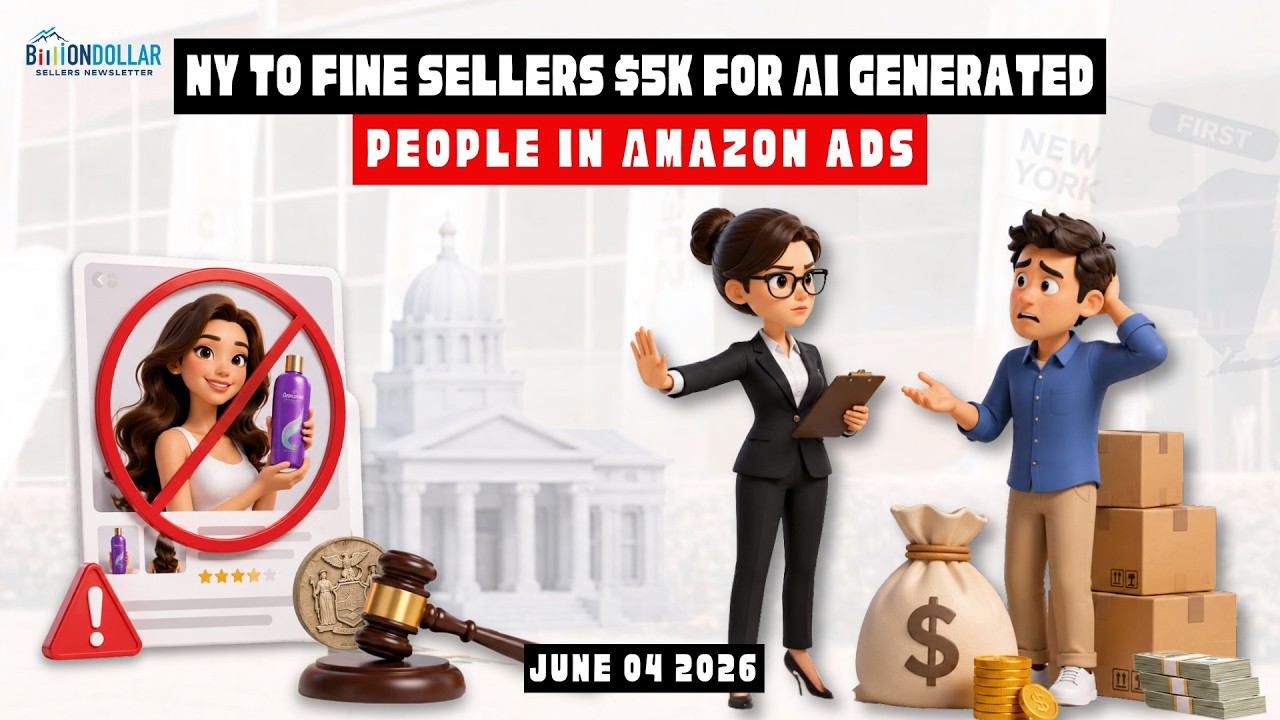
NY to fine sellers $5K for AI generated people in Amazon ads
Summary
New York's new law mandates disclosure for AI-generated humans in ads starting June 9th, with penalties up to $5K per violation. Amazon's Marketing Cloud just unlocked 1P data features for free until December 31st, giving sellers unprecedented access to customer journey insights. Plus, AI search traffic on Shopify converts 49% better and boosts average order values by 14%.
Transcript
This, this is the Billion Dollar Sellers Podcast. Your go-to source for cutting edge strategies and success stories from the world of Amazon and e-commerce. Buckle up and get ready to take your Amazon business to new heights. Don't forget to subscribe to the Billion Dollar Sellers newsletter. Welcome your host. Welcome your host. Kevin King. >> Hey everyone. >> [music] >> Welcome to the Billion Dollar Sellers Podcast. I'm your host Kevin King and today is June 4th, 2026. Uh we got a packed show for you today. So let's get into what's coming up. The big story today is Amazon just removed the paywall on the best part of AMC and this is huge because most sellers have never been able to see the organic side of their customer journey. We've also done an important breakdown on New York's new synthetic performer law that goes into effect June 9th. And if you're using AI generated humans in some of your ads, you got to hear this. Plus a really cool cohort study showing that cheap customers actually cost you the most. A software tool that helps AI understand your store better. And we'll check out some interesting stats around AI search traffic on Shopify. All right. Here's your Stunt Bezos question for today. Walmart says it's using its tariff refund from the US government to lower prices for shoppers. So how much is Walmart eligible to get back? Think about that and I'll give you the answer at the end of the show. All right. Let's get into it. So this first one is a really big deal and most sellers have been completely missing out on this. Amazon just removed the paywall on the best part of AMC, which is the Amazon Marketing Cloud. And this came from Dream 100 member Mansour Norouzi who posted this inside the Billion Dollar Sellers Club a couple days ago. Until December 31st, you can query Amazon's 1P paid feature tables at no cost. Now third-party data like experience still costs money, but the Amazon side is free. And here's why this is bigger than it sounds. Your ad data in AMC was always free, right? That part never cost anything. With the paid tables, like Amazon Insights, that's where the real gold is cuz they show you the organic side of customer journey. Most sellers never subscribed, so they never saw it. Now it's free to query. So, you can finally ask the questions you couldn't before. Like, what happens after someone buys through an ads? Do they come back and buy organically? Do they subscribe? After how many purchases do they subscribe? Is your one pack a cheap way in and then they upgrade to the two pack or do they buy something else entirely? How long after seeing your ad do people actually buy? Cuz the default 7-day window might be high in sales. And how much of your so-called LTV is just retargeting? Like, what share of your ad spend is going to customers you already won? That's the LTV math most sellers have never been able to run and for 7 months it's free. So, you haven't jumped into AMC yet, uh this is your window. All right, click announcement. So, my buddy Chris Rawlings hosted a live workshop a few months ago for Amazon sellers who want to replace themselves with thought workflows and uh it was so popular that BDSN subscribers are still asking me how I get access weeks after it ended. Now he's doing it again later this month. It's called the AI Amazon PPC Challenge and it runs June 29th through July 3rd, live daily from noon to 2:45 p.m. Eastern. He's going to show you the exact AI powered PPC systems and campaign templates that Sophie Society uses to manage more than $5 million a month in Amazon ad spend across 800 plus brands. Early bird tickets just went live, so if you know you need to learn how to use Cloud in your Amazon brand, there's a link in the show notes to grab a seat while they're still available. All right, so there's a great new episode of Marketing Misfits you got to check out. So, me and Nora Forrar sat down with William De Vito who has taught AI mindset to MBA students in more than 30 countries. And the big takeaway is this, most businesses that add AI end up spending more, clearly walking it back and blaming the tech. The real reason is almost always the They automated a broken system. Garbage in, garbage out. William shares the exact five core requirement documents every business needs to train AI to sound indistinguishable from a human, plus a hidden framework to test 40 different LLMs at the same time. And he shares his secret method for building automated agent networks that run entirely on autopilot. It's a really good one. You can find the link to that episode in the show notes. All right, let's talk about some interesting stats. So, Shopify just put out some data from Q1 2026, and it shows that AI search traffic is still small, but the quality of those clicks is way higher. Conversion rate from AI search is 49% higher than organic search, and average order value is 14% higher. So, the volume isn't there yet, but when someone comes in from an AI search, they're way more ready to buy, and they spend more. That's, you know, that's a pretty big signal for where things are headed. All right, so this next one is a really important legal update. And if you're using AI-generated humans in your ads, you need to pay attention. On June 9th, New York becomes the first US state to force advertisers to disclose when their ads use AI-generated humans. They're calling them synthetic performers. And here's the thing, you can't geo-fence New York out of Amazon sponsored ads. So, treat this as a national rule for any US-facing campaign. So, what counts as a synthetic performer? It's any human-like figure created or heavily altered by AI to look like a real person in an ad. The test is, would an average viewer think they're seeing a real human, even though nobody's actually photographed? So, for Amazon sellers, it means that if you got an AI-generated mom in the kitchen holding your product, for example, it's a synthetic performer. AI-rendered families, couples, groups, and what looks like normal product photography, those count, too. And AI brand ambassadors who look human, but aren't any real individual, those are covered. Now, a digital replica of a specific identifiable real person, that's a separate New York law with its own consent rules. This one is specifically about made-up humans. So, what does the law require? If you produce or create an ad with a synthetic performer and you know it's there, you got to add a conspicuous disclosure. The duty sits with the ad creator, so that's brands, agencies, freelancers, not Amazon, not TikTok, not Meta. The disclosure has to be conspicuous, but the law doesn't dictate exact wording, font, or placement. Something like, "This advertisement contains AI-generated performers" or "includes AI-generated human imagery." Short and direct is the safe path. Now, penalties. First violation is up to $1,000. Each one after that up to $5,000. But here's the key for high-volume advertisers. There's a cure window. If you get written notice that an ad is missing the disclosure and you fix it or pull it within 5 days, you can dodge the penalty. That makes a fast takedown process essential when you're running dozens of creatives. And the exemptions are the following: audio-only ads, ads where AI only translates language without changing appearance, and promos for films, shows, and games. Most product advertising won't qualify for those exemptions, so assume you got to comply. So, what's in scope for Amazon specifically? Sponsored products, sponsored brands, sponsored display with AI humans in the creative, that's likely covered. DSP static or video featuring AI people, that's covered. Off-Amazon paid media on Meta, TikTok, YouTube, CTV with synthetic performers driving to your listings, also covered. And organic posts, the moment you put ad spend behind them, that counts, too. Now, product detail page images and brand store modules aren't explicitly named, so that's a gray area. But brands reuse those same AI lifestyle shots inside sponsored brands and off-Amazon ads, so treat them as ad assets and disclose when you use them in ads. And don't expect Amazon to label your creative as for you. This is on the seller. So, here's your checklist starting now. First, audit. Export your current US sponsored brands, sponsored display, and DSP creative and flag every image or video where a person was AI-generated or heavily edited. Second, map risk. Mark any campaign reaching US users with AI humans as New York risk. You can't reliably exclude New York. Third, add disclosures. Drop a clear label like includes AI-generated performer on ad-risk creative. For video, add a short on-screen notice plus a line in the copy. Fourth, update your briefs. Make disclosure standard in every agency and freelancer SOW and require partners to tag files with synthetic performers. Fifth, build a fast-fix lane. Name one person who can pull or patch a creative inside 24 to 48 hours. That's how you use that 5-day to your window. And then, ditch your long game. Some brands will switch to real models and skip the issue entirely. Others will keep AI for the cost and flexibility, but bake disclosures into every ad template permanently. And this isn't just a New York thing. California, Texas, and Illinois are already lining up their own AI advertising rules. New York is just the first domino. So, if you get your disclosure process dialed in now, you're not going to be, you know, scrambling to swap out creative in the middle of Prime Day. If there's an AI human anywhere in your US ad stack, make June 9th your baseline and start labeling today. All right. Now, let's take a look at the software tool of the day. So, uh Google says LLMs.txt files don't really matter, but still doesn't hurt to have them for other LLMs and to provide some structure to spiders and crawlers. An LLMs.txt file helps AI models like ChatGPT better understand your e-commerce page and store by providing structure info about your products, policies, and brand. So, it actually improves AI's ability to accurately answer questions about your store, helps AI find and in to policies and product info, and reduces incorrect information or hallucinations about your brand. And you just fill out a form with your store info, download the generated file, then upload it to your website's root directory, same spot as your robots.txt. Uh there's a link in the show notes to generate your file for free. All right. So, this next one is really interesting, and it kind of flips the usual CAC logic on its head. Gabriel Caseros, a performance marketer who runs paid media for Amazon and Walmart brands, shared a cohort study on LinkedIn. His agency manages a beauty brands. They pulled 2 years of data, broke customers out by the channel that first acquired them, and tracked each group over 18 months. Five channels, same brand, same products. The only difference was the front door each customer walked through. And here's the headline number. Customers acquired through Amazon bought 2.3 times more over 18 months than customers acquired through TikTok. Amazon sponsored brands branded defense came in first with a 67% repeat rate, $74 average order value, and $312 in lifetime value. Amazon DSP was second at $204 LTV. Amazon sponsored products was third at $187. Walmart Connect came in at $129, and TikTok Shop was last at $81 LTV. Now, here's where it gets really interesting. TikTok had the cheapest CAC at $11. Looks great up front, right? But the LTV to CAC multiple was only 7.4x. Amazon sponsored products had a $24 CAC, which is more than double TikTok, but the LTV to CAC multiple was 7.8x. And Amazon sponsored brands branded defense? $9 CAC, $312 LTV, at 34.7x multiple. Holy cow. Upfront CAC made TikTok look best, but 18-month return math showed Amazon sponsored brands branded defense was the clear winner. So, here's what he changed for the brand. He shifted 40% of TikTok spend into Amazon sponsored brands branded defense. Built a subscribe and save cadence that lifted the sponsored products clover repeat rate by nine points. Layer DSP retargeting onto past buyers targeting the highest LTV cohort with reactivation campaigns and kept TikTok running at a lower budget treating it as a discovery channel that feeds Amazon rather than a direct ROI play. The night and day result? Well, revenue stayed flat, but contribution dollars rose 31%, CAC rose 18%, and LTV per acquired customer declined 47%. And Facero closed with a five-step framework any brand can run. First, pull 12 to 18 months of cohort data by acquisition source. And if your tools can't go back that far, well, AMC now gives you 25 months of lookback, so you've got plenty of runway. Calculate LTV per cohort, not blended across all channels. Uh reset your CAC ceilings based on cohort LTV, not first purchase margin. Then reallocate spend toward channels with lower visible return on ad spend, but higher repeat behavior. And stop measuring channels in isolation. Measure them as parts of a 12-month customer journey. The brands chasing the lowest CAC are building the worst customer base. The brands measuring LTV are building the moat. All right, before we wrap up, a few more hot picks for you. Amazon just announced that Prime Day is June 23rd to the 26th. And Prime Day is becoming an energetic shopping event, which is, you know, pretty wild to think about. Motorola phones are apparently hijacking affiliate codes in Amazon app. And there's a new list out of the 100 best 3PO companies in the USA for 2026. Links to all of those are in the show notes. And here's your parting shot for today. This one's from Napoleon Hill. He said, "Opportunity often comes disguised in the form of misfortune or temporary defeat." I think that's a really good one, you know, especially right now with everything going on with tariffs and regulations and AI changes. Sometimes the biggest opportunities come from the things that feel like setbacks. And finally, about that stump Bezos question from the beginning, how much is Walmart eligible to get back in tariff refunds? The answer is 2.4 billion dollars, up to 2.4 billion dollars in tariff refunds. Holy cow, 2.4 billion dollars. That is a massive number. All right, that's all for today, folks. Have a great weekend and I'll see you again on Monday. This is Kevin Chen, signing off on the Billion Dollar Sellers Podcast.
This transcript page is part of the Billion Dollar Sellers Content Hub. Explore more content →