YouTube
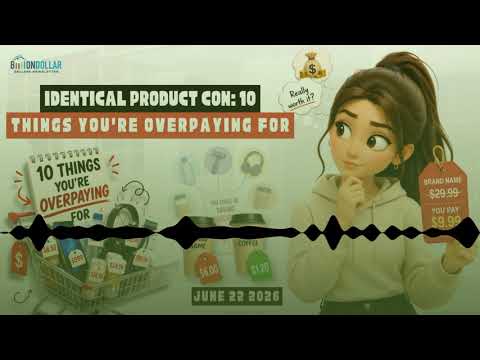
Identical Product Con: 10 Things You're Overpaying For
Summary
A 4.3-star rating with 12,000 reviews beats a 4.8 with 200, signaling more legitimacy to savvy buyers. Discover why people overpay for identical products like Monster Cable and baby formula, uncover the perceived value game, and apply Dan Martell's Buy Back Your Time framework to reclaim hours in your Amazon business. Helm's new AI orchestration tool could streamline workflows, giving sellers a competitive edge.
Transcript
This This is the Billiondoll Sellers podcast. Your go-to source for cutting edge strategies and success stories from the world of Amazon and e-commerce. Buckle up and get ready to take your Amazon business to new heights. Don't forget to subscribe to the Billiondoll Sellers Newsletter. Welcome your host. >> Welcome your host, Kevin King. >> Hey everyone, and welcome to the Billiondoll Sellers podcast. I'm your host, Kevin King, and today is Monday, June 22nd, 2026. We got a packed episode today. So, let's get right to it. We're going to talk about why a 4.3 star rating with 12,000 reviews out sells a 4.8 with 200 reviews every single time, and what that means for your review strategy. Then, we've got a really fun one. 10 products where people are massively overpaying for basically the same thing with a different label and a private label lesson baked into every single one of them. We got some interesting AI stats about who's using what. A new software tool called Helm. And then a deep section on Dan Martell's buyback your time framework, which if you're still doing $12 an hour task yourself, you got to hear this. Plus a few more hot picks and usual parting shot to wrap things up. All right, here's your stump Bezos question for today. So, total US e-commerce sales are projected to be about $26 billion between June 23rd and 26, the 4 days when Amazon and other retailers are running their big sale events. The question is, how much of that $26 billion will be Amazon's portion? Think about that and I'll give you the answer at the end of the show. But first, quick shout out to True Cy Moss. So, these guys came to uh BDSS Market Masters in 2025 already doing $110 million in revenue and in 2026 they're on track to exceed $200 million building toward a billion the strength of their omni channel playbook as proof that even 9 figure operators come to the mansion to break through the next ceiling and you should join us in Austin next month at market masters 4 is a link to that in the show notes. All right, let's get into it. So, no Wickman who manages about $1.4 $4 billion in sales came on and said something I think a lot of people need to hear. He says the brands obsessing over a perfect star rating are quietly bleeding market share to competitors who have worse stars but way more social proof. And here's why. Amazon shoppers never read a rating in isolation, right? You see a 4.8 with only 200 reviews and you're like, that's a small sample. Could be a fluke. But you see a 4.3 with 12,000 reviews and your brain goes, okay, a ton of people bought this thing and they were happy enough to keep it. Volume signals legitimacy in a way that you know a tenth of a star never can. And the shopping psychology breaks down by review count. Under 100 reviews, every star matters because the sample size looks suspects. From 100 to a,000, rating and count both carry weight. Over 1,000, the count starts compounding and the rating just has to clear the floor. And that floor is about a 4.0. Drop below that and you create resistance that no amount of volume is going to fix. And here's the uncomfortable part for your review strategy. Burying three star reviews to protect your average doesn't move the needle, but generating 10 times the review velocity does. A brand with 50 reviews lives and dies by every new one. A brand with 5,000 barely notices a bad week. Volume gives you cover. Perfection makes you fragile. And the fastest way to build count isn't tricks. It's Vine, follow-up emails, the request a review button, product inserts, and honestly, just making a product good enough that people actually want to weigh in. The 4.3 of Momentum beats the 4.8 sitting still every time. All right, let's talk about some interesting stats real quick. So, there's uh some really interesting data out on AI usage broken down by household income. And uh it's kind of wild. Claude from Anthropic has 80% of its weekly users making over $100,000 a year. 80%. That's by far the wealthiest user base of any AI platform. Microsoft Pop- Pilot is at 64%. Chad GPT at 60%. Grock and Gemini both at 56%. And then MetAI is all the way down at 37% over 100K, which means it's reaching the mass market way more than the others. So you got this huge gap, 80% versus 37%. And you know that tells you a lot about who's using what and where the purchasing power sits when these AI platforms start recommending products. All right. Now, this next section is one of my favorites because it's basically the private label playbook hiding in plain sight. So, there's a great video from Chill Dude Explains and there's a link to in the show notes about 10 products that are identical but cost five times more with a different label. And the consumer framing is like, "Oh, you're getting cons." But if you flip it around, this is literally what we do as sellers, right? The margin lives in perceived value, not the bill of materials. The product is rarely the product. The story, the box, the feeling, that's what people are paying for. And so, let me run through these real quick. Um, number 10, Monster Cable. $150 for quote unquote oxygen free speaker wire versus a literal coat hanger. They did some blind tests and the sound came back identical. You were paying for thick rubber and gold plating, but not sound. Number nine, baby formula. Since the FDA mandates the exact same nutrients in every brand, the $40 name brand and the $12 store brand are nutritionally identical. The difference is a smiling baby on the label. And that markup adds up to about $1,000 a year per family. Number eight, Nexium, the purple pill. So when Pryosex patent expired, the company patented half the molecule, rebranded it, and ran a huge marketing campaign so you'd skip the cheap generic classic farmer move called evergreening. Number seven, mattresses. Serta, Simmons, and Celely secretly make most store brands, too. Same phone, same coils, just renamed at every retailer, so you can't comparison shop. Consumer Reports found identical mattresses at $900 and $2,800. Holy cow. Number six, olive oil. Extra virgin is barely regulated. A university study found about 75% of imports failed the standard. Often cut with sunflower or canola oil dressed up with fake family crests. If you want to tell the real stuff, look for a harvest date. It should go cloudy in the fridge and it tastes peppery. Number five, pet food. Ingredients are listed by weight. And if the $90 artisal bag and the $25 bag list the same first four ingredients, it's basically the same food. Just look for the AFCO complete and balance statement. It's on both. Number four, Zquil versus Benadryil. Both are 25 mg of dyen hydramine. Same molecule, same dose. ZQ just added a moon in the words nighttime sleep aid then charged twice as much. That's the whole game right there. Number three, cereal. Honey Cheerios at $8 and store brand Toasted Oats at $3 off the run off the same production line in the same factory. General Mills, Kellogg's Post, they all make store brands as a side business. A mascot is what you're paying for. Number two, skincare serums. Hyaluronic acid is hyaluronic acid. The ordinary $7 serum matches luxury serums that cost 30 times more. A 2021 dermatology study found that price had basically zero correlation with effectiveness. And number one beats headphones takes about $17 to make and sold for 200. Tearowns found they added metal weights inside so they feel premium. $40 headphones often beat them in sound tests. And Apple paid $3 billion for the brand, not the audio. Think about that. So the lesson for sellers is every one of these is the same story we live every day. A smiling baby, a heavy haircut, a harvest aid, an aco line. The margin lives in perceived value, not the bomb. If you can make someone feel something when they open the box, you can charge more for the same ingredients. And that's the entire private label playbook right there. All right. Now, the software tool of the day, and this one's called Helm. So, Hell is basically an operating layer that makes all Amazon tools your team already uses actually work together through AI agents. And here's the thing, NCT access is becoming a commodity, right? Everybody's getting it, but very few teams actually know what to do with it. Your data is scattered across Keepa, ad platforms, keyword tools like Helium 10, data dive and wise, plus catalog exports, seller central, dashboards, and custom MCPS. Helm doesn't replace any of that. It orchestrates it. Uh you connect Helm as a single remote MCT connector in cloud and on every workflow run it loads your brand context like margins, targets and client rules. Then routes the question to the right sources, coordinates multiple MCPS in parallel, stores an evidence trail you can audit and produces operator ready output like alerts, briefs and review cues with a human in the loop. Uh the first package workflow is called listing guard and it monitors buy box, price, seller count, rank, reviews, and content changes. Then classifies and routes alerts to your review queue. And they've got more coming, things like Cyclops for ads priorities and waste, catalog agent, keyword gap, brand health pulse, all in the same infrastructure. There's also a free five skill pack, sales drop diagnostic, ad waste audit, catalog scan, listing conversion diagnosis, keyword gap snapshot, so you can try the operator logic before committing. It's pilot stage, hands-on, and run by Brett at Vortex. If your team has a pile of MCP connections and tools, but no system tying them into repeatable, reviewable workflows, then Helen is positioning itself as that connective tissue. There's a link in the show notes. All right. Now, this next section uh I think might be the most important one in today's episode and it's about buying back your time. So, if you're powering through your seller to-do list like it's a badge of honor, answering every customer message, tweaking every bid, chasing every reimbursements, here's the brutal math. Every $12 an hour task you do yourself is costing you way more than $12. So Dan Martell, the guy went from a six-month jail sentence at 17 to running a portfolio of companies doing more than $100 million a year while still having time for his family and staying in shape. He's now the number one executive coach for founders, a Wall Street Journal bestselling author, and has over 2 and a half million followers on Instagram alone. And he laid it all out in his book, Buack Your Time. The whole thing transfers almost perfectly to running an Amazon brand. So, while every other guru was telling entrepreneurs to wake up at 4:00 a.m., take ice baths, and grind 12-hour days, Dan said the whole premise was wrong. And he's like, "You don't have a time management problem, you have a time delegation problem." And his framework starts with one number, your buyback rate. You take your annual income, divide by 2,000 hours, and divide by four. So, say your take-home last year was $140,000, divide by 2,000, and you are worth $70 an hour. Divide that by four and you get 1750 an hour and that's the rate at which you should pay someone else to take a task off your plate. Anything you can outsource for less than that you outsource every time. That's a four time return on your time. And the goal isn't efficiency, it's liberation past a certain threshold. Dan calls it the pain line. Doing everything yourself stops being hustle and starts strangling your growth. And he says there are three excuses that keep founders from hiring the help they need. And I think every seller has used all three. First one is I can't afford it. And the answer is run your buyback rates. Once you see the number, you realize you can't afford not to. Second is it's too much work to delegate. And the answer there is climb the replacement ladder, which I'll talk about in a second. And it tells you exactly who to hire and in what order. And the third one is nobody can do it like I do. And that's where the 108010 rule comes in. So let me break down the buyback loop, which is the core engine. It's three steps. Audit, transfer, fill. Audit means you track your week and split every task into two buckets. The ones that drain you and the ones that fuel you. Highlight the drainers in red. And for most sellers, that red list is brutal. Inbox, reimbursement claims, manual PPC tweaks, listing ads, returns, report pulling, then transfer. Offload the red task to someone whose time costs less than your buyback rate. A VA, an ops hire, an agency. Start small with one hire. Free of hours. Reinvest the profit those hours generate into the next hire. That's the flywheel. And then fill. Don't let the freed up time leak back into busy work. Fill with the high leverage stuff, sourcing, supplier negotiation, new products, building the brand, or you know, just being present with your family. And here's what a lot of people miss. The bottleneck at the top of your business isn't somewhere down the or chart. It's you. So Dan lays out the order to hire. And I translated for an Amazon brand. Um, first hire always is a admin or executive assistant. uh inbox scheduling, report pulling, reimbursement chasing, data entry. Million-dollar brands aren't built on $15 tasks. Second is delivery and operations, inventory, logistics, supplier coordination, customer support, returns. Third is marketing, PPC, listing optimization, content, external traffic. It stops being your job to run the ad account. Fourth is sales and partnerships, wholesale, retail, bisdev, new channels. But don't hire here before marketing is humming because if you don't have leads, there's nobody to sell to. And fifth is leadership. A COO or brand manager who owns whole functions with real accountability for the numbers. And then the 108010 rule. That's for the nobody can do it like me crowd. The first 10% is ideation. You set the vision, the angle, and the outcome. That's where your expertise lives. The middle 80% is execution. Your team runs with it. Drafting, building, testing. And the final 10% is polish. You step back in to refine and add your fingerprint before it ships. You stay on the genius work. You let go of the grunt work. Steve Jobs ran Apple this way. Big idea hands off the build back end for the final polish. So bottom line, you don't need another morning routine. You need to stop being the cheapest employee in your own business. Figure out what your time is worth. Run the loop and buy back the hours that are quietly capping your growth in your life. All right, quick note on the black hat world before we wrap up. There are now robotic phone farms out there with rigs that continuously tap, swipe, and scroll through short videos around the clock. The system simulates human activity to generate artificial views, watch time, likes, and other engagement signals. So, you know, the black hatters are literally using robots now. That's the craziest thing I ever saw. And speaking of events, BBSS Market Masters 4 is August 20th through 24th at the Gatsby mansion on Lake Travis in Austin, Texas. Three and a half days inside an 18,000 foot mansion where the top 1% of e-commerce operators tear real businesses apart and put them back together. Most attendees call it their favorite event in all of e-commerce. This is the one that radically changes lives. There's a link to more info in the show notes. All right, before we wrap up, a few more hot picks for you. Shopify launched a tool to track sales from AI platforms. Amazon may face penalties from the FTC ad lawsuit. Google's new merchant center report tracks your brand in AI mode. And Tik Tok now has a seat next to Amazon and Walmart and RFBs. Links to all those are in the show notes. And here's your party shot for today. This one's from Dan Kennedy. Traffic and visitor counts are frankly BS flung about by fools and social media promoters and charlatans like monkeys at the zoo flinging feces. It's meaningless. Only traffic converted to prospects and customers converted to sales and profit count. Oh, I love that he does not miss words. Think about that one. And finally, about that Stump Bezos question from the beginning. How much of that $26 billion in e-commerce sales will be Amazon's portion? The answer is 60.3%. So about $15.7 billion out of 26 billion goes to Amazon. Uh, that's a lot of the pie. All right, that's all for today, folks. Have a great week and I'll see you again on Thursday. This is Kevin Kang signing off from the Billiondollar Sellers podcast.
This transcript page is part of the Billion Dollar Sellers Content Hub. Explore more content →