Ecom Podcast
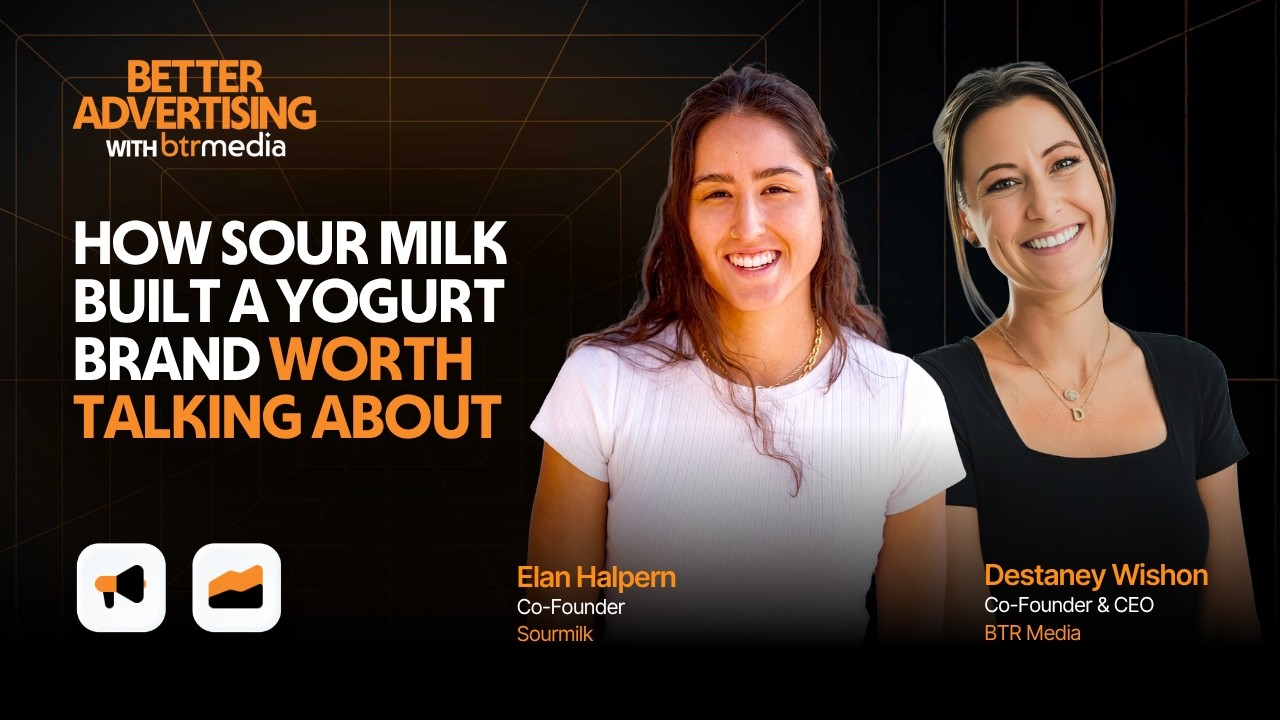
How Sourmilk Built a Yogurt Brand Worth Talking About
Summary
Elan Halpern shares how identifying a gap in the yogurt market for gut health led to creating Sourmilk, a brand with 92% household penetration, highlighting the potential for entrepreneurs to transform familiar products by addressing widespread consumer health issues.
Full Content
How Sourmilk Built a Yogurt Brand Worth Talking About
Speaker 2:
Welcome back to Better Advertising with BTR Media. Today, I'm really excited to have a unique guest on the podcast. We have Elan Halpern from Sourmilk. Elan, super pumped to hear about your story.
Can you just give us a really high level on the brand, how you got started, and how the hell you've scaled to the point that you have?
Speaker 1:
Yeah, absolutely. Thank you for having me. I'm excited to chat. The kind of path to starting a yogurt company, I would say, is not typical, especially with the background that my co-founder and I have.
Taking it back from the beginning, we actually met in undergrad. We both went to Stanford University out in California. I studied computer science. She studied human biology, so totally different paths.
I went on to be a product manager for four and a half years. She worked in private equity for four and a half years, so nothing related to food or consumer or yogurt.
But throughout that whole process, I was always really passionate about health. And in fact, I was an athlete in college. I was on the rowing team and had very early mornings. And every day after practice, when we would row,
our coach would come off the dock and our coach would line up Greek yogurt bowls for us after we got off the water. And this sort of became like a dietary habit that everyone on the team had, especially me.
We were like, we'd finish our workout and then we'd eat Greek yogurt. And that habit really stuck with me post-graduation. So it wasn't just something that I was doing there.
I was like, really liked Greek yogurt, thought it tasted good, had high protein and good macros. And so after graduating, I continued this habit of eating Greek yogurt every day, but I started to face all these gut health issues.
And this is really common, especially for women in their early 20s, but really throughout life, both genders. You know, we learned that two thirds of Americans have digestive issues, but we'll get to that in a little bit.
And when I looked at this food that I thought was probiotic and fermented that I was eating every single day, I realized that none of it was actually helping with my gut.
And so I was eating this thing that I thought was helping and turns out I had all these like crazy gut health issues like chronic bloating, inflammation, brain fog, my hormones were all out of balance.
And this food that I was eating wasn't actually contributing positively to that. And so I decided to start making my own yogurt. I've always been into food and kind of a nerd about the microbiome and health.
And what I kind of realized that yogurt actually is a vehicle. Sourmilk is a really good host for getting a lot of probiotics. It's just that commercial yogurts you can buy on the shelf aren't doing that.
They're designed to be produced as quickly as possible,
as yummy as possible and just like efficiently and not really designed to be the equivalent of like a probiotic supplement that has a ton of CFUs in it that's really good for your gut and just designed in that regard.
And so I was making my own yogurt for like three years really before we started Sourmilk. And I think the biggest thing that my co-founder and I realized is that, again, two-thirds of Americans, like my story is not an anomaly.
Two-thirds of Americans have digestive issues and simultaneously yogurt as a product category has a 92% household penetration. And so if you can take this thing that people are really familiar with,
eating every single day, but actually design a version that's truly, truly good for their health, Then you can reach way more people and actually help them achieve optimal health outcomes.
Speaker 2:
That is incredible. But I feel like there's quite a few missing steps that you are not giving yourself enough credit for. I mean, one, identifying a market opportunity and discovering a passion for your own personal need is incredible.
You still brought this thing to life. And I feel like it's really easy to have great ideas these days. I think even more so when you have A.I. like gassing you up on every little thing that you think is amazing.
How did you then decide, hey, we're doing this, we're taking this to market, like what are your first steps when building a brand?
Speaker 1:
Yeah, it's such a good question. I mean, I think we didn't know anything. Like we literally knew nothing. I think, funny enough, I had been at a startup in tech and, you know, joining, we were 10 people.
By the time I left, we were like 250 people, had an international office. So I'd seen that sort of growing and scaling past. And one of the things I learned, especially coming from Stanford, is that There's no right way to build a company,
full stop. But the way that I thought was most relevant and successful and exciting to me was to build it iteratively and to actually set points of validation before moving on to the next step.
And the reason why I call that out is because I think far too often, especially in CPG, Someone has an idea and their first step is like call a food scientist and find a formulator.
And then the next step is find someone, a designer to make the package. And the third step is to find a factory to make it. And then all of a sudden you've spent all this money paying for all those people and then producing the product.
And then you have all this thing that you have no idea if anyone even wants or if it tastes good or you know what I mean? So I think that people jump to production too quickly before validating that it's even a good idea.
And so the way we started was actually by doing like 50 user interviews. We literally talked to everyone, which, you know, a lot of people eat yogurts. It wasn't too hard to find candidates.
We started with friends and friends of friends and people we didn't know and just like, why do you eat yogurt? What type of yogurt do you eat? What do you like about it? What don't you like about the yogurt? What do you look for in a yogurt?
What's about texture, flavor, like all of these things that help just like give us data of like, what's the type of yogurt that we think we want to build and who is our target demographic? What do they care about?
What else is in their item, in their shelf? And are they taking supplements and all those kinds of things? And that kind of helps us start to formulate, like, what is this product going to look like?
And then we just, like, made small batches. So we'd make these small batches. Like, I was making yogurt for three years for myself. And so it started to look like yogurt. Yeah, I mean, it actually is.
What's cool about yogurt is it's one of the few products that is, you know, in a grocery store, mass scale, that you can actually make from home. If I were to make a protein bar or even a shake to some extent or some Cheez-It type thing,
those can only be made in factories. Yogurt is actually a whole food. It's just milk and bacteria. And so the same yogurt that we're making in the factory, I can actually make it at home.
It's just that the factory uses bigger equipment and is a lot safer and certified and all of those things, but the product is effectively the same. And so there was this ability to make that and we'd hand out samples.
What's interesting is that the early versions, because we were setting out to make a probiotic supplement. We weren't setting out to make a yummy yogurt. So we weren't like, okay, what's the best yogurt on the shelf?
Now let's try and go for that taste. It was like, okay, what do people like? And then how do we make a probiotic supplement? And then how do we make that probiotic taste good?
And because that was the process that sort of narrowed our recipe development. And I think the early versions of Sourmilk actually like were too sour. Like they went too far on the line.
Speaker 2:
I was cracking up. I was listening to your guys' podcast earlier that you did with the Startup CPG podcast and you were talking about the small things I don't think regular consumers think about.
When you take a probiotic or a general supplement, you're usually familiar with the side effects. When you're eating yogurt, you're not as sure on that.
So you were talking about the tweaks you had to make on formulation to make sure the yogurt and the probiotics wasn't running through someone too quick.
Because I've assumed negative side effect with food products, but not always necessarily supplements.
Speaker 1:
Exactly. Exactly. And so we didn't want to have a product that people were having to run to the bathroom every time. That wasn't a good experience for anyone.
So it had to be the right balance of like this has efficacy in terms of the amount of CFUs and the cultures that we use with like it still tastes good. It's still well balanced.
I think we often get the question like, you know, how do you know if sour milk is working? Like, how do you know if it actually is effective? And do you feel it? And I think the analogy I like to give is like,
If I have a raging headache and I take an Advil, I will feel the effect of that Advil. I will like, okay, this medicine is really working. My headache is going away.
If I'm perfectly normal and I feel great and things are going well and I take Advil, I'm probably not going to feel anything. I think you can apply that same logic to probiotics.
If you have a really, really bad, messed up gut that's like you have digestive issues, you're bloating all the time, like all these things, and you introduce a lot of probiotics into your diet,
you actually probably will feel something right away. If you have a pretty well-balanced microbiome and you have a healthy biodiversity, like it'll never harm you to introduce more probiotics,
but you might not like feel an immediate effect.
Speaker 2:
That's incredible. I also feel like the baseline for a healthy gut is something that is probably lost in a lot of society right now because we're really trained with things like fast food,
a ton of caffeine, Flamin' Hot Cheetos, things like that. So it's also like, what is your baseline for a healthy gut? How should I be feeling? What is my brain fog, my bloat situation?
I think a lot of people haven't even discovered what that is. So maybe they don't always know what to look for when probiotics are introduced.
Speaker 1:
No, I totally agree. I think like two thoughts on that. One, you're not set up for success in America. We are set up to have unhealthy guts in America, whether it's antibiotics from an early age or it's like processed diets or it's fast food,
whatever it is, we are not set up for success. You actually do have to actively work against that in order to have a healthy gut. And then number two, I think, especially here in the US, we often conflate common versus normal.
And I think what I mean by this is that it's really common to have gut health issues. For me to be like, oh, I feel so bloated every time after I eat, five out of the six people in the room will be like, me too.
And that's common, but that's not normal. It's not normal to feel bloated if you eat a very healthy, clean, balanced meal, right?
And so I think acknowledging that what's common isn't necessarily what's normal and then holding yourself to a higher standard to actually get to a place where you feel closer to 100% every day is really important.
Speaker 2:
I love that and I love the approach that you guys took to also going to market with this product. You mentioned the first priority was actually making sure consumers like the product.
I think something that you talked about is you guys did a lot of one-to-one marketing.
You were going to places where you knew your audience was Already introduced or intrigued with the health and wellness community and I think that's something that we see brand owners get wrong.
They want to start incredibly, incredibly broad and you're like, you know, let's start where our audience already is.
Speaker 1:
Yes. So I think that it's really common, especially for products that are in the refrigerated space. In general, all CBG, but especially in the refrigerated space to say, OK, if I want to launch this product, I need to go for grocery stores.
I need to get into all these grocery stores because that's where people buy the product. And I think the way we thought about it wasn't about like, what grocery stores do we need to go after and get into?
It was more about like, we need customers. We need like people who are excited to buy the product. So you can be in a grocery store and yes, maybe someone will pick up the product,
but more importantly, if you have like evangelists and customers who you know will walk into that store and buy it, like that's really how you move it. And so the way we did that was actually really unscalable and arguably like,
you know, Had we started a dairy company or any food company in the past, we would not have done it this way. Just like how our brains thought about it was like, okay, in the beginning,
we should try to meet every single customer face-to-face. And so in our initial, we did these yogurt drops that I'm happy to share more about. But for everyone who came and met us and bought a yogurt, we gave them our personal phone number.
And we were like, here's our phone number. Text us what you think. We want to know. And so we built these really intimate relationships with our customers.
Speaker 2:
That is incredible. I love that. One of our kind of mottos at BTR Media is to do things that don't scale. And I think the trade-off is sometimes things take longer.
You know, we've been doing this for five to six years and yeah, some of my competitors grew much quicker,
but the deep evangelism that we had has really turned into a flywheel in terms of our retention rate and the lifetime value of a lot of our customers. I think that is also really starting to spin for you guys.
I mean, you just had your Midwest launch. According to the Instagram and the digital shelf that I'm seeing, you guys are selling out pretty quick, which is really cool.
Do you want to talk a little bit about how you decided to take that step?
Speaker 1:
Yeah, so I mean just on the things that don't scale like looking back there like I totally agree. I think that like for us in particular,
The biggest difference that we saw was that if I'm walking down a grocery aisle for the first time and I see a new product, I might be like kind of curious about that product and say, what is that?
But if I'm walking down the grocery aisle and I see a product and I'm like, I met the founders of that company and I've been like eating that yogurt all summer and bought it from them directly, like it's just such a different experience.
And you build these evangelists that then kind of go on as hub and spokes to then be kind of your advocates in their community. So I totally agree with that. And then on the Midwest, yeah, so literally as of like the past 24 hours,
we were on the cuffs of the Midwest. This was a really interesting case. We launched with this amazing grocery store called Fresh Thyme. They have about 70 stores throughout the Midwest.
We actually had no intention of going to the Midwest this early. Our mission is to help people have really easy ways to do something good for their gut every single day. And the way you do that is by being everywhere.
We have to cover all of the states and build products that people are excited to eat. But, you know, we launched our first grocery store in November. So it's been less than a year of being in grocery stores.
And our initial kind of strategy, and it still is what it's worth,
is to kind of stay focused on the Northeast and make sure we really deeply understand our customer base before we do the whole logistical thing of expanding out West and into the Midwest and South and all those things.
But that said, We got introduced fresh time. We met them like at a trade show. They're an incredible team.
They are known for taking bets on new and innovative products and be really excited about bringing them in and supporting them through their launch. And we kind of had this realization that's like, okay,
They want to take in our product now for this category reset. I'm happy to explain what that is, but it's basically when grocery stores reset their shelves. And so they have this opportunity to swap out new products.
And so they're excited about taking us in. It's earlier than we wanted to launch in the Midwest, but ultimately we want to be a national brand. This is a perfect opportunity to see how we perform outside of New York.
We've been building Sourmilk in our backyard. My co-founder and I both live in New York. I'm born and raised in New York City. So it's definitely like our backyard.
But eventually we need to test this outside of that in an area where maybe nobody recognizes us when we walk down the street or we aren't in with all the communities yet. And our Instagram social media isn't really hitting those areas yet.
And so this felt like the right opportunity to take in order to actually test to see how our brand does outside of New York.
Speaker 2:
I love that and I love the view of it being a test to learn and collecting more data. I think that's another key area where brands make a mistake is sometimes they want to solely focus on profit your first year.
And if you're in it just to make money, I think you're sometimes not in the right space, especially when it comes to how competitive CPG is. You have a story that is founder-led.
This is a passion project that meant a lot to you and changed your life, quote-unquote. Maybe not that dramatic, but had a lot of impact on your life. And then you guys have said that the vision is really to go national,
to change, affect as many lives as possible. Keeping that in mind, I think, makes the really terrible months, because entrepreneurship is a roller coaster.
I think it makes it easier because you're building for something that is much more beyond yourself. And I think a lot of people miss that piece when it comes to launching a brand.
Speaker 1:
I totally agree. And then I also have to add, like, we're super excited about the product. And I think that that's a huge motivation for what led us to this is like, we love food.
We are really excited and passionate about health, but also getting the chance to do it with my best friend. Like, I think, you know, underrated.
How close Kiki and I were prior to this and obviously are now and I think getting to build something really cool and impactful with someone that you genuinely like spending time with is like a huge underrated thing in terms of enjoying the experience.
Like we're about to spend 36 hours in three cities and do like 20 events together and we're probably going to be sharing the same bed in a tiny hotel room and just like not, you know what I mean?
And the fact that I can do that with my best friend just makes it like so much better.
Speaker 2:
I absolutely love that. And I want to circle back on your roadshow. But before I do that, I feel really similar. My co-founder and I have been working together for seven years.
I'm going to throw him under the bus with this because he has also become like one of my best friends. I got a text message from the vet saying that they're going to need a stool sample for one of my cats.
And I was like, how the hell am I supposed to get this? I have multiple cats. And my co-founder Amazon primed a poop knife to my door. Like, if you don't know what that is, it's an actual thing you can buy on Amazon as a gag gif,
but it arrived today and I was just like, the fact that I do business with this man. That's amazing. There's no big difference. When you find that intersection between loving what you do, loving the service or the product that you sell,
and also having the long-term vision, you have to have that. As an entrepreneur, I think it is one of the most difficult things that you can do. You have to be able to ride the wave of emotions.
One day you're getting national expansion, the next day you're getting sued. That's constant. I always say that the goal is to find the middle. And having people to that you love doing it with is really what makes the most difference.
Speaker 1:
I totally agree. And I think I often say this, especially people like early in their career who are deciding between things is that like,
ultimately, especially if you're at a startup, you spend more time with your coworkers than you do with anyone else in your life. Like more than your partner, more than your family, more than your pet,
like you will spend all of your time with them. And if you have the opportunity to choose who to do that with and to do it with a friend, like that's just unmatched, I think.
Like your time allocation towards spending it with people that you love to be around, I think is just so important.
Speaker 2:
Absolutely. And make sure you travel well together. To your point, we have been stuck in Airbnbs in the south of France, locked out after 24 hours of travel, no suitcases. And it's like, We're getting chicken nuggets.
Speaker 1:
Okay.
Speaker 2:
I want to pivot as a personal question. Okay. You're a, you're a collegiate athletes. You were about to do an insane road show and be on the road and just hit the ground running.
You had your Midwest launch this week and you're riding a hundred miles on a bike tomorrow. Is that, is that what you posted on LinkedIn?
Speaker 1:
That's right, yeah. Every year my dad organizes, like I said, I border raised in New York City as my family and pretty much since 9-11 happened, my dad's been organizing this 100-mile bike ride that's just like a New York Appreciation Day.
So it's not like a race, but it is like a, you hit all the five boroughs, you hit the oldest kind of spots and classic New York pizza places and These kind of best-kept secrets and sort of like a New York Appreciation Day,
and I've been doing it for a while, and it happens to fall on the day before our, you know, six-day intense roadshow, but, you know, you can't plan for anything. There's no good time for anything, so.
Speaker 2:
That is, that is insane and incredible. What do you think, what do you think the core principle that makes you such a go-getter? Like what, what allows you to handle all the things that are going on with so much grace?
Speaker 1:
That's a good question. I think something that I adopted early on is the ability to prioritize in the confines of what I care about. So I think like ultimately the way you spend your time is just about prioritization.
There's like absolutely no such thing as there's not enough time. There's always enough time. It's just about what you prioritize and what you choose to do at that time. And I think recognizing that early on gives you a ton of freedom to say,
OK, you know, I have a crazy day. I have to be in Soho for a meeting at 830 a.m. and I have this other thing that goes to like 10 p.m., whatever it might be.
And I know myself and I know that I will function better if I'm able to get some form of exercise before, which means today I'm going to take an hour out of my sleep and do that. And so it's just about kind of adjustment.
In the case of the 9-11 ride, it's not a good time for me to take an entire day of 100 miles. And also, I'm going to be insanely sore going into it. But it's how I choose to prioritize my time and my energy.
And this is really important to me. It's important to my dad and just being a New Yorker. You know, there's always going to be stuff that comes up in your business.
I think making sure that you're prioritizing what you want to prioritize is really important.
Speaker 2:
I love that. I could not agree more. I've taken a very similar approach as well as one. I like the principle of imagine you're juggling. Some of your balls are glass. Some of them are rubber and knowing which ones you're willing to drop.
And I think that's different for every person and every entrepreneur. I think a lot of people get caught up in trying to build their business how everyone else did, trying to follow someone else's playbook.
But at the end of the day, it really depends on what do you want to accomplish? Like as the founder and the founder vision, you have to be able to define that first.
Because if you're trying to spread yourself way too thin, making everyone else happy, your business is going to suffer because of that and your mental health is going to suffer.
Speaker 1:
I totally agree. I think that like us, especially as a founder, ultimately your job is to be able to make really good decisions and sometimes execute on them. For us, it's all the time execute on them so we don't have any employees.
And in order to do that, you just have to be high functioning. And that means you have to do the things that make you feel good, whether that's exercise, whether that's nine hours of sleep, whether that's...
Speaker 2:
That's me. I'm the nine hours of sleep.
Speaker 1:
Yeah. And that's great. Yeah, and that's great. And I think that that is worth prioritizing over like push the meeting back 30 minutes that you can do that. I know, you know, it's not always possible,
but I think just constantly questioning what's the most important thing right now is good.
Speaker 2:
Well, this has been a fantastic interview thus far. I kind of wish we had three hours just to talk philosophically around starting a brand and entrepreneurship.
I have one question for you and then I want you to give a shout out of all of your socials where everyone can follow you because you're also building in public and I love that.
But if you had one piece of advice for anyone that's thinking about starting a brand, what would you give them?
Speaker 1:
This might be a little bit, but I would say build in the public if you're comfortable with it.
I think that one of the single greatest marketing strategies that my co-founder and I took on was both being very public about how we're building the company.
And I think that's totally changed the trajectory of the business and the product. So I would say like, if you're questioning it, just do it.
Speaker 2:
And on that note, where can people follow you to realize and to see the journey and everything you're building?
Speaker 1:
Yeah, so LinkedIn, Elan Halpern, I post pretty much every day on there, little snippets of what we're dealing with and the bad and the good. I also write a weekly newsletter called Gut Check.
So you go to sourmilk.com slash gut check, you can subscribe to that. And it's, again, like insider kind of founder story, how we're building the company. My co-founder does an incredible job on Instagram and TikTok.
So I would say follow her personal account for her founder story, which is sort of a different angle than mine. And she's Couchwoman on all social media platforms. And then Sourmilk is at GetSourMilk on all social media platforms.
So definitely check that out.
Speaker 2:
I love it. Everyone, stop what you're doing right now. Give her a follow and give the brand a follow. And again, thank you so much for joining.
Speaker 1:
Thanks for having me. It was awesome.
This transcript page is part of the Billion Dollar Sellers Content Hub. Explore more content →