Ecom Podcast
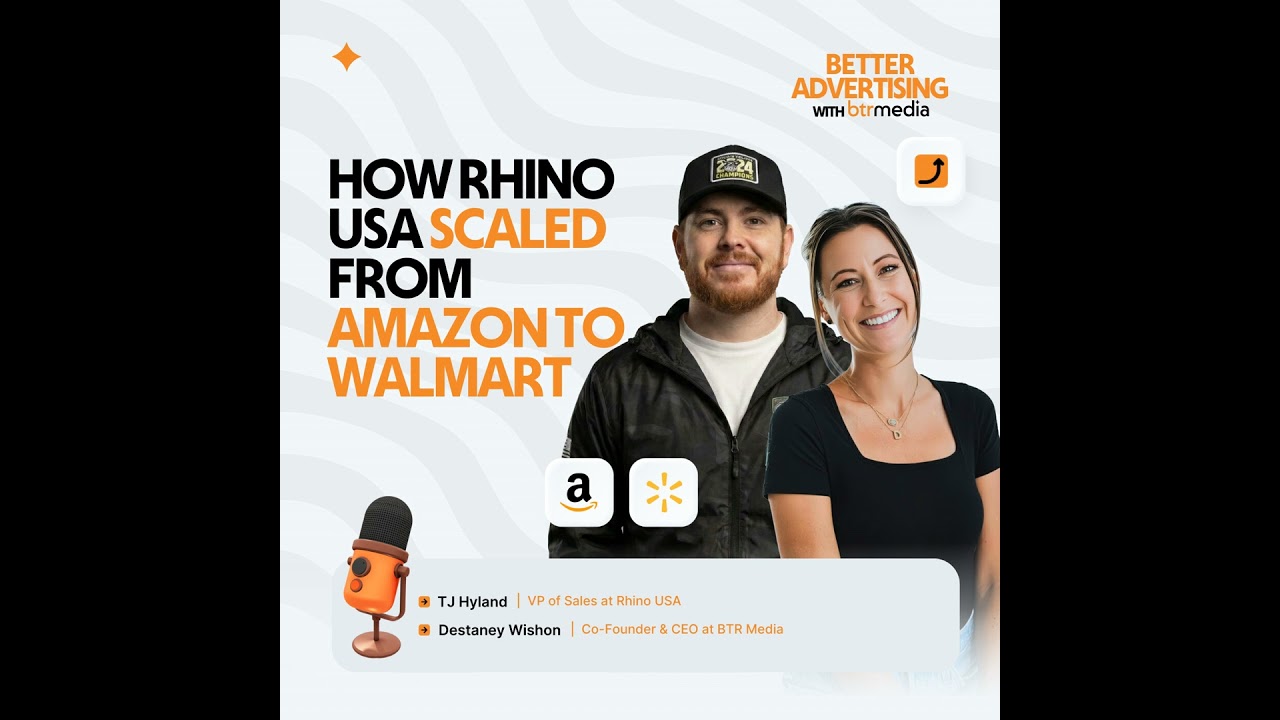
How Rhino USA Scaled from Amazon to Walmart
Summary
"Rhino USA's transition from Amazon to Walmart emphasized the importance of maintaining original leadership to drive growth, resulting in expanded brand presence and opportunities beyond e-commerce, instead of just cost-cutting measures that can harm long-term brand strength."
Full Content
How Rhino USA Scaled from Amazon to Walmart
Speaker 2:
Hello, everyone, and welcome back to the Better Advertising with BTR Media podcast. Today, I'm incredibly excited to have my good friend TJ Hyland on the podcast. TJ, how are you doing?
Speaker 1:
Amazing. Destaney, thank you for having me. How are you?
Speaker 2:
I am. I am doing well. For some context for the listeners, TJ and I have been connected for quite a few years in this space. For those who have been in the space for over five years, TJ and I were part of that OG crowd.
TJ actually was one of the members that got to join the really exciting Aggregator Gold Rush and the highs and lows that came with that. And you're now the VP of Sales of Rhino USA, which is huge in itself.
And I want to just kind of kick things off with saying congratulations for all of your evolution.
Speaker 1:
Thank you. Yeah, so it's pretty fresh and new, that title to Rhino just in the new year in 2026. But I've actually been working with Rhino for the last four-ish, three and a half, four-ish years.
So Elevate Brands, one of the original aggregators actually Invested in Rhino, did not acquire 100% of it, but rather 50% of it. And in hindsight, I think obviously everything's 2020,
but that was the key to success and is keeping on the original team and the founders and then leadership who really drive, built the business, but really drive that through.
And as you mentioned, like tremendous growth throughout the business since then, and obviously what led to me stepping in full-time here.
Speaker 2:
I love that insight of the founders driving vision and growth because I think that is what made you all so successful in my opinion. You know, we did a lot of consulting for a lot of the aggregators through the highs and the lows.
And one of the things that we saw is a lot of the aggregators went straight into cost-cutting, profitability, lean machine mode. And I think it was a bit of an eye-opening experience when they saw things like,
yeah, their tacos and their egg cost improved, but their organic rank dropped, their repeat purchase rate, their brand building, their demand creation tanked.
And getting to your point, a lot of your role actually transitioned into driving more growth rather than cutting back. I think Rhino drove a lot of growth. That's where I've seen a lot of their success in stores.
But also just how can we create more opportunities for the brand? And I think you were in charge with leading a lot of those initiatives across both pieces of the business.
Speaker 1:
Yeah, so I think, you know, if you go back to 2022, kind of 23, kind of how I got 22, excuse me, how I got really involved here is I was originally joining Elevate to help kind of connect them to the Amazon world.
I had been in it since 2014. Things were going great until they weren't. And as we've spoken about the aggregator world, like the cost of capital went up and the markets dried up, right?
I wanted to keep a job and we looked at the brands and we tried to see what in the portfolio deserved to live offline as well. Deserve to be a brand with a capital B, not just an e-commerce brand, but rather a household brand, right?
And many of the aggregators talked about, you know, this XYZ brand is in X many households across the country, like, okay, but they don't know it. It's a marketplace brand. They don't know the actual brand. They're not searching for it.
And one of the things we've realized in 2023 was trying to, you don't know until you don't know, right? Or until you know, I guess, right? You know,
we took it slow and we tried to figure out Does this brand have legs to stand on its own in physical retail? And it took a while to get there, right?
It's no secret that you can't just go buy a product and put it in the store the next day at Walmart or AutoZone or Costco or Sam's or whomever, right? There's a lengthy process there and the retailers want proven brands and proven success.
And I think from our perspective, we had proven ourselves on The marketplace side, which is Walmart, 3P, obviously Amazon as well at that period. And our first buyer at Walmart, I often say, took a chance on us, right?
We started in 2024 with six products. In 2025, we added another six to bring it up to 12. And then in the spring of this year, we're going to add another nine. So we're going to have 21 products in Walmart nationwide.
We've done tests in other retailers and other clubs and we're launching another two this year as well. So really exciting stuff. But I think just to your point and not to cut you off,
but it's really just proving that whilst the e-commerce world and Amazon in particular becomes increasingly challenging with fees and competitors and things like that, we often talked back in early Elevate days of,
Brand protection and building a moat and things like that. And it's super difficult to do online. You can have all the brand protection and brand registry on Amazon or XYZ marketplace,
but you're still going to get copycats who can go launch and put up a product the next day or next month or next quarter. When you are in physical retail,
you're not getting those copycats that live in other countries to go fly to Bentonville or fly to Memphis or fly to Seattle to go meet with these major retailers and be able to get on the shelf or on the floor.
Speaker 2:
That's an incredible point and angle. I don't even think I've necessarily considered as a leading benefit for expanding to retail. When you mentioned defining the brands with a capital B,
you had an opportunity to transition from online to retail by justifying your success online, I would say. That gives you kind of a foot in the door of, hey, we're doing XYZ on Amazon, so I think we will also do well in stores.
What were some of the other variables you looked for that would, hey, this will do impactful, this I can use to pitch to a Walmart or a Target or an AutoZone in order to get in stores?
Speaker 1:
Yeah, 100% comes down to social media marketing and reach, right? Ultimately, a buyer at XYZ Retailer can go put any brand on the store,
but they really need to get, I often say like what I do in getting the products on the shelf is the easy part. Getting the products off the shelf in the hands of the consumers is the more difficult part between,
you know, word of mouth, people walking up and down the aisles or advertising and getting them, you know, to know that the products are there. Right. So the big thing for us has been the marketing side of things.
We absolutely leverage TikTok as a brand awareness platform. We do activities and promotions and events with TikTok online and we see direct traffic in store of that. And I think one of the things that we often say is like,
The world in which we play in automotive and tie-down and trailering and towing, not super sexy, right? And we're sitting there on the shelf online as well as in-store next to frankly dinosaur brands, right?
That are not doing anything to drive any traffic in-store. One of the things that I love to think about is year one in Walmart around holiday season. We sold out. We told them, buy more from us, replan more. We will see holiday sales.
We will be able to drive foot traffic into you. And they were like, okay, okay, okay. They didn't act on it, but that's because forever before that, they had a very flat 12-month predictable business. Now they listen to us.
Now when we do events with other marketplaces or run deals or run promotions or campaigns, they listen to us and they stock up ahead of time. I'll say this. Walmart has been an incredible partner, right?
And, you know, for us, it was our first in-store partner. People often say you shouldn't start with Walmart because if you mess up, you're done. You can't do anything there. Obviously,
it went the other way and it went super successful or it's been super successful and that's why we continue to lean in with them. We spend a ton on marketing and driving to traffic, even from our own Shopify store.
You can go log on there and buy all the products. I'm a direct link to Walmart Marketplace. In Q4, inevitably, we buy more and more and more of our products every year and we still continue to sell out.
For the first two weeks or December this year, we ran two campaigns. One on our website. If you want these products, you can go get them at Walmart and direct link to Walmart Marketplace, but also our Need It Now campaign.
When it is last minute shopping for holidays and things like that, you don't have maybe the flexibility to wait two days or four days or a week if you're ordering from wherever.
You can go buy this product, the exact same product in 3,900 Walmart stores nationwide.
Speaker 2:
Wow. One, that's incredible. Two, I think one of the points you made that I want to tie back for the listeners because it's a discussion we're always having is, you know, the path to purchase is not linear.
What we mean by that is someone is going to see an ad on TV or they're going to be scrolling TikTok and you're not going to be able to perfectly assume where they complete the purchase,
which is a big conversation we're always having when it comes to things like setting your ROAS goals or budget distribution.
I don't think there's going to be a world where you're ever going to be able to perfectly track every single touch. We're going to run into privacy issues. But we talk about a lot on Amazon.
Amazon loves off-platform traffic and branded searches. And again, Walmart is the same. Walmart wants more people. They're stepping foot into their store.
So when it comes to some of that social media investment, like you said, it's not always about direct purchase. It's really about that brand building and that reach.
I think brands are still thinking a little bit too small about that, unless you have, again, a founder or a visionary leading the way saying, hey, I want to be here, here, here, here, here.
Speaker 1:
Right. From our perspective, just from traffic, we did get some insight from the Walmart team, which was incredible about how our spend on 1P and 3P for us actually correlates, and there is direct correlation to in-store sales.
In-store, we can spend online all we want. We'll never know what actually gets attributed to driving foot traffic. A,
we do because we know we spend around certain periods not in high holidays that we are able to see in-store purchases versus just marketplace purchases. But I think one of the key insights that we got from the team was about people.
That scan QR codes and look up products while in store connected to the Walmart Wi-Fi. There's absolutely like the privacy thing and whatever, but like people are seeing the product in store,
looking it up online to see reviews, videos, et cetera, and then making the decision to purchase, right? So it really goes back to our whole play of being omnipresent in all platforms, right?
You can't just do one and think you're going to be successful. At least for us, when we want to be You know, a much larger brand than we are today and we're already a pretty big brand.
Speaker 2:
That's that's incredible. Walmart actually provides a decent level of this reporting. It typically falls into brand spin tiers, I would say. And I think to TJ's point, your in-person relationships are going to matter. A ton even in the future.
One thing I will call out is I was scrolling Walmart's incrementality reporting that they had and in small, small asterisks at the bottom it said, TikTok data slated to be included in year 2027. That's going to be a really interesting one.
They're already providing in-store insights, but if they're going to be able to tie it back to some of your TikTok insights as well, I think it's going to make those investments even more powerful for our brand.
Don't need a deep dive on that too much. But one of the things that you mentioned is, you know, you got your foot in the door for Walmart, incredibly successful. I think it opens up opportunity for other retailers and omnipresence matters.
That being said, you're an incredibly lean team. You are historically and you're still continuing to be incredibly lean. How do you balance prioritization and deciding what retailer makes the most sense?
And especially when you're running into price matching policies or differentiation on SKUs, how do you view that?
Speaker 1:
One of the mantras of Rhino is karma, right? We have a good karma initiative that goes back to the very early days of the brand. Rhino started in a proper off-road world, right? And if someone's off-roading and they get stuck,
We have Facebook groups that our team works on and sends people to go rescue them. And when they do, we'll send them free product or things like that. But karma is a core value of this business, right?
And give before you ask is obviously part of that as well. And obviously, just having all of that constantly in the back of the mind. I think the prioritization for us has always been Yes, you want the biggest dollars and cents,
but I kind of said it before. Walmart's been an incredible partner to us, so we're continuing to lean in there. I think there is absolutely opportunity to do that with other retailers.
Quick anecdote, there's a retailer that we had a meeting with. They wanted to bring us in store and things did not seem right.
Things seemed a little fishy based off some of the conversations we were having and things did not seem right and we walked away. So it's not always about dollars and cents and growing the business as big as it can.
Going into the relationship at that time would have probably ended pretty poorly for us and been ill-reflective of what the brand is and what we stand for. We were patient. We waited on to the next year, had a good line review.
We are doing business with not Walmart, but we are doing business with that retailer this year. It'll come out a little bit later this year. You know, I think patience is incredible to wait there, right? There's tremendous opportunity.
There's almost too much opportunity.
Speaker 2:
Yes.
Speaker 1:
And that's kind of how we think about it a little bit as well. It's being strategic. Like, you know, when we had our first conversation with many retailers, it's we don't want to be everywhere.
We want to be with our strategic partners, right? We consider Walmart our general partner. We wanted someone in home improvement. We wanted someone in automotive and we wanted You know, that's where you start.
And then, you know, other retailers recognize you and see the success that you're having and the noise that you're making, especially in the largest retailer in the world. I'm a physical retailer in the world.
You know, they recognize that and they say, oh, what's going on here? Or I can't tell you how many line review meetings I've been in where they say, I know, Rhino, I saw you on TikTok, right?
So, you know, it's just like goes back to all those omnipresent points of, you know, you have to hold the values of the business core, right? It's not always about making The best, biggest buck as fast as you can.
If you look on my wall here, I have about seven or eight different retailers that we're in or we're talking to that we want to be in, right?
I also oversee our government business and I also oversee our commercial business that looks into different fleets of national fleets and national distributors, right?
All of these businesses are, or all of these opportunities are potentially tremendous. And the hierarchy and the kind of ranking of them or the prioritization also falls back on us of like,
do we have the right products for everyone right now? Sometimes yes, sometimes no. So there's a little give and take of where the business is and where we want to be. But 2026 will be a absolutely tremendous year for Rhino.
Speaker 2:
You all have leaned into a mentality that we have as well, and it's trying to do things that do not scale. And I want to give an example of that. Last year, you and I happened to be in Bentonville around the same time for meetings.
Rhino had purchased a toy hauler or had a toy hauler wrapped with Rhino USA all around it and they parked it in the middle of the home office. I know this because my father sent me a photo and was like, check this out.
Bentonville is a small town and I was like, yeah, I know the team that is there making that pitch. But it was one of those things where, no, it's not going to be perfectly attributable.
It's not going to maybe drive a ton of business within the next three weeks. It stood out to Walmart,
it stood out to everyone in the area and it was an incredible show of again that relationship building that you all have promised and the doing things that don't scale and that still matters in a digitally native world where people want to outsource,
automate, and systemize everything. You guys have really broken that mold. And like you mentioned in the beginning, you've built a brand out of something that's usually very commoditized.
When you think about the DeWalt and everyone has the debates on, are you a DeWalt household? You know, X, Y, Z. I only know DeWalt. My dad is a DeWalt household. That is all we're allowed to have. You all have done that to your category.
You've started really carving out a niche, which is pretty incredible, and built a brand out of products that normally don't have a brand. I think that's been amazing.
Speaker 1:
I think one of the big differentiators for Rhino has been the community. It's not forced. I think that's the biggest difference. It's very organic. Again, one of the things that Ted, who's the CEO, talks about is, Business in general is P2P,
person to person, right? And I've often throughout my years, you know, leverage relationships to have the conversations, right? Treating different people no matter who they are. You never know what's going to open the next door, right?
Or you never know what people catch up, catch and pick up on and things like that. So, you know, from our perspective, it's just The RV that we wrapped was Ted's personal RV,
but he wrapped it for the business and we drove it up to Bentonville and there's Walmart on it and there's different aspects of it and it's cool. Like he talks about, often he drives it around country.
Last year we did about 25 events around the country. This year we'll do over 40. That's a really big key part to the business is that Rhino is real and there's real people behind the business and people making decisions that,
you know, live the brand and feed, you know, the products and use the products and have the Broncos and have the Ford F-150s that drive and go off-roading and things like that, but also like the everyday people that, you know,
need to use ratchet straps and tie downs and things like that. So, you know, I think there's authenticity to the brand and it's only gotten more We're only gotten stronger,
excuse me, as the brand has grown, which I think is obviously a really good thing, but attributable to Ted and the Repik family that started the business, right? You can't lose that.
You can't go from a 10-person business doing a couple tens of millions of dollars to a 75, 80-person business or whatever we are today and lose the core of the business.
And I think that's really what's differentiated Rhino over the years and will continue to do.
Speaker 2:
Well, you have provided exceptional feedback on this call and I think you've spoken very highly about everything Rhino's built and I've seen it from afar and it's incredible to get a little peek under the hood.
One last question for you in order to be cognizant of your time because I'm going to assume we're going to have lots of follow-ups and people wanting you to hop back on the podcast,
but Knowing that it's a world of opportunity and it's hard to prioritize, do you have any quick high-level tips on things not to do in the early stages of trying to expand into retail?
Speaker 1:
Don't go until you're ready. There's nothing you can do worse than over-promising and under-delivering, right? I had a meeting with Costco two or three months ago, and we had been pushing on Costco for like two to three years.
And in hindsight or reflectively, we were not ready. We did not have the operations or the infrastructure or the proper partners to fulfill and manufacture at the scale and the speed in which those retailers or clubs need.
I said it in the meeting with Costco, like we were not ready then, we are absolutely ready now, right? And we've kind of proven ourselves, right?
If you can distribute to a national retailer who has 3,500 doors on a weekly basis and keep your in stocks and fill and on time and full and on the shipping, like you can do it for other retailers, right?
So I guess the first point is like, make sure you're ready. And even if you're not ready, like, There's a lot of prep to do. And then my other point is don't do it on your own.
I'm a big proponent of these rep groups that exist around the country. And where do they live? They live in the cities in which the retailers are. And why? It's because they speak the language of the retailer, right? And that's the key.
I don't speak that language. I speak Rhino, right? But I don't know what XYZ means for Walmart or in the systems or things like that. And they actually act It's a very open communication channel, but they act as an intermediary for us,
good news or bad, right? And I think leveraging those, and yes, they typically take a percentage of the business, but everything's negotiable. So you look to, I'll be honest, the ones that we have are all success-based, right?
There's no retainer there because whether they saw it or renegotiated, there's potential here to make a lot more money for them rather than just a retainer. And obviously it depends on the brand.
It really depends on the TAM, like the total adjustable market in store. So before you go jump in, like go to XYZ Retailer that you think you want to be in, see who's there and what's for the taking, right?
I think there's a lot of research to do there. I'm a little ashamed-ish to admit this, but growing up in New York, there's no Walmarts. There's no Walmarts anywhere near me in New York.
I had never been in a Walmart before like five years ago. I probably go to Walmart and go check our products or look at competitors or look at different sections throughout the store at least every other week, probably every week.
And I go to every other retailer too. And the market's constantly changing of different brands doing different things and people entering markets, people leaving markets and leaving retailers. And what is that opportunity?
And just the last point is like, stay true to yourself. And I appreciate that the most about Rhino is we're not trying to be anything that we're not.
Yes, we've evolved from 6 to 12 to 21 products in Walmart, but all of those are existing products. We're not trying to step outside of our world just to fill a gap in a retailer.
Now, is there natural evolution of where we should go next and does that help Drive potential product development? Yes,
because you develop those relationships in that P2P side with the buyer or with the retailer and you've proven yourself that you're able to deliver on what you say,
let alone the product side, but the marketing side and the sales side of product on the shelf, product off the shelf. I could talk about this for days, so you have to stop me.
Speaker 2:
No, I love it. I'm telling you, I want to have you back on when we have more time. I was actually going to summarize and reiterate that same concept of P2P.
Everything you just ran through, those three levels of here's what you need to focus on, it really comes down to still people-to-people relationships. Algorithms are easy. All of my sellers that know how to hack an algorithm,
they know that algorithms are unforgiving if you're out of stock. I can promise you selling into retail is going to be even worse because humans are a little bit less predictable.
So making sure you're maintaining who you are and showing up to those meetings in authentic matter really matters. Well, TJ, this has been absolutely incredible. Thank you so much for all of the value you've added.
Again, congratulations on your success thus far and in the last few years. And I'm sure I will have you back on relatively soon to go even deeper on all things retail and brand.
Speaker 1:
I appreciate it. Thank you, Destaney.
This transcript page is part of the Billion Dollar Sellers Content Hub. Explore more content →