Ecom Podcast
How Brands Are Scaling with Amazon DSP Performance Plus
Summary
Better Advertising with BTR Media shares actionable Amazon selling tactics and market insights.
Full Content
How Brands Are Scaling with Amazon DSP Performance Plus
Speaker 1:
Hey everyone and welcome into Better Advertising with Better Media. We're a retail media podcast for sellers and brands looking to grow their brands in the e-commerce world today.
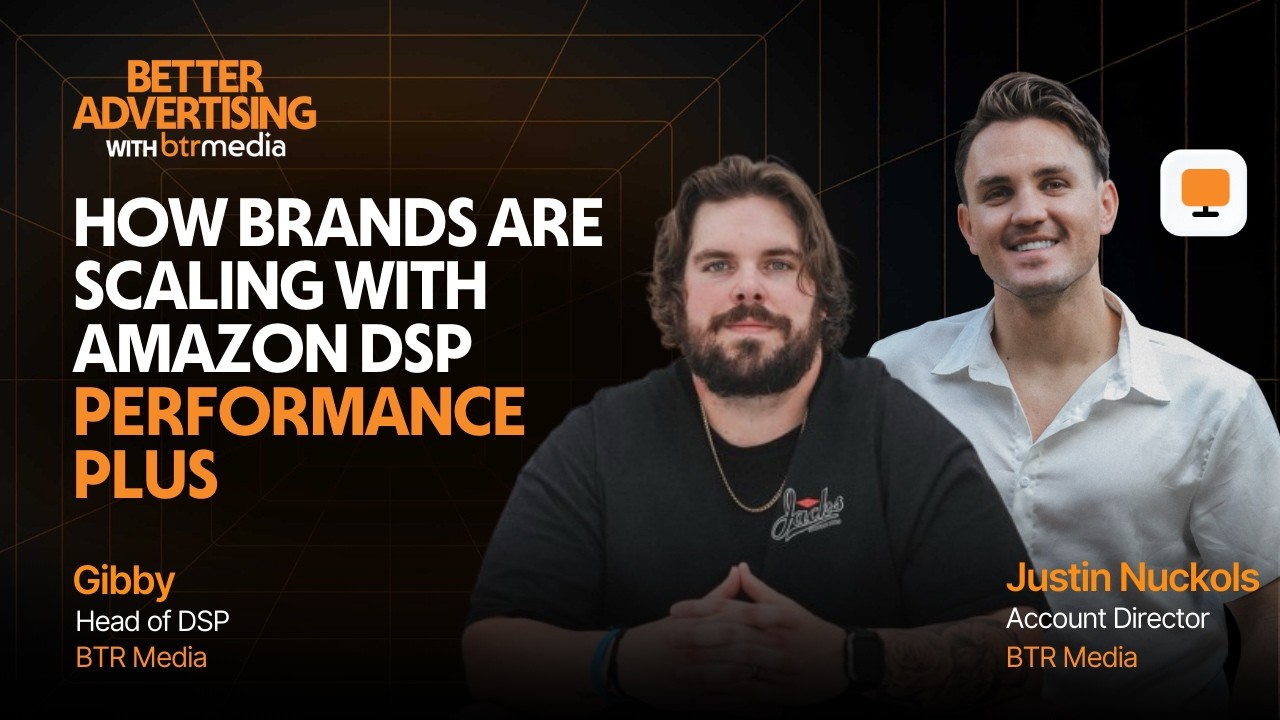
Today, I'm sitting alongside Gibby here from BTR Media and myself, my name is Justin. I'm an account director here at BTR Media. But before we get into the meat and potatoes of today's conversation, Gibby,
want to welcome you back into the podcast and intro yourself to everyone listening.
Speaker 2:
Yeah, like I said, my name's Gibby. First name's Austin. We covered that in one of the other podcasts, how I got the nickname. But it's essentially stuck for the last 10 years. But yeah, I'm the head of DSP here at BTR Media.
And I'm super excited to kind of dive into the topic that we're discussing today.
Speaker 1:
Yeah, so as you are our in-house DSP programmatic expert, not even just specific to Amazon, but all retail media networks at this point in time,
wanted to dive into Amazon's DSP programmatic offerings and specifically around Performance Plus, which I don't even want to call it a buzzword. It's just been a big topic around the DSP space for the last year or so.
And a lot of people may not even be using DSP. And I think Performance Plus is kind of a good place to dip your foot in the water if you're not already.
And that said, if anyone is looking for information as to what is DSP, how do I get started? We did an entire DSP series that you can go back into the vault on this podcast and check out some of those episodes. Great content to check out.
But today, again, we're gonna jump into specifically Performance Plus, which is a little bit newer to DSP and programmatic advertising, at least in the Amazon world. Gibby, before I let you kind of go on your spiel as to what this is,
why it's valuable X, Y, and Z, let's just give people the definition from Amazon as to what this is. So I'm gonna read this here from my screen.
From Amazon, in the fast-moving world of programmatic advertising, advertisers face increasing challenges in achieving advertising goals.
Key obstacles include proving return on investment amidst inconsistent data, operating efficiently under tight budgets, and integrating advanced technologies like artificial intelligence into advertising workflows.
Scaling campaigns without sacrificing performance while also maintaining transparency across platforms adds further complexity. These challenges often hinder the ability to maximize marketing potential.
Amazon DSP Performance Plus was designed to address these issues head-on. By leveraging AI-powered automation, actionable insights, and streamlined processes,
it empowers advertisers to overcome these barriers while delivering measurable improvements in campaign performance and efficiency. So, let's demystify that. What does that mean, Gibby?
Speaker 2:
Basically, what that means is that it is Amazon's new platform that is AI-driven, that helps you set up a DSP campaign from a customer acquisition standpoint or marketing standpoint or retention standpoint.
In a point and click model, so you're not wasting time researching your audiences. Amazon is taking into account the featured product within the order that you're going to be creating and looking at,
okay, if this is a customer acquisition tactic, where are shoppers coming from? Where are they most active when they search for products related to this product?
It's basically taking a look at all of their behavioral signals on Amazon, curating that specific audience. Excluding recent converters and then basically allowing you to show your ads to them either on Amazon O&O properties,
you know, Fire TV, Amazon Native, APD, or branching out to more third-party sites like, or inventory sites like OpenX, Share, through TripleLift and so on.
Speaker 1:
So what I'm hearing and I'm sure the average listener is hearing is this almost just sounds like the easy button for DSP, which that probably gets a bad rap to call it that,
but it really is like the easy button and does all of the heavy lifting for you. Is that fair?
Speaker 2:
It is fair. It is extremely simple. Like I said, it takes into account the ASIN that you're advertising and taking a look at everything that basically that ASIN touches from category to consumer.
So yes, it simplifies basically the manual 70-step process that DSP usually takes and that basically manual overhaul.
Speaker 1:
And many brands probably don't appreciate that because they're oftentimes not the ones hands-on in DSP. They're usually working with Amazon as a managed service or agencies like us. But a lot of advertisers, such as said agencies and Amazon,
can appreciate how much more simple this is in terms of structure, setup, and getting going. You know, I almost want to equate this to an auto campaign, which again,
that may raise a red flag to people and say, oh, we don't like automatic campaigns. We want to have precise control over what we're targeting, which is true and has a place, but shine a light on like the automatic nature of this,
which I think is actually really beautiful given all of Amazon's first party signals and data that they hold.
Speaker 2:
Yeah, and to share a light on it, you can think of it like an auto campaign, but what do you use auto campaigns for in search? Research.
That's basically what you can utilize these Performance Plus campaigns as because you can see different audiences, where they're coming from, where they're going to,
and then you can pull those out and then actually manually target those within in-market segments, lifestyle segments, and so on. But essentially, you know, Performance Plus is into three facets.
You have customer acquisition, remarketing, retention. Customer acquisition, all behavioral based. This is your top of funnel. These are going after new customers, excluding recent converters. Remarketing, it's like your bread and butter.
It's your added to carts but didn't check out. It's your product but didn't purchase. It's your, okay, hey, they viewed a couple of times, coming back, they purchased maybe six months ago and are coming back.
And, you know, that's more for like cost per or repeat purchase goods and so on. And then retention, just the subscription base. What's your goal with the retention strategy? Let's build up our active subscribers.
So we want to subscribe and save headline across those tactics. So while as an agency, it is a point and click model. It's easy to set up. It is an auto-campaign. You're also using it for research. You're not just setting it.
It's not just a set and forget. You're pulling out all the data. You're looking at, okay, hey, these tactics are working. This is driving incremental value. I'll kind of leave it there.
Speaker 1:
Yeah. And I think you hit on it at the beginning and at the end of your phrase there, but you know, you get all the insights from this targeting while you just see in the DSP console, customer acquisition, retention, remarketing tactics.
You can actually pull out the insights from that as like which specific lifestyle in market behavioral audiences you're targeting. You know, targeting and which ones are working.
And then, like you said, you can roll those into manual campaigns to have direct control on the budgeting, the bids, the placements.
So I think that's really awesome that Performance Plus has evolved to that point where it acts like our research tool.
Speaker 2:
Yeah, absolutely. You know, we've been out for a while, about a year, I would say. This is actually kind of the time frame that Performance Plus started coming out. And over probably the last three to six months,
it's just gradually gotten better and better as Amazon has adopted more AI capabilities, as they're starting to understand more of the consumer journey.
The reason why I really like Performance Plus is it's not just looking at just face value data. It's actually taking into account a lot of the data that you have to scour through AMC reports to dig into and understand.
It's pulling all that together to curate your audiences. It's not just going to be a set and forget audiences that never updates. It's going to update routinely over hours, days, weeks, months.
It's a great tool to definitely use to scale and scale efficiently.
Speaker 1:
Yeah, absolutely. And a lot of brands listening may say, okay, is this even right for me? Is there any instance you've seen introducing this Performance Plus to a brand and it didn't work?
Speaker 2:
Not yet.
Speaker 1:
Yeah, I can say the same. I know you have much more experience with Performance Plus than me, but at that point, I've never seen it not work for any brand. But like you mentioned, some brands may not want retention.
If you're a one-time purchase type product, you probably don't want to be putting money behind retention. But that said, pretty much everybody, customer acquisition and remarketing, I think is a great starting point.
Speaker 2:
Yeah, and then you hit it on the head. You have to understand your catalog. You have to understand the business or the brand. So, hey, maybe customer acquisition, if we're just focusing on upper funnel pool, let's just run that.
If we are more ROAS focused or more subscription-based focused, let's focus on our marketing and retention. Each one of these strategies is going to play into a key aspect of what you're trying to utilize DSP for. Yeah.
Speaker 1:
Yeah. And one thing I mentioned earlier, which I want to again, shine a light on, and I know we've done it a lot back in the DSP series we put out a while back, but again, Amazon is a data company.
They are a retail market, but at the end of the day, they're a data company. They have so many deep insights into their shoppers and the behaviors and shopping patterns of their They're viewers and customers.
So that said, I think this is a great place to tap into that first party data and lean on Amazon, who likely knows who's gonna purchase your product six months before they ever purchase your product.
And before they've even been brought into your funnel, they have the signals from your past purchasers, the behaviors and related categories, people that buy your product, shop within.
So I think it's a great way to tap into Amazon's genius and start using that targeting.
Speaker 2:
Yeah, absolutely. And I think, you know, one of the points that we haven't touched on yet, but is, okay, if we're just going to run Performance Plus, do we need to run, you know, general prospecting?
Do we need to run, you know, different AMC strategies? And the answer will always be yes. You want to have these strategies working in tandem. We actually see better brand momentum when we layer in, you know, general prospecting,
your contextual, your in-market audiences in line with your customer acquisition Performance Plus. So it's not just a, hey, we're just going to shift away from this strategy or shift away from,
you know, the tried and true tactics on DSP and only use Performance Plus. It's, hey,
this is another lever that we can pull that is going to help us scale and drive new to brand engagement and drive overall brand awareness across Amazon and, you know, different inventory sites that are linked back to Amazon.
Speaker 1:
100%. I think this is a great, you know, what is Performance Plus, but let's talk about like, How does it work? So, you know, is this strictly static images? Can we do videos? What does the creative side of Performance Plus look like?
Is it pretty similar to the manual side of DSP?
Speaker 2:
Pretty similar, and the strategies for Performance Plus are actually available through OLB and STV. So when you do go through and set up an order, you can actually, okay, hey, I want this to be an OLB specific order.
I want to track video completion rate. Great. You'll take a look at, you know, prospecting Performance Plus tactics that will be available for the OLB side of things.
So you're not just showing standard static responsive e-commerce images across Amazon native or showing custom assets across different 3P inventory sites.
You're actually able to utilize like a full funnel strategy with Performance Plus and layering in OLB and STV. So it's a great way to, all right, hey, we have a heavy budget this month.
Let's invest more in video to drive that overall brand awareness to engage consumers where they're not active on a static display side of things. So that's another key aspect of Performance Plus.
It's not just to the responsive e-commerce and static image side of DSP, but it's also to the video display side.
Speaker 1:
And I think you already hit it there in your answer, but again, placement-wise, this isn't just Amazon owned and operated properties, right?
We can go bid anywhere that DSP is capable of winning us placements, whether that's third-party exchanges or anywhere else, right?
Speaker 2:
Fire TV, Roku, you know, different three-piece sites that are linked back to Amazon. You know, the sky's the limit with inventory placements here.
Speaker 1:
So let's talk a little bit more about the reporting. Again, I know you, again, briefly touched on it earlier saying, hey, we can see which audiences are working and not working.
With your experience in Performance Plus, what other insights have you pulled from that reporting? That maybe informed your manual tactics.
Speaker 2:
Yeah. So one, you'll be able to see like an audience mix of, hey, this is where consumers are most active. And what you can do is you can pull that out and say, you feel like that doesn't directly correlate to the market that you're in.
Well, you can take that audience and kind of see like an overlap through audience insights and see, okay, hey, maybe these are more linked to what I'm selling and so on.
And then with Performance Plus, what I always like to look at is your typical KPIs that you look at by funnel. If we're looking at customer acquisition, the biggest drivers or indicators of, hey, this tactic is working is,
all right, what do new-to-brand sales look like? What does What does the click-through rate look like? What does brand search volume look like? How is our estimated cost changing? What does our cost to acquire those conversions look like?
So, you know, measures don't change significantly. You're still thinking of this as a tactic within the funnel. So you're still leaning into the base KPIs that you want to look at. But I think a key thing that kind of helps point to, hey,
where does Performance Plus lie and how can we actually quantify this is one, through the audience mix, you can pull those out. But two, always run your AMC reports, look at your Net New Reach reports.
Look at your path to conversion in line with these specific orders on the DSP side of things and how this is either enhancing conversion rates through sponsored products or leading directly to a purchase from just one scene,
one or two DSP ads. So, yeah, that's kind of how I look at reporting. Obviously, you know, there's a few different things that you're going to look at between the stages of the funnel.
So, you know, customer acquisition, you're not focused on ROAS, but when you get towards retention, maybe you're looking at ROAS, you're looking at cost to acquire new subscriptions and new subscription counts for marketing.
You know, you're looking at ROAS and sales changes. So, it all kind of works together and it all kind of relates back to, hey, this is what I optimize for in the more mid-funnel style tactics that I'm running. So.
Speaker 1:
And again, I appreciate you calling out that we measure each lever, I guess, we measure each And I'm here to talk about the next layer of Performance Plus by its appropriate KPI, whether that's retention versus customer acquisition.
So just wanted to call out again, Performance Plus can also integrate with the goal-based bidding. So as we set KPI targets for customer acquisition a little bit differently than remarketing and retention,
you can set those KPIs that then influence budgeting and bidding, which I think is awesome. A lot more control than just a basic automatic campaign.
So I almost want to dismiss that notion that it's a set it and forget it automatic campaign. You do truly have a lot of control over these campaigns as you go forward and test and learn and gather data.
Speaker 2:
Yeah, absolutely. It's like you said, there's a ton of different things that you're going to look at that you want to keep track of. So with auto campaigns, you use them for research.
We use these for research, but we're updating them constantly.
Speaker 1:
Yeah, and so I almost want to take this like a case study lens and say, can you think of any specific brand, not naming names that you've introduced this to and saw a noticeable pre and post impact in a positive way or even a negative way?
Speaker 2:
I'll lean into a positive one. You know, we started this, this tactic was brought to us very early of, you know, or well, late Q1 of 2025 when Performance Plus was kind of rolled out.
And ultimately it was, okay, hey, let's test 5k budget behind these. What changed? And, you know, through In our EMC reports, we were able to quantify, okay,
brand lift and brand awareness increased by, you know, 15, 20% month over month, just by a 5K investment early on. We'll now fast forward to this year and this, you know, March end of Q1,
2026, we've actually scaled our budget from about 40K a month to closing in on close to 150K this month.
With about 75% of that budget going to Performance Plus because every month we are seeing that incremental value being driven through customer acquisition and retention tactics. We're seeing our subscription count go up.
We're seeing our new-to-brand rate go up. We're seeing that we are actually driving value off of Amazon that is bringing in a ton of extra business that was not Initially available through like sponsored search or sponsored brands.
So that is one of the biggest things that we've seen. And that's, you know, the client is, you know, head over heels like, Hey, this, this is help scale our business almost a hundred percent year over year,
just by leaning into these tactics. And then ultimately utilizing some of the data points that we're seeing on DSP and relating it back to search. So that's one of the bigger success stories I've seen so far.
Speaker 1:
That's awesome. I think you very humbly alluded to it, but you know, this scaled out without cannibalizing any top line growth.
Like it truly drew, excuse me, it truly drove new to brand growth, customer acquisition and top line improvements. Is that fair to say?
Speaker 2:
It is fair to say.
Speaker 1:
Again, I think a lot of people think of automatic campaigns as I don't want to put money there. It's not going to do anything for me in the long run.
And we're here to talk to you about how you can scale out your business, other than research purposes. But like you're seeing with this case study, like you've scaled this out and you've seen meaningful growth to subscriber count,
top line revenue. And I think that's pretty impressive to call out here, that it's worth scaling out. It's not just a, let's set 10% of our budget to Performance Plus for learning purposes.
It's something that you can truly lean on with all of the granular controls we've talked about. And it can actually drive meaningful improvement to top line.
Speaker 2:
One of the ways to look at it is, okay, hey, if this is truly a growth driver that we want to look at, don't just stick to one facet of it, of Performance Plus. Don't just stick to the static side.
Utilize everything that's capable towards you because you're only going to continue to build up your brand awareness for different placements that you show up in.
Video is going to continue to drive that overall lift that maybe your brand does need. Static is going to be there to capture some of the demand that is falling through the funnel. I'm a huge, huge advocate for it.
Speaker 1:
And I wanna shift to a case study from my experience in which advertisers often come to us and those that have maybe been scared of testing DSP or maybe had a bad experience in the past. And so they're not full sending a budget onto DSP.
And so for example, a couple of months ago, we started working with a brand and just wanted to kind of dabble in DSP with smaller budgets. And given that, the way we like to build out DSP is very granular,
We can't spread that budget across so many strategies. And so I think this is a great alternative to that and allowed a lot of advertisers to come in and set limited budgets to see the proof.
We're here to help you with that limited budget and showing maybe a 5K budget monthly between a couple of products with Performance Plus only showed that we can scale this thing out.
And those same brands have now grown from maybe a 5 to 10K budget to close to 20, 30K. And so leaning on Performance Plus, I think gives a lot of brands the confidence to say, no, let's use Amazon signals. Let's use DSP programmatic.
And again, like we said, it's driving meaningful top line growth. It's not this cannibalizing tactic.
Speaker 2:
Yeah, it's not a fluff piece to say the least. It's definitely a growth engine that I've seen scale a lot of the brands that I'm working with and has opened up additional opportunities to say,
hey, DSP is actually driving meaningful growth for us and for our brand. Let's continue to scale where we can. And ultimately, it's just unlocking additional potential for them to expand what they're currently doing.
Speaker 1:
So we've been talking for a bit now on all the positives of DSP, Performance Plus, but let's maybe not say the negatives, but like what's a wishlist that you're maybe still hoping for,
looking for maybe more to come from Performance Plus, whether that's reporting or anything else.
Speaker 2:
Let's see, a couple of wishlist items that I do have for it are just like further exclusions rather than having to go through and add additional fail safes or additional exclusion points to certain tactics.
It's just, okay, hey, we have customer acquisition that is focused on that true upper funnel, new to brand growth. Rather than just excluding recent purchasers, let's exclude recent viewers to ensure that we are going after brand new,
net new customers. You know, obviously adding in maybe additional levers and changing kind of like remarketing, having it more siloed to just views and then having like an add to cart so you can actually see the difference between the two.
So I think it just more comes from, all right, hey, what other tactics can we kind of think of and theorize around that we can add in and utilize as an AI model via Performance Plus? That's kind of where I'm shifting.
And then maybe, you know, customer acquisition is more like mid, I would say mid to upper funnel. Maybe let's look at, you know, this is all directed at Amazon, so sorry.
But hey, let's look at like an awareness specific rather than just like a prospecting specific. So definitely a short list of what I would love to see, knowing that, hey, this is still a strong growth engine for us.
This is still scalable and an efficient scalable tactic, not just, hey, we're increasing our budget by 15K month over month, and we're just seeing impressions go up.
We're actually seeing the residual effects of continuing to invest in these strategies.
Speaker 1:
And who knows, maybe by the time this episode comes out, there's been all these improvements made. I feel like every week we're hopping into our BTR Media Slack and Gibby's posting, hey, here's a new update from Performance Plus.
So who knows, by the time this comes out, maybe all of our answers and hopes and prayers are, you know, solved. But that said, anything else to note on Performance Plus before we really put a bow on this, Gibby?
Speaker 2:
No, I think that's it.
Speaker 1:
Awesome. Well, again, thank you everyone for sticking around, listening to our conversation around Performance Plus. If you guys have any questions, be sure to hit up Gibby on LinkedIn.
He'd be happy to chat with you guys and answer any and all questions. And that said, if you guys are looking for an advertising partner to get this up and running for your brand, please reach out to BTR Media.
We'd be happy to see if we're a good fit and set something up for you guys. Again, thanks for listening to the podcast.
Be sure to subscribe wherever you're listening so you guys don't miss future content from us and have a great rest of your day and rest of your week, guys. Cheers.
This transcript page is part of the Billion Dollar Sellers Content Hub. Explore more content →