Ecom Podcast
His vibe coded app hit $55K MRR in 109 days (full breakdown)
Summary
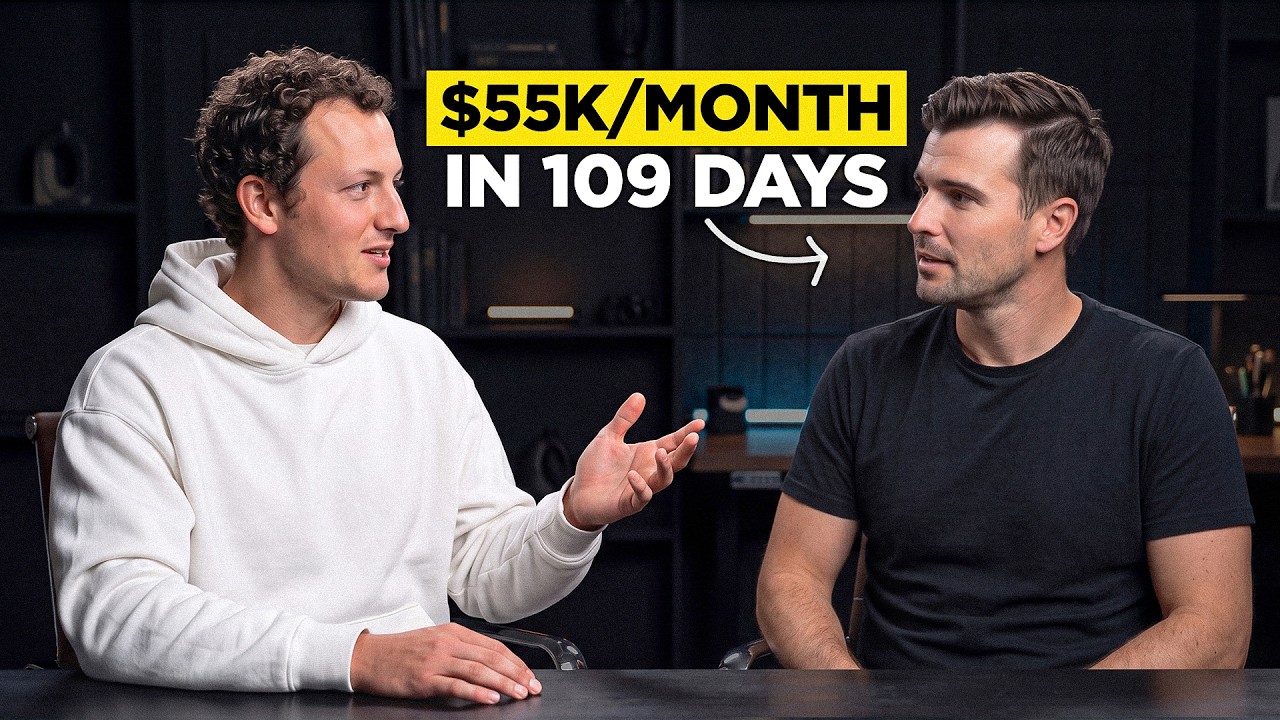
Ryan Matthews built a niche elk-calling app using Claude Code, achieving $55K MRR and over 3,000 customers in just 109 days, demonstrating the potential of vibe coding for rapid product development and market success without coding experience.
Full Content
His vibe coded app hit $55K MRR in 109 days (full breakdown)
Speaker 2:
We're about to hear from Ryan Matthews, who vibe coded this sick app in a niche that I never heard of, but it's making a ton of money. He's not a developer. He literally built this thing from scratch, I think using Claude Code.
And so he's going to show us what the idea is, how he built it, how he found clients, how he vibe coded the whole thing. And honestly, he's making a lot of money with it. So excited to hear all the details. Ryan,
do you want to just give us kind of like the elevator pitch on what somebody is going to learn if they stay till the end?
Speaker 1:
Yeah, so we got to about 3,000, I think it was actually a little bit more than that, 3,000, 3,500 customers in about 110 days from launching this thing. So grew this thing pretty fast.
It was literally just me with Claude Code, with Codex, building this app. I don't think I ever read a single line of code, which was pretty awesome. And yeah, so we'll go into the marketing, how we did it, how we built it, all of the sauce.
Speaker 2:
So for the people out there who say that like, oh, vibe coded products are trash or you can't make money with it or it can get you to an MVP, but you can't actually turn it into a production product. You're all wrong.
And Ryan's going to show us why. So let's let's jump in, man.
Speaker 1:
Sweet. Sounds good. Where should we start?
Speaker 2:
Let's just start from the beginning. How did you come up with this idea? Because this is super niche. I didn't even know this was a thing until you told me about it. Let's start there.
Speaker 1:
I guess I should explain what the product is. What I'm holding right here is an elk call, like E-L-K. Elk is an animal, if you don't know. I'm a big hunter. I have some antlers right there. When you hunt elk, you make calls.
I don't know if this will come through, but it sounds something like this.
Speaker 2:
Yeah, we can hear it.
Speaker 1:
So that's one type of call. There's other types of calls. But I wanted to learn how to do that better because elk hunting is extremely difficult. Like success rates are typically 10 to 20%.
You're trying to get within 50 yards typically of these animals that are on super high alert. So I've been hunting elk for five years and every year I've been super frustrated at my calling because I just like I couldn't quite get it down.
And I was lucky enough to have a friend who's also a client at our agency, Funnel Architecture, who is a world champion elk caller and he calls in like more elk than anybody every single year. And he was trying to teach me.
How to do the calls that he uses, but it just wasn't clicking. And I would send him a video and he'd give me some feedback and I'd feel bad. I wouldn't want to send another video. So I would try to figure it out.
And then every year I just wouldn't get it down. So earlier this year, actually I'll back up a little bit. A few years ago, I was playing with a different app from Cornell University called Merlin. And it's a bird identification app.
And it's basically you hit record on this app and it tells you like, oh, that was a crow or that was a barned owl or whatever, right?
And I had this app and I was using a similar call to this one to practice turkey calling and seeing if I could trick it into thinking I was a turkey, right? To know if I was doing it right. And about 10% of the time I could.
But as I was using this, I'm like, dude, somebody should make this for hunters where not only it tells you if you sound like it, but also how close you are and what you're doing wrong, right? Actual feedback.
But that was like, I think I was pre-ChatGPT when I had the idea. So I just was like, can't do anything about it. Somebody should. Earlier this year, elk season is coming up and I'm like, dude, I'm going to figure it out this year.
And I was literally brushing my teeth. I was like, let me actually ask Claude if I could build this. And I've been playing with Claude Code. You and I met at Greg Eisenberg's event in January, I think.
I've been playing with Claude Code after that, building things for my agency, building things personally. So I had a little bit more confidence and I asked Claude and it's like,
yeah, this is, you know, it was really overconfident, but it's like, we can definitely do this. So I started messing around with the app earlier this year because of that. And there was also some other things going on too.
I heard Peter Walls on, he was on MFM. He's the guy who does Starter Story. He said apps are the new info products, which I thought was really interesting. And he like mentioned a few different iOS apps like Kali Eye is an obvious one that,
what is it called? Puff Check. The one that, have you seen that one?
Speaker 2:
No, I'm not familiar.
Speaker 1:
It was like supposed to count how many times you've vaped in a day to like help people quit vaping, but that one got acquired. Yeah, it was like a pretty niche app, but that one got acquired.
And these are all like marketing heavy apps and that's my expertise. So anyways, that was kind of where the idea for the app came from.
Speaker 2:
Well, I love that it was just a, it was an idea that came from a problem that you really had and you were like, I bet a lot of other people have this problem.
I know how to use Claude Code, so I'm just going to build a solution that I would probably pay for, so most likely other people would pay for it too.
Speaker 1:
Yeah, and at the time I was listening to a lot of Jason Freed. You know Jason Freed?
Speaker 2:
Where's he from again? Okay, yeah, I was like that name sounds super familiar.
Speaker 1:
Yep. I like his philosophy a lot and that is kind of one of the core pieces of like build software that you want and then other people will want it too, right?
You don't need everybody to want it, but like there's some people who are like you, which is, yeah, that's definitely the perspective I came at it with.
Speaker 2:
Nice. I think it's smart. No, I think it makes perfect sense. Now it looks like the next kind of visual you have here. Is that like a how I built this? Like maybe the actual infrastructure you use?
Speaker 1:
Yeah, for sure. So I, like I, I started, I said briefly that Claude was a little bit overconfident in its ability. So my first idea was it was just gonna be like a generic app that scores, you know, I'll get into how that evolved.
Speaker 2:
And are you able to maybe even zoom in a little bit? Sorry.
Speaker 1:
Uh, I don't know. Will it let me zoom in here? I could do this. I think that's as much as you can let me. Is that better? Cool. Sounds good. So yeah, it was just gonna be like a generic scoring app.
And when I first started, I just gave it straight to Claude Code and it was just not working. And what I mean by not working, I think the problems we're running into is just the scoring was not anywhere close to accurate. So very quickly,
I ran into a wall with this where the constraint for just an average Joe to go build this was good data, right? So either data online is like, you know, copyrighted or whatever, like you can't just use random calls online,
or like free stuff had a lot of background noise because it's recorded in the wilderness. So, that's where it kind of clicked that the guy who had been trying to teach me how to elk call,
he's a two-time world champion elk caller and he also has tons of footage of elk. So, I called him like, hey, dude, I'm building this app. Do you want to be involved in it? He's like, whatever you need, man. Like, I got you.
So, he started providing some reference files. So, as we started building it, the first check was, can he get like 100 out of 100 or 95 out of 100 on this app, right? Because it's going to be scoring against him.
So, can we at least get that core functionality working? And I think we ran into a few issues with just using Claude Code. And a big unlock for me is I'd heard that Gemini came out with some new model,
I forget what it was, but it was trained on a lot more scientific research. So I was like, let me just go to this and just ask Gemini to do some deep research on this.
It came back with a plan of different machine learning models to use that Claude hadn't tried. I fed that back into Claude Code. And then from there, we had a big breakthrough on getting that initial scoring to work.
So that was the initial flow. I don't use Gemini much anymore, but in the beginning, that was super helpful. Now, pretty much everything is just built with Claude Code.
I do have this cool loop that I think is probably becoming more common now. You've probably seen this Codex and Claude Code connection. For those of you that haven't heard it, what I was doing, a friend of mine told me,
I have Codex review everything Claude built, right? Because it'll find things that Claude misses. Obviously, you're doing your security views, code reviews with the anthropic skills on Claude Code, but this will find even more things.
So I was literally, they both had access to my GitHub. I was pasting whatever Claude Code gave me into Codex and saying, review this. And I was pasting Codex's response back into Claude Code, which was super annoying.
Then I found out by just brain dumping to Claude one day, and this is like a common theme I've done. Whenever I get super frustrated with the workflow, I just tell my problems to Claude Code.
It recommended like, oh, there's a CLI that I can just do this for you. I can just send it to Codex. It will do the review and it'll give me the response. You don't have to do anything. And now it does that all the time.
So anytime it has a proposition for me, Before it tells me what it wants to do, it reviews it with Codex. If they both agree, I'm going to put a lot more stock in that.
Anytime it wants to ship something, it's going to run through its normal reviews and then it's going to review it with Codex, which it saves so many bugs.
I can't believe how often it's like, oh, Codex caught something that I would have missed.
Speaker 2:
That's so smart. Yeah, but especially if you're doing a lot of coding work. I mean, I think a lot of people know at this point that it's typically best practice to bounce the models off each other,
but this is just a really good example of that. So good stuff. Yeah, let's keep going.
Speaker 1:
Yeah. A couple other things that were very, very helpful and just Yeah, very, very helpful and I think where things are headed. First, every tool that we use inside of this business,
Claude must be able to like see the data and even act in it typically. So like now there's the meta ads MCP, so it can see everything going on meta. It uses resend for email so it can, you know, like I can just,
in Claude, Have it write the initial draft for an email, I'll revise it, and then it blasts it out to everybody. It can build email automations. It can query all of the data in Stripe or Postmark or whatever it needs to do.
So that has been a big, big advantage to just being able to move fast as one person and not having to go into a different tool. The more Claude can do on its own, with your supervision,
but like that it can actually go inside and do the better. The other thing that has been super helpful is to find skills. I love like if I think about where the best skills are being talked about, it's probably on X.
So, I love going to Grok and saying, hey, I have this problem. I'm struggling with this thing. What are the best skills people are talking about for this specific thing?
And then Grok can go and look at what people are talking about next and then recommend the ones that are getting the most traction, much more than the other models can that I've found. So, that has been super helpful for me.
Speaker 2:
Awesome. I love it. Well, I'm sure we'll talk about like how you actually found customers and your pricing. And yes, I see we've got marketing here. So let's dive into that.
Speaker 1:
Yeah. So the price point of this is $29 a month or $99 a year. That's the current pricing. I'll probably test different pricing, but that's the current pricing. The reason I did it that way is, I'll show you a graph of this in a second,
but elk season is really like 30 days of peak and really 15 days of like primo elk season because you only call them when the elk are what's called in the rut,
which means they're breeding, they're mating, and that's when they're very vocal and they're receptive to these calls. So like if you look at a Google search trends, like September is insane.
July's a little bit, June's a little bit, August is a little bit more, and then the rest of the year is basically like zero, right? So the demand is extremely seasonal. So I wanted to incentivize people to be on annual.
So it's basically the price of like three months. So that's the pricing. When I started this, I had a few ideas of how we were going to get customers.
Initially, I was like, we're just going to run meta ads and say, score your elk calls, basically. What we ended up doing once I got my friend who's the world champion involved.
He has a very like unique, what I would call contrarian way he calls elk. So there's like the traditional, you know, do this, right? Make these sounds. And he's like, that is biologically incorrect. The way I call elk is way more effective.
And you should call elk this way, right? If you want to call on more elk.
Speaker 2:
He's got the credibility for that to resonate with people who are scrolling to see their ad. Like, oh, this guy who's a world champion says to do it this way versus the way that I probably heard about it before.
I'm sure that was really effective from a marketing perspective because of his credibility.
Speaker 1:
Yes. If you read the comments, 50% of people are like, this is complete nonsense and 50% of people are like, this is amazing. What was cool after the season is we got a comment and somebody's like,
He's big on this call called the Distressed Calf Sequence. Somebody's like, this doesn't work. And literally we had customers respond in the comments like, dude, you are doing it wrong. I just called in 12 bulls last week with this.
Another guy comments, I just called in this bull. He has a picture of the bull he got. I just called in this bull. So it was cool at the end of the season to have our customers actually like vouching for us.
But yeah, that contrarian aspect like, I mean, if you think about Russell Brunson's new opportunity, right? This is like direct response 101. I can't tell you how well it fit into the mold, which wasn't even planned.
It's just as I started writing the copy, I was like, oh my goodness, this is just kind of perfect. Yeah, he has the credibility. He's a two-time world champion.
There's also, and actually what clicked for me on this was I have a friend who I was trying to tell, because Joel's been telling me this stuff for years, right? So I was telling my friend Ben, I'm like, Ben, you got to call like this.
You got to learn these calls. He's like, yeah, yeah, sounds good. Well, never learns it. Then one day, as I'm working on the app, he texts me. He's like, dude, like, I need to get these down. Like, what do you mean?
He's like, I just listened to Joel on a podcast and like, I can't believe how effective it is. I've been telling you this for years. So it clicked for me that when Joel tells it, he's a very good communicator. He has great stories.
Again, he hasn't been selling anything in this space for the last decade, but he's just a very good communicator. So he has these things that land in the same way that you'd put into a webinar script. That's how he communicates.
So that kind of clicked as well that I just need to get Joel in front of people and that is going to do a lot of the selling.
Speaker 2:
That's awesome. Yeah, that's super smart. And again, his credibility obviously is a big selling point. And you know your marketing is effective when 50% of people love it, 50% of people hate it. That's like the absolute sweet spot.
You don't want everybody to love it and you don't want everybody to hate it. You want to be in the middle.
Speaker 1:
Yeah, for sure. So that was super cool. It was also, it was novel, right? It was like a new idea. Nobody had a scoring system like this. Now, literally, and this is actually one of the reasons, you know,
you and I talked about doing this podcast a couple months ago. I was like, I don't know. I don't really want to like invite a bunch of competition. But then I realized like getting further into the industry,
All of the call companies are already like, they've seen this now. They're like, oh, we're going to build our own apps, right? So like the people that I actually should be, you know,
concerned about competing with are already going to do it. So I'm not really as worried about that now. But yeah, at the time it was super novel and it still is. It'll be, I'll be curious to see who gets in the game in the next few years.
But basically every big call company now wants to build their own app, which is interesting.
Speaker 2:
Well, especially after seeing the success that you guys have had, right? Now, can we talk about actual marketing tactics? Again, I know you ran a lot of meta ads.
I'm just curious as to how, especially those early customers, how did you bring in some of those early customers?
Speaker 1:
Yeah, so the first 50 we sent an email, maybe it was the first 40, we sent an email to Joel's list and it was just like, I'm working on this thing, here's what it is.
And we gave them, I forget what it was, but some like founding member discount. And that was good. We got some feedback and we also got more data to improve the scoring on. After that, once my friend mentioned that podcast,
it all clicked for me and I was like, oh man, I'm going to go very indirect with the marketing. I'm going to lead with education, not even mention the app in the ads, just mention Joel's methodology.
If you want to call an elk, stop doing everything you've been taught. Watch this video. We'll explain it all. So that was the idea. So we recorded this like 45 minute podcast style video, just going over like leading with proof,
you know, how many elk he called in last year, how many the year before that, etc. Handling objections going into like his strategy of calling elk and at the end it's like,
By the way, if you want to learn this, I kind of went over my story. You've been trying to teach me this for years. It's very hard to know if you're doing it right. It's very hard to know what to fix if you're not doing it right.
So we made this thing. It's called Mountain Whisperer, and you can get it below. So we recorded this video for the purpose of making it like a VSL on meta ads or add to this VSL. And I was like, what the heck, let's just post this on YouTube.
Joel has a YouTube channel. He normally gets like, he basically never posts, but he normally gets a couple thousand views. So I was like, maybe we'll get a couple customers from posting it. So we post this video on YouTube.
And I, you know, last year I worked with a couple of YouTube consultants that spent like 25 grand last year, just learning YouTube packaging and retention and all that. So I tried to edit it as best as I could.
And I tried to make the packaging, you know, what I thought would really work. And that video did not get 2,000 views. It got, I think it's 150,000 now, which is just bonkers. Yeah, it's been bonkers.
And I'll go to this next slide really quick because this dives into it a little bit. So 150,000 views. So that kind of opened up this like YouTube organic strategy. We posted, I think, four more videos.
The second best might have got 80, 70 or 80,000, I think. So we like just very, very lucky and good packaging and all that stuff. It was to the point where Joel was getting texts.
He's like, dude, I was just at this archery event in Montana or whatever, and everybody's talking about this podcast you did. It really became this industry buzz, which was just bonkers.
Speaker 2:
Yeah, that's crazy.
Speaker 1:
I forget who says it. I think I heard it from Amjad, the Repl.it CEO. I think he got it from somebody else. He said product market fit feels like stepping on a landmine.
Obviously, there's levels to this game, but it was pretty crazy just how much buzz it created. Again, that wasn't even because of the app. It was because of Joel's unique method that he had been saying for a decade,
but nobody Put the right packaging behind it.
Speaker 2:
I was going to say nobody packaged it correctly. That's the thing is like, and I've said this before too, is that you can have the best product in the world, but if you, if it's not, you know,
if the offer isn't optimal or if you haven't packaged it correctly or you don't know how to get it in front of the right people, then it doesn't matter.
Like somebody who's better at marketing and better packaging with an inferior product is going to make a hundred times more money than you.
So I think that speaks to your talent as A marketing professional and obviously the money you've invested to learn YouTube and then obviously that's the ROI that you got from that is that video absolutely blowing up.
So yeah, I just wanted to make that point. But no, please continue. This is this is really awesome.
Speaker 1:
Yeah. And then so after that, we we then did we basically created like an academy side of this app. So like, you know, it scores you, it coaches you, but then also like, here's how to make the sounds. And that was Joel teaching me in person.
And I was like, hey, Joel, I know this is part of the paid thing, but what do you think if we just literally give these videos away for free on YouTube and then make a call to action at the end?
Like, hey, now you know how, but the problem is still the same. Know if you're doing it right. So we did that. So it doubled as product content. As well as YouTube content. And I think our second best video came from that batch.
And then we also ran those videos as meta ads. We ran the full 45 minute long video as a meta ad. So yeah, that was the initial. I don't know how many customers came from YouTube.
I think probably 40% of our 3500 have come from YouTube and then probably 60% meta. And yeah, so that YouTube was the main was that The podcast we talked about and then the funnel there would go to test your first call.
And this idea actually came from my wife, I think, because I was explaining the app to her and what I wanted to build with it. And she's like, this sounds a lot like Duolingo. And I was like, oh, that's smart.
So I go to Duolingo, I go to their meta ads and figure out what are they doing, which is just my favorite strategy in the world. Who's successful with the closest marketing that I can model off of?
And their whole you know they have this like long. Onboarding sequence where you like test yourself. So you know, what level do you think you're at? Okay, try saying, Hola, right?
And it's like, it grades your accent grades, if you say it correctly. And then it like builds your curriculum. And it's like, hey, upgrade to pro right, right after all that, right after you have all this investment into the process.
Yeah, so we did that we have like a few questions in our onboarding sequence. Like, you know, what level are you? What's your goals? And then it has some tests, right? So it's like, Here's the call, blow your own call, right?
And they blow this call and they get this aha moment of like they see theirs over the reference, they get coaching feedback, they get a score, right? And then if they don't buy, that goes into an email automation of like,
you scored this, come back and improve, right? A few emails on the method, et cetera. And right after they get that score, a few seconds later, it pops up. It says keep calling with Mountain Whisperer Pro.
And then that takes them to a page where it's like $99 a year or $29 a month. They pick a plan, they go to Stripe. What was crazy, I have this out here somewhere.
I think it's, yeah, so about four in 10 people who test their call for free buy. We're trying to reproduce this now on Duck and we're still working on it, but yeah, it was like 40 to 50% of people buy after they get that aha moment,
which was pretty sweet. That was great. And then 52% of people chose annual. It was actually higher in the beginning. The closer we got to season, the less it dropped off. In the beginning, it was like 85%, which was great.
We have a 30-day no questions asked money back guarantee. Only got about 1.8% of people asking for a refund, which was cool. And yeah, so that was the funnel. You want to dive into meta ads?
Speaker 2:
Yeah. Again, I'm curious how you scale this because, again, it makes sense. First of all, I know there's going to be people in the comments or in the audience who are like,
oh, well, it was easy for them because your partner already had a list and he was already in that space. Of course, people will come up with any excuse in the world, but it's like, okay, well, let's assume that we didn't have that.
How do we scale it with no social media or personal brand or anything like that? I think ads are Typically the best way to do that. Partially because I want to learn how to run ads effectively.
So I want to hear your strategy around meta ads and kind of how you guys approach that.
Speaker 1:
For sure. And yeah, it's hard to obviously say where this would have been without Joel, right? It definitely wouldn't be where it was. I'll say that.
But there was some interesting marketing that we did that didn't really have much to do with Joel, which was, you know, towards the end of the season, that was actually became our best ad. So I'll go into that in a second.
So my first question is from first principles, I was trying to think like, okay, what, what happened on YouTube? Like YouTube was obviously super successful with that 45 minute lesson. So like, how do I reproduce that?
Because as I was, you know, launching the campaign, the first couple of campaigns were not working. I was not getting sales. So I just try to make it as similar as my, okay, on YouTube,
they see the thumbnail, they click on the thumbnail, they watch the video. And then I looked at the retention, like, okay, this many people made it.
Then we got, you know, in the beginning, the only customers we were getting were from that video. So I could see like, okay, this was the purchase rate, et cetera. So I've tried to make the ad as similar as possible.
Like ad goes to a page with just the video. CTA is delayed until they get to the, you know, or maybe it was like five minutes or something. So CTA is delayed and then it goes to the landing page just like it would on YouTube.
So I made the flow exactly the same. And that worked pretty well. In the beginning, I wasn't optimizing based on purchases in Meta because we weren't going to get enough because I was only spending, I don't know, 50 or 100 bucks a day.
So what I optimized for instead that worked pretty well was in Vitalytics, which I recommend Vitalytics in general for video hosting,
but they also have a feature where you can pass back view retention or like how long people stay on the video to Meta. So I could tell Metta this person watched 75% of the video.
Speaker 2:
You could retarget them?
Speaker 1:
Well, not even retarget. I could optimize based on that. So we fed that back in and we told Metta, find us people who are going to watch 75% of this 45-minute long video, which is like 30-something minutes.
And that was basically right when the CTA came up because that was the closest I could get to purchase intent at the time. And it found us people for $1.50 to watch like 35 minutes of this video, which was insane.
Speaker 2:
That's insane. That's crazy.
Speaker 1:
So that was profitable. That's when we first started getting profitable customers, day one, right? I was fully prepared to have a CAC payback, customer acquisition cost payback period of three months, right?
Speaker 2:
Yeah, because you think about a $29 a month product or even at $99 a year, I mean, customer acquisition costs. And B2C SaaS, I'm assuming is like much higher than $29 or even $99. Right.
Speaker 1:
So I was fully expecting that. So when we were profitable, like we were about 2x at this point, I think, when we were literally like we're spending a dollar making back two, I was like.
Speaker 2:
And your costs are nothing, right? Like what are your, what's your overhead at this point?
Speaker 1:
I mean, ads was definitely the biggest one. That's not only overhead, but ads.
Speaker 2:
Yeah. Aside from, I'd say aside from ad spend, like fixed overhead.
Speaker 1:
Yeah. Fixed overhead, overhead, basically nothing. I mean, there there's software expenses, but it's, it's so nominal. It does, it grows, you know, like. At .01% of, you know, whatever your total revenue, like it's basically nothing.
Like Railway, Vercel, Superbase, but these, they're so minimal compared to the revenue you can generate. So yeah, basically no overhead. So we're making back $2 for every dollar we spend.
Once I got to $5 a day, I was like, oh, I should launch a retargeting campaign. So I go and I launch a retargeting campaign. I title it Retargeting Website Visitors and I make the audience, anybody who's viewed the website, retarget them.
I do this one straight to landing page because they've already seen the video in my mind. Why would I go back to the video? So I go direct to the product page and I'm not very surprised.
It starts getting customers even cheaper than the main campaign. Actually, I think the main campaign maybe was like 1.5X or something like that. Then as I was scaling it, it was kind of going down. I do this retargeting campaign.
It's like 2x, but it's like 20 bucks a day. I'm like, oh, great. Let me go to 40. I'm pretty nervous. I don't want to break it. Let me go to 60. Let me go to 80, and I keep bumping it.
Well, pretty soon, the retargeting campaign, I was spending as much as the main campaign. I'm like, dude, this doesn't make any sense. So I was telling a client, I was like, you got to launch one of these retargeting campaigns.
These things are great. He's like, can you send me a loom on how you set it up? I'm like, yeah, sure. So I go and I'm like looking at the targeting of how I set this thing up and I'm like, oh.
I forgot to save the targeting in this meta campaign. So it wasn't retargeting. It was no targeting.
Speaker 2:
It was like net new. Oh, so you're saying it wasn't targeting anybody at all. It was just like a free-for-all?
Speaker 1:
It was just free-for-all, which that's how the other campaign was set up too, because now with Andromeda, the idea is like just your copy is the targeting. Meta will figure out who to target. You don't need to tell them who to target.
They can do it better than you can. So, it was just completely cold. But then the aha moment was like, dude, I thought we had to send people this 45-minute long video to get them warmed up. Turns out,
an ad direct to landing page where then they can just test the call and remove all that friction was way better. And I think that's when we officially got to like 2x, maybe a little bit better at low scale.
So, then I was like, okay, now I can really scale this campaign because I realized it was just cold audience. So, that direct approach This is what we really scaled, and we did a variety of ads. Some were very heavy on Joel's method.
It's like, if you want to call an elk, stop doing the traditional method. Do this instead with proof and all the stuff you'd expect. And then again, getting to the CTA, it's like knowing the method isn't enough.
You need to make sure you're doing the calls right. That's why we built this app. Check it out. You can score your first call for free. Then we'd also do some direct ones, where when I say direct,
I just mean like straight to the point of what the product is, where it'd be a video of me and this is what I mentioned earlier that was like not as much involving Joel. And this is what really worked well towards the end.
It would just be a video of me and I would like be doing the call and that would be kind of the hook because it's kind of weird seeing some, you know, guy in video doing a call.
And then I would turn my phone around, I'd say that was whatever call, and I just got a 70 out of 100 on Mountain Whisperer. Mountain Whisperer scores your calls against...
Speaker 2:
It's almost like a UGC style ad, but you're the user in that case.
Speaker 1:
Yeah, exactly. And at the same CTA, you can score your first call for free. And those worked really, really well. So that direct approach worked well. But yeah, so we had a few different variations there.
And then we were just kind of creating more creative every week. Some of the some of the videos were just videos of Joel calling in bulls. Some of them were, you know, static images with some text that Claude made a variety of things,
but everything was working pretty well, honestly.
Speaker 2:
That is crazy. So that's also really cool to know, mainly for me, because I don't have any paid ads experience and it's always been intimidating to me as far as the idea of learning paid ads.
But I remember when we were working with you a couple of months ago, some of the feedback you gave us was like, dude, just learn paid ads. At this point, It's not that hard to learn, especially with Andromeda, like you said.
I mean, Meta kind of does the targeting for you. It's more so building the creative and testing and tweaking, more so than being a paid ads expert at this point. So I think that's just a really good feedback for the audience.
If you're listening to this and you've got any sort of product, especially a higher ticket product,
start experimenting with paid ads because you can probably Get some clients on the hook a lot quicker than you would just like making content from scratch.
If you have like no audience to start from or, you know, versus some of these other colder methods. Now, so Ryan, are you open to sharing? Like what is your, how much are you guys spending on, on ads today per day?
And what's your current MRR? Like, are you willing to share that?
Speaker 1:
Yeah, I don't, I haven't checked the current MRR for a bit. Our annual runway, we've got up to 650. So that works out to be.
Speaker 2:
So 55K MRR in what, three months, three and a half months?
Speaker 1:
Yeah, we got there in 110 days or something like that. Wow. So what's interesting though about the business is like I mentioned, we launched in June with kind of the beta founding member thing.
July picks up a little bit, but then it's really August, September. It's like 60 days of peak. We're building out other species, so we just added duck, and that gives you October through January,
but we're still working on scoring, coaching, all that stuff. Goose is a similar season as well, and then you can do turkey. Which kind of comes right after those two, but then summer will always kind of be a dead zone up until about,
again, really right around June, practice picks back up. So hopefully that keeps customer acquisition through the whole year more consistent.
And then hopefully that helps churn because the problem we're running into now is if somebody subscribed for, you know, on monthly in September, why would they stay for the rest of the year if they're only hunting elk?
They'll just come back next summer and practice again. So I do think having worked with people that have very seasonal, like I have a client who has a similar type product, subscription product in the Madden space, like the video game.
Speaker 2:
Oh, yeah. Yeah.
Speaker 1:
And that's very seasonal because like the new game comes out, everybody wants to practice. And then, you know, once the Super Bowl happens, like people forget about it for six months. And he actually was talking to Hermosi about it.
And he was talking about churn.
And he has an interesting metric where like I want to say it's like 50% of his new customers every month have been a customer in the past to the point where one of his customers last time we checked had come back 14 times or something stupid.
Speaker 2:
That's insane. So they just join. When Madden comes out, stay for a month or two, churn, and then literally come back next year when the next game comes out. That's crazy.
Speaker 1:
Hermosy called it, which I thought this was clever. Hermosy separates recurring and reoccurring. Recurring is like a subscription. Reoccurring is like...
Speaker 2:
They just come back again and again.
Speaker 1:
Yeah, Coca-Cola, right? You keep buying more. So you said you have a reoccurring recurring business, right? Churn rate might not be the best way to measure that because they keep coming back. It's not even true churn.
We're trying to work through that. To answer your question about ad spend, we got up to $2,200 a day in ad spend towards end of September. Then somewhere in that last week or so of September,
you could just see CAC rising because demand is going away. They're done. So now we're still spending a little bit on elk but not much. Trying to get duck and then hopefully we'll get duck back up to that point.
And then we'll keep, you know, do the same thing with goose and turkey. And hopefully next year an elk I can spend a lot more than $2,200 a day. Because now... I think I'll be a little more risky early August, September. It was so easy.
Speaker 2:
You were figuring it out on the fly this season. You basically launched right before the busy season. You were figuring out all of it. And so come next year's season, you'll have a whole year of data behind you to be way more aggressive.
And I really like the idea that you guys are adding duck, goose and turkey, because obviously those are different seasons and that'll really help you smooth out some of the seasonality, as you said.
So, I mean, dude, what's crazy to me is that you guys built this to, like you said, what, almost 55K MRR in three and a half months. I mean, you could probably sell this today for, I mean, hundreds of thousands of dollars easily.
Speaker 1:
In September, we did one, I don't want to give a wrong number, but I think we did 130 in revenue. The 650 is annualized, right? So that takes a $99 subscription and spreads $8 across 12 months.
So September was like 100 and something, I forget. And we spent 30, I want to say we spent like a little bit under 40 count ads that month. So it was a super profitable month.
Speaker 2:
Yeah. And I mean, I'm assuming, again, you don't have to give details if you don't want, but like I'm assuming you guys are probably 50-50 partners.
So the profit that you guys are making on this is exponential compared to most businesses you could start in a three or four month period, which is why it's so impressive to me.
And again, I think it just highlights the fact that Anybody that has initiative and that has a niche need like this, that they're like, hey,
somebody should build that or somebody should turn that into an app or somebody should turn that into a SaaS or whatever. There's plenty of ideas like that still out there for the taking. The reason you guys are winning is on execution.
I'm willing to bet you guys are not the first people to try that exact idea.
Speaker 1:
Yeah, we're not. I thought we were, but I've heard so many examples.
Speaker 2:
You partnered with the right guy. You're the marketing mind. He's the credibility and the face. Again, for the people watching this that are going to use that as an excuse, if you're a builder, go find a marketer.
If you're a marketer, go find either a builder or somebody to be the face of it. It's not that hard. It's not easy, but it's not hard.
Speaker 1:
Yeah, for sure. The next challenge, I'm in that right now. I have a little more credibility because we can point to the success, but we're trying to... Joel, he's won a couple state championships for Duck, but he's not as well known for Duck.
So we're doing that currently, but probably we'll have another person there as well. Yeah, we need a duck guy, a goose guy, and a turkey guy.
Speaker 2:
Which is crazy to just say out loud. Well, the turkey guy, you know.
Speaker 1:
They're hard to get, man.
Speaker 2:
No, I believe it. I believe it. Yeah.
Speaker 1:
They're just, you know, they're like guys that just, they want to hunt every day. And you're coming at them and you're like, you want to make some money? And they're like, I don't know. It's just, we're working through it.
But we've talked to some of the best, the best of the best in the space. We're trying to land something, but yeah.
Speaker 2:
Well, it's because those guys, the reason they want money is so that they can go and hunt. And if they already just hunt all day anyways, then more money to them is like useless. They're like, well, what?
So I make more money so that I can go do more of what I already do? Like, no thanks.
Speaker 1:
Right.
Speaker 2:
But dude, this has been awesome. Is there anything else you want to share with anybody who... Maybe they've got an idea for an app or a SaaS, they want a vibe code or they're just kind of getting started on their journey and they,
you know, this resonates with them, but maybe they're kind of stuck on where to go next. Do you have any feedback for that person?
Speaker 1:
Yeah. I mean, if I follow my own, I'll give a few tips on like the more technical side of building, you know, with these tools. The big thing, like I mentioned, was like, you just got to start.
So when I left Greg's event, I don't even remember what I was working on, but I just started building stuff. For myself building stuff for clients and that gave me confidence.
I started teaching me and I was watching different YouTube videos You know on how to use the tools like but when I was at Greg's event You guys are talking about the terminal you're talking about Claude code.
Like I was like, what are you guys talking about?
Speaker 2:
Yeah, it was intimidating.
Speaker 1:
That was ten months ago, you know, right? Um, so you just got to kind of dive in and start learning it the other thing too is The models are great, but it's still, and I think this is becoming less and less of a thing,
but I still have to steer it a lot. I still have to give it great UI, UX suggestions and inspiration. Literally just yesterday, I was trying to improve the scoring on Duck.
I had to kind of hit a wall with it and I was asking Claude and this is just one of my things I like doing is like, you've heard the expression who not how, right?
I think one of the downsides of building like this with AI is we like get too much in the how mode, right? Just like keep running after it. But I backed up like who has solved this problem before, right?
And it mentioned like, oh, well, the guy that made the Merlin app, the one that gave me the idea, he does consulting work. I'm like, oh.
Speaker 2:
Easy money. Take my money. Yes.
Speaker 1:
So I go and I'm like, I reach out to him and he hasn't responded yet. But as I'm on his site, he has this hour long video he did at some university called the challenges of,
I think it was like the challenges of making Merlin scoring work or something like that.
Speaker 2:
Oh, crazy. Like super relevant to what you're doing.
Speaker 1:
An hour long video. So I gave it to Claude Code. I'm like, can you get the transcript for this to see if anything's like relevant to, you know, what we're working on?
And it's like, oh man, it said the biggest improvement he got is from this thing, right? And I'm like, run the experiment. So Claude Code goes off for six hours, you know, does this experiment on 6000 calls,
and it comes back and it's like, yeah, we actually reproduced basically the exact same thing he said. And, you know, like, I can now go and do this experiment. So just like Taking a step back, looking at it, you know,
just like the same way you'd solve any other problem, I think is helpful. The other thing I found super helpful, and this I think is more technical than just like a bit,
you know, like if you were building, I don't know what people are vibe coding, but like, you know, Puff Check or whatever the app is. That's I could be wrong but like that seems a little easier.
It's just like a database right with like counting how many times you've vaped. This is like hasn't hadn't really been done before. And you're using these like heavy machine learning models and all that.
I would ask it like when it would hit a wall, meaning like we have a data set. So, Joel grades these hundreds of calls manually and then we're trying to get a scoring engine to match what he's doing.
So, that's one of the core aspects of the product. Well, when it would run into a wall, we just can't match them. It wasn't matching them. It was like a coin flip. So, that's not a good product.
When I would ask it, I heard Elon Musk, he always is attacking the limiting factor. Asking Claude Code, what's the limiting factor here? Why can't we do this? We're not defining physics. What's the bottleneck? What's the constraint?
Then it would tell you, oh, it's a data problem. We probably need 10 times more of the data set. All right, well, let's just go get that rather than running in circles together trying to fix something that we can't fix.
So the same way you solve any other problem I think is what you solve here. I am, and this is maybe I guess my pitch to the audience,
I am looking for like a really competent developer I think to take it to the next level as we're expanding into more species. I think we're out of the stage of just like building purely with AI.
I think a competent developer building purely with AI is what we need.
And we're also looking at hiring like some people that are really like that guy that built the Merlin app consultants to come in and kind of give us strategic advice on some of the bigger things in the app to make it that much better.
So it was great to like building alone to get this to this point. But I think to take the product to the next level, I want to bring on some some excellent people.
Speaker 2:
Well, I wish I would have known that because we've got I mean, there's literally four people that come to mind immediately from inside AI Operator Academy.
We've got So obviously our community is mainly for non-technical people who want to make money with AI, but we, funny enough, have a ton of very experienced developers that join.
I'll introduce you to two of them right after this call that I think would be a perfect fit for what you're looking for. That said, if anybody listening to this in the audience is like, oh, I'd love to entertain that opportunity,
definitely reach out to Ryan. His contact information and his social information in the description below. I'm sure we'll probably collab with his channel on this video as well on YouTube.
So like you can literally just scroll up and click into his channel. But dude, really good advice. And I think the one point I want to highlight that you make is,
and Hermosi says this all the time, is just getting clear on the problem to be solved. I run into this issue all the time where I'm talking to somebody or a business partner, or we're just even at like a mastermind,
and we're trying to give somebody feedback or advice on something in their business. And then We look up 15 minutes later and it's like, well, what are we actually solving for? What is the actual problem that we're trying to solve?
And just by re-asking that question, it forces everybody to get super clear on what is the constraint. And then oftentimes we can answer the question within the next two minutes. I think that's good feedback for the audience.
You know, when you're working through a problem, always go back to what's the problem we're trying to solve and attack that constraint. So, Ryan, this has been so good, dude. I've enjoyed it.
Where can people follow you and where can people get Mountain Whisperer?
Speaker 1:
Follow me, I'm pretty much just on YouTube. Mountain Whisperer has an Instagram account, but for Ryan Matthews, it's just YouTube and that's more like marketing stuff. And then Mountain Whisperer, it's M-T-N-W-I-S-P-R.
It's on the App Store, but it's like to join, it's only on, you join on web and then you can like log in on the App Store or just use it on the web.
Speaker 2:
Got it. And of course, we'll link to all of that in the description and in the show notes. So, Ryan, thank you so much for your time and for everybody in the audience. We will be back here within the next couple of days, as we always are.
Thanks, guys.
Speaker 1:
See ya.
This transcript page is part of the Billion Dollar Sellers Content Hub. Explore more content →