YouTube
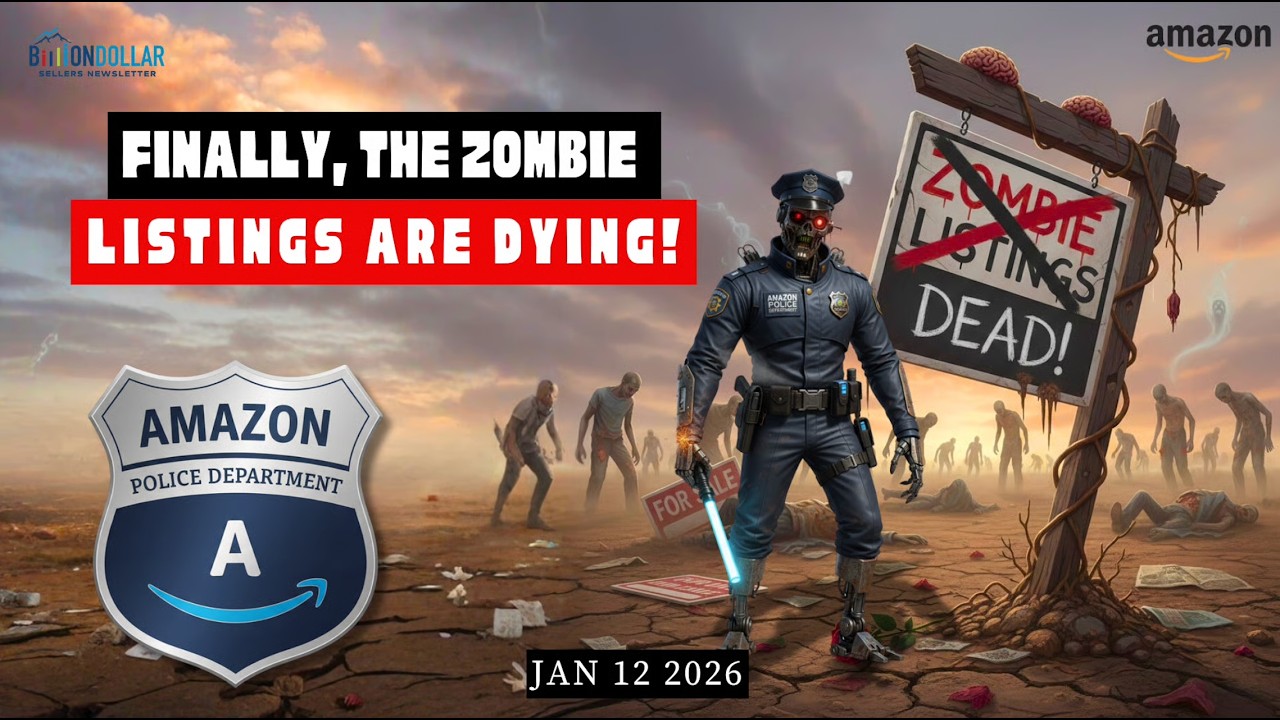
Finally, the zombie listings are dying!
Summary
Finally, the zombie listings are dying! - Date: January 12th, 2026 Summary: Kevin King discusses Amazon's major review policy change that wil...
Transcript
This This is the Billiondollar Sellers podcast, your go-to source for cutting edge strategies and success stories from the world of Amazon and e-commerce. Buckle up and get ready to take your Amazon business to new heights. Don't forget to subscribe to the Billiondoll Sellers Newsletter. Welcome your host. >> Welcome your host, Kevin King. >> Hey everyone, welcome to the Billiondollar Sellers podcast. I'm your host, Kevin King, and today is Monday, January 12th, 2026. We've got a lot to cover, so let's jump right in. But before we do, I want to let you know about something happening this Thursday inside the billiondoll Sellers Club. Anthony Kofanesco is joining us for the January brain crusher session. Anthony will show you proven ways to use AI to boost your Amazon conversion rates, plus some other cool tricks he has up his sleeve. That's Thursday, January 15th from 1:00 p.m. to 2:30 p.m. Central. If you're interested in joining us, there's a link in the show notes. Now, I've got a question for you. In 2024, the average cost per click for an ad on Amazon was 98. So, in 2025, what did the average cost per click go up to? Think about it. I'll give you the answer at the end of the show. Speaking of AI, BDSS13 virtual is just 8 days away and it's all online, so no travel necessary. We've got 21 top speakers all focused on AI for e-commerce tactics and strategies from creating images to listing optimization to crushing it with PPC using AI and much more. You can see the full schedule and grab your ticket using the link in the show notes. There are two ways to join us. You can secure your ticket directly and there's a replay option too or you can join the billiond dollar sellers club for $9 and get a free live ticket. I'll see you on Tuesday, January 20th. And if you can't attend live, there's an option to get the recordings. Now, let's talk about a big change that's coming. Finally, the zombie listings are dying. Starting February 12th, Amazon is fundamentally changing how custom reviews are shared across product variations, and this could immediately impact the review counts visible on your listings. So, what's changing? Right now, all reviews are pulled together if you have a pair listing with multiple variations. For example, if you sell wireless earbuds in black, white, and blue, each with 30 reviews, shopper see 90 total reviews, regardless of which color they're viewing. That's about to change. Going forward, reviews will only be shared when variations represent the same core product with minor cosmetic differences. If a variation changes how the product performs, feels, or functions, those reviews will be separated into distinct pools. Then we break down when reviews will still be shared. Uh, Amazon will carry on pooling reviews for color or pattern differences, uh, like a black yoga mat versus a purple yoga mat. They'll also continue pooling for size variations with identical function, like twin bedding versus queen bedding. A three-pack of resistance bands will share reviews with a five-pack since it's the same product, but different quantity. Secondary scents on non-scent products will share reviews like lavender dish soap versus unscented dish soap, but reviews will be separated for variations with meaningful differences. This includes performance specifications of the Bluetooth speaker with a 10hour battery over a 20our battery. Plus, products made from different materials will be separated like a stainless steel water bottle versus a plastic one. Finally, platform or compatibility differences will be separated like a deeming headset for PlayStation versus Xbox. Let me give you a real world example. Imagine that you sell chef's knives and some are 6 in and others are 8 in and some have red handles and others have black handles. may share reviews, but a ceramic knife versus a stainless steel one would have reviews separated. So, what does this mean for your business? The good news is this eliminates one of the oldest black hat tactics on Amazon, where sellers would add completely unrelated products to old listings with thousands of reviews for instant fraudulent social proof. The reality check is that if you sell products where variations seem similar but affect the customer experience like supplement flavors, candle scents, or products with different material compositions, you might see your review count drop significantly overnight. Here's a timeline and action steps. This rolls out gradually by category from February 12th to May 31st. You'll get a 30-day email warning before changes affect your products. Right now, you should review your variation structure and manage all inventory. Make sure your variation themes accurately reflect actual product differences. And you should also fix any mismatched attributes. For example, don't use a quantity variation for color differences. And if you restructure variations correctly after the change, eligible reviews can be reshared. The bottom line is this isn't Amazon punishing sellers. It's about showing reviews that actually apply to the specific product they're buying. The goal is increasing customer trust and reducing returns. But make no mistake, some listings will wake up with dramatically different review counts. Now is the time to audit your catalog and ensure your variations are structured correctly. Let's now move on to some interesting stats. Looking at share of global e-commerce sales by country among the 10 largest markets, China leads with just over 39% followed closely by the United States at about 38%. Japan comes in third at just under 6% with the United Kingdom at 4% and Germany at about 3%. South Korea rounds out the major players at just over 2% with other countries making up the remaining 7.7%. I've got a full graphic in the written version of today's podcast and you can find a link to that in the show notes. Now, let's talk about a potential acquisition that could shake up the e-commerce landscape. Open AAI is reportedly in talks to acquire Pinterest for around $17 billion according to uh an article published by the information. Neither company is confirmed, but Pinterest stock jumped 3% on the news. So, why does this matter for e-commerce? OpenAI isn't just building chat bots anymore. They're building a shopping ecosystem. Pinterest would give Open AI three critical assets. They would get over 200 billion labeled images showing real purchase intent. Things like gift ideas and kitchen remodels. They also get established ad infrastructure built for searchdriven shopping. And they'd gain direct connections to merchants that could plug into GPT's emerging commerce features. This is OpenAI's answer to Google's dominance in product discovery. While Gemini uses Google search results, OpenAI will leverage Pinterest visual search gold mine. The endgame is AI that doesn't just recommend products, it completes the entire purchase journey. So, what's the impact on sellers? If this deal closes, expect Chat GPT to become a serious product discovery channel. We're talking AI generated shopping recommendations that look like Pinterest pins, voice and visual search that connects directly to merchants, and a new battlefield for product visibility beyond Amazon and Google. It's another signal that AI powered shopping channels are no longer future tech. They're arriving now and they come in for market share. The companies who own distribution will win and Open AI clearly knows this. Now for the BDSN software tool of the day. Affiliatefinder.ai helps Amazon sellers quickly build a pipeline of influencers and affiliate partners who already create content around their niche so they can drive external traffic and sales with far less manual prospecting. It's an unfair discovery engine that replaces more than 20 hours a week of manual Google, YouTube, and social searching with a single keyword-driven workflow. It finds creators like bloggers, YouTubers, Tik Tockers, and Instagram influencers who are already talking about your product category or keywords. So, you're not pitching cold or misaligned influencers. It surfaces perfect fit affiliates with evidence of real audience, engagement, and sales potential instead of generic influencer lists. It finds contact details so you can move straight into outreach and plug them into your existing CRM or email tools. You enter a seed keyword like collagen supplements or ergonomic office chair and get a curated list of creators actively covering those topics. Then you filter and short list prospects whose content style, platform, and audience match your target customer. You can run recurring searches for seasonal or trimbased angles like back to school desk setup to continuously feed your affiliate pipeline. You can find a link to affiliatefinder.ai in the show notes. Now, let's talk about another major development in AI commerce. Google and Walmart just announced a major integration that brings the retailers full inventory directly into Gemini, marking another significant shift toward AI first commerce. You'll hear the latest on Aentic e-commerce. Don't miss Scott Mingo's talk at BSS 13 virtual next week. Scott founded a company which became Goto, and that's what Google Ads is based on. And later, he founded Channel Advisor. Starting soon, Gemini users can discover and purchase Walmart and Sam's Club products without leaving the AI interface. Ask Gemini for camping gear recommendations, and it'll surface relevant items from Walmart's catalog, complete with pricing and availability. The integration goes beyond basic product search. Walmart customers can link their account and get personalized recommendations based on purchase history, seamless cart integration across platforms, and full access to Walmart Plus and Sam's Club membership benefits. and it's all within the Gemini conversation. Incoming Walmart CEO John Furer said, "The transition from traditional web or app search to agent commerce represents the next great evolution in retail. The partnership leverages Google's universal commerce protocol, an open standard designed to enable what they're calling Agentic Commerce. AI assistants handle the entire shopping journey from discovery to purchase. Walmart maintains its competitive edge with rapid fulfillment. They have hundreds of thousands of locally curated products available for delivery in under three hours with some items arriving in as little as 30 minutes. This follows Amazon's aggressive Roffus AI rollout and chat GPT's recent shopping features. The message is clear. AI assistants are becoming the new front door to commerce and major retailers are racing to secure their place in this emerging channel. For sellers, the implications are significant. Product discovery is shifting from keyword search to conversational AI, requiring a fundamental rethinking of how products get found and presented to buyers. The integration launches in the US first with international expansion plan thereafter. Speaking of reaching more customers and if you want to reach page one on Amazon simply by sending free products to micro influencers, check out Stack Influence. Use the platform to automate micro influencer product seeing collaborations that scale and increase your Amazon ranking. Gite UGC and boost up your recurring revenue like never before. Top Amazon brands like Magic Spoon, Unilver, and Mary Ruth Organics have been able to get to number one page positioning on Amazon and increase their monthly revenue as high as 13x in uh as little as 2 months. You pay influencers only with products so you can stop negotiating fees. You increase external traffic Amazon sales to get to top page rankings. You get full rights image and video UGC to build your brand with authentic content and it's 100% automated management so you don't have to lift a finger to get influencer collabs at scale. Check out the results from the Blueland micro influencer campaign which generated 13x ROI scaling up influencers on Amazon. After successfully raising investment on Shark Tank, Blueland turned to Stack Influence to boost their Amazon sales and become a top selling listing using micro influencer marketing. You can increase your Amazon listings ranking for targeted keywords and multiply your organic recurring revenue. You'll get 10% off by signing up this month and you can find the link in the show notes. Now, while we're talking about major retail moves, Amazon is planning a Walmart style Super Center store. Amazon is piloting a massive big box physical retail concept in Orwin Park, Illinois that blends grocery, general merchandise, and e-commerce style convenience in a single Walmart scale store. This is a clear signal for e-commerce sellers that Amazon is pushing harder into omni channel. They're not using brick and mortar as just a pickup point, but as a full competitive answer to traditional super centers. Well, the plans show a roughly 230,000 square foot onestory building positioned as a firstofits-kind large format retail store offering groceries, general merchandise, prepared foods, and the best that Amazon has to offer from Whole Foods, Fresh, and online. It is framed as a retail store, not a distribution center, with a larger than usual back of house store room, plus landscaped open space and traffic improvements tied to the development. Here's how this store will operate. Amazon describes a hybrid shopping experience where customers browse in person and use phones or instore kiosks to locate and purchase items that may not be on the shelf, integrating digital discovery into a physical trip. The warehouse component supports on-site operations and does not function as a regional fulfillment hub, suggesting that inventory is optimized around local high velocity retail rather than longtail e-commerce storage. So, what does this mean for e-commerce sellers? Amazon's no longer just online plus warehouses. It's building a Walmart style physical footprint where shoppers can fill a cart, order online only skews using a kiosk and potentially choose immediate pickup or fast local delivery from the same site. This kind of store creates new merchandising real estate for brands that perform well on Amazon and it raises the bar for pricing and service expectations for independent e-commerce sellers on the wider Chicago region. these formats roll out, sellers should expect more blending of physical and digital programs. That means more intore promotions tied to Prime, local inventory preferences influencing buybacks dynamics, and even new pathways to get products into Amazon branded aisles. And before we wrap up, here are a few more hot picks for you. There's an article about how Tik Tok shop is driving social commerce growth. Another piece covers how OpenAI's shopping ambition hit messy data reality. Finally, there's an article revealing that 37% of consumers now start their search with AI instead of Google. You can find links to all these articles in our written newsletter at billiondollarellers.com. And here's your parting shot for today from James Clear. There are two ways to grow. By adding or by shedding. Do you need to add something or do you need to shed something? Oh, and remember that question I asked you at the beginning? Well, the average cost per click on Amazon hit a $112 in 2025. That's all for today, folks. I'll see you again on Thursday. This is Kevin King signing off from the Billiondoll Sellers podcast.
This transcript page is part of the Billion Dollar Sellers Content Hub. Explore more content →