Ecom Podcast
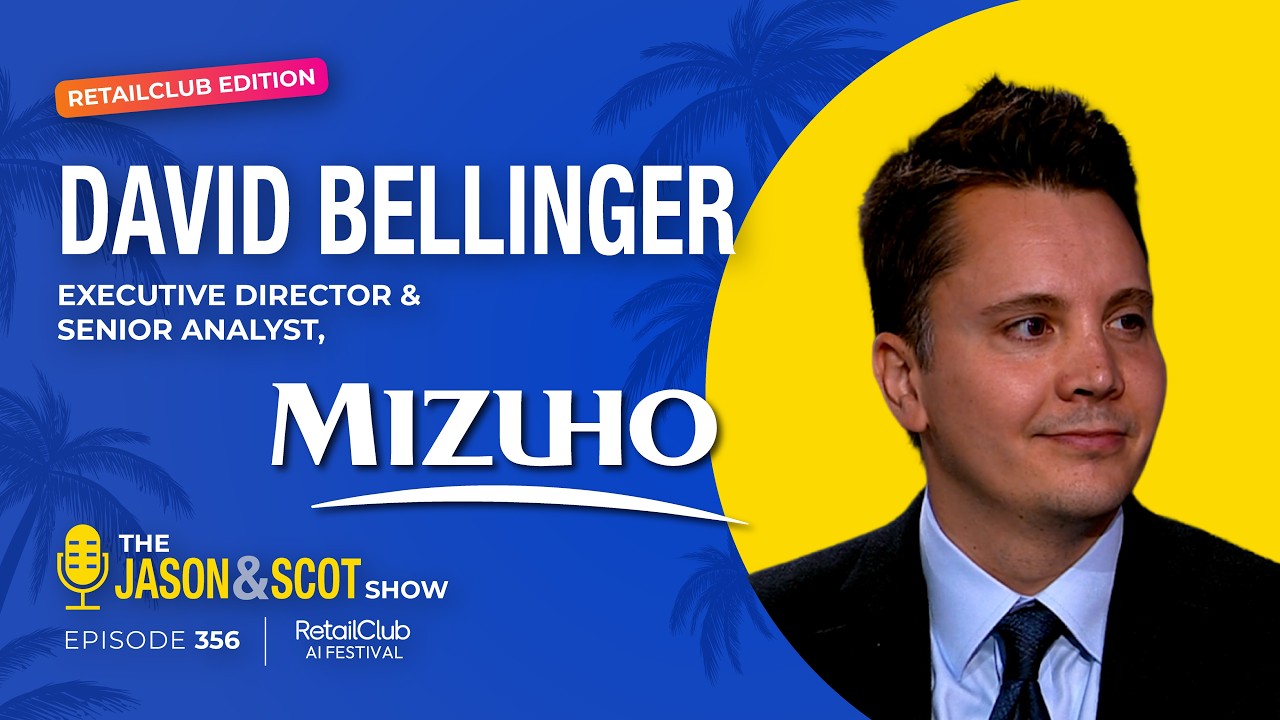
EP356 - Muse, Sparky and the Buy Side: Mizuho's David Bellinger
Summary
"Mizuho's David Bellinger highlights the potential of Muse, a new agentic tool with 3 million downloads, as a game-changer for retailers like Walmart and Best Buy, offering improved shopping experiences and acting as a catalyst in the e-commerce space."
Full Content
EP356 - Muse, Sparky and the Buy Side: Mizuho's David Bellinger
Unknown Speaker:
Welcome to The Jason & Scot Show, your source for the latest news and trends in the e-commerce industry.
Featuring hosts Jason, Retailgeek Goldberg, Chief Commerce Strategy Officer and Publicist, and Scot Wingo, co-founder and CEO of ReFiBuy. Here are Jason and Scot.
Speaker 3:
Welcome to this episode of Retailgentic. I'm joined by my retail club co-host, Jason Goldberg. Joining us today as our guest is David Bellinger. He is the Executive Director and Senior Analyst at Mizuho. Dave, welcome to the show.
Speaker 1:
Dave, great. Thanks for having me on.
Speaker 3:
Absolutely. You were one of the first analysts when I started Retailgentic to reach out and say, I think this is really something interesting Wall Street should know more about and we did a channel check call.
I don't know what you call them. Expert call, I guess. Yeah, expert call. Yes.
Speaker 2:
And when you couldn't find any experts, you called Scot?
Speaker 3:
Yep, yep.
Speaker 1:
Pretty much.
Speaker 3:
All he could find was me. Yep. And I was like, sure, sign me up. I'm an expert. And yeah, it was really well received. I think you were surprised by the reaction on the buy side.
Give us a little bit of background for what you've been up to before Mizuho and then what you do at Mizuho and how that ties into Wall Street.
Speaker 1:
Yeah, perfect. So, I've been a sell-side equity research analyst for about a decade now. I've been on the Mizuho platform for about three years. In the past, I've been at Oppenheimer, Citi, Wolf Research, a number of platforms.
But I cover about 20 consumer and retail companies, mainly hard lines, broad lines, consumer internet, names like Walmart, Costco, Target, Wayfair, Chewy, even the auto parts retailers, AutoZone, O'Reilly.
So wide-ranging group, a lot of content to talk about. And then, yeah, how it connects to agentic. We've been working on this for well over a year.
One of the earlier analysts seems to pick up on it and with your expert calls definitely gained some traction, but it's very surprising by side investor reaction to it. I would get a lot of calls of like, hey, Dave,
is this actually happening or is this going to happen? What's the timeline? And no one really knows yet, but coming to a conference like this and just seeing the size of it and all the energy and time and resources behind agentic,
It does seem like a real thing that's happening. Maybe certain categories faster than others, but you've got big names like Amazon, Walmart, Target all talking about it. It does seem like we're still in the very early stages of agentic,
but we are getting a lot more momentum behind the whole space here.
Speaker 3:
So a timely thing is we saw Muse launch here in the last week or so. It feels like it's been a month because they've had so much news. So it's really pretty, maybe like 10 days old at this point. If you had a chance to play with that,
what do you think that's going to do to some of the various retailers out there?
Speaker 1:
Yeah, I've played around with it a good amount so far. Like you said, we're still early, but I think some of the numbers are approaching about 3 million downloads.
They announced some partnerships last night, Walmart, Wayfair, Dick's Sporting Goods, Best Buy, a few other retailers, but in my personal experience, it's much better than what we've been accustomed to before.
It does seem like almost a true catalyst for the whole space, as in you actually have a real agentic tool in the hands of millions of people immediately and the reviews are great. I've tried some shopping experiences with You know,
buying a polo shirt or piece of furniture and it does seem as though it's a very thoughtful tool. Like it'll go and do some work in the background for you and surface some, you know, real life applicable items for you.
So I found it pretty good so far. I haven't purchased anything yet, but I think we're getting there and it seems like people are getting more comfortable with, you know, these types of tools.
Speaker 3:
Well, earlier we had Stripe on and they said it's totally, totally safe. So go crazy. Give it all your credit cards.
Speaker 1:
They probably have them already, so it doesn't even matter.
Speaker 2:
Yeah. I'm interested because I feel like the Muse announcement has made it more mainstream in my mind.
And so it's suddenly a lot of people that maybe didn't even understand what we were talking about when we said agentic commerce now have more practical use case. From your perspective, like a lot of the retailers you follow,
does it increase the sense of urgency for them to have a coherent agentic strategy?
Speaker 1:
For sure. I think the consumer is starting to learn that you could do some of these arduous tasks with something like Amuse of, hey, book my restaurant reservation or get me a hotel room.
So you'll be on this timeline, this curve of what you'll actually let it do. I thought the timing was very interesting. Coming out late September, we're right ahead of the big holiday season, some of these high-volume months.
So as people get more accustomed to it, I think you'll see a faster adoption. And yeah, some of these big players have been spending a lot of time and resources behind this already, trying to get ahead of it.
Some of the smaller players or even a small, medium-sized business, it's almost like a wake-up call to these guys. It's, hey,
this can't move too quickly away from us because if we don't have our product cards and the content and the context there, we're basically going to be invisible and we can't be surfaced in this new shopping format.
So I think it is almost a seminal moment here. We're still super early. There's room to catch up, but it does seem like more of a near-term catalyst than anything that sparked the whole sector.
Speaker 2:
Yeah. In my mind, the biggest mass merchants had been putting real work into this and preparing for it, and they understood it was coming. But even the category leaders in a bunch of these specific segments, it was a very abstract thing.
And now suddenly they're all having the meeting. Should we be blocking news? Should we not? Like those sorts of conversations are suddenly Moving to the boardroom.
Speaker 1:
Yeah, I mean, I'd say, too, from some of the big companies I follow, no one's come out there and give you specific data points. I mean, Walmart's talked about Sparky and the 35-40% higher ticket that's associated with that.
You don't necessarily know if those are your initial power users and then that tails off after.
Speaker 2:
Oh, we can be pretty sure it is.
Speaker 1:
Right. You hear things like today Target was talking about Basically two-thirds of the code that powers their app has been rewritten over the past 18 months.
So that shows you the long timeline that they've been thinking about this for a while. Everything's moving in real time, talking about blocking. I'm a blogging muse on Amazon, so I think everyone's trying to figure it out,
but it's almost as if you have the infrastructure built, you could quickly figure this out and adapt as consumers evolve as they're spending shopping patterns as well.
Speaker 3:
One that tends to block people that doesn't make the news is Chewy, and I know they're in your coverage universe. Have you talked to Chewy about their philosophy here, or have you asked?
You're also famous I love joining the earnings calls because David jumps in and he always asks the agentic commerce questions. It's kind of like your brand on these calls now. Have you asked Chewy about this?
Where are they on this whole spectrum?
Speaker 1:
Yeah, I tend to bug a lot of these management teams. I'm sure they're already sick of me on the agentic piece. But yeah, Chewy, we like Chewy a lot. It's one of the leaders in the pet category.
Their CEO, Sumit Singh, he actually had a very long detailed post on this, LinkedIn post, company post. And it was almost as if Certain companies, if you break this in two segments,
the digital advertising piece is what people are very fearful of that being disrupted. Companies like Chewy or Wayfair, that's only 1% or 2% of the business, so small but growing, high margin, to be determined on where all that goes.
But in the second piece, in terms of the core business, I mean, Chewy is a lowest price and definitely a fast shipper as well. They've also got the auto ship business, right? So you don't necessarily need an item same day or next day.
They're basically pre-planned to get you that order. So it's almost as if the demands might be rerouted back to these lowest price aggregators like a Chewy. So to me, all to be determined,
but it doesn't seem like a name like that will be completely disrupted and some investors are Quick to pull the trigger, shoot first, ask questions later. So I think a lot of these names, Wayfair included,
have been wrapped up in more of this negative investor mindset. But to me, this is all a potential volume driver. And if you do have those product cards really built out well, you have the lowest cost,
very fast speed, it's almost as if it could be a demand aggregator on this new shopping surface.
Speaker 3:
Brian Nowak was here. He's another Wall Street analyst, and he's at Morgan Stanley, and part of their thesis is there's a bull case here where this really accelerates not only e-commerce,
it accelerates e-commerce, and then when you ask, when you dig into the model, it's not accelerating the share of retail, it's accelerating retail. So it's kind of like giving people new experiences and helping them buy things they didn't.
You know, know that they would be delighted by.
Speaker 1:
Yeah, I mean, I agree with that.
Speaker 3:
Do you have a thesis?
Speaker 1:
I mean, that makes sense, too, especially some of these marketplace operators, like in Amazon. Walmart has such a long tail of SKUs, things that you probably wouldn't even know Walmart sells.
So you're buying your groceries, you're buying whatever household essentials you need. You don't realize that Walmart pretty much sells everything. They've got hundreds of millions of SKUs out there. And I get a lot of questions about too,
what does this mean for store-based retailers and could you have a further shift of Call it the 20% or so of retail sales that are e-commerce or digitally driven.
You can definitely see that, but it doesn't necessarily take away from the importance of the store, right? Just think about Walmart, Sam's Club, 4,000 plus locations across the U.S., but a lot of those are used as fulfillment hubs as well.
We've done a lot of work around Walmart is potentially developing a dark store network. Maybe you have 500, 1,000 stores that consumers don't go into, but they're stocked with really high-velocity items,
grocery items that their Spark delivery network could deliver to you in 20 minutes, 30 minutes. So that's what we see a lot.
Speaker 3:
Is that a rumor or is that a confirmed thing?
Speaker 1:
Well, they've tested about 10 of these. I found a few. There's one in New Jersey that I camped out at for two hours one day. You do see a lot of these.
Speaker 3:
The things analysts do cracks me up.
Speaker 1:
Try to get a nice edge on this.
Speaker 2:
Are you a spark driver? Are you?
Speaker 1:
Not yet.
Speaker 3:
Some people have done that.
Speaker 2:
Oh yeah, sure they have.
Speaker 3:
Was it Anthony Noto that famously, he like worked in an Amazon warehouse?
Speaker 2:
Yeah.
Speaker 1:
It could be my backup plan when things go south.
Speaker 2:
I don't think any of you would be very good fulfillment center workers.
Speaker 1:
The Spark driver network is incredibly underappreciated. There's something like 1.6 million drivers that Walmart uses. It basically functions as an Uber or DoorDash for them. I've talked to the company a lot.
We think it's something that you might see eventually. It's hard to put a time frame on it, but there is so much dislocated retail out there. Drug stores or dollar stores that are now not operational.
It seems like something they could quickly lease a lot of these stores and power that 20-minute expedited delivery to a wide swath of the country.
Speaker 2:
I want to pivot to it. Well, hey, I just want to comment. I do think it's interesting. I think a lot of this agentic that makes buying more friction-free is really about fighting for the demand that already exists, right?
So if someone figures out a better checkout, that could be good or bad for Chewy. A lot of this discovery stuff is net new purchases, right?
So you look at most of the volume on TikTok shop and that stuff that wouldn't have gone sold were it not for someone discovering it on TikTok. So in terms of adding to the pie,
I'm most interested in these discovery experiences because it creates a larger TAM for the whole industry. But when we talk about agentic retailers, like the OG agentic retailer in my mind was Stitch Fix.
And while everyone else is on their first cycle, they're kind of on their third, right? Like they had a high valuation first mover, the trough of disillusionment. And I know you just put out a note on Stitch Fix this week.
Is their first mover position like Still an advantage today or is that like sort of total history and they've got to figure out how to compete in the modern agentic 3.0 world?
Speaker 1:
Yeah, great question. It's evolved a lot. Stitch Fix just reported results in a bit of a step back last night. It's got the stock down pretty meaningfully. There's so much great and rich data that they have.
It seems as though their model is a little more niche than others, so that's where this has been a little more contained,
talking about 2 million or so active customers, very different than a Walmart that gets over 100 million shoppers a week.
But I would say what surprised me a little on the agentic piece is We initially thought that this could move into some of the repeat purchases right away.
Groceries, household essentials, things that you don't want to think about and save time for. It seems like the trust factor hasn't built up yet where you're enabling the agent to do that.
What we are seeing a bit more is some of those discoverability type categories, things like apparel or home decor where Wayfair plays.
That does seem like a potential new incremental demand where you don't really know how to visualize these categories. You could actually see apparel on yourself in an image.
You could see what a couch looks like in your living room on your app. So I think that is where we're seeing some initial incrementality.
And even Walmart yesterday was talking about some more visualization over the next 18 months within their agenda stack. And I think that could be super helpful as well.
If you get a little more visualization, maybe you couple it in with live shopping or some kind of social aspect, like a TikTok. Put that together with Muse and then maybe agentic takes off. Hard to put a time frame on it,
but it might be even if it's two to five years out, it does seem like this whole evolution of shopping is changing incredibly fast and that's where it's going, but to pinpoint a certain quarter of things is nearly impossible.
Speaker 2:
Yeah, I totally agree. I do think it's like people don't realize, but You can pop open the Walmart app in any Walmart store right now,
like do visual recognition on any garment in that store and see it on yourself or on a mannequin with your body dimensions.
And like consumers aren't used to using that amenity yet and I don't know that Walmart has I've never like promoted it in any way. But as these agentic experiences become more mainstream,
I do think the expectation of when you have such a rich experience online, the expectation is you're going to have that rich experience in store.
And I do think that's going to be an important part of their shopping experience in the long run is that co-shopping on that phone while you're standing in the Target or Walmart.
Speaker 1:
Yeah, exactly. I mean, the Sparky agent, that might be more helpful in store to you at some point than online.
Speaker 2:
Absolutely.
Speaker 1:
And I've learned not to discount. Walmart, just the size and speed that they move. I remember maybe six, nine months ago,
they were telling me that there's a potential that they could deliver your pizza in 30 minutes from your local pizza shop, Tony's Pizza in New Jersey, right?
It seemed a little crazy to me, but they were telling me you could just connect these systems, and now you see these partnerships with Subway, Dunkin' Donuts.
Speaker 2:
Yeah, coffee coming for Scot right now.
Speaker 1:
Yeah. Should include me, I'm a big pumpkin user. But yeah, they've hired Daniel Denker as their head of AI and acceleration, and it's almost as if these companies weren't designed this way,
but there's been a whole rethinking in a lot of these corporate structures of, we've got to think agentic and agile first,
and then everything else we could Sort of shape based the way the consumer is coming in and connect all these systems.
So it's just something that a lot of these traditional legacy retailers aren't used to and they're having to rethink all this in real time.
Speaker 3:
Yeah. When you get calls from the buy side, what are the top three or four things on their mind?
Speaker 1:
I mean, lately, it's just been consumer spending in general going into the back half, end of the year. It's been some weaker data points.
It's hard to say whether that's just a low before the end of the year or we've heard a lot about higher highs, lower lows. So, to be determined, it does seem like there's a little strain on the consumer with all the inflation out there.
I get asked a lot about speed and convenience around these expedited delivery aspects of companies and who needs to catch up, who's behind, who's way ahead. So that's a big piece. And then, yeah, the agentic questions,
I would say they hit almost like a fever pitch maybe a little over a year ago as we started doing some of these initial expert calls. And again, I was getting asked, is this a real thing? And are younger consumers starting to shop that way?
You had the Walmart OpenAI partnership and the company reached a trillion-dollar market cap. Then you had some of those step-backs with ChatGPT, shopping. Gemini seems like they leapfrogged them.
And then now with news, I mean, that's been a hot topic lately. Hard to say the winners and losers right away. There are definitely equities that are moving all over the place on some type of knee-jerk reactions out there,
but we tend to take a longer view, and we are seeing a lot of this work done in the background, and you don't see a specific payoff in any given month or quarter. Investors are very focused on like 30, 60, 90-day ROI timelines.
This might be 1,000, 2,000 days, but it seems like it's all coming.
Speaker 3:
Yeah. I get the most questions about Shopify. That's not in your coverage universe, though.
Speaker 1:
No. No, we do cover it, though, and our analysts do a lot of great work around that, but I do pay attention, and you've got a big name like that that powers so many small and medium-sized businesses, you have to pay attention.
They seem like a real leader in the space with all the connectivity they have to that smaller customer.
Speaker 2:
Anything you've been surprised about or any any key takeaways from this show?
Speaker 1:
Yeah, I mean, the volume of people here is great.
Speaker 2:
Yeah.
Speaker 1:
First, it just seems as if, you know, there's a lot of companies rising up to help companies get ready for agentic, trying to help with conversion.
I've heard a lot about trying to get returns down while getting conversion up and making sure that your agents don't go a little off the rails and try to sell you something more tailored to you.
Just to fit your description, I'm trying to make sure that it's authentic. And then one thing I'd say too is I thought we'd have a little conversation about potential end of the world from AI. I haven't really heard that at all here.
This is almost like the benevolent side of AI that helps you, helps your shopping experience. But the five, 10 year timeline of all humanity going away, I haven't heard a little glimmer of that.
Speaker 3:
Not a lot of AI doomers here at the AI.
Speaker 2:
Yeah, there's a little bit of selection bias. There's so much uncertainty in all this stuff. We talk a lot with clients about scenario planning, that you're foolish to assume a particular outcome, right?
So obviously you have to have a plan for everything. There's no scenario planning for end of world. So it's almost fruitless to spend too many cycles on it.
Speaker 1:
Yeah, exactly. And if all this is compressed into five, 10 years, what's your priority of things to do, right?
Speaker 2:
Yeah, more time with my kids, less time at trade shows.
Speaker 1:
Exactly. Yeah, it just has a whole feel that, especially the Muse thing of this being in the hands of many, many more people that it actually works and can be helpful for you.
It's almost showing a different side of all the AI push that we hear in the media in a good way.
Speaker 3:
Coming back next year?
Speaker 1:
Hopefully, hopefully it'll be good. At least next year I'll bring some sunscreen with me. Yesterday was a tough day.
Speaker 3:
Yeah, yeah. We got a little break with the clouds today.
Speaker 1:
Yeah.
Speaker 3:
What are you thinking about the future? What are some things as we roll into holiday? Do you think we're going to have a good holiday this year? Do you put out a forecast or not?
Speaker 1:
Not necessarily. Just tons of deflation out there. Inflation on top of inflation. And we've even seen some of these essential categories pull back a little, like grocery has been a tough space.
The pet space has been tough in terms of New pet adoptions and just pricing that hasn't been there, elevated and kind of stagnated, hasn't reverted back at all. And a lot around the home, home improvement activity has been pretty slow.
You've got rates popping up again. But it does seem like these companies that have had A big value proposition with on-trend merchandise, they're doing fine. Names like Five Below, even Target are doing well.
But I do think we are in one of these periods of growing investor concern about the holiday period. We just heard about an auto zone miss. McDonald's was talking about negative U.S. same-source sales in the month of August.
So a lot of mixed consumer data points out there. You have things like trading cards, which are totally discretionary, just exploding.
Speaker 3:
It doesn't make any sense.
Speaker 1:
Squishy dumplings exploding. Squishies.
Speaker 3:
You're tracking the squishy market.
Speaker 2:
Nitos.
Speaker 1:
Yeah, exactly. So there's a lot of mixed signals out there. I feel like spending has been on a bit of a downdraft, but that doesn't necessarily mean the holiday period will be bad. Consumers have shown up year after year.
It seems almost as if, again, this is like a lower lows, higher highs point of the year. Maybe people are just saving up for that holiday period again.
Speaker 3:
What are they, Prime Day deal? Prime Deals?
Speaker 2:
Prime Deals Day, yeah. October 6th and 7th, maybe?
Speaker 3:
So they've taken the original Prime Day that's...
Speaker 2:
Yeah. I mean, the origin there is during COVID, they moved Prime Day to October.
Speaker 3:
Yeah.
Speaker 2:
And so then after COVID, they moved Prime Day back to summer. But they, as you know, once Amazon comps something, they never want to like...
The prime promotions have to be more longer duration every year because they always have to make an announcement that it was bigger than last year and so they didn't want to have a soft spot where they had that that prime day in October so that it's kind of second prime day.
Speaker 1:
Yeah, you do see a lot more I'd say concentration around those big promotional events, like a Wayfair's Way Day. A lot of retailers draft off of these prime days. Target, Walmart, they have their own days. Costco's been running some days.
It's almost as if the consumer is holding back a little until they could get that certain promotion that they've been waiting for. And again, I think that's just a byproduct of all the inflation out there,
oil prices high and just price growth on top of price growth. And at some point, you think the consumer will be tapped out. But to date, you haven't seen a massive downshift.
Speaker 3:
Yeah. Awesome. Well, I know you're busy. We really appreciate you coming by. Any last thoughts before we call it?
Speaker 1:
Thanks for having me on. We keep doing a lot of work around agentic and this show has sort of reinforced our bullish narrative, things that we've published on for the last year or so. I'd say it's more of a conviction thing than anything,
but it's great to see all the people here and just all the momentum behind this whole aspect of retail and the evolution of the shopping experience. Awesome.
Speaker 3:
Well, Dave, Jason, thanks for joining us for this episode of Retailgentic.
Speaker 1:
Thank you.
Unknown Speaker:
You've been listening to The Jason & Scot Show. For all the latest news and trends on e-commerce and shopper marketing, subscribe to us on iTunes or visit jasonandscot.com.
This transcript page is part of the Billion Dollar Sellers Content Hub. Explore more content →