Ecom Podcast
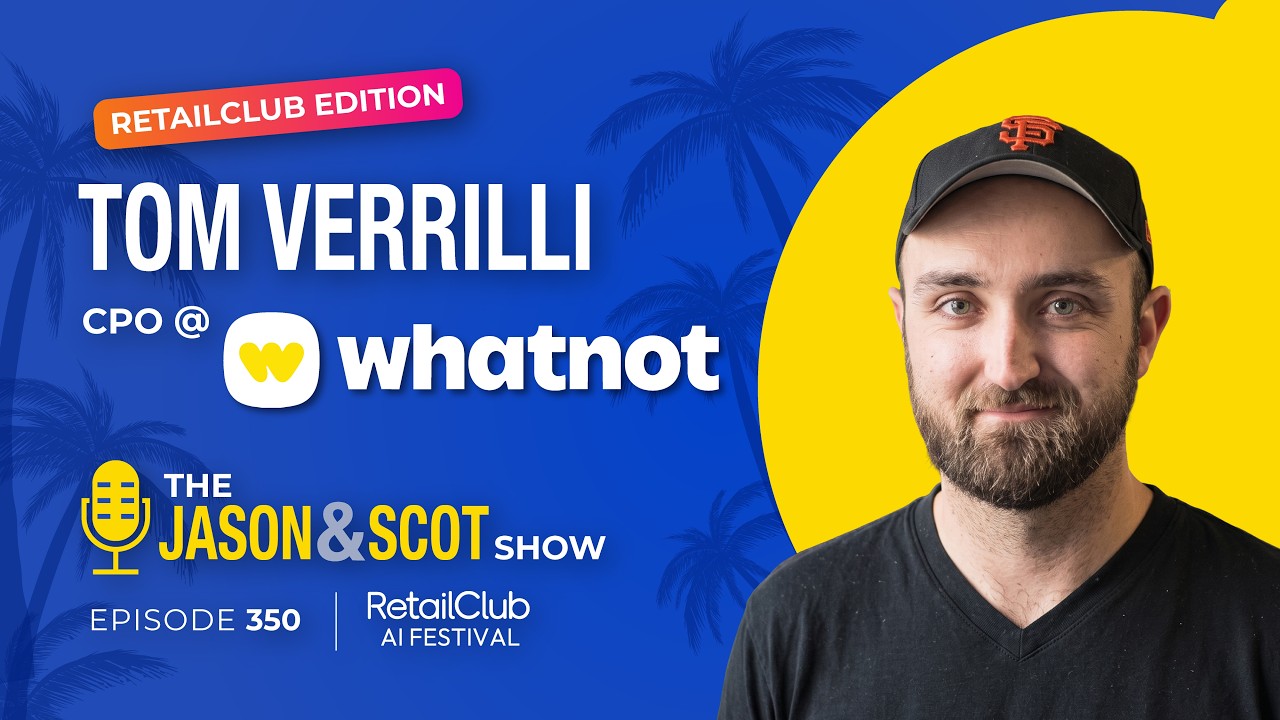
EP350 - Live Commerce Is Where E-commerce Was in 2005: Whatnot's Tom Verrilli
Summary
"Live commerce is revolutionizing e-commerce by fostering high-trust interactions, with Whatnot's Tom Verrilli highlighting that sellers can leverage direct buyer engagement to enhance sales, much like e-commerce's rise in 2005."
Full Content
EP350 - Live Commerce Is Where E-commerce Was in 2005: Whatnot's Tom Verrilli
Unknown Speaker:
Welcome to The Jason & Scot Show, your source for the latest news and trends in the e-commerce industry.
Featuring hosts Jason, Retail Geek Goldberg, Chief Commerce Strategy Officer of Publicist, and Scot Wingo, co-founder and CEO of ReFiBuy. Here are Jason and Scot.
Speaker 1:
Welcome to The Jason & Scot Show. I'm your host, Jason, Retail Geek Goldberg, and as usual, I'm here with your co-host, Scot Wingo.
Speaker 3:
Hey, Jason, and welcome back, Jason & Scot Show listeners. We are continuing our live series here from the Retail Club AI Festival in beautiful, yet cloudy today, Huntington Beach, California.
Speaker 1:
I'm grateful for cloudy after yesterday.
Speaker 3:
Yes, we had a very sunny day. Joining us fresh off the main stage is Tom Verrilli. He is the Chief Product Officer of one of Jason and I's passionate, guilty pleasures, I guess is what you would call it? Whatnot.
Speaker 1:
I'm not guilty.
Speaker 3:
Yes, not at all. Whatnot.
Speaker 2:
Thank you for having me, gents.
Speaker 3:
Welcome to the show. We're excited to have you. Give us a little background. What did you do before Whatnot? I have a feeling I know what Chief Product Officer does there, but let's make sure that everyone understands what's there.
Speaker 2:
Yeah, let's start there. I'm really lucky. I get to lead the product and design teams at Whatnot. And for those of you who aren't familiar with, you know, tech product, that's basically how does the app work,
how does it look, how do the features function, you know, whether it's tools for our sellers or whether or not it is things like discovery for buyers and all of the kind of like follow-on post-purchase stuff.
Speaker 3:
So you have both sides of the equation.
Speaker 2:
Both sides of the equation. So I've been at Whatnot for just on three years now. I think three years next week actually, which is great.
And prior to that, I spent just under seven years at Twitch, which is obviously live streaming video games. I had a little bit of time in social before that. I was at Twitter back when it was Twitter.
And before that, believe it or not, I was in India running an e-commerce startup. So I've been a bit everywhere.
Speaker 3:
You've been at this for a while?
Speaker 2:
Just a little while. Thankfully, the gray hairs don't show up on a podcast.
Speaker 1:
The key is to just sit next to someone that has more gray hairs. You're fine.
Speaker 2:
Oh, great.
Speaker 1:
Yeah.
Speaker 2:
Perfect.
Speaker 1:
Yeah.
Speaker 3:
Yeah. A lot of people are set up, a lot of marketplaces are set up where you have a seller side and a buyer side. Is that kind of how you guys organize kind of underneath what you're doing?
Speaker 2:
Broadly.
Speaker 3:
Yeah.
Speaker 2:
I mean, I think for us, one of the things that sets live commerce apart is like just how much it is like a really high trust interaction because you can kind of see the seller. So we tend to be very over-indexed on making sure that's true.
Loosely speaking, buyer, seller, and kind of trust as our three core pillars, but we're remarkably flat. So it's not, we don't spend a lot of time talking as orgs. Much more just kind of like direct work with the teams.
Speaker 1:
Slightly rudimentary questions because I'm going to be honest, in my world, I'm shocked by how many people are still not completely aware of you or paying enough attention to you.
Just to put this in perspective, I talk to a lot of big brands and retailers on a daily basis and a common question is like, What am I not paying attention to that I should?
And two years ago, the answer for me was disappointingly, it was TikTok shop, right? Because tons of these huge momentum, fastest growing retailer in the history of mankind and tons of big consumer brands were like,
that's some time waster for kids. We're not thinking about it, right? And so today they're all aware of it, whether they have a good strategy or not is another thing. And so my answer today is you. Thank you, sir. Hey,
the thing you're not paying enough attention to in our space that's very likely to be important to your future is whatnot. The next problem I have with everyone is they conflate two things, which in my mind are related but different,
live streaming and short-form video commerce.
Speaker 3:
Sure.
Speaker 1:
And so, first question for you, are you exclusively committed to one or the other? I think I know the answer here.
Speaker 2:
I think the short answer is no. Like, Whatnot today is almost exclusively live streaming. And so, for those of you not familiar, imagine, you know, a FaceTime, but you've got all of your commerce kind of integrated,
a one-to-many broadcast with, you know, dozens or sometimes thousands of customers, and you are running, whether it's fixed-price buy-it-nows or auctions. So, Whatnot today, the heart and soul of it is live, but increasingly, you know,
it's important to us just that we serve our customers and retailers well. Live, as a format, is incredible because it's very trust-building. You can talk to your seller. You can interact with them.
For the seller, it's the most revenue-dense time that you can possibly spend. Customers are coming very deliberately to buy. You get all of the same advantages you used to have when you were in brick-and-mortar selling,
where your curation, your personality, your sales all really matter, but you get internet distribution. But we're kind of pragmatic as a company is the honest answer.
And so as we grow and talk to more retailers, what they need are the things that we will build. But at its core will always be that idea of like, you know, we think live is probably the best format for selling,
but it's not a like we shall never, never.
Speaker 1:
Fair. And then the other thing I always get is people misunderstand the categories that you cover, right? So very commonly, it's like, oh, there's some kind of collectible scarcity thing, cards or shoes or whatever.
Speaker 3:
Yes.
Speaker 1:
And can you talk to us a little bit about what categories are important on the platform?
Speaker 2:
Sure. So believe it or not, Whatnot is live today in 224 categories in nine different countries. And kind of collectively across those, retailers made about $8 billion in sales last year. This year, they will comfortably double that.
Speaker 1:
Does that mean your salary will double this year?
Speaker 2:
Gosh, I hope so.
Speaker 1:
It just seems reasonable to me.
Speaker 2:
I don't know that that's exactly how that works. Okay. With a little bit of luck. So we started in collectibles. Whatnot's kind of like origin story is actually, you know Funko Pops, you know, the more collectible figurines with the big heads?
Speaker 3:
I have many Funko Pops.
Speaker 2:
So do our co-founders.
Speaker 3:
Yes.
Speaker 2:
And they actually started just a static website for buying and trading Funko Pops. And then this is like December 2019, world changes, early 2020.
And what they noticed was that people were going live on Instagram and then they were trying to negotiate in the comments to exchange these things. And so they kind of like shut down the company, spent two weeks locked in a room,
recoded it to be full live commerce. And then from there it went basically through the collectibles loop. It went into kind of like Pokemon cards, sports cards. But you know, today fashion is actually our biggest vertical by order volume.
And we are selling everything on the platform from live lobsters to Louboutins, from kind of like skateboards all the way through to kind of, what did I buy recently? I think I bought a musical instrument on Whatnot recently.
I bought an accordion. Like you can actually get almost anything you can imagine.
Speaker 1:
Did you already know how to play the accordion or is this a new hobby?
Speaker 2:
I didn't but I annoy my team a lot with an analogy about accordions and so I just bought it as a prop.
Speaker 3:
I got it.
Speaker 1:
Yeah, I have some of those too.
Speaker 2:
Yeah.
Speaker 3:
So $16 billion, and you guys did a big funding raise recently when I think I saw the $16 billion number come out.
Speaker 2:
We did. We were very lucky. We just raised our Series G that values this company at about $20 billion.
Speaker 1:
Yeah.
Speaker 3:
So those are some real numbers. I'm not an expert. That seems like a little momentum there.
Speaker 2:
You know what? My take on this one when I talk to folks is like, There was this period in the early 90s where everybody was like, okay, the internet exists, but are people really going to buy stuff on it, right?
You used to hear this, like, no one's ever going to buy a car on the internet. That's crazy. And then you got to like the late 90s. It was like, all right, this might be a thing for collectibles.
It might be a thing that the nerds are going to use, but I doubt that the average person is going to. And kind of mid-2000s, it was like, okay, this is inevitable. Everyone who sells is going to sell online.
The question is going to be how much of your business will be online. And that obviously changes depending on the retailer. I think that's basically 2005 for live right now,
where it is quite clear to me that everything that is sold online will be sold live. How much of their channel mix live makes up for retailers I think will vary.
The sellers that are really the kind of like heart and soul of Whatnot today are actually like small brick and mortar businesses. Businesses who predominantly find when you sell on most marketplaces,
your entire personality and supply chain gets reduced down to a listings detail page, which is homogenous, right? You all show up exactly the same on Amazon, whether or not you want.
And you know, there's a large number of goods in the world, but there is a finite number of them. And so you're selling the same thing someone else is selling in the exact same UI that someone else is selling it.
And all you can do is compete on price. Whereas live selling gives you the opportunity to bring personality, it lets you bring knowledge,
it lets you bring your community and it kind of really helps you build that core repeat customer as opposed to just kind of competing for search traffic.
Speaker 3:
I haven't had a chance to shop on the fashion side. What are some examples? Are there any brands we would know that are kind of going live there or is this again like a local boutique that got some excess inventory?
What's the model on the fashion side?
Speaker 2:
At the moment, it's kind of started in two things. It's mostly local boutiques and small businesses like more of the kind of mom-and-pop shop brick-and-mortar.
The other thing that we've seen move really materially is the kind of Kind of like the TJ Maxx kind of model of people being like surplus inventory and surplus stock that they want to move on Whatnot where you are really volume sensitive and less margin sensitive.
And the amazing thing about live commerce is there are sellers on Whatnot who run an option every three seconds. So it's like, here it is, and you just kind of, you can move,
if you're doing that math, you can move a couple hundred items an hour. And it's really material. So it started mostly like in liquidation, and it's starting to move up into the kind of like boutique retailers.
And interestingly, in fashion, one of the examples I really like is Invicta watches, which is like an owner-operator manufacturer now.
Speaker 3:
I have seen this channel, yeah.
Speaker 2:
Yeah, Invicta now have like three channels on Whatnot and are kind of like reorienting basically their entire business around it because they can cut out that entire middle layer of distribution and just kind of go direct to the customer.
And they've got an incredible community and following. Those guys are very entertaining. But like it doesn't have to be loud and brash. There's a lot of people where we find that like, you know,
the owner of the brand is the most compelling person to go shop with. A good example, I was talking yesterday to a couple based in Houston called The Don's Luxury and they move about,
I think they said this year they'll do between $60 and $80 million of kind of like high-end consignment, whether it's kind of like Birkin bags or Louboutins. And for them,
it basically takes what was going to be a consignment store and they're fighting for traffic and they get to kind of build that community.
Speaker 3:
We'll wait one second.
Speaker 2:
Yeah, wait for the hard hard one.
Speaker 3:
Yeah.
Speaker 1:
Someone just heard they could get a Louis Vuitton bag on Whatnot and they just...
Speaker 2:
Red hot deals right here.
Speaker 1:
They're rushing.
Speaker 3:
I'm more of a collectible person. I've been on Whatnot for a long time, and it's really interesting. I feel like there's a new type of a format added all the time. So it used to be kind of like an auction.
Then people would have a little store hung off the side. Now, I can't even keep track of all the different formats. How do you guys innovate in that way? Is this like coming from a merchant request?
The merchants are asking you for this stuff or you're just kind of like, wow, it'd be really cool if we did this?
Speaker 2:
Almost exclusively from starting with the merchants. One of the secrets of product is to always believe your customer but never necessarily listen to them exactly. Because people don't necessarily understand all the nuance,
but the way that we work and maybe one of the differences between Whatnot and the dozen or so live startups that started and didn't kind of last is we think about growth in a category by category manner.
So, you know, as I said, we started only in Funkos, then it became Cards, then you kind of slowly move out and you go and talk to a seller in that vertical and you work out what do you need.
So one of the newest verticals on Whatnot is like fresh and specialty foods. So I wasn't kidding when I said earlier that we sell everything from lobsters to Louboutins. There is a guy not too far from here called Scott.
He's down in San Diego, and he...
Speaker 1:
He spells his name wrong though, correct?
Speaker 2:
I'm sure he does. There's only one way.
Speaker 3:
Yeah.
Speaker 2:
And he was a massive Pokemon buyer and whatnot, and he emailed our CEO one day and said, I own a company called eFishCo. We're down on the dock in San Diego, and I think people would love to buy farm-to-table, sea-to-table goods on Whatnot.
How can we do it? And later on that week, we flew out our co-founder and an engineering team to his place. And they were like, all right, what do you need? And so it's things like, you know, obviously when we're selling you collectibles,
it's okay if it arrives in seven to eight days on USPS and it's fine if there's a delay in shipping. It's annoying but like you'll live. No one is waiting eight days for their lobster. So you've got to go in and say, okay, great.
How do we get, you know, overnight shipping? How do we start handling, you know, the dry ice of the world and all of those things? Each time you're seeing that new format pop up, Scot,
that's us sitting down with a seller or a collection of sellers and saying, what do you need? Are you margin sensitive? How can we build better margin formats? Are you volume sensitive?
Maybe we can help you, you know, customize the length of your options. Eventually,
our biggest sellers now will have multiple channels running 24-7 and one of the things that I'm pretty passionate about at the moment is like how do we help you with more revenue per hour because eventually we run against like the clock.
Physics is the problem for some of our sellers as opposed to...
Speaker 3:
You have formats like Dutch options. Correct. What are the formats available right now?
Speaker 2:
So currently we've got a mixture. We've got like two auction formats. One is like just a classic kind of auction where you can start it, you know, anywhere from like say 30 seconds and it just runs the classic countdown.
We've got that, that auction does the little increments of plus 10 seconds when there's a bid in the last 10 seconds and that's, that's one.
Speaker 3:
It's an extended bid.
Speaker 2:
It's what people basically use to try and make sure that they optimize for price.
Speaker 3:
Yeah.
Speaker 2:
And then we have what we call sudden death auctions where you can set the auction anywhere from two and a half to 10 seconds and when the clock runs out,
the clock runs out and that's your old classic like You know, V1 internet experience of like, you know, sniping. You're trying to win the auction at the last second, and that tends to be for folks who are trying to move a pallet of shoes,
you know, and how do we kind of move through those. And then within our fixed price formats, we've got a couple of different ones. We've got your classic, just straight buy it now. We've got what we call flash sales,
which is the ability to kind of like run a large group of things in a very limited window for discounts, so 50% off for the next 30 seconds. We've got a thing called Party Purchase, which we really like,
which is kind of taking the early internaut group buying theory and basically setting a series of milestones. Basically, you can incrementally drop the price depending on the more you set,
but that's all built into the UI and you can kind of see. So the lobster guy could say, we just got 1,000 in and if I can sell 500. They're $9.99 unless I sell 250 and then they're 30% off and if we sell 1,000, it's 50% off for everybody.
And all of that kind of like happens as it rolls. And then, as you say, we're like always trying to build and experiment with new formats.
So, you know, later on this year, there's a lot more that I think we can do with helping sellers kind of get, you know, different things like, you know, today,
one of the hallmarks of Whatnot is you've got to basically ship As soon as you sell,
how can we help people who maybe want to build custom goods get more of those kind of like pre-orderings type things which would also help with collectibles when there's like really big releases and so we're always trying to work through those formats.
Speaker 1:
Do you guys get involved in fulfillment at all today?
Speaker 2:
We don't currently.
Speaker 1:
Yeah.
Speaker 2:
It's very vertically integrated for the buyer. So there's a lot of marketplaces where after you sell, you as the seller then have to go and buy the shipping label and you've got to do the math in your head of like margin.
On Whatnot, all of that's vertically integrated. So the buyer pays shipping and then the seller basically can just immediately, you know, kind of like fulfill from there.
And we support, you know, a variety of shipping providers globally for that. But we're not currently in the fulfillment game.
Speaker 1:
Yeah.
Speaker 2:
So it's something I'm very curious about.
Speaker 1:
Very early marketplaces, one of the early problems was trust. How do you guys think about trust? What do you do to instill confidence in buyers about the sellers on your platform?
Speaker 2:
I think trust is the question in e-commerce. Unlike if you're working in socials, where all someone's doing is just giving their time. Here, it's my credit card.
Speaker 3:
It's my money.
Speaker 2:
So trust has always kind of been right at the fore for that for us. We have very kind of vigorous like both buyer protection policies and seller protection policies as to how those things come together.
The first thing obviously is like live video is great for that because there is like this wonderful artifact of what you were selling and what you said about it and what I asked for in the chat. We've got all of that on file.
So that tends to make things easier in a dispute. We're like, no, no, I said 7 and you sent me an 8. You can go back to the table, you know, as if it's a football game. And that tends to be pretty useful.
And then, you know, again, vertical by vertical, there's lots of nuance in the policy. So something like in collectibles, in sports cards, one of the questions is like,
are you ensuring a product is the value of the purchase or its collector's value, which may be very different than the price that you bought it at and whatnots kind of like high value items policy has always been,
we'll make it right for the buyer at the value of the item, not what they paid for it. Those two things in a marketplace can differ pretty meaningfully. And then similarly, it helps with things like, you know,
everybody in retail is worried about like counterfeits and supply chain and all of that. It really helps that we've got all of that on video and can kind of run it down.
And then the last thing for us is we've always taken a pretty active role in verifying our sellers up front. So they go through a lot of different steps of verification before they sell.
And then you've got the advantage obviously of very real-time responses from folks in the chat where, you know, Scott, you could probably pick a fake in a particular collectibles categories because you're passionate about it.
So we've got like a really active community element as well that doesn't typically exist in common retail.
Speaker 3:
It seems like the competition is waking up. I've been working with eBay for decades and they go through these. They're not what I would call a super innovative company right now,
but I think they've ramped up the eBay live format to try to kind of counteract what you guys are doing. Do you feel like, are you guys feeling that in your business or is it,
you know, how do you feel about the competitive landscape these days?
Speaker 2:
Listen, I think a format is not a moat, right? So, like, if you're going to, you know, anchor your entire business on we're the only people doing this particular type, I think that's probably a short-lived business.
For us, the really thing that sets Whatnot apart is the incredible sellers who are alive there and, like, the buyers who show up every day with that very specific high intent to kind of shop.
And it's kind of interesting, one of the things we're talking about on MainStage is there's a type of high-intent buying which is like very, I want, I need to replace my air filters. I've got like, I need this particular light bulb.
It's very hyper-specific and a lot of e-commerce is optimized for that. Whatnot shoppers are much more like people who go to the mall. They come with the intention to shop, but I don't know specifically what I want.
It's kind of like I go to the mall because I know I've got a bunch of weddings coming up this summer and I need clothes, but it's not like I know I need a crisp white oxford, right?
And so, Whatnot buyers come in every day with incredible high intent. They spend upwards of 90 minutes a day shopping on Whatnot. They're very engaged from that perspective.
And that core community of buyer and seller and the degree of retained customer that you build is ultimately the value proposition. You know, U.S. retail was, what, $7.5 trillion last year.
If live really is a omni-channel for everyone participating in retail, there's no way we will be the only people competing in that, but we are currently the vast majority of that market,
and I think we have both the best offerings in terms of product as well as, like, price for sellers, and so I spend remarkably little time, Scot, worrying about what anyone else is building,
and most of the time, I'm trying to make sure you've got enough virtual feedback.
Speaker 3:
I have a feeling that's a much larger list that you worry about than what someone else is up to.
Speaker 1:
I'm curious. I mentioned you as someone that big brands should be watching. If a big bank came to you and said, hey, like, how should we be working with or thinking about Whatnot? Like, what is the best advice? Like,
if you're a big apparel manufacturer and you just found out from the show that apparel is a significant category on Whatnot, like, do I need to go recruit a bunch of presenters and get them to sign up on the platform?
Would you help do matchmaking for me? Like, should a big apparel manufacturer have a direct relationship on Whatnot?
Speaker 2:
Listen, as I said earlier, we are delightful pragmatists.
Speaker 1:
I heard if I just have a few lobsters that the founder will come to my house and work out a selling arrangement. So I'm assuming if Abercrombie & Fitch calls, you're available.
Speaker 2:
I imagine if somebody like Abercrombie & Fitch called, yes, we would probably take that call. But the success that we've seen for folks, and if you take Invicta as a good example of a very real brand selling tens of millions,
what we found is there's a consistency required in order to kind of like, it's not a, we can do a show a quarter or like we'll do a tenth show. You kind of got to come in and you got to build your audience.
You got to build that kind of loyal customer base. And one of the amazing things about Whatnot is just how much repeat buying there is. So for the vast majority of our sellers in any given show,
more than half of their customers are repeat buyers. And so if you want to come in and really take advantage of live, I think it is about how do you commit to saying, great, we're going to go live two,
three hours a day, every day, Monday to Friday, and start building that audience. And then our best sellers end up doing things like a theme show on Friday. We're going to have a bag show on Saturday. It might be shoes.
And they try and make sure that the seller there is kind of catering to the audience who's really interested in those things. And then the other one is, You know,
understand if you're looking for margin or if you're looking for volume and then tune your formats accordingly. Am I looking to make sure, you know,
we've got some of our best bag sellers are obviously not going to let go of a Louboutin for less than it is worth. That would be crazy.
And maybe my favorite fun fact that I've learned at Whatnot in the last three years is Lego sets never depreciate in value. I'm glad you said that.
Speaker 3:
Whenever a big Star Wars set comes out, I buy three of them. One to keep boxed as a collectible, one to open and play with, and one to sell two years later, and it pays for the other two.
My wife thought I was crazy, but I've replicated this.
Speaker 1:
That does not prove that you're not crazy, however.
Speaker 3:
Yes, I am crazy, but not about that one.
Speaker 2:
Passionate and crazy is a very fine line. But like if you were coming to kind of, you know, if Lego was coming to talk to us,
obviously Lego wants to make sure that they're selling those things at full retail and so it's a very different show set up.
But the nice thing that I would honestly say is if you're curious about Whatnot from listening to this or you've been listening to Jason long enough, go and watch Whatnot.
Spend some time on the platform, watch the sellers because the amazing thing about live from my perspective is it's a blank canvas. There's a lot of things that sellers can do, and so most of the innovation on the platform,
as much as I appreciate the compliment earlier, does not come from me. It comes from a seller who's pushing a thing and trying a thing, and you kind of watch them almost break it,
and then you say, great, how do I fix that for you so that it works better?
Speaker 3:
Yeah. Speaking of almost breaking things, in the early days of Whatnot, I would log on. There'd be like three or four live streams in my little part of maybe comic collectibles or something.
I'm sure there was more going on, but I could kind of see that. Now I go in there and it's just like this massive amount of everything. There's always, at least for my world, hundreds of things going on in one category.
Yes, you multiply that, you said 224, 24. And it's always very crisp and tight because you have these timed auctions that matters, right?
Speaker 2:
Yes.
Speaker 3:
So how have you guys tackled that technological problem of like how many streams are running it? This may be, feel free not to answer this, but it feels like there's thousands of streams running at any time.
And then on the other side, there's millions of people picking from those streams.
Speaker 2:
Correct.
Speaker 3:
And then it also works really well on desktop, mobile, iPad. So you've got a lot going on there.
Speaker 2:
We do.
Speaker 3:
As a technologist, I'm kind of curious. But it feels like you have an insanely small team too.
Speaker 2:
We do.
Speaker 3:
How does all that work?
Speaker 2:
A pretty small team relative to the technology. I think some of it is you hire the best people and that doesn't mean you need loads of them. I think part of it though just comes from focus.
If you decide the things that you want to be really good at and then you kind of apply yourselves at that, that tends to be payoffs. So some of the crispness and the discovery you're describing is a format advantage.
If you think about traditional retail, you basically have the commerce signals. If you think about traditional social, you get all of the engagement, watch time, likes, chats. I get both.
And so I have this capacity, not just the Lego streams you might look at, Scot, but also the ones where you comment, ask questions, the times when you've purchased. So we've got a lot of advantages that we can interact those two things.
And then sometimes that format trade-off is like live. It really matters if you get there one second after the auction ended or 10 seconds before. And so we had to go and tackle the like,
how do you make your recommendations incredibly fast problem really, really early.
Most companies are still doing like what we would call batch recommendations where overnight they'll calculate what is the thing that Jason might want to buy tomorrow.
And then if Jason shows up, we basically filter everything on the site for the list that we calculated last night. On Whatnot, what is being sold this minute is not predictive of what's being sold next minute.
And so we're doing it as Jason shows up. And that has these real compound advantages over time. And like, you know, some of it is earlier this year, we actually went and acquired an AI company in New York called Shaped.
And their particular technology is how do you extract and extrapolate from the data you have really rich understandings. So we would know that you're a Star Wars Lego nerd.
Not just a Lego nerd generally and not just a Lego shopper broadly because my mom buys Lego and whatnot for her grandkids. She is not the same customer as you and she doesn't want to be in the same options as you.
Speaker 3:
Yeah, yeah. You must have to have your own codex for the video and all kinds of stuff.
Speaker 1:
Yeah, I'd actually like a filter to make sure I don't bid on any options against Scott.
Speaker 2:
That would be a bad idea.
Speaker 1:
Yeah.
Speaker 3:
Well, Tom, I know you have a lot going on here, and we promised 30 minutes. So, unfortunately, we're out of time, but we really appreciate you coming by.
Speaker 2:
Yeah, of course. Time flies when you're having fun.
Speaker 3:
Yeah, you guys.
Speaker 1:
It's great to talk to you, and we'll look forward to the lobster dinner tonight. And until next time, happy e-commerce-ing.
Unknown Speaker:
You've been listening to The Jason & Scot Show. For all the latest news and trends on e-commerce and shopper marketing, subscribe to us on iTunes or visit jasonandscot.com.
This transcript page is part of the Billion Dollar Sellers Content Hub. Explore more content →