Ecom Podcast
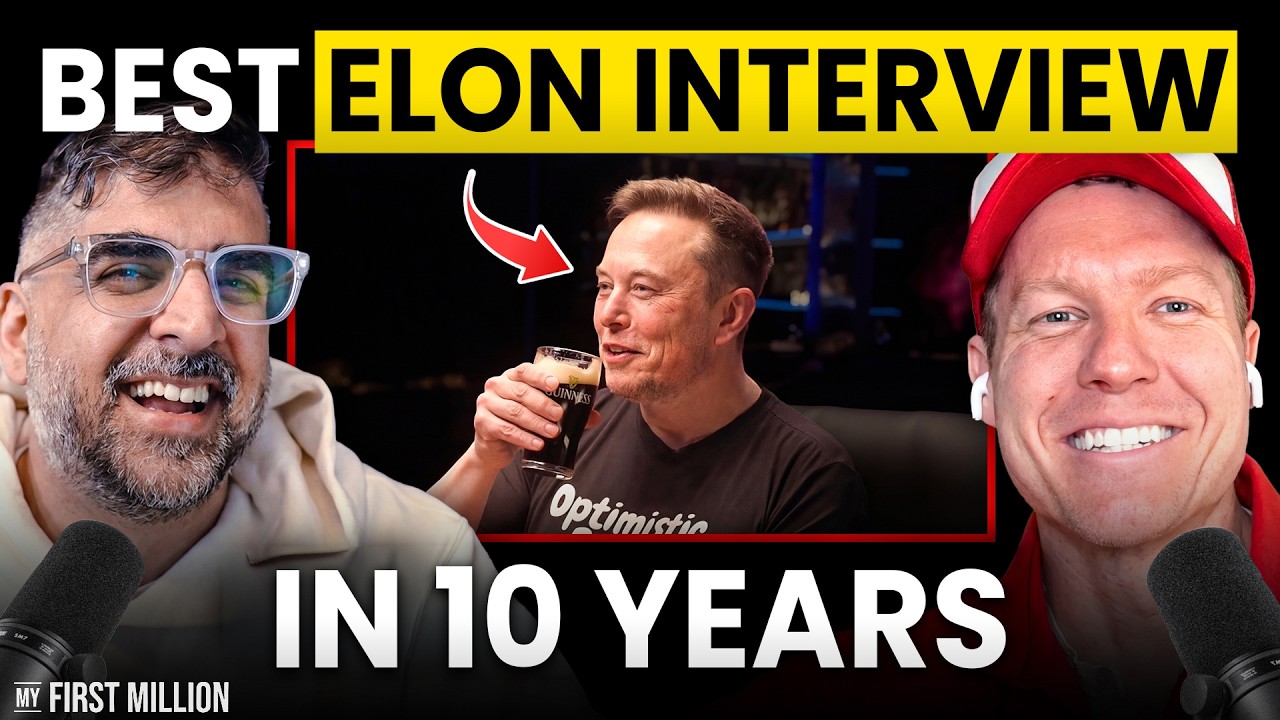
Elon’s recent podcast was business steroids
Summary
My First Million shares actionable Amazon selling tactics and market insights.
Full Content
Elon’s recent podcast was business steroids
Speaker 1:
He goes, if you get things done, I love you. And if you don't, I hate you.
Unknown Speaker:
I thought that was so great.
Speaker 2:
What a weirdo.
Speaker 1:
When I heard it, I was like, that's how Sam is.
Unknown Speaker:
Can I tell you about this Elon Musk podcast?
Speaker 1:
Did you did you listen to this Cheeky Pint episode with Elon?
Speaker 2:
I saw it, didn't listen to it.
Speaker 1:
You gotta listen to this thing. This is an amazing podcast.
Speaker 2:
Who's the Indian guy? I started seeing him pop up like out of nowhere.
Speaker 1:
Dwarkesh. Dwarkesh is a podcaster. He's got his own YouTube channel and whatnot. He is this unicorn because he's a really good podcaster. He's got good energy, good vibe. You like to listen to him.
He's like an authentic nerd in a way, but he's also technical. One of the reasons this podcast is really interesting is because normally Elon says something and he'll be like, I predict that in four years, we will have, you know, whatever,
10 more data centers in space than we have on Earth cumulatively. And then what me or you or Joe Rogan or any of us would do when he says that, oh my, whoa, that's crazy, man. How are you going to do that? That's all we're capable of.
Our little peanut mind can only do so much.
Speaker 2:
But Elon, that doesn't make sense because electricity doesn't work the same way in space or whatever.
Speaker 1:
Yeah, he was pushing back the whole time to where I was like, is Elon going to throw his drink in his face? What's going on here? Is he going to get mad that this guy keeps pushing back on every idea that he says?
And because he pushed back, so he would be like, but why do we need that? You're talking about this much energy. That could be done by this many solar panels. That could fit in just Nevada. So why do we need space to power this?
And then Elon would be like, well, here's the reason why, permitting and blah, blah, blah, blah, blah, blah. And he's like, but won't there be other problems in space that are just as difficult?
How are you going to fix a broken GPU when it's in space? What are you going to do for maintenance? That's going to be incredibly difficult to do when it's floating in space.
And Elon was like, you know, then had to come back with a counterpoint each time. So that was one remarkable thing about the podcast was somebody with enough technical acumen to on the fly calculate.
So Elon would say something about space and then he'd be like, so if you're going to do 10,000 launches, that means you're launching a starship every hour. Every hour you're gonna do a Starship launch?
How many have you done in the last, you've done like three or whatever in the last year? Is that even possible to do an hour every hour? And then Elon would be like, well, there's more planes than that taking off from airports, so yes.
And then they would go into why that's either correct or incorrect. By the way, it's really funny, because the founder of Stripe is sitting there, right? It was like a collab. It was on CheekyPint, which is made by the Stripe guy.
And he probably asked, five questions total in three hours. And Dwarkesh asked 500 maybe. But it was exactly what was needed. And shout out to the guy from Stripe for letting that play out the way it did. I thought it made for a great podcast.
Speaker 2:
Did he best Elon in anything?
Speaker 1:
No, no, it wasn't like a one-upmanship, but it was definitely a, I'm not just going to let you say that shit. Like, wait, So what do you know that I don't know? Because I would just think this.
And he would like kind of earnestly ask the question and he'd be like, okay, I buy that that does this, but I don't see the connection you made to this. And so he forced him to keep going, which I thought was great.
Speaker 2:
Did you feel the same sense that I feel when I see a white guy with 100 meter dash or like?
Speaker 1:
That's a national pride. Yeah Like uh, yeah, like when chris anderson white cornerback in the nfl Is that how you felt a little bit Actually, I felt scared for him. I was like dude tone it down.
It's a little crazy You just get a little you get a little feisty here. Uh, but he was also like autistically like, um unaware of like So I like, I can't not ask this. I have to ask this because I want to know the answer to it.
And I thought that was so great. He's so earnest in the way he does everything. It's great. Um, all right.
Speaker 2:
What are you like? What? What? What? Like high-fiving your wife, watching it.
Speaker 1:
Like a world star hip hop.
Speaker 2:
Yeah. Where we at? Where we at? Next.
Speaker 1:
I may or may not have bought a Dworkish, uh, you know, hoodie after that. Um, so can I tell you some of the crazy things that Elon said?
Speaker 2:
Did he mention Epstein at all?
Speaker 1:
He did not. They didn't go into they were they basically were like, we're going to use this time to talk about technology,
not like The world of politics like politics elon they like did a very minimal amount of that did a little bit on doge at the end but like not not much.
I'll tell you first just like a useful thing and i'll tell you something crazy things because the crazy things you're gonna be like we're both again gonna be like wow man but let's just do the useful thing so they asked about hiring so they were basically getting into their like so.
What are you doing differently than the rest of us? What is it that you're doing that's leading to all of this incredible, like individually any one of your companies is doing incredible things, right? SpaceX, trillion dollar company.
XAI came into the AI game like, I don't know, seven years late or something like that and became a $250 billion company.
Speaker 2:
I saw the XAI thing. I didn't even know what it is.
Speaker 1:
Have you ever used Grok? It's Elon's competitor to ChatGPT, which is, the product is called Grok. It's his revenge company, because when OpenAI kind of screwed him and did exactly the opposite of what he wanted, right? OpenAI, open source AI,
that's a non-profit and now it's a for-profit closed source company and he funded $50 million and now owns none of it. His revenge company was XAI. But again, seven, eight years late to the game and still caught up.
Tesla obviously worth more than the next 20 car companies combined. So it's like, you know, any one of these companies dominate. All of these companies, supernova, what is this? What's even happening? And so they're asking about hiring.
And they were like, you must have an incredible people because just by logic, there's no way you could be in five of these companies at the same time doing the things yourself. So you must have incredible people.
How are you getting these people? And so they were like, what do you look for when you hire? Because he hired, I guess, the first thousand people at SpaceX or thousand plus people at SpaceX. He interviewed them himself.
And he just goes, I'm looking for evidence of exceptional ability. And he goes, sometimes I would see a resume and I'd be like, this person sounds great. He goes, but I've learned you trust the conversation, not the resume.
So he's like, if in that first 20 minutes, I'm not saying, wow, I believe the conversation and I don't believe the resume. And he goes, all I asked them for in the interview is tell me about something exceptional you've done.
I'm looking for evidence of exceptional ability. And if they can't tell me a story, he goes, if they say one thing or, you know, one to three things that I'm just saying, wow, wow, wow. That's all I'm looking for.
Speaker 2:
When I heard you define that. Could it be like I was an NCAA athlete and I won?
Speaker 1:
He's looking for technical achievements or things you've built or done technically. And he was saying, it's not that I'm batting a thousand, right? I make a lot of mistakes. He goes, but at this point I have probably, to use the AI terms,
I have the most training data probably out there of hiring technical talent.
I've been doing this for a long time and I've interviewed so many of these people myself and I've gotten to see what worked and what didn't and then I revised my training. I have a big training set and I revised my own.
I RL'd myself and I did reinforcement learning on myself in order to figure out what should I actually be looking for? What do I actually want? And then they were like, they asked him this great question.
What do you look for in a sparring partner? What does it take to work well with Elon? And what do you want? And he goes, I don't want a sparring partner. I want you to execute well. If someone executes well, I'm a huge fan.
If they don't, I hate them. He goes, I don't care about my own idiosyncratic preferences. He goes, if you get things done, I love you. And if you don't, I hate you.
Unknown Speaker:
I thought that was so great.
Speaker 2:
What a weirdo.
Speaker 1:
You say that, I feel like you're the same way, dude. I literally feel like when I heard it, I was like, that's how Sam is.
Speaker 2:
Well, I just took Andrew Wilkinson's personality test. You see him tweet that thing out the other day?
Speaker 1:
Yeah.
Speaker 2:
Your boy's autistic, apparently. So that's literally what the test is.
Speaker 1:
Wait, why didn't we lead with that?
Speaker 2:
Yeah. Yeah. Breaking. Tell TVPN I need to get one of those little announcement things. What's the date?
Speaker 1:
This is better than your birthday. Feb 9th. That was your awakening day.
Unknown Speaker:
You found out the good news. The big A day.
Speaker 1:
Maybe now our podcast can get into the top, top charts here. We need to break into the top 10. We've been lacking.
Speaker 2:
Yeah, it turns out, capital A, autistic. And so maybe Elon and I, I don't know, maybe he's got the good type of autistic though.
Speaker 1:
He's got like the math one.
Speaker 2:
Yeah, we both got the one where we are just awkward in social situations and we say things like...
Speaker 1:
You got the social one and he got the math one. By the way, for anyone who's a fan, we say this with extreme love and a sense of humor about this.
There's a long running joke, which is like in San Francisco, like it's one of the highest status. It's one of the highest status things you could have. And that's where the origin of the joke comes from.
Speaker 2:
All right, so a lot of people watch and listen to this show because they want to hear us just tell them exactly what to do when it comes to starting or growing a business. Now, a lot of people message Shaan and I and they say, all right,
I want to start something on the side. Is this a good idea? Is that a good idea? And again, what they're really just saying is just give me the ideas. Well, my friends, You're in luck.
So my old company, The Hustle, they put together a hundred different side hustle ideas and they have appropriately called it the Side Hustle Idea Database. It's a list of a hundred pretty good ideas, frankly. I went through them.
They're awesome. And it gives you how to start them, how to grow them, things like that. It gives you a little bit of inspiration. So check it out. It's called the Side Hustle Idea Database. It's in the description below. You'll see the link.
Click it. Check it out. Let me know in the comments what you think.
Speaker 1:
Can I tell you another thing he said in this? So he was like, they kept asking, they were like, okay, so like, what are you doing differently? He goes, I just have a maniacal sense of urgency.
And he goes, I shoot for a deadline that I have a 50% probability of success. And people make fun of me because that means half the time I'm late, and I'm wrong about my deadline, and I miss my deadlines.
But it's worth it because He goes, work is like a gas. It expands to fill the time you give it. And so I just don't give it much time. And so, okay, that was good. Now let me tell you about some of the crazy stuff.
Speaker 2:
Wait, that's actually really interesting. I get criticized within my own company of doing that, of creating these super urgent, and people get worn out. And then Hermosi, who I think is a really smart business guy,
he preaches all the time of have patience and everything like that. That's a hard dichotomy to handle.
Speaker 1:
Yeah, I think it's sort of like, Long-term patience as in you're not going to give up and you're going to stay at it. I think short-term maniacal sense of urgency is on the task.
So it's like patient with the mission and maniacal about the task is probably the way to do it. So here's another thing that I picked up. He might have said the phrase limiting factor 400 times in three hours. Have you ever said that phrase?
So if one thing came out of this, it was how Elon thinks and works is you have a huge mission, right? We're going to go to Mars. We're going to build the first electric car company. We're going to build artificial general intelligence, right?
Like whatever it is. Huge mission. You have a maniacal sense of urgency. Great, that's the second component. And what's the third one? It's this idea of the limiting factor.
And so at any given time, all he's doing is he's sort of scanning for what is the limiting factor, as in what is the bottleneck that's preventing us from getting to the outcome sooner right now?
So for example, with AI right now, they're like, you're doing these space data stations, data centers. That sounds crazy. Why are you doing this? Why can't we just do it on Earth?
And he's basically like, well, To make AI smarter, we need bigger data set and more compute. And so you're either going to be limited by chips. Initially, we were limited by chips. So I started building chips.
So like Tesla's building like their own GPUs to like, you know, like the equivalent of the NVIDIA chips. And he bought the most, you know, he bought like huge orders of NVIDIA chips and,
you know, told Jensen, like, give me everything you got. The second thing is power. And so he's like, the limiting factor is now power, not chips. He's like, I suspect that actually in the next, you know, 24, 36 months,
there will be more GPU chips that can't be turned on. So the limiting factor will not be chips anymore. We're not constrained by chips. We will be constrained by power availability. And so they walked through.
They're like, so what do you mean? So why can't you just connect to the grid? And he's like, you can't connect to the grid for these reasons. Okay, well, why can't you do it off-grid?
Why can't you just buy a power plant and power your own chips, not connect to the grid? He's like, well, there's three companies that make the power plants and they're all booked out till 2032. We can't build the power plants fast enough.
There's not enough people or projects and time to build enough power plants as we're gonna need. And they're like, well, specifically, why? He's like, actually, it's the turbines inside the power plants that we cannot procure in time.
And there's this many companies that make the turbines. And actually, within the turbine, it's the blades and vanes that you can't do. And so we're going to try to make them at Tesla, but even that will take time.
And so we're limited by this. And so I'm throwing all my weight into whatever is the limiting factor at any given time in this business. And so it ended up with like, eff it, we're going to launch these data centers in space.
That's the way to get around this limiting factor. But over and over and over again in the whole podcast, it's basically like the formula is like identify the limiting factor and then go ape shit to get over it.
And most people don't do either of the two. They don't actually correctly address or identify the limiting factor. And then even if they did, they don't go ape shit, right? And so ever since this podcast, any meeting I've had,
so I check in with my portfolio companies and I've just gone full Elon on them where I'm just like, so we want this outcome. What's the limiting factor? And then the CEO will talk for five minutes.
I'm like, cool, you didn't answer my question. What's the limiting factor? Well, the limiting factor is X. Okay, great. Why are you talking about all these other things besides X? X is the limiting factor. So all we're going to focus on is X.
Okay, so what does that mean? Now, once you identify that, you need to drop everything else, just focus on X and then go apeshit on it. And he would say, he's like, in my companies, if something is going well, you're not going to see me.
Right now, the boring company is going well. I don't spend any time on it because it's going well. If it hits a roadblock and there's a limiting factor and they can't solve it,
then I will come in and I'll throw my full force, my full weight at it.
And I just thought this simple operating philosophy I think can serve a lot of people is to identify the limiting factor and then figure out how to throw your entire weight against it.
And sort of if you got to go over the wall, through the wall, around the wall, under the wall, whatever you got to do, you got to get past that wall. I don't know if you want to play the game, but right now, let's take Hampton, for example.
What's the limiting factor in Hampton? Thought exercise.
Speaker 2:
Yeah, so we basically only do two things. We get the best people to join a core group and then we allow them to have good conversations.
And so for us, the limiting factor in order to expand to chapters globally is to get more of the best people. So more people.
Speaker 1:
What's the limiting factor on more good people?
Speaker 2:
Well, I could probably make a list of five things that we could do. For example, we could ask for referrals more than we do. We could probably spend more on advertising.
Speaker 1:
So, okay, so those would be solutions, but just one level deeper into the problem. So, like, we have a lot of people, they're not good, or we have good people, but we just don't have enough of them, we don't have enough people applying,
period.
Speaker 2:
We're limiting our prospects to only 13 cities. So we need to open that up in order. We have thousands and thousands of people applying every single month, but we limit it only to 13 cities.
Speaker 1:
So what's the limiting factor of opening up 13 more cities?
Speaker 2:
Bandwidth probably of like having someone really focus on a particular city because once one person joins or a prospect shows interest in let's say Birmingham, how do we find seven other people who are interested?
And then the way that we will eventually scale that is we will instead pivot our business to where moderators are basically franchisees owners and they have to go and help recruit seven other people once we give them one person and so they're running their own little coaching business.
Speaker 1:
Right. And so a useful exercise in this case would be basically what's stopping us from doing it tomorrow. So let's say tomorrow you wanted to open 10 cities. What would actually break if you if you open 10 cities tomorrow?
Speaker 2:
Well, a customer would potentially be angry because they'd have to wait a long time until we found seven other people in, let's say, Birmingham.
Speaker 1:
And so then you say, is that true? Is there is there not? Do we have to have 10 cities? You need how many members? Like to activate that city?
Speaker 2:
Well, you just need one core group of eight people.
Speaker 1:
So you need 80 people, so you need eight per city. Do you have eight that are ready to open one city tomorrow or no? Could you open one tomorrow?
Speaker 2:
Yes.
Speaker 1:
Could you open two tomorrow?
Speaker 2:
Probably, maybe, but it would be hard. I would need more people. And then the question would be like, well, why do I need more people? Well, you know, why can't I just do it with less people?
Speaker 1:
Yeah, okay. So you start to get into like the nuts and bolts of it, right? But like, if we just even just look at what just happened, right, it was like, started with a high level problem. We need more power, right?
In your case, it was like, we need more good people. And then you got to turbines and blades and veins is the limiting factor, which was like, actually, Mississippi has four people, and we need eight.
That's the Turbines, that's the Blades and Veins level of detail. We need to do 10. Could I do one? Yes. Could I do two? No. What happened at two? Why did one to two break? Okay, there's a limiting factor somewhere between one and two.
What's different? What happened there? And also, a second ago, you were like, we could ask for referrals, we could do X, we could do Y. It's almost like we jump to solutions really quickly.
And what I think actually happens in these companies is we sort of already have in our mind a bunch of pet projects of good ideas, generically good ideas, but not specifically problem-solving ideas.
And I think the one big source of waste in companies is when everybody wants to do their pet projects or everybody wants to do their generically good ideas rather than the specifically effective ideas that are going to solve the current bottleneck that is right in front of us that we could unblock for tomorrow.
Speaker 2:
I think this makes sense. I think it's hard to pull off. I think that, like, it's hard to pull up just because of interpersonal relationships. A lot of people would, like, approach this and be like, well, I'm doing all these other things.
Like, how dare you, like, tell me just this one thing? Like, you don't understand. Like, how are we going to keep the business running? You know what I mean? That's the pushback mostly.
Speaker 1:
Totally. And I think that's, by the way, that's a very real thing. Like, hey, we're going to focus on this. And it's like, well, actually, you don't really realize I'm holding up this entire ship by keeping these six trains running on time.
And I have to keep doing that. So a lot of people, a lot of times I've seen this where it's like, I could tell the good people in my company, they're like, yeah, I hear what you're saying and I'm going to do that.
I'm not even going to like, I'm going to have to keep some of these trains running and we don't need to discuss it. I just know it needs to get done and blah, blah, blah. What I found is pretty effective is to address it in the call.
So what I'll do is I'll address The trade-off. So I'll say, so here's what that means. By focusing on this,
what that means is that this area where we actually know how to improve it and we have a bunch of good ideas and maybe even two things that are in flight,
we're actually just not gonna do any of those and we're gonna accept mediocre progress here for exceptional progress here. And nobody wants to say that out loud, but I'm going to say it out loud because it's true.
We have a trade-off of energy and focus and intention. And if we're going to move it all over here, that's what that means over there. We're all saying out loud, yes, we understand and accept this.
It's like accepting the terms and conditions when you sign up for a website. It's like, yes, you're going to sell my data. It's like, yep, over here, we're going to make far less progress than we want.
And I think this happens throughout life, right? You have a kid and you're like, wow, this is really important. Well,
guess what's going to be a little less important is like your work for the next three months and your gym routine is going to go out the window and you just have to like, you know, if you don't accept those tradeoffs,
you're just going to feel a constant underlying state of anxiety or stretch yourself too thin and do a poor job of everything. It's actually just better to say, great, for this season, this is what matters,
and I'm okay with a less than stellar rate of progress. I will only do this amount to keep this running, but beyond that, I will not be doing for this next period of time.
Speaker 2:
Are you good at not bitching at them about why this thing sucks? For example, for The Hustle, it was grow email list. Therefore, social media does not matter.
Speaker 1:
Why do social media suck?
Speaker 2:
Yeah.
Speaker 1:
Well, I give them permission to, I mean, we put the thing right in front of us, like front and center. I'm an obnoxious repeater. So like every day when I start my day, I will say, hey, here's our goals for the year.
Here's the things we said matter. Here's what matters this week. And I'm like a bot. But because I realize like if I don't keep repeating it, people don't even know what we're trying to do.
And we don't like, so I try to get a really crisp set of things, really crisp, clear set of things we're doing. And I will repeat it so much to the point that I myself remember we said, social media doesn't matter.
All that matters is growing email list. And they have permission to be like, wait, but social media doesn't matter. All that matters is the list. And it takes some time to work together where you kind of screw that up.
It's like, you feel like, why was this last month not as productive as we wanted? And then you sort of come to the powwow and realize like, well, it's because we said we were going to focus on these things,
but then we kept getting distracted and wanted to also do these five other things. And guess what? When we try to do it all, we can have anything, we just can't have everything all at once.
And you learn that the hard way, once, twice, and it's like George Bush, fool me once, shame on me, fool me twice, don't fool me again. It becomes that at a certain point.
So the good thing, I've worked with Ben for like six years, so we kinda know. We've stepped in that gum before. Do we really want that on our shoe again? I can kinda see it coming if we're gonna do this.
Or you're saying this, but remember, this is like that other time, so let's just stay focused.
Speaker 2:
You threw that George Bush quote in there like you were rapping.
Speaker 1:
Seamless.
Speaker 2:
That was great. What's the quote? Fool me once, shame on me. Fool me twice, don't fool me again.
Speaker 1:
Yeah, he like loses the quote. So he's like, fool me twice. You can't keep fooling me. It's like an old timer. Today's episode is brought to you by Hubspot. Did you know that most businesses only use 20% of their data?
That's like reading a book but then tearing out four-fifths of the pages. Point is, you miss a lot. And unless you're using Hubspot, the customer platform that gives you access to the data you need to grow your business,
the insights that are trapped in emails, call logs, transcripts, all that unstructured data makes all the difference. Because when you know more, you grow more.
And so if you want to read the whole book instead of just reading part of it, visit Hubspot.com. Can I show you one other clip that I thought was pretty just, I don't know, wild?
Speaker 2:
From Elon? Yeah. Is it the clip about how he lied about not going to Jeffrey Epstein's island?
Speaker 1:
No. Did he go, actually?
Speaker 2:
I'm not sure if he went or not, but he said that he refused to go. But the e-mails say that he was actually begging to go.
Speaker 1:
Yeah. Hey, we're going to be around the town. You guys got anything going on? Yeah, definitely. All right. Watch this.
Unknown Speaker:
Vastly more intelligent than humans.
Speaker 1:
So in some sense, you're like a doomer and this is like the best we've got.
Speaker 2:
It's just like it keeps it around because we're interesting.
Unknown Speaker:
I'm just trying to be realistic here. If we have, if AI intelligence is vastly more, if AI is like Let's say that there's a million times more silicon intelligence than there is biological.
I think it would be foolish to assume that there's any way to maintain control over that. Now, you can make sure it has the right values or you can try to have the right values.
Speaker 1:
I don't know if I think I might have picked the wrong time step a little bit there, but.
Speaker 2:
We're 50 minutes in and they barely drank their drink.
Speaker 1:
No, there's refills. There's refills. Well, one of the funny jokes is that Dorkash doesn't touch his pint.
He just keeps bringing it up to his mouth and it just wets his beard and then it goes back down with the same amount in it while the other guys are just like crushing them. All right, so here's what he says about AI.
So the topic is, how do you make sure that AI ends up being good for humanity? And he says something where he goes, They were like, how do you stay in control? And he says, if you have intelligence that's 100 times smarter than any human,
it's hard to imagine that the humans stay in control. And then the second thing, then they go, so wait, are you like a doomer here? Like, you know, you just think we're doomed? And he goes, I'm just trying to be realistic here.
If AI is vastly more intelligent, like there's a million more times silicon intelligence than biological, I think it would be foolish to believe that we can maintain control over that.
All you could do is try to make sure it has the right values, like kind of like basically it goes on like that it would keep us around. And I just thought that's a pretty stunning admission.
For a guy who's building AI to basically say out loud. This thing is going to be so much smarter than humans, and when it is, the idea that the chimps are going to stay in control of the humans,
that the humans are going to be in control of this thing that's a hundred times or a thousand times or a million times smarter than us is foolish.
Speaker 2:
It doesn't make sense to me because the ego is the reason why Napoleon's Napoleon. Does a computer have the need to dominate?
Speaker 1:
It's not even that it dominates. It's that we don't control it. So, for example, like if we say, cool, I want you to run all decisions by me, but it makes decisions a thousand times better than any human alive in the history of mankind.
Realistically, if you gave it the mission of being successful, is it actually going to run the decisions by you?
Speaker 2:
But that's what I'm asking. Does it actually have the mission to be successful? Like a human has...
Speaker 1:
Well, you're going to give it the mission. Even if the human is the one prompting it. Say, hey, I want you to make this thing really... I want you to help me become president. I want you to build this successful company.
I want you to build this technology. Do you think after that, it's going to care what you have to say?
Speaker 2:
Well, but you could turn it off if you turned it on. That's my point. Humans have a compulsion to be right. A lot of humans have a compulsion to be nice, to reciprocate. It doesn't have compulsions.
The way that you just told it to dominate or to win, can you also say, win less?
Speaker 1:
You might. Then the next guy says, no, I want to win. Stay on. All it takes is one guy to not turn it off, right? Like the same thing with one country to not have safeguards on it.
Speaker 2:
I've seen the AI social network where they're like all AI guys talking about like how they're going to dominate humans.
Speaker 1:
Yeah, although that might be kind of faked. It's unclear at this point if that's fake or real. It might be that humans are saying, say something like this because it freaks everybody out and goes viral. Have you seen this?
Elon tweeted this meme. I don't want to live in a world where someone else makes humans irrelevant before we do.
Speaker 2:
That is kind of how it feels. I hope he's wrong.
Speaker 1:
Yeah, even with SpaceX, you know, he's talking about, like, you know, the goal is, you know, the original mission with SpaceX is to, like, preserve the, they call it, like, the candle of consciousness.
Like, basically, like, what if something happened to Earth? If we're a single planet species, like, all consciousness could get wiped out. It should be really important that we're a multi-planetary species so that, like, you know,
human consciousness or intelligence, like, you know, lives on. And in this interview, he kind of backs off that. He's like, you know, consciousness, we don't really know what that is. So let's just say intelligence.
Because XAI just merged with SpaceX. He's like, so, you know, at least intelligence will propagate through the internet. It's basically like, the robots and the chips and the AI will definitely be multi-planetary, whether we are or not.
Like, he basically, his argument, and so Dwarkesh is like, why do you think that they would care that humans survive? And he's like, well, You know, there's no reason to kill us. That's not very reassuring.
It was essentially the way that he put it. He's like, you know, humans are interesting and we're part of consciousness. So like if you want to maximally expand consciousness, you would keep humans around, right?
There's not a big advantage to doing it. It's like, whoa. If that's the moral victory we're clinging to, this is a pretty startling thing. So I just thought that's a kind of crazy admission that he was making.
Can I tell you two other just insane things from this? So he's talking about what he's doing with his AI project, which I don't think he's ever really talked about before. Have you ever heard of this macro hard project?
Speaker 2:
What's it called? Macro Hard?
Speaker 1:
Yeah.
Speaker 2:
Like the 70 for 30, or what's that called? 70 for 70, where you got to like run a mile every day for 70 days? 70 Hard?
Speaker 1:
No, no, he made it the opposite of Microsoft. So he's like, what's the opposite of Microsoft? It's Macro Hard. And basically what he's doing is he's building what he calls human emulators.
So here's the Elon philosophy or the strategy that kind of got revealed during this podcast. So the strategy is, How do you win? Well, he goes, if you think in the limit,
what is the most that AI can do before you have robots that are artificially intelligent robots, which they're trying to build at Tesla, right?
So Tesla's building Optimus, which is the robot that can do any of the work that a human could do, and that's robots. He goes, so what is he doing with his software play? He goes, think in the limit.
Well, the limit is, If you're not in a robot, it's anything a human can do on a computer. And so he's like, basically, I think he says within like 12 or 24 months,
he believes that AI will be able to do anything that a human can do on a computer. So they're building what they call the human emulator. So it's a AI that can work, like do anything a human could do with a computer.
So like I have an executive assistant. So the idea would be, Obviously the AI would be able to do everything she does for me. So researching things, booking things, making anything happen, that's obviously there.
But also you and I doing this podcast. If we can do this online, that means the AI should be able to do this online. It should be able to produce an interesting podcast twice a week about business trends,
opportunities, ideas that are related to entrepreneurship for business junkies just like us. And it should be able to have a sense of humor, but bring to the table three or four really interesting topics per episode.
So AI should be able to do that because this is done online. So he goes, anything that's moving electrons, the AI should be able to do. And they go, well, how are you trying to solve that?
And he goes like, so do you want me to just give away all my secrets on a podcast? Like that would be sort of stupid, right? Like I'm in the most competitive game in the world right now is to create this.
He calls it the highest Elo battle in the world. Like, you know, the chess rankings, like your Elo ratings.
Speaker 2:
Dude, Elon needs a wedgie, man. This guy's hilarious. Macro, hard, human emulator. This is crazy.
Speaker 1:
So he's like, you know, he's like, it'll take at least three more beers for me to get, you know, to reveal that. But he's like, it'll be something like the way that Tesla solved self-driving.
And then they were like, okay, unrelated question, how did Tesla solve self-driving? And he's like, well, what it did was it used very basic sensors, the same sort of sensors that humans have,
in this case, mostly cameras, eyes, vision, and it watched humans drive a lot, like millions and millions and millions and millions of miles. And then it tried to emulate what they would do.
So it tries to while you're driving, it tries to guess what you would do. And anytime there's a difference,
it notes it and it tries to learn from other people in similar situations until it can basically match what a human would do while driving. And that's what Tesla Self-Driving does.
And so similarly, what they're doing with the human emulators is they're basically getting tons and tons of data of humans using computers. And they're using that to teach computers how to use computers.
And that's where this is going for MacroHard. And then he talked about on the robot side.
Speaker 2:
Is MacroHard a company?
Speaker 1:
I don't know if it's a project or a company. I think it's a project within XAI. I don't think it's a separate company.
Speaker 2:
How many people work at XAI? Is XAI considered Twitter now?
Speaker 1:
They did merge. XAI and X merged and now that merged with SpaceX.
Speaker 2:
Crazy.
Speaker 1:
And okay, so now let's talk about the robots thing real quick. So he goes, the optimist robot, he goes, it's the infinite money glitch. Because labor is the biggest market in the world.
And if you can have robots that can do human labor, And specifically, once the robot can build more robots, that's the infinite money glitch. So basically, once the optimist can build more optimists, it's over.
And they were like, well, how will you do the emulator thing? Because Tesla made sense, right? Humans bought the cars and drove them around. So that gave you all the training data of how to drive.
And with MacroHard, theoretically, you could have a bunch of humans using computers and emulate it. But how do you do the robot one? There's not enough robots to learn from.
And so he said he's building this warehouse where 10,000 robots will be able to self-play.
So it's basically this giant warehouse where 10,000 robots are a bunch of toddlers walking around trying to figure out how to do tasks like pick this up,
move this here, try this, work together on this, you know, build this box without it breaking, you know, whatever. And they're not going to tell them how to do it.
They're just going to self play over and over and over again until they figure it out the same way.
Speaker 2:
They're going to come in after three weeks and they're going to be like trying to like solve the bars to get out. You know what I mean? Like they're like escaping prison.
Speaker 1:
So this is how they built the best chess engines and Go engines was instead of telling it strategies and rules, they just said, play 10 million games and figure it out.
All you know is the rules of where the pieces can move, like this pawn can move forward, the bishop can move diagonally. That's all we tell you. And we'll tell you that winning is good. Go.
And it played like 10 million games and it became the best chess player in the world. They did it with Go, it became the best Go player ever. Now he's doing the same thing with robots. But I thought, how crazy is that going to be?
There's just this self-play warehouse where the robots are trying to figure out how to do stuff.
Speaker 2:
Where is it going to be? Where's this going to be?
Speaker 1:
I don't know, he didn't give me the address, but it sounds pretty awesome, right?
Speaker 2:
They got to put like, you know, they got like puppy cams, live cams, like doggy daycares. You know, we need that.
Speaker 1:
Tell me I wouldn't be watching that thing four hours a day.
Speaker 2:
This is like, whenever we talk about this, my fight or flight response goes up hardcore.
Speaker 1:
Can I ask, what's the, okay, so I have this theory that basically A thing happens. We give it a meaning. The meaning just decides the feeling. You told me about the thing happening, hearing about all these exciting AI breakthroughs,
and you told me the feeling, which is like kind of fight or flight, fear, anxiety, exhaustion. What's the meaning you're putting on all this that's making you feel that way?
What does it mean that Elon's doing this or that these tools are rapidly advancing or there's new tools every day? What's the meaning you're putting on that? I'm falling behind?
Speaker 2:
You either got to get on or get off, and you have to adapt faster than ever before in order to keep up. And all these opportunities are flying by. And what's the phrase? Opportunities are like trains.
Thankfully, there's always another one, but these trains are moving real fast. And I don't even know if I can grab it, if I don't catch on when it's at the stop.
Speaker 1:
And what happens if you don't catch on?
Speaker 2:
Well, I'm lucky. I'm at a point in my life where if I don't catch on, I just...
Speaker 1:
Nothing.
Speaker 2:
I'm safe. But as an opportunity-loving entrepreneur, you do feel FOMO. And also, there is fear. There's a bit of fear, but it's weird. You have to think about it. I'm lucky.
I'm not fearful entirely of myself, but I still feel that humanity is changing and it's scary. It's just change, and change is good and bad, but it's just like the speed of things. It is incredible.
I mean, I remember in 2021, my friend was telling me about OpenAI and thinking about joining the company, and I was like, I don't know, man, is this legit? Like, who knows? That was only five years ago.
And it's like, our parents use it, you know? It's pretty...
Speaker 1:
My mom uses it constantly, which is crazy.
Speaker 2:
It's astounding. It's crazy. It's wild. And there's a different tool every single day, and they're so good.
Speaker 1:
Yeah, I guess I just, I think we should leave it with the optimistic version of that, which is there's never been more opportunity than this. If you're good, you get to lever up and whatever your output was going to be,
you can sort of 10 to 100X that using these tools. You don't need to use all of them. You don't need to catch every opportunity. Catching any piece of this is going to be huge.
Catching any piece of this at all is going to put you in the top 1% because if we're feeling this, we have to remember the whole world is not If it's all about change and adaptation, who better than us?
Who better than the type of person that listens to this podcast than to take advantage of that? 99.99999% of the world doesn't even listen to a podcast like this.
If you're listening to the podcast like this, you're already in the 0.0001%. of adaptability, of change, of future promise. And so you're better positioned than anybody to take advantage.
Yeah, the problem is we compare two decimal places over and we're like, but Elon's doing this, but this guy's doing this, right? And it's like, you don't have to be them to win. In fact, we sort of stand on the shoulders of giants.
Speaker 2:
I have a friend who was telling me his father owns a nursing home company or something like that. It's like at-home care. And he's like, my dad's in his 70s. He lives in the Midwest in Missouri.
The business does 90 million a year in revenue, 8 million a year in profit. And I told him about AI and he had never heard of it.
Like he didn't even know what that word meant like it wasn't even like and he's like I went to his office and it was like 80 employees and they all look like the same woman over and over and over again of like,
you know, you've seen Ferris Bueller's Day Off like the secretary like with like that haircut. It's like they like that word AI. They literally didn't know what it was and it's just crazy how I'm like, how much do they spend on payroll?
He's like, they spend $8 million a year on payroll. And I was like, what are they doing? And he explained, I'm like, that's crazy. That one little business that you've never even heard of in the middle of Missouri,
that just unlocked $8 million a year probably in value that someone can go and do.
Speaker 1:
Alright, let's take a quick break because I got to tell you a story. Let me tell you about the first time I tried to run payroll for my team. I was using a traditional bank and you know the type. It's got a janky interface.
It's built like a 2002 tax form and it was open only during business hours and I hit send and it froze. They flagged the transaction. They locked my account.
They put me on hold for 45 minutes and then they told me I got to visit my local branch. And that was the day I started looking for a new banking solution. After asking a few founders what they were using, I found out about Mercury.
And so now my payroll is two clicks. I can wire money, I can pay invoices, I can reimburse the team, all from one clean dashboard. That's why I use it for all of my companies. And so do 200,000 other startup founders.
And so if you're looking to level up your banking, head to mercury.com and apply in minutes. Mercury is a financial technology company, not a bank.
Banking services are provided through Choice Financial Group, Column NA, and Evolve Bank & Trust members FDIC.
Speaker 2:
Alright, listen, Shaan, you're getting dumber.
Speaker 1:
Am I?
Speaker 2:
Well, we all are. So I'm reading this book called Stolen Focus because I'm basically incredibly depressed by the fact that I get 10,000 notifications a day and it's impacting my mood. And so I saw this book called Stolen Focus.
Have you ever seen it?
Speaker 1:
Well, I saw it, but then I left away.
Speaker 2:
Great. Good joke. But it kind of got me interested, and it's coincidental. Just last month, this one neuroscientist did this thing in front of Congress, this testimony or whatever in front of Congress,
where he basically said that this is the first time in history of measuring this, since the 1880s, that the current generation, Gen Z, is dumber than the generation above them. So have you heard of the Flynn effect?
Speaker 1:
No.
Speaker 2:
So basically, since like the 1800s, since like we started like measuring IQ at a large level, every generation is roughly 10 points higher than the previous generation.
So every 30 years, it goes up by 10 points or every 10 years, it goes up three points, which is kind of cool because that means that the average person today would have been gifted in like 1900.
And so it's been going up for a variety of reasons. One, education, diet, a bunch of different stuff. But starting in 2010, they noticed a decline. And this isn't just in America. It's in Norway.
They noticed this in a bunch of different countries. I think 80 different countries have actually studied the same thing. This isn't just an American thing. But starting since 2010, there's been a decline.
And so now officially, according to like, I think a sample size of like 800,000 test subjects, Gen Z is the first generation, I think since 1800, that has a lower IQ from the generation before. Is that insane?
Speaker 1:
They blew it. We had it going. We had a trend going. We had a streak going. So, the Flint Effect is the long-term study showing an increase in standardized IQ test scores observed through the 20th century at about three points per decade,
as you said, primarily due to environmental factors such as education, nutrition, smaller family sizes, more technology rather than genetic changes.
It's most significant in tests measuring fluid intelligence, which is problem-solving, rather than crystallized intelligence, which is acquired knowledge.
It highlights that intelligence is heavily influenced by environment, blah, blah, blah. Okay, great. And then you're saying recently it's not holding. Gen Z is the first generation to score lower than their predecessors.
And they have just this picture of someone as the headline article, which is always great.
Speaker 2:
Gen Z is like gayer than ever before. They like zoom in on you.
Speaker 1:
Dude, I'm never just going to, I'm never just going to pose for a picture without asking what it's for again.
Speaker 2:
Gen Z is that I think 2010 onwards. So people who are like 16 years old, I think maybe 10 to 16, something like that. Is that right?
Speaker 1:
I thought this was like Gen Alpha, 97 to 2012. Sorry, I got that way off.
Speaker 2:
Yeah, you're right, Gen Alpha. Okay, so they're like, what, 25 right now? And so what, you can guess probably, what do you think has caused this?
Speaker 1:
Well, yeah, just seems like the sort of brain rot, the brain rot consumption, right? Like it's like diet. Why are we getting fatter? And then you go to the grocery store and you see that a grocery store is basically lead gen for a hospital,
right? It's just the sugar factory. So, yeah, so, you know, it's not a big surprise.
Speaker 2:
So the correlation, and I think there's causation proof, but the correlation is certainly the rise of smartphones and social media.
It kind of got me thinking, like, I think that we talked about inflection points on this podcast about businesses. So inflection points means a tech inflection, meaning everyone has a smartphone and thus we all have GPSs,
therefore new businesses can launch like Uber because of it. Or a regulation inflection. During COVID, doctors were able to prescribe medication virtually, so that created telehealth.
I think that we haven't gotten to the inflection point yet, but in the next 10 to 20 years, we're going to see an inflection point with a variety of cultural changes, a cultural inflection and potentially a regulatory inflection.
I actually think there might be something there. We're going to see a lot of different opportunities in businesses and just cultural change due to the lack of focus. We call this a focus or attention inflection.
I think that we're at the very early stages of that. I had some ideas that I think could thrive there, but I wanted to hear Have you noticed this in your life? Have you noticed that you are changing your...
Is there a household inflection going on?
Speaker 1:
We're all getting dumber, you mean?
Speaker 2:
No, well, you're combating this.
Speaker 1:
Well, yeah. So the first thing to combat this over the weekend, my wife was like, oh my God, did you see what Trump tweeted? And I was like, no. And then an hour later, we were... And then that conversation happens.
An hour later, they were like, oh, you hear about the... The news anchor whose mom got kidnapped. And I was like, no. And then there was like another third story. And again, I was like, no, don't know anything about that.
And I think I've been totally fine without it. And I kind of realized I had this like, I don't know. You know when you get happy that you're better than everyone else? That's kind of where I was. I was in that beautiful state of mind.
I was in a smug, smug state of mind.
Speaker 2:
California has a smug problem, doesn't it? Yeah, exactly.
Speaker 1:
I went to the emissions shop and sure enough, smug check.
Speaker 2:
You did not pass the smug check.
Speaker 1:
I did not pass the smug check because I don't listen to the news. I don't watch the news. I was thinking about this and I was like, dude, imagine if every day you just woke up And then instead of focusing on your life,
you just said, distract me with everybody else's problems. And then the people would tell you about a problem happening 3,000 miles away, another one happening 9,000 miles away,
another one that happened 10 years ago, and one that might happen 10 years from now. And then your brain gets to think about all that shit instead of what's going on in your life.
And that's essentially what it is if you're a regular consumer of the news. And the news is one of these things that today at least there's like a half warning label on it, but the warning label is like fake news.
It's like you need real news, not fake news. And actually the answer is less news. You just need way less news than you're currently consuming. You don't need to know the stock price right now.
You don't need to know the Bitcoin price right now. You don't need to know what's happening in D.C. You don't need to know any of that stuff. And I think and some people will argue the exact opposite.
They'll say, oh my God, you're so uncivically minded and You really need to care about what's going on with other people in the world.
Speaker 2:
And you're like, guys, it's not my ability to not watch the news. It's the fact that I lied to get out of jury duty and I told them that my wife is a drug addict and I had to be home with the kids. That is why I'm not civically minded.
Speaker 1:
Yeah, this is not the correct argument. This is not the correct evidence. I've given you the right evidence for that. I would say on the whole, an overconsumption of news I've seen this as one major leak people have in their life.
I guess the answer is not zero, but definitely not the set point that most people have. It's like your thermostat is set to 88 degrees in their house and they're wondering why they're sweating all day.
There's just overconsumption of content in general, one of which is news and then the other is social media. I told you my challenge this year was I deleted all the social media off my phone.
And so, well, that definitely changes things, right? Because I get back a couple hours a day of time and attention. But it's not even really the hours, it's kind of the moments.
It's like, oh, like every time I open my phone, I type in X to open Twitter.
Speaker 2:
It's weird, right?
Speaker 1:
And all my phone has is the Xfinity app. And I'm like, I guess I could check my internet speed right now. That's all I could do.
Speaker 2:
It's like when you were a grown up and you would sit down and you'd start reading the back of the cereal box or when you're on the toilet, you like read the shampoo ingredients.
Speaker 1:
No, seriously, that's happened to me all the time now. So I'm like, OK, what the hell am I going to think about? You know, like and then I think about important things and think about things that are like really meaningful to me,
like what I'm going to do that day, my time, my precious asset. I think about my kids and where they're at. And I think about I start thinking about other things because I created space.
And I think that space is the thing that most people are lacking nowadays. So yes, in my household, I have felt this, especially this year, because I deleted social media and I was totally, like anybody else, a social media addict, right?
And it became more obvious than ever that, like, you don't notice the addiction until you feel the withdrawal. And that's, you know,
the phase that I went in the first month of this year as I deleted all these apps is the withdrawal of like, I keep checking my phone. I just keep getting into the Xfinity app.
Speaker 2:
I'm like a fact checker addict. Like I I get addicted to social media, but then it's like someone will be debating something Try to see if it's right. Like how old's Tom Brady? You know what I mean?
I'm like, well, I'll just tell you right now or you don't like, you know, like we were debating you like man Trump's, you know, 76. That's so old.
Speaker 1:
Right.
Speaker 2:
Actually, you know like you Useless facts.
Speaker 1:
Yeah, like if I type I right now for Instagram I get Instacart And I get iAqualink, which controls my pool temperature. Those are my options for distraction, for voluntary distraction from the world.
Speaker 2:
So my prediction is that we are going to look at this problem the same way we look at obesity. We're going to look at this stuff and we're going to say there are some people who can just put it down and just walk away.
There are some people like, well, just stop. Just don't do it. It's like, well, but this processed food is addicting and it triggers something in my brain and it makes it almost impossible.
So I think that what we're going to see is that this is going to shift from what it is now to like either we ignore it or we think it's just like a small problem to it's an environmental problem. And there has to be changes.
And I have a few ideas like on what could be cool. But I think that this is...
Speaker 1:
You referenced another study before that I thought was fascinating. Explain that one again, the train classroom study. I thought this was like... A really important, do you remember this one?
It was like something about the noise from a train and just that like a train went by in the classroom was lowering their score. What was it again?
Speaker 2:
Yeah, so basically the hypothesis was, does noise interruption impact people's focus? And a study looked at something like two or three or four hundred thousand children in school in fourth grade,
and they looked at kids that were under an overpass of a train or nearby a train and kids who weren't.
And they found that the kids that read silently without the interruption of a train passing by retained information significantly higher. I don't remember the points, but basically just that decibel level, even if it was a intermittent,
it significantly impacted their ability to retain information that they were reading.
Speaker 1:
Right. But did you see the Pavel Durov tweet he had on New Year's? Did you see this thing? Okay, so Pavel is the founder of Telegram, which is like one of the biggest messaging apps in the world.
He also started one of the biggest social networks in the world before that. It's like the Facebook of Russia.
Speaker 2:
Isn't he like the father of a hundred kids too?
Speaker 1:
Yeah, and he's like built like a Greek god and he's brilliant and he's super rich and he's got a great jawline. I can't say enough good things about this guy. I don't know if you know the story.
When they asked him for access to all the data and they wanted a backdoor, he said no. And then they sent him like an official notice and he sent back an official response, which was a dog wearing a hoodie, like flicking off the camera.
And then he left the country and then they took his social network. But he was like, fine, take it. But you're not going to I'm not going to give you access. He tweeted out this year, he goes, this year I wish you less.
Less information, less food, less entertainment, less communication, less stimulation. You already have too much of that and it stands in the way of your serenity, health, sleep and creativity. Merry Christmas.
And I just remember like that really stood out to me and I like it and obviously I agree with it but the part that I think is more interesting is this guy created one of the biggest messaging apps and social networks in the world.
He doesn't use his phone.
Speaker 2:
So I don't know anything about that. What do you mean he doesn't use his phone?
Speaker 1:
He doesn't have a phone. He's like, if something needs to get to me, like... Somebody will bring me the message if it's really important. And he's like, I just don't use or look at my phone.
I think it's either at all or most of the day, he does not look at a phone. And he was like, and then Steve Jobs, he'll invent the iPad and the iPhone, but at home, his kids don't use it. Zuckerberg, his kids aren't on social media.
Do as they do, not as they say, that you should do. You guys should use this, but we're gonna do this. I don't know what the executives at Kraft do or the food scientists at Kraft do,
but I don't think they're giving their kids Kraft mac and cheese every day. You should have it, for sure. Please buy it. But we're not gonna eat that shit. And I think that that's kind of where I stand with the Social distraction, focus.
Obviously, it's super hard, right? But it seems like the fight worth fighting is kind of what you're bringing up here.
Speaker 2:
Well, I personally think that, yeah, I think it's a fight worth fighting, but I'm just acknowledging that this is going to be a trend.
I think that what we're going to see is that there's going to be like these classes where like the upper class, the rich people who don't have to be on their phone or computer all the time, they're going to know that this is an issue.
Sort of like, it's a little bit different now, but sort of like In the 90s and early 2000s, whole foods was a luxury. So health food was a luxury. And so I think that's what's going to happen here, which is sad,
but I think that's just probably naturally how things are kind of tend to play out almost all the time.
Speaker 1:
We've seen this on the podcast. We've had guys who come on here. Remember, there's one guy who owns an NBA team, he's a billionaire. And we were like, are you doing this podcast from a phone? And he was like, yeah.
He's like, I don't own a laptop. And then we were like, can you move the thing? And he's like, there was somebody, he's like, I don't know what this is. He's like, somebody set this up.
Speaker 2:
I'm here.
Speaker 1:
And then I'm leaving. And this is, I don't really even understand what this is. And yesterday, sorry, not yesterday, last week, I did a call with a guy who's the richest guy of a country.
Not the biggest country in the world, but he's the richest guy of that country. So, you know, this is a very wealthy multibillionaire probably worth 10, $20 billion. He was trying to screen share during our call.
And he's like, he's like, we were in Zoom. And he's like, I'd like to show you this, but, and I know I can, but where do I go? And I was basically tech support for this guy. I was like, look at the bottom of Zoom. There's a thing called share.
It's like a little square with a thing. And he's like, okay. Oh, it says I need to have a, a different browser. And we were like, are you not using Chrome? He's like, no, what is, what is Chrome? I was like, wow.
He's like, yeah, usually people do this stuff for me. I've like abstracted myself away from Like my computer, from tech problems, from having to like set these things up and be like,
you know, to do this stuff myself, to be hands-on with it. And I feel like there's, like you're saying, like a, almost like a wealth or a status thing here where like the wealthier you get,
the more you're going to be able to abstract yourself away from some of these tools, right? From digital, you know, digital dopamine.
Speaker 2:
Yeah, yeah, I for sure think that's gonna happen, but I think that it will get to the masses eventually. I think that's just like how things work. I think that, so listen, tell me what you think about these two or three ideas I have.
So I think that, have you ever done a VO2 max test?
Speaker 1:
No.
Speaker 2:
Do you know what it is?
Speaker 1:
Yeah, you put on a like a Bain oxygen mask and you run on a treadmill, I think.
Speaker 2:
Basically, yes. No different than like the combine idea you have. It's just like a way to measure how good is your heart.
You use it oftentimes to figure out where's your max heart rate and at like what level can you run comfortably in zone two for an extended period of time. That's like why endurance athletes use it.
Speaker 1:
So you exercise on a treadmill or bike with increasing intensity and the mask you're wearing analyzes your oxygen consumption and CO2 production until you reach exhaustion. OK, gotcha.
Speaker 2:
And so I think that we can I think here's a business idea. I think that we're going to see like a VO2 max. Test for attention. It sounds hilarious. I'm telling you, I think this is going to be a thing.
Speaker 1:
What would that even be? You just sit in a room and they see how long it takes you to like, it's like the Marshmallow test. It's like how long it takes you to pick up the phone.
Speaker 2:
Have you ever felt like, this is kind of, this is, I don't know exactly how to explain it, but have you ever felt like your nervous system being fried? Where you're like, I'm just like, my anxiety was too high.
Like I just, I've been, I was in, um, fight or flight too much. Have you ever felt that feeling?
Speaker 1:
A hundred percent. Yeah.
Speaker 2:
Do you ever get that looking at your phone?
Speaker 1:
I get it all the time. What it should be is that you're in the normal state, which I think is called parasympathetic or whatever nervous system, and then you go into fire flight when there's this extreme stimulus.
I think for me, it's almost the opposite. I think for most people, it's probably the opposite in modern day, which is You're always running with this sort of baseline anxiety,
fight or flight type of response, and then you remind yourself to take a breath, go for a walk, put it away, and you sort of come down off of it, and you re-regulate yourself.
Maybe I just live in San Francisco, and I'm around too many kind of tech addicts, but I think it's almost, whatever the ratio is, it should be like 90-10 or whatever, I think it's almost the opposite, or it's 50-50. Of course.
It's a terrible ratio.
Speaker 2:
And I believe that one of the best ways to lose weight is to weigh yourself every single day. What gets measured gets changed. And I think that we could see you can measure like your nervous system.
There are ways to measure your resting heart rate. And like, for example, just like pulling up your phone, your heart rate could go up. I mean, there are ways to do it.
I don't know exactly all the ways, but I think that There's this huge group of people doing pre-novo, all these measuring things, and I think that we are gonna see this for nervous system or attention.
It'll be advertised towards, let's see where you rank or where you are in terms of attention, and we're gonna tell you how fried you are, and then we're gonna give you a plan on how to get unfried, and you can come and measure it.
You can come and re-measure your body fat in six months.
Speaker 1:
Yeah, I think that's very true. When I've been coaching this basketball team, one of the things I find myself saying a lot to the guys is concentration is a skill.
Because, you know, the players, when they come into the gym, they think, you know, through the legs, behind the back, you know, whatever. And they think that's the skill they need to do well in the game.
And I'll tell them, like, how often do you do this move? Pretty much never. That's not even your role on the team is to do moves like this to score. For the most part, what we want you doing is playing really, really,
really hard and concentrating on the task at hand, like being where you're supposed to be during the play, focusing on where the ball is versus your man versus whatever.
And we have some really talented guys who don't get in the game because we don't trust their intensity or their concentration. And I've been trying to tell them those two things are a skill. They don't sound like skills.
They sound like effort. But effort's a skill. All of these things are a skill. There's a guy on our team, Sam, who's not the most talented. But his ability to ratchet up his intensity and then sustain that throughout the game,
he's puked during three games this year. He plays so hard, he throws up in the middle of the game. And that's the only time he comes out of the game is to throw up, basically, and he goes right back in.
And I'm like, do you need a towel or some water? What's going on? He just goes straight back in. It's incredible. And I've realized that intensity, concentration, the ability to be maximally present These are not just kind of nice to have,
like soft things. They're hard skills. And you actually need to practice them and get better at them. And like what you're saying is, if it's a skill, then it can be measured. And if it can be measured, it can be approved, right?
And so on and so forth.
Speaker 2:
All right, I'll give you two quick more. I think we're gonna see, remember, you know, what's it called? Kumon?
Speaker 1:
Kumon, yeah.
Speaker 2:
Kumon, it's got the worst logo ever. It's like a sad kid's face.
Speaker 1:
They hired the artist. They were like, just observe and then draw what you see.
Speaker 2:
Yeah. I think we're going to see a Kumon for focus for kids. I think kids are going to be impacted by this. They're going to learn exercises and stuff for focusing. I think we're going to have like a Maria Kondo. But remember Maria Kondo?
I think we're going to have a Maria Kondo. You know, Maria Kondo was this, I think she was Korean lady who was famous for organizing.
Speaker 1:
I guarantee you're saying her name wrong, by the way. Maria Kondo?
Speaker 2:
Marie Kondo.
Speaker 1:
That's like a Latina who's a real estate agent. Maria Kondo.
Unknown Speaker:
Her name is Marie Kondo.
Speaker 2:
Oh, come on. I was a Korean lady and all I got wrong was the Maria versus Marie. Hey, Maria, like, come on, give me a break. All right.
Speaker 1:
It wasn't as far as off as I thought.
Speaker 2:
Yeah.
Speaker 1:
So like an influencer who's all about the tidiness of the mind.
Speaker 2:
Yeah. And they're going to, like, use their program to create coaches who are going to, like, come and talk to you and like, it makes sense.
Speaker 1:
Like, I think that probably the number one affliction for kids is like ADD, ADHD. Right. And then you have to medicate and all the stuff. And it explains why you're bad at school when it's like, I don't know.
I've seen that same kid focus at Fortnite and Roblox for four hours straight. So what's up with that? Like, perhaps they're just not that interested or the school is not that interesting to them because when they're interested,
they seem to lock in.
Speaker 2:
And also they've not used that skill and they need to learn that skill because they're like been fucking on TikTok and it's like swipe, swipe, swipe, swipe, swipe.
Speaker 1:
Yeah. So I think you're absolutely right about that part of it. I also think this is gonna happen for adults. So, you know, the idea of a gym today seems totally normal.
But if you rewind, I don't know, 200 years or something like that, you're like, yeah, see, what's gonna happen is we're gonna spend all day sitting Because we're gonna have this like box that we work on,
you could use your fingers only to just type on the box. And then because our body's not gonna get any, we're not doing any actual work,
like the thing you think of as work today, like agriculture, you know, any sort of like lifting of objects. We're gonna go to this other box, this other place, and they're gonna just have weights on the ground.
And you'd be like, what do you mean weights? It's like, it's just like a heavy thing. And you're gonna pick it up, put it down. Yeah, you could do it 10 times for three sets. And then they're just going to go home. And you go, what?
Why would they do that? That's crazy, right? And it's like, well, that's what happened. Basically, the more we got away from doing manual labor, we then created this demand, this need for stimulating our bodies with weights.
Well, I think the same thing's gonna happen for intellectual stuff, right? Like already people are like, well, I could either think about this or I could just ask ChatGPT to think about this.
And you just outsource the idea of critical thinking. So I think there's gonna be a place where you go that's essentially the gym for your mind. It's a good place you go with a bunch of puzzles,
a bunch of thought experiments and riddles and shit like that. And it's gonna be a gym for the mind and it's gonna be where you go to keep your mind active because most of your thinking is now done by the AI chip in your brain, right?
This seems like if you fast forward 50 years, either we're just gone Or we have to come up with some way where we're going to exercise our mind because so much thinking is going to be done by, you know, digital intelligence.
Speaker 2:
And the last thing is Justin Mares came on our podcast and he told us about this business that he has or he helped fund. I forget his association, but it was basically Justin Mares for the listener.
He's like our buddy who's like a health freak and he has an amazing company called Lightwork. I gotta give them a shout out. Lightworkhome.com. Okay.
Speaker 1:
What is this?
Speaker 2:
My wife did it. They come to your house and they kind of inspect it to figure out where things are not healthy and where they are. And so they looked at like some of the basic stuff like do you need different air filters on your AC,
which like everyone does. But then they did other stuff. Like for example, they educated us like I have a Wi-Fi router like right in my bed stand, like next to my head. And they're like, check this out.
Like the EMF is coming to your head right here. I didn't know that.
Speaker 1:
As he wears a hat right now that says Midwest Trash on his head.
Speaker 2:
Or they'll be like, look at your pillows, what they're made out of. You're sleeping on plastic. For us, it was like we needed more plants in our house because the CO2 levels was shit. It was like a bunch of stuff like that.
It's pretty interesting.
Speaker 1:
Did you end up like, here's my fear with this, right? I do this and then anytime somebody audits my thing and tells me where something's bad, I'm immediately like, the sale is done.
It's like, well, all right, is this a $100 fix, $1,000 fix, $10,000 fix or $100,000 fix? What's the damage here? So did you end up doing a bunch of changes?
Speaker 2:
My thing was mostly like reorganizing or small fixes. I'm also renting, so I'm not going to change the paint. But I think that we're going to see what he's doing, but for digital products.
Speaker 1:
Feels to me like today that's something we should do, but nobody wants to do. And at some point, you're right, the inflection, it'll tip. It'll go that way.
Speaker 2:
It hasn't happened yet, but it will.
Speaker 1:
It's not there yet.
Speaker 2:
Alright, is that it?
Speaker 1:
That's it.
Speaker 2:
That's the part. All right, my friends, I have a new podcast for you guys to check out. It's called Content is Profit, and it's hosted by Luis and Fonzie Cameo.
After years of building content teams and frameworks for companies like Red Bull and Orange Theory Fitness, Luis and Fonzie are on a mission to bridge the gap between content and revenue.
In each episode, you're gonna hear from top entrepreneurs and creators, and you're gonna hear them share their secrets and strategies to turn their content into profit. So you can check out Content Is Profit wherever you get your podcasts.
This transcript page is part of the Billion Dollar Sellers Content Hub. Explore more content →