YouTube
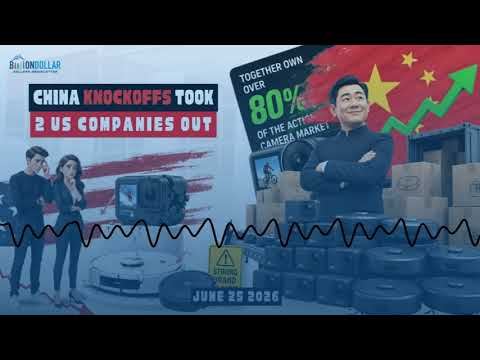
China knockoffs took 2 US companies out
Summary
"GoPro and iRobot's downfall signals a crucial lesson: brand recognition alone won't save you. True competitive moats are built with patents, data privacy, community engagement, and reliable service. Chinese competitors like DJI and Roborock seized over 80% market share, showcasing that innovation and strategic positioning are key to survival."
Transcript
This This is the Billiondoll Sellers podcast. Your go-to source for cutting edge strategies and success stories from the world of Amazon and e-commerce. Buckle up and get ready to take your Amazon business to new heights. Don't forget to subscribe to the Billiondoll Sellers newsletter. Welcome your host. >> Welcome your host, Kevin King. >> Hey everyone, and welcome to the Billiondollar Sellers podcast. I'm your host Kevin King and today is Thursday, June 25th, 2026. We got a lot to cover today, so let's get right to it. So, we're going to talk about how the Amazon Solar Universe is actually shrinking and why that's probably the best news you've heard all week if you're still in the game. And we've got the Prime Day 2026 numbers and holy cow, they're already breaking records 2 days in. We've also got a new software tool for dealing with New York's AI disclosure log. a big story on how GoPro invented the action camera category and China just took the whole thing plus some hot picks and the usual parting shot. All right, here's your stunt Bezos question for today. So, more than 250 creators are at the Cam Lions ad festival this week uh rubbing elbows with the big brands. The question is, what is brand spending on influencer marketing expected to hit this year? Think about that and I I'll give you the answer at the end of the show. But first, quick shout out. My buddy Chris Rawlings hosted a live workshop a few months ago for Amazon sellers who want to replace themselves of cloud workflows. And it was so popular that BDSN subscribers are still asking me how to get access weeks after it ended. Well, he's doing it again next week. It's called the AI Amazon PPC Challenge. Runs June 29th through July 3rd live daily from noon to 2:45 Eastern. He's going to show you the exact AI powered PPC systems, the plug-and-play agents, and the campaign templates that Sully Society uses to manage more than $5 million a month in Amazon ad spend across over 800 brands. Early bird tickets just went live. If you know you need to learn how to use claw in your Amazon brands, this is it. There's a link in the show notes to grab a spot while they're available. All right, let's get into it. So, Tokier Kell put out a post on LinkedIn reminding everybody that the number of active sellers on Amazon is shrinking and uh the numbers are pretty eye opening. Active Amazon sellers dropped from 2.4 million in 2021 down to 1.65 million by the end of 2025. And new seller registrations just hit a decade low, down 73% from the 2021 peak. Now, that sounds like bad news, right? It's not. Look at what's happening underneath all of that. Third party sellers now lose 62% of all units sold on Amazon. That's an all-time high. Over 100,000 sellers are clearing more than a million dollars a year, which is nearly double what it was in 2021. And traffic per active seller is up 31%. So fewer players, more revenue each, higher stakes. This isn't a shrinking opportunity, it's a consolidating one. The brands that are winning right now are pouring money into operations, content, and ad infrastructure. The ones that are losing are still running their 2020 playbook. So, if you're listening to this, you're probably on the right side of that equation, but you know, it's worth thinking about. All right. Now, there is a really cool video from the marketing misfits that you got to check out. So, Mo Ferrar and I sat down with Andrew Ericson, and this guy is uh a former Qualcomm engineer who built and sold two physical product brands, including a wooden map company, both for seven figures. and he went from literally handwriting postcards for early Etsy reviews to building highly advanced AIdriven e-commerce software. He breaks down exactly how he uses model context protocol autonomous coding agents and something he calls logic lead magnets to scale businesses. Whether you're trying to capture more emails with simple custom apps or you want to learn how to securely host virtual AI workers, this episode is honestly a master class in modern e-commerce automation. And by the way, Andrew is going to be doing an AI workshop at BDSS Market Masters 4 next month in Austin. There's a link to the video in the show notes. Now, let's talk about some interesting stats real quick. So, Amazon Prime just keeps getting bigger. The estimated number of US shoppers using Prime went from about 26 million back in 2013 all the way up to 201 million by 2025. And during the pandemic alone, the user base grew by about 60 million just during the pandemic. That's uh that's a lot of new Prime members. 201 million. That's nearly 75% of all US adults, which means if you're selling on Amazon, your addressable audience just keeps expanding. And speaking of Prime, let's talk about Prime Day 2026 because holy cow, the numbers are nuts. We're 2 days in and day one of this 4-day event did $8.3 billion in US online sales across all retailers. That's up 5.3% over last year and the biggest e-commerce day of 2026 so far. It blew past Adobe's $7.9 billion projection and Adobe is holding its full event forecast at 26.3 billion which would be a 9% jump over last year. And for context, those numbers come from tracking around 1 trillion site visits across 18 categories and 100 million SKs. So this is a big sample, not a guess. Now here's what shoppers are actually doing. Average order size is sitting at about $49 and people aren't doing one and done. Uh nearly half of households, 49% placed two or more separate orders. So buyers are coming back multiple times, which means if your listing converted once, you had real shots at the repeat add to cart. That's a big deal. And where the money went on day one, it clustered in electronics, appliances, tools, and home and garden. Electronics alone more than doubled versus a normal June day up 105%. But everyday essentials climbed too and some categories went absolutely vertical. Strollers and baby gear up 220%, school supplies up 140%. That essentials bump is no accident. Amazon lean hard into grocery and household this year. Trash bags and dishwasher pods are quietly eating share from the pricier discretionary stuff as shoppers feel the squeeze. And looking at the broader picture, 63% of items sold were under $20 and only 7% were over $100. So, people are buying, but they're trading down and watching prices real closely. More than half compared prices across retailers, and about 50% said they bought something they've been waiting to buy on sale. The typical shopper profile is a highinccome suburban female, aged 45 to 64, and 83% are Prime members. 92% have shopped Prime Day before, so these are, you know, seasoned deal hunters. Here's a number worth saving if you're benchmarking your own promo depths. Uh price cuts on day one ran 10% to 24% and Adobe expects the rest of the event to stay in that same band. So you didn't need to torch your margin to compete. That's the zone that moved volume this year. And a lot of people are wondering why June this year. Amazon pulled Prime Day out of July for the first time in 5 years. It now runs June 23rd through the 26th. The reason is they're dodging the FIFA World Cup and July 4th. Prime VP Jamal Donnie said that both events drove the shift. And Amazon's even positioning World Cup watch parties and holiday gatherings as demand drivers for food and household items. And the Amazon effect is real. When Amazon moved the date, the whole retail calendar moved with it. Walmart and Target ran parallel events to ride the wave and pull extra shoppers online. That's the lesson. Amazon sets the tempo and everyone else dances to it. All right, now software tool of the day. And this one's actually really timely. So, New York just made AI disclosure the law. If your ads run to New York consumers and use AI generated people, you got to label them. Background extras, digital standins, even a computerenerated hand modeling a watch. All of it counts. Miss the disclosure and the fines start at $1,000. Each one after that is $5,000. And the catch is volume. Most sellers run hundreds of images across listings, ads, and social. Labeling them one by one is a nightmare. That's what this tool from Gemma fixes. It's called the synthetic performer disclosure tool. You upload up to 100 images at once, set your disclosure style, hit apply and export, and download the whole batch as a zip compliant disclaimers across your entire image library in one pass. And a few things worth knowing about the law itself. It applies based on who sees the ad, not where you're based. So, if New York consumers are in your audience, you're covered by it. Audio only ads, AI translation of a real person's voice, and expressive works like movie trailers are exempt. and platforms that just host the ad are off the hook. The liability sits with you, the advertiser. If you're running AI creative at scale, this is probably the cheapest insurance you'll buy all year. There's a link in the show notes. All right. Now, this next story is uh I think one of the most important lessons for anyone selling physical products right now. Two American companies invented entire product categories from scratch. Both had huge brands and both are now getting run over by Chinese rivals. Anyway, the lesson for sellers is simple. A strong brand is not a moat. If you don't have one, Chinese sellers will eventually put you out of business. So, here's the story. Someone moves to Taiwan, takes up scuba diving, and goes shopping for an underwater camera. Simple search, right? But it turned into a lesson on where consumer tech is actually heading. There was a time when the answer was obvious. Just buy a GoPro. GoPro invented the action camera category back in 2002, and as recently as 2022, it still own an estimated 75% of the global market. Then it flipped fast. In early June, GoPro told regulators in a filing that there is quote substantial doubt about its ability to keep operating. Global share down to roughly 18% in 3 years. Ask any diver, any travel creator, or any outdoor person what to buy now, and you get one or two answers. DJI or Insta3, both Chinese. Together, they own over 80% of the action camera market. And what did GoPro blame in the filing? Rising costs from the global memory chip shortage. But what it left out was years of falling sales and brutal pricing pressure from DJI and Insta3 that left zero room to absorb a shock. And the pattern is familiar. GoPro peaked in 2015, then got squeezed by smartphones on a string of failed product bets. DJI entered in 2019 and kicked off a price war. Insta3 showed up in 2022. Both shipped new models faster and stacked on AI editing features that GoPro just couldn't match. And yeah, GoPro made its own mistakes, too. Analysts call him self-inflicted wounds, but manufacturing scale plus rapid product cycles made a comeback close to impossible. Now look at robot vacuums. Same movie. Iroot invented the home cleaning robot and named it Roomba. Chinese brands Dreamy and Robot took over and iRoot filed for bankruptcy in December and got by its own Chinese manufacturer Pisa Robotics. I mean, how wild is that? And this is a new default. A western brand creates a category. Chinese competitors outship it, outpric it and bolt on AI faster. Action cameras, robot vacuums, EVs. As AI gets baked into more hardware, the gap could widen. Now, there is one crack in the story, and that's trust in data. Robot vacuums raw on cameras, sensors, microphones, and detailed maps of your house. That is now a security conversations. The same concern already put limits on Chinese drones and EVs in the US. And GoPro's own escape plan tells you everything you need to know. They're looking at pivoting into defense and aerospace, which is basically them trying to build a moat after the walls are already crumbling. So, what's the play if you sell physical products? Here's a hard lesson. If you don't have a mode, Chinese sellers will eventually put you out of business. Not maybe, eventually. They out ship you, out price you, and copy your best features in a single product cycle. A strong brand alone doesn't save you. GoPro had one of the most recognizable brands on the planet. Roombo is so dominant, the word became a verb. Both still got run over. Brand is the price of entry now, not the moat. A real moat is the stuff that scale can't copy overnight and a factory in Shenan can't just clone. Patents and defensible IP, data privacy, and country origin trust where it actually matters to the buyer. A community that buys from you because of who you are, distribution or relationships a competitor can't buy their way into service and experience that travels with the customer, not the skew. If your only edge is we have a nice logo and good reviews, you're renting your position. The minute a Chinese competitor decides your category is worth taking. The rent comes due. Uh so build your moat before you need it. Uh worth asking honestly which side of that line your products sit on right now. All right, before we wrap up, a few more hot picks for you. There's a really interesting piece on the shadow market selling access to Amazon employees. Then there's a breakdown of the four ways brands can show up in agentic commerce. A Tik Tok shop is apparently selling personal transformation primarily, which is an interesting angle. Chad GBT's market share slipped below 50% for the first time. YouTube shopping and memberships are now funding full-time careers. And there's a cool behind the scenes look at Etsy shop other Jeff's campaign. Links to all those are in the show notes. And here's your parting shot for today. This one's from Joe Turnoff. Good marketing makes the company look smart. Great marketing makes the customer feel smart. Oh, I love that. So simple, but uh if you really sit with it, it changes how you think about every piece of copy, right? Think about that one. And finally, about that Stump Bezos question from the beginning. What is brand spending on influencer marketing expected to hit this year? The answer is 12.42 billion. That's uh that's a lot of influencer money. All right, that's all for today, folks. Have a great weekend and I'll see you again on Monday. This is Kevin Kane signing off from the Billiondollar Solers podcast.
This transcript page is part of the Billion Dollar Sellers Content Hub. Explore more content →