YouTube
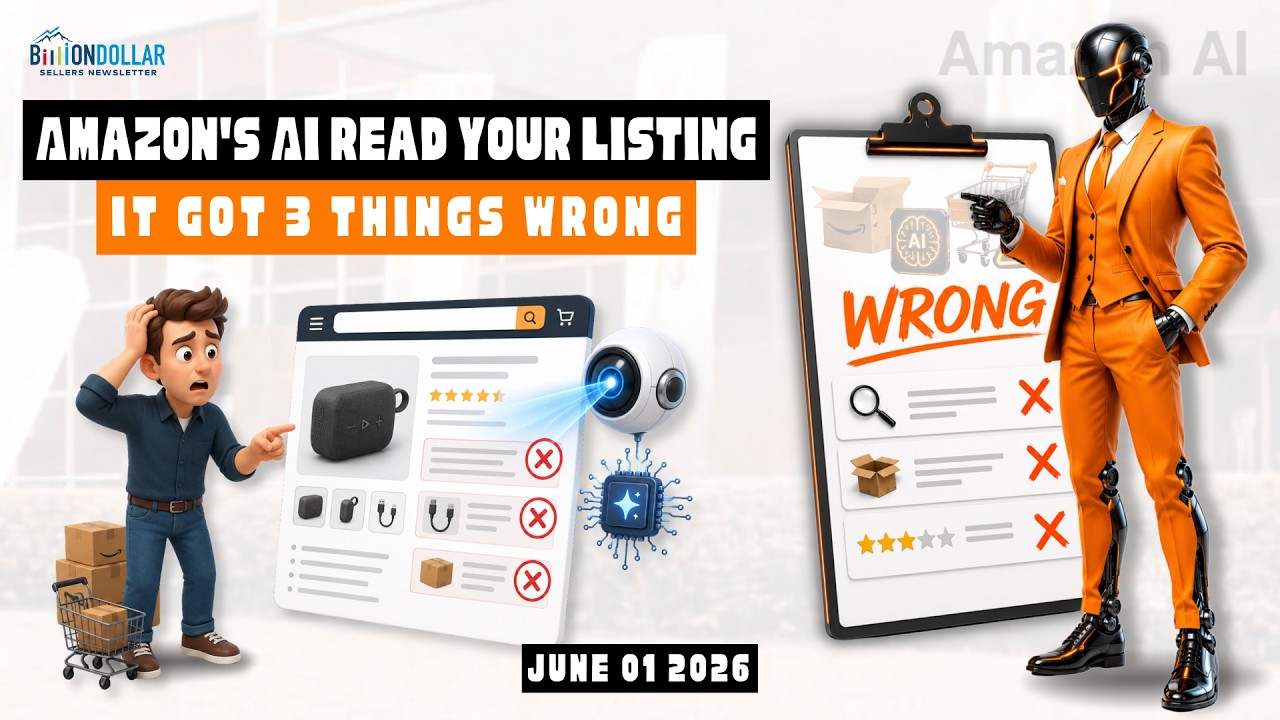
Amazon's AI read your listing. It got 3 things wrong.
Summary
Amazon's new AI Auto Buy feature is now available to all US shoppers, offering a one-time deal at their target price, competing directly with Subscribe and Save. Meanwhile, you could be eligible for Trump tariff refunds as the Supreme Court overturned IEEPA tariffs, with claims processed via the CAPE tool on the ACE portal. Plus, TikTok Shop Europe shows UK leading with €52.5M in GMV, driven mostly by creator-led sales.
Transcript
This, this is the Billion Dollar Sellers Podcast. Your go-to source for cutting-edge strategies and success stories from the world of Amazon and e-commerce. Buckle up and get ready to take your Amazon business to new heights. Don't forget to subscribe to the Billion Dollar Sellers newsletter. Welcome your host. Welcome your host, Kevin King. >> Hey everyone, welcome [music] to the Billion Dollar Sellers Podcast. I'm your host, Kevin King, and today is June 1st, 2026. We got packed show for you today, so let's get into what's coming up. The big story today is Amazon just turned its shopping AI into a product and is now licensing it to other retailers through AWS. And that changes the game for everybody. But we've also got a really important piece on how to get your Trump tariff refund, cuz most sellers don't even know they're owed money. And a cool software tool that breaks your orders down by state and city and zip code. Plus we'll take a look at Amazon's new auto buy feature that could be eating your subscribe and save. And finally, the 10 most powerful words for YouTube titles based on over 800,000 titles analyzed. All right, quick announcement first. So me and Norman Farrar just wrapped up the AI for eCom 2.0 workshop. And if you missed it, the Sunday replays are available right now. We covered everything from why your AI forgets everything the second you prompt it to the three things Amazon's AI got wrong reading a real listing, including a screen protector that didn't exist and a wrong size guide. We also went through a genetic AI employees your competitors are running overnight while you're still typing prompts one at a time. 29 free GPTs. How Amazon's new AI reads your customers Prime video history to decide which products to rank. And a whole lot more. 9 hours, eight experts. Discounted replay access closes Tuesday, then the price jumps a hundred bucks. There's a link in the show notes to grab that replay. All right, now here's your Stump Bezos question for today. Amazon's US marketplace isn't just the biggest by volume, it's also the most lucrative per seller. So roughly how much higher is revenue per seller in the US compared to the next largest marketplace? Think about that and I'll give you the answer at the end of the show. All right, let's get into it. So, this first one is a really big deal and most sellers are completely sleeping on it. Andrew Erickson, founder of Inventory Hero, just got $25,242 wired back from CBP. Tariff refund plus interest straight into his bank account. And most sellers he knows don't even realize the money exists. Here's the deal. The Supreme Court killed the IAPPA tariffs back in February, the reciprocal and final duties. CBP is now paying that money back through a tool called CAKE inside the ACE portal. And, you know, this may be the biggest one-time cash event your brand will see this decade. If you imported 500 kg from China in 2025 at a 25% IAPPA rate, you're sitting on roughly 125 grand. That's real money. So, Andrew laid out a playbook for getting your money back and uh I'm going to walk you through it. Step one, confirm you're owed money. Pull any 2025 CBP form 7501 and scan for HTS codes 9903.01 or 9903.02. If you see those codes, that's your IAPPA duty amount and that's what you're getting back. It should take about 5 minutes to figure out your number. If the codes aren't there, it means you don't have a refund. Step two, confirm you're the one who gets it. The refund goes to the importer record on line 22 of the 7501. Your EIN has to be there. And here's the trap that costs sellers the most. If you ship DDP and your supplier included duties to your warehouse, they were the importer of record. CBP refunds them, not you, and getting it back becomes a private fight with your supplier, not a CBP claim. Now, good news for AGL users, you're eligible. Amazon acts as your broker, but you stay the importer of record. Your EIN, your refund, and Amazon Customs and Trade will even email you a pre-built CSV and offer to file the claim for you. Step three, check your timing. Phase one covers entries that are unliquidated or liquidated within the last 80 days. Past 80 days, you're waiting on phase two, which has no timeline yet, or you file a protest under 19 USC 1514, and that has a hard 180-day window from the liquidation date. So, don't sit on it. The clock runs. Step four, get set up. Open an ACE portal account, uh set up a US bank account, and enroll it for ACH refunds inside ACE. And here's the thing, ACH setup for paying duties doesn't count. It has to be the refund enrollment specifically. Step five, file the CAKE claim. Upload your CAKE declaration in the CAKE tab in ACE, or authorize your broker to do it. If Amazon brokered your entries, use the pulse survey link in their April email to let them file for you. Step six, get paid. Refund usually hits your ACH account 3 to 5 weeks after liquidation. Andrew's took about 30 days start to finish cuz he had a bank account ready to go. And one thing your CPA needs to hear, this is not income, it's a refund of cost. For most sellers, it reduces COGS in the year it relates to, not the year it lands. And don't redeploy your old tariff inflated landed cost. Your forecast is lower now, so reorder on the new math. Bottom line, the money is yours, but only if you go get it. So, open the ACE account this week. There's a link to Andrew's full step-by-step in the show notes. All right, let's talk about some interesting stats. So, there's some new data out on TikTok Shop in Europe, and uh the big takeaway is that the top TikTok shops are creator-led, not store-led. The UK is dominating at about 52.5 million euros in Jan/Feb for the top 50 shops, and 82% of that is coming through affiliates, through creators. Germany's second at about 12 million euros. France is at about 7.5 million, then Italy and Spain after that. And the interesting thing is Spain has the highest creator dependency at 87% affiliate, while Italy is the outlier with about 34% of sales coming from self-operated stores. So, if you're thinking about TikTok shopping Europe, the message is pretty clear. You got to be working with creators. The brands just running their own storefronts aren't the ones winning. All right. So, this next one is a really big deal. Amazon just opened a new front in AI shopping race, and it's not aimed at shoppers. It's aimed at other retailers. AWS is now licensing the technology behind Alexa for shopping, which is the age of Amazon rebranded from Rufus earlier last month. So, any retailer can spin up its own AI shopping assistant. Amazon is handing over the architecture, starter code, and learnings, and says that a brand can launch something tailored to its own catalog and branding in as little as 60 days. And this is the AWS playbook all over again, right? Build internally, solve your own problem, then sell the solution to the industry, competitors included. Same move Amazon made with cloud, cashierless checkout, and its logistics network. And the smart part is that it's being sold through AWS, not the Amazon retail side. That's deliberate. Retailers who would never share catalog and customer data with the Amazon storefront might trust the cloud unit they already pay every month. First customer out the gate is Kate Spade, which is under Tapestry, and they used it to build a gifting assistant. More brands are in testing. Now, here's an interesting tension. Amazon is telling every other retailer not to hand their shopping experience to an intermediary, arguing brands know their products and customers better than any general-purpose AI. Meanwhile, Amazon is the intermediary for its own third-party sellers, and its buy for me feature reaches onto rival sites to complete purchases. So, you know, there's a little irony there. The AI shopping layer is consolidating fast. OpenAI, Google, and Perplexity are all chasing the shopper directly. Now, Amazon is arming every other retailer to build agents of their own. For brands selling on and off Amazon, the storefront is no longer just a place customers browse. It's becoming a network of agents deciding what gets surfaced and bought. And that means optimizing for how these agents read your listings so the AON GO work, it stops being optional. All right, now let's take a look at the software tool of the day. So this one is the Amazon orders intelligence dashboard and it's one of those things where you look at it and go, why wasn't I doing this already? Most sellers stare at total sales, but smart sellers ask a sharper question which is, where are those sales actually coming from? Your Amazon business isn't one big blob. You might be crushing it in Florida, flat in Texas, sinking in California, and totally blind to what's happening in the northeast. Total revenue hides all of it. This dashboard breaks your orders down by state, city, zip code, hour of day, average order value, SKU, ASIN, business orders, and subscribe and save. And here's why it matters. Sales drops are often regional. We had a client whose numbers dipped and nobody could explain it. Ads were fine, listing was fine, category was fine, too. Then we pulled orders by region. One area was way down because shipping lead times got delayed there. Slower delivery tanked conversion, which tanked ranking, which eventually tanked sales. You'd never catch that looking at one revenue number. So use it to spot which states have the highest average order value, which regions are underperforming, which shipping speed is hurting your conversion rate, where demand is strongest, and what time of day orders are hitting. Amazon hands you this data. Most brands just never look at it this way. There's a link to try it out in the show notes. All right, so this next one is something you really need to pay attention to if you sell anything people reorder. Two weeks ago Amazon put auto buy in front of every US shopper. Here's how it works. A customer sees your product page, taps add to auto buy and tells Amazon the maximum price they'll pay like 29.99 based on the 90-day low, and when to start watching and when to stop. Then they leave. The second your listing hits that number Amazon buys it for them. No return visit, no second decision. The button is rolling out inside the new Alexa for shopping experience right next to the ask Alexa prompt chips. Vanessa Hong is one of the first to spy it live and share a screenshot. Some categories already have it, others are days away. Now, here's the take that matters. Autobuy is a one-time deal catcher, one unit. Fires once at the shopper's target price, no coupons, no promos, FBA only. So, on a consumable, you now have two automated paths fighting over S&S reorder. Subscribe and save is recurring. You set the discount, the customer stays on a schedule. Autobuy is one-time. They set the trigger, it fires the moment you discount. So, every promo you run now clears the autobuy queue at your deepest price instead of turning those shoppers into subscribers. The buyer who would have subscribed at 10% off, they're parked on a 20% off trigger waiting you out. And here's the part that messes with your data. Every autobuy rule is a conditional purchase order sitting in a queue. A loyal rebuyer sets the rule once and stops coming back to comparison shop. So, your search and demand data goes quiet on customers who are still very much in market. They're not gone, they're in line at a price you haven't hit yet. Read your numbers like those shoppers churns and you'll make the wrong call. So, what do you do? Make subscribe and save the easier yes before the target ever gets set. A subscription discount that beats the wait, a stable list price so the 90-day low trigger stays out of reach, and FBA you never run dry on. So, here's your one action item this week. Open one of your hero ASINs and check whether the autobuy button's on the page. Knowing it's there changes how you read everything else. All right, so this next one is really cool if you're doing anything with YouTube or content creation. Jake Thomas allies over 800,000 YouTube titles to figure out which specific words consistently drive above-average performance. And he came up with the top 10 power words for YouTube titles right now, and some of these numbers are pretty wild. Starting at number 10, the word never. Videos with never in the title perform 3% better than average. It works as a strong warning or personal boundary. Number nine is habit at plus 4%. This taps into people's desire for self-improvement and routines. Think about how big Atomic Habits was. People crave this word. Number eight, stop, also plus 4%. Works either as a warning or as a solution to a problem. Number seven, only, at plus 9%. Creates a sense of explosivity or extreme constraint, and both of those spark curiosity. Number six, change, also plus 9%. People are wired to notice change, and it leaves viewers wanting to know what changed. Number five, forever, at plus 12%. That's the ultimate time word. Dramatic, extreme, emotionally charged. Number four, regret, at plus 13%. People are obsessed with avoiding regrets, which makes it super clickable. Number three, every, at plus 14%. Gives titles a sense of completeness and scale, makes the content feel comprehensive. Number two, any, at plus 16%. Lowers the barrier and makes advice feel universally accessible. And the number one most powerful word for YouTube titles, the current year, 2026, plus 30%. It signals freshness and relevance, especially in fast-changing niches. So, the big takeaway is that being current wins. Just putting 2026 in your title was by far the strongest thing you could do. So, if you're doing YouTube or, you know, any kind of content, then try working these words into your next few titles and see what happens. All right, before we wrap up, a few more hot picks for you. Shark Ninja has a really interesting piece out about how they mitigated tariffs with supplier diversification. Worth a read. Amazon launched a know-before-you-buy feature on product pages. Walmart is crediting their AI assistant Sparky with lifting sales and average order value. And the EU just hit Temu with a 200 million euro fine over illegal product risk failures. Links to all of those are in the show notes. And here's your parting shot for today. This one's from Brené Brown. She said, "Vulnerability is the birthplace of innovation, creativity, and change." I think that's a good one, you know, especially for sellers. You got to be willing to put yourself out there, try new things, and fail sometimes, cuz that's where the real breakthroughs come from. And finally, about that stun Bezos question from the beginning. How much higher is revenue per seller in the US compared to the next largest marketplace? The answer is $200,000. Revenue per seller in the US is 200K above the next largest marketplace. Holy cow, that is a massive gap, and it tells you why everybody wants to be selling on Amazon US. All right, that's all for today, folks. Have a great weekend, and I'll see you on Thursday. This is Kevin King, signing off from the Billion Dollar Sellers Podcast.
This transcript page is part of the Billion Dollar Sellers Content Hub. Explore more content →