Ecom Podcast
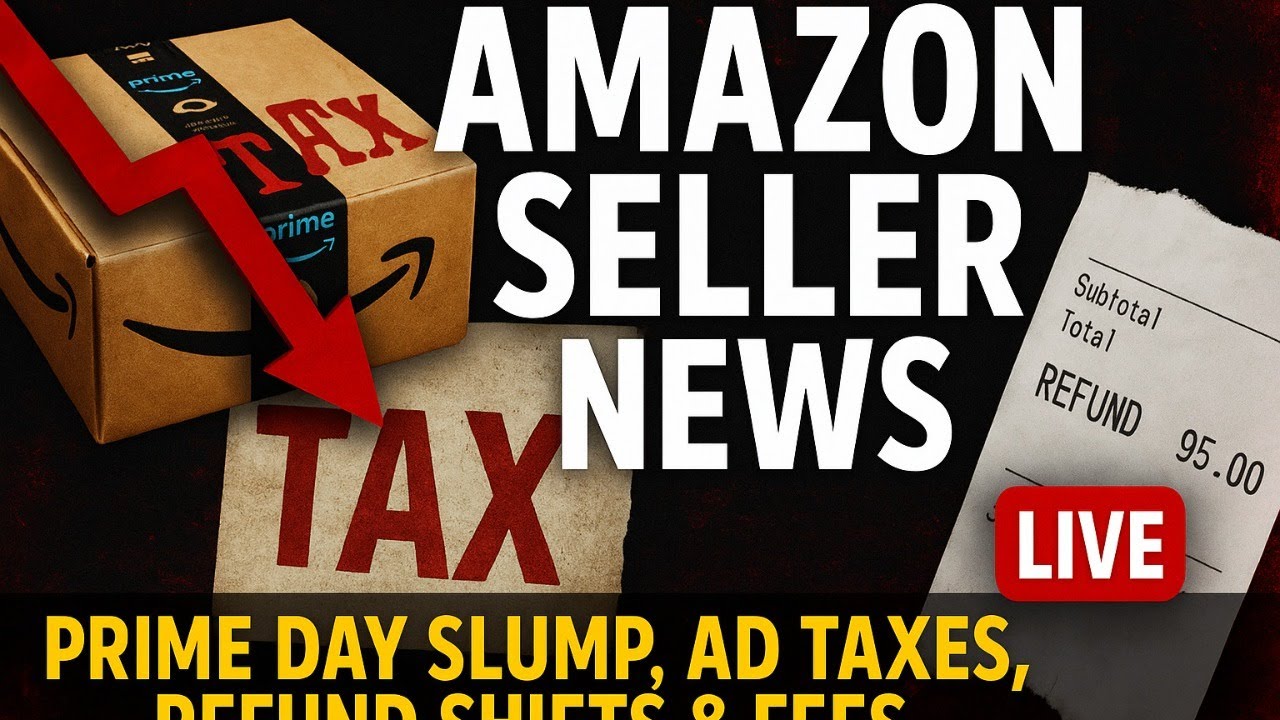
Amazon News: Prime Day Slump, Ad Taxes, Refund Shifts & Fees
Summary
The Prime Day slump highlights the need for Amazon sellers to sharpen pricing strategies and enhance value positioning, as average order sizes dropped 15% and economic pressures led shoppers to focus on essentials rather than holiday splurges.
Full Content
Amazon News: Prime Day Slump, Ad Taxes, Refund Shifts & Fees
Unknown Speaker:
Welcome, fellow entrepreneurs, to the Amazon Sellers School podcast, where we talk about Amazon and how you can use it to build an e-commerce empire, a side hustle and anything in between. And now your host, Todd Welch.
Speaker 1:
Hey, hey, hey, everybody. Welcome to another episode of Amazon Seller News Live. I appreciate you joining us today. I got Andrew Morgans from over at Marknology with us today. So, Andrew, appreciate you joining us.
Speaker 2:
Todd, thanks for having me back. I'm excited to be on the news show today and talk about what's the latest and greatest.
Speaker 1:
Yeah, absolutely. I'm really looking forward to it. We've got some good news today. Danan isn't going to be able to join us today. He's got lots of stuff going on, but me and Andrew are going to hold it down.
So we're going to be talking about some Prime Day news here and then a big one coming out of Washington with a new tax that's going to affect Amazon sellers big time.
Some changes to Amazon Prime that allows sellers to edit their orders after the fact, which is cool. And then if we have time, we're gonna get into some opinion pieces on whether Amazon is rubbish now or not.
So without further ado, let's go ahead and dive into the first article here. So Amazon's October Prime Day underwhelms shoppers signaling caution for holiday 2025.
Amazon's October Prime Big Deal Day fell short compared to July's record-breaking event, with shoppers mainly buying everyday essentials like apparel, shoes, and household goods, rather than splurging on big holiday purchases.
Average order sizes dropped 15% from July, and satisfaction levels slipped as buyers compared deals with Walmart and Target. Economic pressures such as tariffs, inflation, and rising living costs drove cautious spending,
with fewer shoppers using the sale to jumpstart holiday shopping. For Amazon sellers, this signals that Q4 promotions may face software demand, requiring sharper pricing strategies,
better value positioning, and stronger differentiation to capture cautious consumers. So I'm curious, Andrew, that last section there was, you know, kind of opinion on their part.
So I'm curious your thoughts as to why Prime Big Deals days might have been slower and smaller cart sizes than July.
Speaker 2:
Yeah, I think Todd, thanks for laying that out there. I think that this article is right on, if I'm being honest. I know it's a bit of opinion, but I feel I could have written it myself in regards to how I feel about how they laid it out.
I don't know if you've been to the grocery store lately. But I think it's one of the easiest places to really feel the inflation and the economy and where it's at.
Like, you know, I think I ordered two pizzas the other day and it was almost $100, you know, pizza hut. Like, so, you know, something that used to feel like it cost 30 or 40 bucks, you know.
So I think you're feeling inflation all the way down to food. It's not just gas prices. It's not just one thing or the other. It feels like it's in every area of life.
Even if you're skipping the restaurants, like you're feeling at the grocery store. And I say that simply because that's regardless of it being Amazon or not. Like, you know, I've got a lot of friends and, you know,
we're very like transparent and open about just economy and how things are going and budgets. And, you know, it's tight on everybody, especially people with fixed incomes.
I think something else to think is those wishlist buys, those premium buys, those luxury buys, those shoppers are not so deal motivated in the first place. I just don't think that they're as deal motivated,
the people that are going to buy that thing they've been holding in the cart or that premium item they've been waiting to buy. The hold up of, you know, this Prime Day almost came and went without like a ton of press.
It felt like to me anyway, like with a kind of a late announcement, right? And I think people are just waiting. You know, I've told my girlfriend, my fam, like, you know, we do Christmas big, like it's coming from a poor family.
It's just always been a special time for us. I don't think gifts are for everybody, but for us, we go kind of hard around Christmas time for each other.
And, you know, just that, I had a conversation already as kind of the leader of my house to guys, let's take it easy or start buying early. You know, I don't want people to feel the pressure of the holidays with just how things have been.
So, and that's someone that's a savvy buyer, you know, so I mean, I did, I did purchase stuff on, The Prime Day deals, I was buying essentials. I was buying stuff I already needed and just grabbing those deals.
I did spend more maybe out of order, buying some stuff in bulk that had some good deals, but it wasn't like I'm there to see what type of electronics are out or what kind of clothing item I could purchase. It was definitely essentials.
I don't know if you spend any money on Prime Day, but that's how I'm feeling.
Speaker 1:
Yeah, I did. And I mostly agree with everything you said there. I bought a few things on Prime Day. I'm just looking. I bought some shelves for the garage that I had already been looking at previously. They were on sale a little bit.
I bought some ring cameras because they were like $39.99 for the ones that you can move around and stuff. So that was just such an amazing deal.
Speaker 2:
Did you already know you wanted some cameras or was it like spontaneous?
Speaker 1:
No, I knew I needed them. So we have a retail storefront for one of our other businesses and I needed to get cameras for it. So I was just kind of waiting for the big sale.
And so I grabbed those, grabbed the microwave as well, but that's for the business also.
Speaker 2:
Yeah, so business expense, right? Not luxury expenses.
Speaker 1:
Exactly. So yeah, nothing really luxury except for maybe the garage shelving you could, I mean, but it was only $73, so it wasn't super crazy.
Speaker 2:
Organizational, I wouldn't really put in like luxury or premium. Not saying it wasn't nice stuff, just like it's not like, you know, that category, I wouldn't say.
Speaker 1:
Yeah, no, definitely not. So yeah, I agree that I think the economy is definitely struggling right now. It's very mixed, right? Because the job numbers, well, they got revised down, but they're still not coming in too bad.
And inflation is looking okay, the jobs numbers. But one stat that I noticed that stood out recently is that Credit card debt is like almost at an all-time high, but credit card usage is way down. So that's kind of a scary metric, I think,
that kind of signals that people are maybe running out of money to spend and they just can't spend anymore on their credit cards, so they're stopping.
So that that could definitely show a problem for coming into Q4. I think people are employed.
Speaker 2:
It's just, you know. I think like people have jobs, people are employed, but everything is just costing more. Everything is costing more across the board, tariffs or not.
I think some companies have taken advantage of the ability to say, hey, everyone else is raising prices. Like, let's do that as well. It just is permeating down to everything, you know, even to, you know, back to school wasn't that long ago.
Was it September is back to school, maybe August. It's been a minute since I've been in school. October is coming right after that. It's right before the holidays, right after school starts.
I've always thought of Amazon Some of the article's subjective in that it's comparing it to a record-breaking July. So compared to that record-breaking, it's true to say that it came in underwhelming,
okay, if you're always trying to beat the last number. But they're also picking the dates of the year to run Prime Day deals when it is the slowest, historically. So it is not already like a big time to shop, like a Labor Day deal,
and they're running a Prime Day deal at the same time. They are running it, like, in times of year, July being super slow, October being right in between school and holiday and trying to find some lift in these like slow times.
So one is just kind of like, you know, if you're running a trying to tell me the, I'm the founder and CEO of Prime Day. And I'm here to talk to you about how well a coupon does or a deal does on Amazon, like on a normal period of time.
And you're only giving me your worst products. It's not a true test of like whether the coupon or the deal works, in my opinion. It's like, you know, if we do it on your Hero Ace, then the data is going to be a lot more true.
We're running on a product that's selling well. And now we're running, you know, the deal to see what happens to customer lifetime value or subscribe and save numbers or whatever it might be.
low season of purchasing behavior already is kind of already setting yourself up for failure. And you know, I saw something else a little bit off topic, but I think there's a there's a female rock artist called named Halsey.
I don't know if you know of her. And I haven't heard of her. She dropped it out. She's been out a while she dropped out. She dropped an album. And I think like,
had 200,000 I'm quoting numbers like don't hold me to like 200,000 like downloads in the first week or like purchases album purchases and. Her label was just calling it a failure. And she's like, what are you talking about?
Like 200,000 in the first week in a time period where no one's buying albums and CDs and everything is streamed. Like that's an incredible launch. But they're holding it against like a previous record that was just like, you know,
maybe best in the country ever. And, you know, she's putting it as like, when you set the benchmark so high, then anything that comes in under that is underwhelming and considered failure. I think it really just comes down to like,
how you're seeing it and what you expected to get out of it. And, you know, understanding sure all the things, the elements we talked about, like the nation and economy and periods of time,
but also as a brand, what were your expectations going in? And, you know, what are we comparing it against to say whether it's good or not?
Speaker 1:
The news cycle plays a big role in people's buying habits. I wonder how much of this is buy all your stuff before the tariff pricings kick in.
Everybody bought everything in July and so they already got a lot of the stuff that maybe they would have bought now that they bought early for the fear of tariff price increases. And so, you know, how much of that plays into it?
How much plays into that? We're right in the middle of a government shutdown at the moment, you know, those kind of fears could raise confidence, right?
I mean, that's, that's a large percentage of the workforce, I something like 10, between 10 and 20%, I believe, of the country isn't employed by the government in some way. So How much could that have had an effect as well?
All these things kind of adding together and then also people saying, hey, maybe I'll just wait till Black Friday, there might be a better deal.
Speaker 2:
At the very least, it's creating doubt. It's creating, you know, it's like a retail store playing the wrong music or having the wrong color scheme or anything else.
And I think everything around Business and commerce is about trust and like whether it's the products or the environment that they're in or the store that they're in or the brand that they're engaging with, whether it's Amazon or other.
And any negative move in the other direction adds impact. You know, I really do think at some level it has impact, like same thing as being an agency owner. Sure, we run 4050 Brands. We're an Amazon seller brand in that way,
but I'm also an agency that works directly with brands to make partnerships. You know, I think on that front, while we've been like, we've had a good year,
I wouldn't say we've had a bad year, we've had a good year, there's still a sentiment of just like, what's happening in the world, like, you know, with tariffs.
And if you're not an expert already, it can be overwhelming to add in all these other things you don't know, before you take the leap into something, you know, so I would agree. And lastly, it's like, at least for me,
the age I'm at and the place I'm at, like after when October starts, like it's less about buying stuff for me that I want. And I just started thinking about holidays.
And like, you know, I just kind of put myself after summer, like, I don't know, it's this like subconscious thing to be like, I'm not buying for myself really now.
And I'm just thinking of gifts or at least saving budget or whatever to start buying for others, whether it's a girlfriend or my mom or whatever.
So even though I'm a purchaser, now I'm purchasing less for Drew and I'm purchasing for other people. So my categories change also, like the things that I'm buying change.
Speaker 1:
Yeah, yeah. It's interesting how that happens as you get older. Somebody asks you like, what do you want for your birthday? I'm like, I don't, nothing. I don't know. I have no idea.
Speaker 2:
Theater or like, let's go to the movies or like, you know, something like more like entertaining or an event based, you know, type of thing. I think that you get more quality of time, but yeah, for sure.
I've got nieces and nephews and little cousins and we have a big family. So instead of being stressed, I guess, where it's at, I think the budgeting is really coming into everyone's mind.
If they had a loose budget, just the budgets are getting tighter. And if I'm budgeting, then I'm like,
how do I start offsetting holiday spending now so it's not such a big lift come Black Friday and Cyber Monday where it's just all hitting me in one month? So maybe it's just starting a bit early.
We have Halloween around the corner too, which for some families is a big expense too, like if they're just buying costumes and doing the whole thing.
Speaker 1:
Yeah, my mom was like that. She would buy Christmas presents all year long. If you looked in her closet, it'd just be filled with toys when we were younger, which always made Christmas a lot of fun.
Speaker 2:
Yeah, because I don't know how they afforded it unless they did that because my mom definitely went above and beyond to make Christmas as big for us. It sounds like we had similar moms in that regard, just putting stuff away.
And like stuff took longer and harder to procure and get and things like that. It wasn't always two days shipping everywhere, you know, to get the next best thing. So yeah, I think we'll see.
I think in general, I think it's just category shifts of what's selling because people are still buying.
It's just like other people are getting lifts because they happen to sell something that's more essential or something that's more everyday or something that's more practical and the premium buyers are staying the same.
There's just not a lift. So they're still buying what they want.
Speaker 1:
Yeah, yeah. That definitely seems to be the shift right now for sure is towards the practical Everyday stuff. People are kind of cutting out the fancy things that they don't necessarily need and focusing on what they really want.
Or really need, I should say. And so it'll be interesting to see if that's, you know, if that's just like a culture shift that's happening, you know, because the millennials are basically the big demographic now. And we'll have to see.
They grew up spent in the 2008 timeframe after the crash and stuff was a large part of their their life cycle and that was an era of cutting back and saving so they've kind of got that mentality a little bit. Yeah,
so we'll have to see if it's here to stay or if it's just a factor in the economy right now. And everybody's just waiting for the crash. You know, I think the crash has been coming for like 15 years now.
Speaker 2:
So, right. So, actually, I mean, I think it feels like that, or at least we're traumatized a little bit to be like, you know, we're feeling similar triggers. And you know, it feels close.
And I think that that hesitation, I mean, it's smart, the credit card stuff is scary, you know, credit card stuff is scary, but I know that it's true. And I mean, just talking to my friends who don't who don't own businesses,
so they're, a lot of them are fixed income, you know, they have good jobs, but they're fixed income. So costs go up, their income doesn't rise with it a lot of times, even if they're employed.
And just talking about maybe being like, having to be the most frugal that they've been in a very long time since they were, you know, we're all approaching 40 or mid 30s.
And maybe for the first time, they're having to be like pretty frugal. You know, it feels like this year, which is like there hasn't been enough big things to make it feel like that.
But I just feel like it's all a lot of these These things all adding up.
Speaker 1:
Yeah, compounding. It's like you were saying, you can't go to any fast food restaurant anymore and get out of there for under like 40, 50 bucks. It's just crazy.
Speaker 2:
The food is where I can really tell the increased costs. For sure. Specifically when I'm like at the grocery store or getting food, it's just like, wow, you can't get out of there without really spending quite a bit. Yeah, so we'll see.
I know it's hard to say like, okay, that's why Prime Day is affected, but I do believe that. I just believe, you know, it's compounding.
Speaker 1:
Before we move on to the next article, Andrew, is there any certain tips that you're giving your clients to prepare for Black Friday and the Christmas shopping season that's coming up?
Speaker 2:
Yeah, I think it's just expectation setting, understanding that it's not just Amazon in a silo. Amazon is just a business channel. The economy and everything else impacts what we're doing. So set expectations, you know, to that end.
I think if you have a product that's outside of gift giving or essentials, you need to think about maybe accepting smaller margins, but to give more incentive for people to make that purchase.
That might be an expectation that you need to set. Be more aggressive with your deals if you're able to do that, if you have margin for that, to be able to get people to overcome that. If you're doing content and storytelling really well,
you could be selling ice cubes in a snowstorm or whatever they say and still get away with it. If your content is doing really good and doing its job right, you're creating that FOMO effect.
You're creating that, I need this to solve this pain point. A lot of sellers and brands aren't doing that. So, you know, I bring that up because it's like, to me,
those are the products I can sell through whatever's happening is if they do just a really good job with their offer. But just thinking about like, okay, if I'm taking a picture, a step back,
I'm not just thinking Amazon tactical, and I'm thinking strategy, what's going on in the world? What's my competition doing? What have they been doing? Have I tried already certain things already this year? What were those results?
Like, you know, should I just double down on that? Or should I should I really try to go another direction? Because one move is to is to not discount and protect your margin and just have smaller,
smaller revenue, but but really protect that margin, kind of like you're just budgeting and, and you're going to sell what you're going to sell without thinking about deal, deal, deal. You know, I think that's, that's always an option.
And people seem to forget that that there's no reason to offer 5 or 10% off when those customers are going to buy from you anyway and just give up that margin just to give it up. So, you know, really put yourself in the seat or, you know,
in the shoes of your customer and be like, would this 5% or this 10% make me buy it if I wasn't going to buy it? No. You know, so if that's the case, then maybe don't discount it at all and just look like the premium offer.
You know, there's a lot of brands that don't ever discount. You don't ever see discounts. So, you know, that's an option for you too. I would just say, don't do what you've always done.
You know, take a look at what experience you have already this year and then adapt to that.
Speaker 1:
Yeah. Yep, for sure. Yeah. And you mentioned something there. You're talking about discounting and a few weeks ago, a couple of weeks ago,
we had an article that talked about doing discounts versus coupons and that discounts were in their measurements much more effective Increasing conversions, clicks and conversions, then coupons. What are your thoughts on that?
Have you seen anything around that?
Speaker 2:
I think with the coupons, by default, they're set up to not get as good a data because you have to actually clip them. And so a customer will see it. Click to buy, maybe they add some more stuff to cart.
They don't actually hit the coupon button and the coupon got them into the listing, but they didn't claim it. So I think by default,
because it doesn't auto claim that some of the clicks and conversions are gonna be misleading versus the slash pricing or the deal is automatically applied every single time.
And so I think by default, you're gonna get more attribution and clicks than that. Other than that.
Speaker 1:
Hey, Amazon sellers. Tired of losing money on storage and shipping fees? Well, Amazon Storage Pros is here to take the headache out of logistics.
We manage everything from inventory and creating efficient shipping plans to working with 3PLs and Amazon's AWD so that you can focus on growing your business.
Start with a free storage cost audit and discover exactly where you're overspending and how to fix it. Don't let logistics eat into your profits. Visit AmazonStoragePros.com.
That's AmazonStoragePros.com to get your free storage cost audit and start saving today. And now back to the show.
Speaker 2:
I'm not sold one way or another. I've heard the argument both ways. I think the more the better. You're just trying to stand out. You're trying to look different in search results than everybody else,
whether it's your main image or a coupon or a deal slash or whatever that is.
I think there's a rhyme and reason to any of them at any given time based on what's everybody else doing and can I do something different than what they're doing.
Speaker 1:
Yeah, yeah, my first thought was that, okay, so the discount is winning over the coupon. But what if I did instead of a $10 discount, I did a $5 discount and a $5 coupon? I'm wondering how that would stack up.
And that's something I want to test, which I haven't gotten around to yet. But that was my first thought. Why not stack them both and take advantage of that?
Speaker 2:
Yeah, so here's a little one that's not in our news, but Amazon released a new feature around business pricing. So if you do, I think it's like, a certain number of units right past one,
of course, so it's like a tiered pricing discount that Amazon is taking the money off of your FBA fees. And I can't quote it exactly, you know, so we might have to pull it up.
But essentially, it's the first time I've ever seen where Amazon is giving a discount because you offer a discount. But you know, if you have a product that works well in the business side,
it's incentivizing you to give them a better deal and then getting a break for it. So that's a place where you could like give more of a deal in order to get some back if you're being like really strategic and have an item like that.
Obviously, this only applies to consumables, but I love the subscribe and save offer. And they've recently just increased the amount that you can offer I think up to 20%.
Speaker 1:
Oh, really? I didn't see that. Very good.
Speaker 2:
You just increase a few like 5% or something all the way up to 20% on that first time subscribe and save. So if I have an option on deal, coupon, or subscribe and save offer, I'm going subscribe and save offer.
If it applies, I just think it's five times your customer lifetime value and all of that. So if you can get customers into your subscribe and save funnel, that's incredible.
So that's the one I'll lead with if it's a consumable, and then afterwards, I'm open to test whatever. That's the way I lean.
Speaker 1:
Yeah, absolutely. Alright, very good. Let's jump on to our next article here. And by the way, anybody out there watching, if you want to throw comments in,
we'll bring them into the show, either related to the news or related to something else, that's fine. Washington to tax digital ads and tech services.
Starting October 1st, Washington State expanded its sales tax and business and occupation tax to cover digital advertising, custom website development, IT services, live presentations, and temporary staffing.
Live presentations, that's interesting. This includes online ad services like search engine marketing, campaign management, and traffic monitoring, which were previously exempt.
For Amazon sellers, this could raise the cost of running ads, developing websites, and using tech services. If they operate in or purchase services tied to Washington,
compliance will become more complex and sellers should track expenses carefully, consider tax automation tools, and monitor legal challenges to the law as companies like Comcast are already contesting it.
And of course, as we know, if one state starts doing this, often there's a snowball effect or companies will just choose to tax everybody because it's easier. So to me, this is a pretty big one and definitely not a good thing.
But what are your thoughts?
Speaker 2:
This isn't Amazon in Seattle, right? So, you know, the law could be simply We can't apply it everywhere, but we can apply it to the state that they're headquartered in and apply it that way.
The live presentation makes me think about live selling, like TikTok Shop Live or Amazon Live.
Speaker 1:
Yeah, that's probably what they're talking about.
Speaker 2:
That's probably what they're talking about. The live presentation part just sounds funny, but it sounds like they are trying to tax Amazon advertising, I mean Comcast is a drop in the bucket compared to Amazon advertising to me.
So who are they going after? I don't think it's just the sellers that happen to be in Washington State. So what will that permeate to? Because if Amazon's getting taxed, we're going to be the ones to fill it, right?
Like we will, if we're getting taxed, they're going to pass it on to us one way or another.
Speaker 1:
Yeah, it's and it's also interesting too. And it doesn't say in the summary here. So I'd have to look at the bill more. But I wonder, you know, who exactly are they taxing? Would they be taxing like me when I run the ads?
Or are they taxing Amazon based on the total revenue that they take in from ads? I would have to lean towards it being an individual tax on each person who's running the ad. So if I'm based over here in South Carolina,
Would I get taxed on my ads just because Amazon is- On Amazon we can't choose where we run them, right?
Speaker 2:
So I can't say that I'm not running a sponsored product ad in Washington to a customer. So would it be on the orders that happen in that state and tracking them to running an ad and then they purchase in that state?
Kind of like tax nexus or however that applies. Definitely food for thought. I don't have an answer on that. I don't know what that would look like.
Speaker 1:
Yeah, to me, you know, a lot of this is, to me, is taxation without representation, right? Like, for example, I get income tax bills from California because I sell products into the state,
but I don't have any power to elect someone to represent me there, so they're taxing me and I have zero representation. So to me, it's unconstitutional and illegal what they're doing.
But so far, nobody's challenged them on it that I know of. But it sounds like this one's definitely going to be challenged because it's making a lot of waves out there and Amazon is not going to just roll over on it.
Speaker 2:
I don't know. Like what you just said, taxation without representation is like what this country was. Founded on in regards to like, you know,
our independence and I take a little pride in that as family has all those badges and certificates of family fighting in those wars. But you know, as freedom gets taken away from us every a little bit more each year,
truly does, you know, what point is it like this is a problem. And the problem is that like, it just costs so much money, you almost have to be a big player to then go Go fight against it,
but I mean my I'm a small company and I'm getting taxed in California I have quite a few clients from from California, you know, so I'm specifically and they went back years on me It wasn't like so they passed on new law,
but they went retroactively went back and like, you know was tracking certain things so I've been getting bills from California for the last few years in regards to tax and And I just didn't think about it as like,
look, I'm not allowed to vote there. So, you know, that is a big deal and a perspective I hadn't seen before. I just, you know, we'll see. I remember when the tax nexus laws came out and me and my business partner at the time,
I own the company by myself now, but I had a partner at the time and we try to do everything the right way. So we were like legitimately,
we almost stopping sellers at the time with some of the brands we were building because we were just like filing in all of these states is like insanity.
Speaker 1:
That was insane for a while, yep.
Speaker 2:
So everyone figured out what to do kind of like with COVID, right? Everyone's just like, what do we do? Like with the tax taxes laws, it was like, How do we officially do this?
Before there was software to track everything and we're literally filing in every state that we had sales and it was getting crazy. So who knows how this will be before it settles down?
Speaker 1:
Yeah. Yeah. It's going to be interesting to watch. That's for sure. And I've already seen that there's several legal challenges. In the article, they talk about Comcast.
But I believe there was some, like an attorney general that was filing a lawsuit as well that I seen and a couple others. So there's definitely gonna be a lot of pushback on it for sure.
Speaker 2:
Yeah, I'm sure Amazon's not gonna just say, yeah, sure, we'll pay. If it's in Seattle, it's all originating there to my knowledge. So I don't consider myself a, We're a tech service or a digital ad service as a marketplace agency,
but we do a level of that. What does it come down to? Is it actually being the seller? Is it being the service provider? In other ad types, you buy real estate, so to speak. If you're doing TV, you're buying positioning.
On Amazon, it's just quite a bit different.
Speaker 1:
Yeah, for sure. And I found this one other article here, which was kind of an opinion piece from the Washington Policy Center, which I don't know much about them.
The summary on that just says Washington State's new digital advertising tax expands sales tax to nearly all online advertising services while sparing traditional media, creating an uneven playing field.
Comcast has already sued, arguing the law violates the federal Internet Tax Freedom Act. That's interesting that they exempted traditional media.
I would assume that's like newspapers and things like that so that they don't have to pay taxes on their ad revenue, but Amazon does.
Speaker 2:
It sounds like a personal fight that we're going to get wrapped up in. Some policy makers there for sure.
Speaker 1:
Yeah, going to be interesting to watch. We've got a couple questions here in the chat that we can bring in. This one from Deepak. He's asking how are check-in times this time of year? I haven't seen too much of a delay yet in FBA, but AWD,
you can't get anything in currently at all. It's full. So how have you seen anything?
Speaker 2:
Well, I'm in the Midwest, but we have brands all over the world, obviously shipping into California, East Coast and West Coast. But I run a 3PL here in Kansas City, a full service warehouse in 3PL.
And our check-in times have been Outside of Prime Day in July, they've been pretty smooth. At least here in Kansas City, we go to a big distribution hub in Illinois. Generally, our shipments go from KC here in Missouri to Illinois.
It's smooth. It's a big operation there. It's all about transit there. If you're on the coast, it's a little bit longer. I think there can be a week to two weeks more just depending on how much you're selling and how much you're shipping in.
If you're shipping in LTL or if you're shipping in You know, like UPS boxes, like case packs and stuff like that. Obviously the case pack size UPS box are way faster, way, way faster.
So just depends on with each brand, it's brand specific to what type of products they're selling, how far behind or ahead we are on inventory. Are we starting off or are we just like supplementing stuff like that?
So it's kind of a moving target. Good question, but it feels like a moving target to me.
Speaker 1:
Yeah. Yeah, and we're just getting into Q4, right? The busy season hasn't officially started yet. So, I mean, technically, you're supposed to have your products in by now, according to Amazon's deadlines.
But, you know, a lot of people are still going to be streaming stuff in. Here in October and even in November and you're still gonna get checked in and received. Most likely, it's just not guaranteed is what they say.
Speaker 2:
Let's talk AWD. We have a few customers in AWD, not nearly as many as even some of my other agency owners that I talk with or brands. What are your options if you have a product primarily in AWD and they're full?
Speaker 1:
Yeah, if you've got product in there already, they're obviously refilling FBA for you. So that function is still going on. But right now you just can't send anything in to AWD.
So you pretty much just have to send everything to FBA and pay the placement fee or split it into that five or more shipments. That's really your only option other than, you know,
you probably want to use like a 3PL or something as well if you've got a large volume of stock. But right now you just got to send everything into FBA, unfortunately.
Speaker 2:
So can you have a product, let's say you have a product in AWD right now. Let's say you have five pallets there, but you know it's not going to be enough for holiday, but they're not accepting more right now.
Are you able to have an ASIN in AWD and also have it in FBA at the same time?
Speaker 1:
Yes. Yeah, that's not a problem because the ASIN that's in FBA is just getting refilled from AWD. It's just essentially backup storage. So that one ASIN is connected to both FBA and AWD. So you can still send in FBA and everything, no problem.
You just have to time it correctly and make sure you don't get a huge storage bill here in Q4 because rates are going up here in five days to the high level.
Speaker 2:
Yeah, so building my own brands, that was... One of the reasons I launched R3PL and Warehouse was there's so much profitability lost and found in warehousing and how you package and kidding and bundling and all of that.
Are you running lean inventory? There was a time in the past where we'd ship whole containers and let them sit at Amazon because it was cheap enough to do so.
It was cheap enough to send a whole container and sit there for nine months selling through the product. It really was. And now, you know, you need to be 45 days at most, in my opinion,
and, you know, just constantly sending in shipments and being efficient in that way, because the storage fees can just, you know, sell through rate and all those things really start to hit you.
If you don't think that all those metrics matter, then you're wrong. You know, like when it comes down to Amazon scoring your listing and giving you visibility and sell through and all of that,
it comes down to, I think, the efficiency across the board, not just on the sell side.
Speaker 1:
Yeah, yeah, they're taking all of that into account now, especially with the moving into more and more of the world of AI. It's going to really be taking all those metrics into account because it's just going to be more easy to do so.
It can take all of those metrics and come up with some kind of scoring system very quickly. And you don't necessarily have to create algorithms all the time for that stuff, right?
Speaker 2:
Less guesswork and just knowing I've always thought of it as like, you know, you have a hundred dials and it's just about trying to dial in the different areas, you know,
whether it's traffic or conversion and I think inventory and inventory amounts has to do with trafficking conversion as much as Images are having the right keywords or price point.
Speaker 1:
Yep Yeah, AI is huge. I know I still have lots of times where I'm working on a thing and I'll be like halfway through it and I'm like, wait a minute, why don't I just throw this into AI?
And I don't have to try to figure out these spreadsheet formulas and everything. It'll just do it all for me. And then, you know, a minute later, I'm like, okay, I'm done.
Speaker 2:
I'm living and breathing the spreadsheet help at least. But I am using it for sure when it comes to data analysis and, you know, stuff we used to have to do with concatenating cells and we don't have to do anymore.
Speaker 1:
Merging two spreadsheets together is so much easier with AI versus trying to We're here to help you figure it out in a spreadsheet. So much nicer for sure. All right, let's start.
Speaker 2:
I was doing just like speaking of AI and spreadsheets, you know, I use a Seller Board, Merchant Spring, Trellis for advertising, you know, a host of suites, SmartScout for research.
And I was pulling just like advertising by product like, you know, year to date and profitability year to date and inventory metrics year to date. And dropping them into my, I use Claude,
dropping them into my Claude AI and telling it to like, you know, setting up the prompt is like, hey, I'm just doing a yearly review of my business and I want to check all the different areas,
you know, by ASIN, looking for opportunities, you know, that, Top 10% and the bottom 10%, like kind of a SWOT analysis and like, oh, it just did it all for me in regards to like,
you know, I had to have the software tech to pull the data and the way I wanted it, but once I put it in there and asked it the right questions, it was pretty comprehensive.
So for any sellers out there that are trying to figure out where to start, like maybe you just start with jumping your data in there and letting it tell you, you know, pointing out some insights for you.
Speaker 1:
Yeah, and one thing I've kind of learned too when you're trying to have it analyze data for you, not necessarily, you know, like merging spreadsheets or something with that, you have to be very specific.
But if you want it to give you opinions and thoughts on the data, You want to try your best not to lead it in any direction because otherwise it will try to make you happy and provide what you're looking for.
But if you try to just stay general and say, you know,
give me as much information about this data that could help my business as possible and hit enter and see what it gives you because that way it just goes broad and just finds anything that it can come up with instead of kind of pigeonholing it into a specific way,
which it will do.
Speaker 2:
You're so right. And it will try to make you happy by default. But you know, if you word it the wrong way, it will try to point out mistakes, failures, areas too, which is also like, if you're guiding it, you can you can end up there too.
So to get that neutral state is you got to be careful.
Speaker 1:
It's important to know what you're looking for and try not to lead it until you want to lead it in a certain direction. But if you just want general business advice, You know,
keep it general and then it does a really good job at analyzing it and just spitting back a bunch of data and then you can kind of start honing in on things.
Speaker 2:
Yeah, how you word it, how you communicate, you know, everyone's talking about AI and you know, it's in every chat, it's in every group, it's in every Facebook group, it's in every combo and too much of a good thing is still too,
you know, can make it a bad thing, of course, just because you get burned out and you can't even hear but there is like you know,
there's a lot of one thing I like about it is that it is At least for the business minded people that are using AI, you know,
it is like forcing us to communicate clearly and articulate and be articulate with what we're saying and be very like, less loose, you know, and so I think as a general whole across society that's using AI,
it's like forcing people to communicate better, which I think is a win for all of us.
Speaker 1:
That's true, yeah.
Speaker 2:
That's an element to it that For its downsides and whatever, there's an element to it around communication that I just like what it's bringing out of people. You know, those prompts have to be, you can't be vague.
You can't say, I don't know, maybe I'll be there on Friday at four. Like giving people maybes, that doesn't work with the AI. You know, you have to be specific and communicate clear and not be leading or not be misleading or,
you know, just like you were talking about, you have to be very intentional and I like that.
Speaker 1:
Yep, yep, absolutely. Yeah, it's an amazing new world, that's for sure. And eventually the AI will just become the computing platform that we're working on top of.
You know, instead of working on a Windows computer or a Mac computer, it still will probably be there, but you'll really be working on ChatGPT or Claude or Grok or whatever the case may be.
Whatever the winner ends up being, there's going to be one dominant one and then a bunch of smaller ones. Like most tech things, most likely. But eventually I think that it'll just become like the operating system that we're working on.
Speaker 2:
We refer to them as two separate things. You know, we don't say smartphone anymore. We just say phone. Like, you know, I know it's, we know what that is, but it used to be a term because we had to separate between the two things.
And now it's just like, for the most part, you just assume phone and you assume it's a smartphone.
Speaker 1:
I know I get frustrated with Alexa now because you ask it, say something and it's like, I'm sorry, I don't understand. It's like, how do you not have like this AI comprehension yet?
It's kind of crazy, but it's a little frustrating when you don't have that ability to just ask anything and get the correct answers, right?
Unknown Speaker:
Yeah, absolutely.
Speaker 1:
All right, another question here from Deepak that I thought was a good one. So Brandon Young says that Amazon A9 penalizes if I repeat a keyword more than two times.
Can I use something like large pot for women, adult pot for women, pot for women with kids all separately? And you are correct that it's not necessarily only penalizing.
It actually won't let you save the listing now if you have too many words repeated. I believe it's three times you can say the same word and then it won't let you save it any longer in the GUI anyways.
Speaker 2:
Well, here's the thing. I think the answer, Deepak, is one. Brandon Young, one of the good ones, right? So glad his name's being brought up. I also wish that my name is brought up in some other people's podcasts.
Then you'll know you made it, you know? So shout out to Brandon. But I think it's less about like the penalizing or it not letting it happen, Deepak, and instead thinking that you're missing an opportunity.
Because by repeating the word, you know, you're taking a valuable real estate and you're only hitting it with one approach. Because you're really thinking about the, you're thinking of it too logically and like in regards to,
okay, I want this exact search phrase and like, that's the A9. But what's happening now with, with Rufus and Is it Cosmo?
Speaker 1:
Yep.
Speaker 2:
It's thinking more like, not theoretical, but like, you know, what are you trying to say? What is this product and who it's for? You know, so it's not just about describing it five different ways.
It's really about telling a story about the product, who it's for, what pain point it solves. You know, so saying like, you know, it's deeper and wider than the competition,
a deeper and wider pot, you know, instead of just saying pot for women, pot for women, pot for women, you know, you're trying to find different ways to articulate that and communicate that better.
So I think the main downside that you should think about with this is It's just not the best way to get the most views. So think less about the and there's a reason that if you understand Amazon's reasoning behind it,
then you'll always end up in the best spot is what I think about. So like, why would Amazon care about this? Why would they? What would be best for their search algorithm?
And instead of trying to hack that, instead, lean into the rules a little bit is what I would say. And contextually, like, think about how you can describe that without just calling it, you know, a pot for women.
Because in this example, I'm thinking about This is a cooking pot, probably. Most likely, this is a cooking pot we're talking about. Pots are not for men or women, at least in our culture here in the West. Pots are for whoever.
There's not even really a search phrase around it being a pot for women. Is there something about it that makes it just for women only, that it's pink or that it's something like that? No, I would say no.
The pot for women is kind of like irrelevant and instead it's really about it being a large pot or a kitchen pot or a stainless steel or that it can be dishwasher safe or that it's used in cooking certain foods or things like that.
So, um, a bit of a long answer, but I, I just had a little fun with that one because I think it's like, that's where it's changing from just the traditional direct response keyword stuffing that we've done in the past.
And now it's changing to be, um, better, more flowy, more, more, um, situational and, um, you know, explaining the environment and what it's used for versus just like hitting those keywords.
Speaker 1:
Yeah. You were, we're moving into the AI world as we were just talking about. And so moving past the days where you have to have the exact match keyword in your title,
For the AI to be able to find you in the display you in the search results. So yeah, doing this kind of thing a couple years ago was what you had to do to show up and rank at the top for those keywords.
Because if you had the exact match keyword, you're more likely to rank at the top. But now moving into the AI world, it's definitely not necessary to just repeat yourself and try to get those exact matches.
You still want to kind of get those keywords in there in a nice way that looks good so that the AI can pick up on those. Yeah, you definitely don't have to have the exact match anymore.
Speaker 2:
I mean, what's a better customer experience? I mean, I think it's a yes, it's a black and white answer. And keyword stuffing is not the best customer experience. It's really not. The information's hidden.
I have to read stuff that doesn't flow right. The English isn't great because I'm just like trying to fit in these exact searches in a way. 70% of searches are now on the phone. We were just talking about smartphones. 70%.
Specifically, the long keyword stuffing type of titles and descriptions show up much worse on a phone. It takes up a lot more page. Amazon is obsessed with customer experience, in my opinion, and that trust.
If you always keep that in mind, if you always keep that at the forefront, what's the best customer experience? In addition to the science that goes behind like how we rank products and whatever,
but if you think about the customer experience, what's the best customer experience? Why would I go against that? I'm going to lean into that. And I think that's where like playing by the rules can pay off when you're thinking about that,
because that's what Amazon cares about. So that's what I care about.
Speaker 1:
Yeah. Yeah. And as we talked about in previous episodes as well, You know, building your listing so that it's almost like a Q&A session, you know, in your bullets, in your description, your A plus.
Your Q&A section as well, trying to build that out and answering questions that the customer might ask Rufus or ChatGPT or something like that. Because if you have in there, you know, what makes this the best pot for women?
And then you answer the question and Rufus will be able to pick up on that if someone does happen to ask the question, you know, what's the best pot For my grandmother, that's decorative or something like that, you know?
Speaker 2:
Yeah, 100%. I agree. And the FAQ as well as the images matching what you're saying in the content, you know, so, you know, example I had was a brand came to me as a beauty brand for like eczema.
And, you know, if you have eczema, what are you feeling? You're feeling insecure. You're feeling maybe that people are perceiving you as dirty. You're perceiving like, you know, you don't feel beautiful.
Maybe you don't want to go on that date night. You know, because you're having an outbreak or whatever. And so you're, you're feeling this type of way. First of all, you're not feeling confident.
And then you're getting a product to try to help you with that you're in need. Like it's like a response by because you're trying to solve a problem. And so then the facts come in. So first, it's like, what is the pain point?
Well, the pain point is, I feel ugly. I feel insecure. I feel like blemished at the very least. And then after that, I was like, I'm looking for a solution. And like, you know, okay, so why this solution?
Okay, because it has these ingredients that are all natural. And, and then, oh, look, here's some before and afters and some user testimonials about like how it worked for them. And it's four and a half stars.
And it's like, okay, it worked for a lot of people. And then like, you know, the FAQs and the reasoning comes in after they feel like this can help them not feel insecure. Like that's what selling is.
This is not really keyword stuffing and so if you have, I brought that example up because the brand came to me and they had spent a whole bunch of money on this new branding package and the visuals looked beautiful,
like bright colors, pretty models, good photo shoots, good locations, but it was a beautiful woman and daughter and we're selling a product to people that are feeling ugly at the time or insecure at the time.
So showing beautiful, perfect skin when we're still trying to sell like, well, that's not what eczema looks like, And that was the problem is they went from almost this like, not iPhone quality branding and pictures,
but like more authentic where it was actually showing like the skin issues and the dry skin and the eczema and that kind of look that honestly makes you feel a little bit like, it's like, you know, seeing a sore or whatever.
But then you're taking them through that journey of like, this is where you are, relate with you here and we'll take you there. And so even the Rufus is taking into mind,
If you're trying to sell a product for women and you have men in the photo, you're trying to sell a picture for elderly women and you have young women in the picture, it's taking those things and saying all this stuff is not relevant.
Positioning and presenting and communicating with authenticity throughout the images, throughout the copy, throughout everything. And they're saying, oh, wow, this is very relevant to what they're selling. Let's let's show that.
And it's not as sciencey as it was before, is how I feel. It's not it's not as good.
Speaker 1:
I think, you know, before we did these things, not because we really wanted to, but because you had to to be able to show up and not because it actually helped your customer in any way.
And now we're moving past that to a point where we can just make informative, nice listings that sell your product. And AI should be smart enough to be able to recommend the products that are the best for the customer.
Speaker 2:
I agree. And Todd, just like a fun one that maybe we can relate, we can refer back to in a year or two is, um, you know, I think, uh, maybe Amazon slower than website or whatever, but I think very soon we'll have personalized shopping,
uh, similar to like Hulu or some of the streaming services, Spotify, where whenever I go to look at a product, I'm going to see an avatar that looks like me and moves like, um,
and you know, so I'm, I'm six, three and, and, uh, I'm a taller, lean guy, you know, that's like 40 and I have some tattoos and I'm not saying that every model I see on a clothing item is gonna look exactly like me,
but it's a lot better than having a shorter guy that's, you know, 5'4 and thick chested and that's not me. So if I'm looking at those items, I'm not gonna relate to that and a better experience,
a better, probably a higher conversion rate would be when I'm looking at a grill and I'm looking in the lifestyle photos, I see a family that looks like me.
And not to make that like, you know, in paid media, it was always like representation, trying to get representation for everybody.
I think that's gonna come to e-commerce way faster than it ever did to TV or the movies or anything else like that. And it will be like, if you have those settings turned on, whenever you get online and go shopping,
I think it will become more and more popular to see, like, it's almost like A-B testing, but in real time to everybody, you know, based on your settings.
Speaker 1:
Yeah, yeah, that's that's a cool concept to think about. You know, I don't know if it would be. A little creepy or not, depending on how it's implemented, you know, if I'm logging on.
Speaker 2:
Don't you feel that way when you like see a Facebook ad or something like after you're talking about it with your friends, it's a little creepy, like that they're just offering you an ad.
But we're also like, I'm also like, I did just need those shoes. Like, you know, like there's an element of it of being like, I also hate getting the Cialis commercial when I'm watching football games. I don't have any issues.
Why am I watching this HIV or Cialis or birth control advertisement that has nothing to do with me? There's also a level of friction there too.
Speaker 1:
Yeah, yeah, I guess what I was thinking more is like I'm going to Amazon and I'm looking for a grill, you know, and I see all the lifestyle photos are like a white guy and standing next to the grill and everything.
And then my wife logs on and she's searching and everything's like a Latino woman on there. Will that be kind of weird for people or you might not even notice it, it'll just kind of blend in.
Speaker 2:
I think it will be where you can modify what those settings are and you can like almost like on a scale of like, okay,
100% I want it to look like me or it could be like 50-50 or you can choose diverse or say like original or random or whatever it is. But I think it will be a scale similar to like video games and or whatever and creating an avatar.
And you can create an avatar that looks like you or you can be like, I want to be a blue person and look like a smurf, you know, and so I think there's going to be a level of personalization, though, that you can set up to be like,
I want to see this shirt on a tall model that that looks like me or this gym thing on a tall guy. And it just get more personalized like that, where it's not only looking at your zip code and your income,
but instead, like, the visuals as the AI, like really starts to dominate. I think it can, it can implement those. You know, I just saw Sora 2 come out, which is the AI video gen.
And you can place yourself in these scenarios and videos very easily now where it's like, Andrew is in the scenario of the video versus like a, an AI avatar.
So it's now placing you with a short clip now in videos that already exist, which is, Mind-blowing to me.
Speaker 1:
Yeah, for sure. I mean Amazon's getting all the data so they know what all you buy. They could probably connect you to your social media and find out what you look like and what you like on there.
They've got Roomba in your house so they know how big your house is. They've got Alexa so they know what music you like. Yeah, they could just completely create avatars that represent your life basically.
Input them into the graphics of the products you're looking at.
Speaker 2:
I mean, imagine Netflix without personalization. Imagine Spotify without personalization. We're so used to it now, but it used to be a completely different, you know, I know a lot of people that would pay, even if Netflix was free,
they would pay just to have the personalization of it, picking shows for them and giving recommendations and things like that. So I think that that has a lot of value and you could turn it off or you could have it on.
I think that's kind of the phase, but I think it'd be very, very interesting and make shopping a lot of fun.
Speaker 1:
Yeah, yeah, it'll definitely improve the experience for sure. Some people get freaked out about the data that they have, I'm sure, but at this point in the world, unfortunately, everybody's got all of your data. From somewhere.
Speaker 2:
So yeah, imagine going the way of the world with no cookies every single time like it gets exhausting. Even if you don't want these websites tracking you, you know, clearing your cache is like a huge pain in the butt.
Speaker 1:
I just had to do it yesterday because Google Sheet kept giving me an error when I try to load it. So it's like clear your cookies. I'm like, no, I don't want to clear my cookies.
Speaker 2:
Pain in the neck, right? So there's a there's a sacrifice and giving up some of that. That data, that information in exchange for convenience. You know, we were talking about politics earlier, and I think it's very similar.
It's like, look, what am I giving up for this exchange, you know, for representation or for for freedoms, you know, and same thing with with shopping and whatever. I think it's always just a give and take.
Speaker 1:
Yep. Yep, definitely. All right, Andrew, we are over the top of the hour already, so we'll go ahead and wrap it up there. But there's been a Great conversation with you. I really appreciate you coming on the show.
Speaker 2:
Thank you for having me on. And hopefully this is one we can look back in a year or so and hear some of our comments, you know, true or false. And, you know, maybe we'll go back through it and say, hey,
when we were predicting kind of the times, you know, how's it look? How's it look today based on some of those those conversations? I think this could be a fun one. So thanks for having me on.
Speaker 1:
Yeah, absolutely. Dana and I were talking about the same thing, throwing the transcripts of all of our past episodes into AI and tell it to give us our predictions and what the result was to see how accurate we were.
So I might have to try that out.
Speaker 2:
Gary Vee's been doing it a long time and I love when he shows himself like saying something 10 years ago and sticking to it today. I think that's a really cool look. So if you do that, tag me so I can see.
Speaker 1:
Will do. I appreciate it, Andrew, and everybody out there watching. Have an awesome Columbus Day weekend, a long one this weekend. See you next Friday for another episode.
Unknown Speaker:
This has been another episode of the Amazon Seller School podcast. Thanks for listening, fellow Amazon seller, and always remember, success is yours if you take it.
Speaker 1:
Hey, if you made it this far in the show, I really hope you enjoyed it and I'd like to ask you a favor. Could you head on over to Apple or Spotify or wherever you're listening to this and leave us a review?
It would be greatly appreciated and would help us continue to grow the show and offer more episodes for you. Thank you. God bless and have an awesome day.
This transcript page is part of the Billion Dollar Sellers Content Hub. Explore more content →