Ecom Podcast
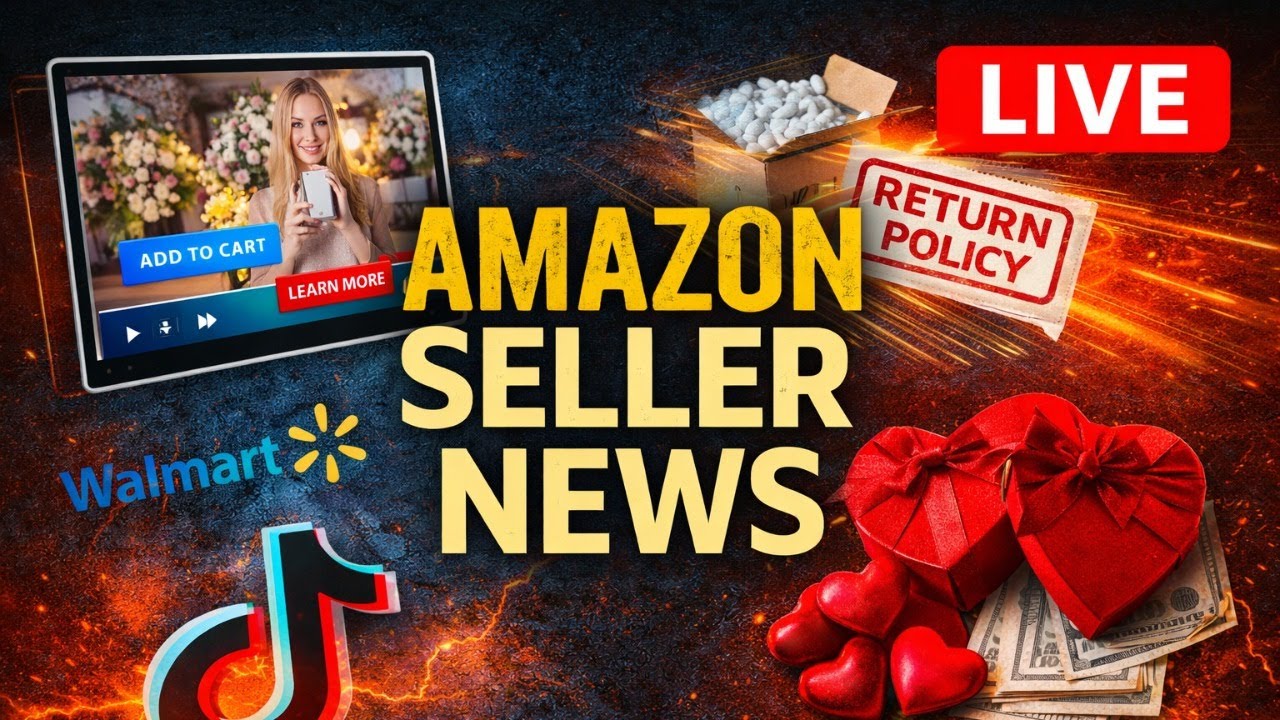
Amazon News: Interactive Ads, Walmart’s Surge & High-Value Return Shock
Summary
"Amazon's new interactive video ads, preferred by 7,000 consumers, allow shoppers to add items to their cart directly from the ad, reducing friction and potentially boosting conversion rates, while Walmart's growth highlights the importance of diversifying sales channels."
Full Content
Amazon News: Interactive Ads, Walmart’s Surge & High-Value Return Shock
Unknown Speaker:
Welcome, fellow entrepreneurs, to the Amazon Seller School podcast, where we talk about Amazon and how you can use it to build an e-commerce empire, a side hustle, and anything in between. And now your host, Todd Welch.
Speaker 2:
Hey, hey, hey, what's going on everybody? Another week of Amazon Seller News Live. Appreciate y'all joining me out there. As you can see, it's just myself right now. We had Brandon Young on the line, but unfortunately he dropped.
I'm not sure if he's having some internet issues or if StreamYard is having issues or not. And same with Danan. I haven't seen him jump on here yet. So right now, gonna be myself going over the news with you and giving you my opinions.
And if they jump on here, we'll bring them into the stream as soon as they're able to get back on. But let's go ahead and dive into the news here. So, first one up. Interactive video ads outperform standard formats across the funnel.
Amazon's Maggie Zhang revealed new research showing that consumers overwhelmingly prefer interactive video ads, finding them more engaging, memorable, and likely to drive action than standard video formats.
The study, there's Brandon right here. There you go. All right, awesome. Glad you were able to get back on there.
Speaker 1:
A little bit of a technical issue, but I was able to get back in.
Speaker 2:
Not a problem. We just went live and started reading the first news one here. I actually brought this one in because I know that you are promoting a PPC course right now.
So I thought this would be prudent to get your thoughts on it and not just Amazon's thoughts. Let me finish reading the summary here.
So Amazon's Maggie Zhang revealed new research showing that consumers overwhelmingly prefer interactive video ads, finding them more engaging, memorable, and likely to drive action than standard video formats.
The study based on 7,000 consumers, 10 brands, and eight interactive formats found that shoppers value being added to add to cart Excuse me,
found that shoppers value being able to add to cart or get more information without leaving the content. So this is coming directly from Amazon. So you got to take that for what it is.
Obviously, Amazon perhaps trying to promote their new ad format and get people to use it. So I'm curious, Brandon, if you have any thoughts and opinions on this, if it's as big of a deal as Amazon's trying to make it out to be.
Speaker 1:
So my understanding what this is saying is that they've removed some friction of between watching the video and being able to add it to cart or purchase the product.
And so it's not just watching a normal video and then going to the deep product detail page and then having to learn more and then deciding what they've allowed you to do is just straight from the video or the ad.
Added to Carter purchases, which to me is, you know, going to be always better. I mean, in marketing, the rule of thumb is the more clicks, the more friction, the lower the conversion rates.
So I don't know that this is saying anything incredibly novel. I think it's great that they're trying to boost video ads.
A lot of products need to be demonstrated and this might be a small way for them to kind of start fighting back against it. This is a demonstrable video that is TikTok, right?
Like TikTok is people showing their products off and being able to basically demonstrate how it works, get people excited about it, and then, you know, lead to that sale at a much higher rate.
Speaker 2:
Yeah, and it makes sense. I mean, of course, an interactive video ad, if you do it right, is going to be more effective than just a static ad. I remember for a little while, I don't know if people are still doing it,
but there is kind of a hack that you could use to make it look. The video would be like a picture of the static image and then the static image would start moving.
I don't know if people are still getting away with that but of course that grabbed people's attention and increased clicks and potentially conversions assuming you had a good product that backed up the ad.
So I think it just kind of makes sense and being able to add it straight to cart. It's good, I think, for most products.
I kind of wonder if it could potentially lead to a slightly higher return rate if they're not getting exactly what they thought they were getting.
Because if somebody clicks over to your page, they're probably swiping through some more images, maybe reading some of the infographics and stuff like that and making sure it's actually what they think they're getting.
Versus a flashy ad that maybe doesn't show the product.
Speaker 1:
Yeah, I mean buyer's remorse is probably higher with any type of impulse purchase, right?
Speaker 2:
Yeah, for sure. So is that something in your course that you guys are covering as far as PPC?
Speaker 1:
We do. So we cover every type of ad from placement to each type of ad you can put on. We also go very deep into conversion optimization. So from a content perspective and an ad perspective.
As a matter of fact, the course starts with that because we have a very simple one, two, three SOP, which is step one is fix your conversion rates. Step two is fix your indexing and your SEO.
And then step three is worry about spending money, right? A lot of people make the mistake and they skip straight to running ads,
going too heavily into ads without getting the feedback loops to go back and start working on steps one and two, which are, are you even in debt? I know what you're selling.
Are you able to show up and rank for keywords that are relevant and how to fix that if you're not? And then are you converting better than your competitors?
Looking at things like your search query performance report and getting some benchmark data. And if you're not, how do you fix it? How do you increase your conversion rates?
And so the first three, four weeks of the 12-week course that we put on are those first two things, which is let's maximize and optimize your conversion rates. Let's see how you're doing versus your competitors,
which keyword and root words and buckets of keywords, as we call them, are going to be where you should be targeting the majority of your ad spend as possible.
Speaker 2:
Yeah. I agree 100%. Click-through rate and conversion rate, of course, are probably your top two metrics that you got to nail because otherwise you're just wasting the PPC ad spend.
If you've got a 1% click-through rate, of course, it depends what category you're in, but if you've got a 1% click-through rate, You probably need to do some improvements on your main images,
maybe some of your ads, your interactive ads perhaps if you're getting such a low click-through rate. And then on the back end, that conversion rate needs to be up there 10%, 15%, 20% depending on your category.
Speaker 1:
Yeah, and it can range anywhere from, you know, 7% might be acceptable in some categories, but maybe 30 or 40% is where everyone else is. Again, I mean, like you said, it's really category dependent.
That's why, to me, the search word performance report and the fact that they're giving that type of data is phenomenal. We didn't have that when we first started, you know, 10 years ago.
And the fact that we're getting all of this information about where our competitors are at, how they're performing and where we need to be in order to win is really a North Star for us. It's just double down and spend more money.
But for us, Really, the number one reason to run ads, and I'm sure you agree, is really the rank, is organic ranking and SEO. And so there are some pretty deep theories we teach around what is your ceiling,
what is your highest potential rank for a keyword. A lot of Let me spend more money on this on this keyword. But the reality is maybe 15 is your ceiling, even though you're the third best in your subcategory.
Some keywords just have a lot of different diversity in search and a lower relevancy or specificity to your product. And so we teach you how to kind of figure that out, solve for that,
so you know whether you're spending the right amount of money or how to optimize how much you're spending on ads versus just always dumping into certain keywords.
Speaker 2:
Yeah. Yeah, absolutely. It's super important to understand your market because in some markets too, it's very top heavy where maybe the one or two top companies are getting 80% of the sales and if you're not one of those top two,
you kind of got to just fight for the scraps that are left over and understand that that's the market that you're in.
Speaker 1:
Absolutely, yeah. And there's not much difference in some of those categories between positions 12 and 10. And knowing where the ads show up and,
you know, like you said, the distribution of the conversions is very different in certain categories. Top three guys, top of search is, you know, 80% of it sometimes.
Speaker 2:
Yep, yeah, absolutely. So I'm curious, it kind of goes along with this for your guys' launch plan currently. Sorry, I'll pause that. What are you guys doing for reviews? Are you launching without reviews and getting them organically?
Are you utilizing Vine or what are your thoughts on that?
Speaker 1:
Yeah, I think as long as you have a decent quality product, we're leveraging Vine as much as possible. They've limited the number of reviews you can get for variations. A lot of people were cheating there.
We never recommended it, but they would launch all the variations separately and in multiple marketplaces. I think the multiple marketplaces still might be working,
but a hack there was that they would only send 20 units or 25 units into Canada and into Europe, into a few marketplaces, do Vine only, at a very low rate. And then those reviews would carry over internationally to you in America, right?
And so it's a little bit of complexity, but it helps you skip the curve of needing reviews in order to maximize your conversion rates in some instances.
But what we try to teach is, You should be winning at a higher rate than your competitors before you even order the product, meaning we use all of the data from the competitor reviews.
We use AI to help us design better products that are more desirable. Better packaging. We have first principles around content and how to make images that will convert higher than your competitors.
And then test that with market testing tools like either PickFu or IntelliVie. We know before we even go and order that product that we should be converting better and that we have a winning product.
So we're okay really going print heavy on day one for ads and for Vine, even without reviews use.
Speaker 2:
Yeah. Yeah. Okay. Very good. Yeah. I like to use Vine depending on the product and how complicated the product is. For example, if it's a product that's going to take like 30 to 60 days of use before you start seeing any results from it,
probably not ideal for Vine because you're going to get those reviews in a couple of weeks and people are going to say, oh, it didn't work for me.
Speaker 1:
Yeah, exactly.
Speaker 2:
So you got to be careful there.
Speaker 1:
Another- I don't want to do that really quickly. Sorry to interrupt, but what I've noticed is If you start with a higher price point, you're more likely to get negative reviews from the Vine reviewers.
Speaker 2:
Yes.
Speaker 1:
That's complaining about the price. But if you start with a low price on launch in order to maximize conversion rates and then you kind of gave them a deal, they will often even mention it's good for the price, five stars or whatever.
But I've seen the outfit where it's like, this isn't worth the money and three stars or whatever.
Unknown Speaker:
And it really hurts me.
Speaker 1:
They have no idea how much like a three or a four star hurts you versus a five star. But they're just complaining because they felt like they didn't get a good deal, even though they got it for free.
Speaker 2:
Yeah, that's exactly what I was going to say, is make sure you start your price at a lower price point before you do Vine, because otherwise you will get that.
They'll be like, product was great, everything was perfect, but maybe a little expensive, four stars or something.
Speaker 1:
I'm not a big fan of starting with lower amounts of inventory for launch. I like to hit the ground running and have enough inventory,
but I've heard of some sellers in certain categories will do something similar where they might only send in 50 units with the intention of using mine with another order, larger order right behind it.
But those units will specifically have nicer packaging, gift packaging, a handwritten card, Hacks like that, like people are using to take advantage of launch. I don't choose to do that, but to me,
it's like they're just trying to butter up the Vine reviewers a little bit because they are so picky.
Speaker 2:
Probably want to be careful with that one. Okay. Yeah. Interesting. I hadn't thought of that, but yeah, I mean, kind of a gray area.
You probably want to be careful, especially if you're doing anything Anything Amazon might see as manipulating reviews, I could come across rather.
Speaker 1:
Yeah, I mean, if you do really nice packaging and then you just don't put it in your content and then it's just like one set of,
and then eventually you change the content to have the normal packaging that everyone else is going to get or that they would get once those units are definitely gone. Yeah, like that's again into the gray area.
I try to avoid that as much as possible. I'm trying to build a very sustainable, long-term business that I can sell and valuable. But a lot of people are figuring out how to deal with these binary dealers, which can be a real pain.
Speaker 2:
I recently got access to be a Vine reviewer because I left a review for a product and it's like, you're invited to be a Vine reviewer. I'm like, awesome, now I can see what the other side looks like.
The interface that they're dealing with is pretty bad actually. There's literally...
Speaker 1:
UIUS has never really been a strong suit of Amazon. Let's be blunt.
Speaker 2:
Yeah. Well, the hard thing is, you know, I was looking to see is there anything I would want to actually grab and review. And there's literally tens of thousands of replacement parts.
And so you got to like next screen, next screen, and just try to find the good ones. They have a tab that's called Recommended for you. And every once in a while, good stuff will pop in there.
But otherwise, you're just going through pages and it doesn't seem like they sort them in any good order. You can filter by category and search, but there's no way to like sort and say, just show me the newest ones, right?
So you might click on automotive and there's a thousand in automotive and you just got to go through them. So it's kind of difficult. And a lot of, I don't want to say junk, but a lot of replacement parts for things. So rather interesting.
So it gives you a little bit more insight as to what the Vine reviewer is dealing with on their side. Also, when you leave a review, I don't know if you've noticed now,
Amazon has underneath the review box different things that they want you to hit in the review and they'll light up green when the AI detects that you've hit that point. And so the reviewers are hitting all those different points.
So you want to keep that in mind as well when you're doing the Vine program to make sure that you're covering all those different.
Speaker 1:
That's fantastic because I don't know how many people have actually seen that side of it. So just knowing what those different things are that you need to check, making sure the instruction is easy to use, readable.
I'm sure it's things like that, right?
Speaker 2:
Yeah, and value for the money is one of them that is there. I was wondering because that has to be something.
Speaker 1:
I see it so often. Yeah, that makes a lot of sense.
Speaker 2:
Well, I grabbed a lunch bag or something. So when that comes, I'll do the review. I'll have to take a screenshot of it and post it in the comments on this video so people can see what Vine reviewers are actually seeing.
Speaker 1:
Sneak peek.
Speaker 2:
Yes, absolutely. All right, let's go ahead and jump on to our next story here. Walmart is rapidly closing the online sales gap with Amazon.
A new payments report shows Walmart gaining online momentum, nearly tripling Amazon's e-commerce growth rate in Q3. And doubling its digital share of overall sales since 2022.
While Amazon still dominates with 56% of US online retail spending, Walmart's 115% online growth over the past few years signals a structural shift driven by grocery and pickup, which is a key thing there, and omni-channel fulfillment.
So, combine that news with this one here, Amazon takes on Walmart with new store concept. They're opening up a 225,000 square foot store. In Chicago, so a superstore basically to compete with Walmart.
I'm curious on your thoughts as far as the future of e-commerce and what it's looking like if Walmart is going to become a major competitor with Amazon going forward. Hey, Amazon sellers. Tired of losing money on storage and shipping fees?
Well, Amazon Storage Pros is here to take the headache out of logistics. We manage everything from inventory and creating efficient shipping plans to working with 3PLs and Amazon's AWD so that you can focus on growing your business.
Start with a free storage cost audit and discover exactly where you're overspending and how to fix it. Don't let logistics eat into your profits. Visit AmazonStoragePros.com.
That's AmazonStoragePros.com to get your free storage cost audit and start saving today. And now back to the show.
Speaker 1:
Yeah, I don't know that Amazon is going to be able to catch up to Walmart with regards to number of physical locations and super stores.
I have a lot of thoughts here because I think Amazon had an incredible way to enter The fashion space that I experienced myself in L.A., they had two concept stores, one in Ohio and one in L.A. But I'll start with the story.
I think the grocery part of it is massive. And I remember studying this in depth, really looking into it last year, maybe two years ago now,
where I was Curious where Walmart was going to be target and who was going to win there and how Amazon might be able to compete. And it was that grocery.
They identified maybe a decade ago that grocery was a key lever for them to get people in the store. And that's why Walmart started flipping all their stores to super centers that have grocery.
And when Amazon then went and bought Whole Foods, I was thinking that, you know, they understand grocery is super important, but Whole Foods are always smaller. They can't do the super center thing.
So they would have to literally start with bigger footprints, right? And it looks like this is where they're finally getting to. So who knows what the landscape looks like in 10 years? I think That's a Walmart, right?
They're making a supercenter because that's getting people in the door on a regular basis, but they've got to modernize it in some way. They've got to be able to do pickup and delivery and deliver your car.
Speaker 2:
Yeah.
Speaker 1:
Um, so it's, it's going to be interesting to see where they play, but to me, fashion is still, uh, there are so many categories that you just can't, and, and, and number of SKUs, you just can't have it a critical location.
You go to a spy and you browse and you look at like one or two things of every category. And it's like, well, if you then just go on Amazon, you've got pages and pages of options. Um, fashion is one thing where people need to try it on.
I really think that shopping online for clothing like Shein or some of these other places have done, it's really hard to shop. Your return rates are insane. They're really, really high because things just lay differently.
The fabric is different. They make it look one way and then you get it that's a different way. They're back from stealing these shirts again. I mean, they're all wrinkled and awful.
It's just Amazon, what they did is in those concept stores is they solve for efficiency of base and options. And the way that they did it is like a picture going into Macy's and you have Polo and then next to it,
you've got like another brand like Nautica or something. And in that one section where you've got Nautica, you've probably got 20 different things,
maybe 30 different things you can buy, but you've got all the different sizes and colors of each of those. So you've got this type of polo, that type of button down, this type of polo, these types of shorts and pants.
Not a lot of options in that space per square foot because you have to carry all the sizes there for people too. What they did instead for Amazon is they just put that same amount of space where every single item was used.
And they only have one size of each. And you shopped with your phone and you scanned it. And when you scanned it on your app, you could see all the sizing options and you would confirm it.
And when you first checked in, they assigned you a fitting room. And so what basically you do is you walk around the store and you send everything you're interested in into your own fitting room that you've got assigned to.
And it lets you know and checks it off as they come. And they've got a two-way door there in your fitting room that even as you're sitting there, they're putting more stuff in that you'd already selected.
But in that same amount of space, you've got 200 options instead of 20. And so the footprint for shopping is so much smaller,
but you feel like you've got the variety to choose from because the color options and the size options are all on your phone. But not only that,
they know you because you have your Amazon profile and they know what you selected to go send back there and they use their smart algorithm and AI. When I sent my five things there, when I got there, there were eight and it said,
because you selected this, we thought you might also like this. I had eight things to try on instead of the five I had selected.
Within 20 minutes, I walked around the store, another 10 minutes of trying things on, and it was the most seamless, easy shopping experience for clothes I've ever had.
Unknown Speaker:
I ended up buying two things.
Speaker 1:
My wife, who hates shopping for clothes, which is rare for a woman, I know, but she's not a big shopper. She bought something as well. I was like, this experience is really incredible.
There are ways to modernize shopping and clothing is one of them, but I just thought that that was relevant to this in a way because I think Amazon should get into the retail space, but they've got to modernize it, right?
Speaker 2:
Yeah. That's a really good thought. I hadn't thought about that aspect of it, but yeah,
if they build the superstore of the future with exactly what you were just talking about, just with Thousands and thousands of products throughout the store that.
You can go look at and try on and especially with clothes like you're saying because that is for sure the return rates in clothing on Amazon is crazy and can make it very difficult to be profitable in the clothing space for sure.
So being able to go to an actual store and try them on and see how it fits and have a kind of almost like a personalized butler experience. In a way,
because you got people going and finding your size and giving you other things that you might like and things like that. That'd be a really cool concept. How much they could scale that, you know, outside of the major cities, I don't know.
You're probably not going to have one of those on every corner like you do Walmart or neighborhood Walmarts and stuff like that. But in the big cities, I could see something like that taking off if they're able to do it right.
Speaker 1:
And Macy's is on the way out. Saks Fifth Avenue just declared bankruptcy. You know, these cooling giants that They're gonna get crushed by concepts like that. They're not modern enough.
And all the discount stores are eating their lunch on the bottom and then you have, if you have Amazon coming in on top with something more modern, with higher end stuff, you know, you just squeeze them out of the market.
You're just, you know, you're not gonna have a Macy's in a year to two years probably.
Speaker 2:
For better or for worse, it's kind of a compression of everything is just going to be in these big marketplaces. You've got the Macy's, JCPenney, technically those are marketplaces, but usually you go there for some specific kind of things,
mostly clothing and stuff like that, fashion, designer.
Speaker 1:
And they're getting crushed by Ross Marshall, TJ Maxx, right? And then on the bottom end, which is, you still get the name brand stuff, just a season ago. Which, I don't know, if you're like me, I don't care.
I mean, I've had this thing pull over and quarters it for.
Speaker 2:
Yeah, no, no. I don't really care about that either, but we're both getting a little bit older, so you kind of stop caring about those kind of things so much. But if you're in your 20s in college,
then you're always buying new clothes and making sure you're looking good or whatever the new trend is. You need to stay up with it for the most part.
Speaker 1:
As far as online and Walmart and the percentage of growth, I mean, I don't know what percentage they went from what to what. I mean, 112% growth could have been from 3% to 5%.
Speaker 2:
Below 10%.
Speaker 1:
Below 10%. I mean, 3% to 6% is 100% growth. There are ways off. I mean, we sell on Walmart. We do quite a bit of like, I'd say there's still less than 5% of our revenue.
So we, you know, we did almost a million dollars on Walmart and close to 20 million on Amazon. So I mean, it's We're pushing there. We're doing our best, but the platform still isn't great. Advertising still isn't great.
It's still way too manipulatable. So you get a lot of the Chinese sellers that are able to manipulate the ranks.
Unknown Speaker:
A lot of cheap stuff.
Speaker 1:
There's no real clear algorithm for ranking. There's no real, outside of just reviews, which is easy to hack and cheat and they don't care.
Unknown Speaker:
There's no real, like.
Speaker 1:
It feels like the Wild West in a lot of ways and the reward just isn't there to fight through that. The advertising especially is just not as targeted. They don't give you as much information around keywords, data.
They're quite a ways off from where Amazon is and it's a lot of the same growing pains that Amazon had to go through.
Speaker 2:
It makes you want to go back in time and stop Jet from selling to Walmart. What could have been if Jet would have kept going perhaps? You never know. Maybe they would have died on the vine,
but there seemed to be a lot of promise there until Walmart took over and then they let it go. Yeah.
Speaker 1:
I think that they were just interested in what they built, their platform and algorithm. Yeah, I don't know. That might go down as a terrible purchase. I don't know what they ultimately got from it, if anything.
Yeah, it feels like you could have just started from scratch as Walmart with infinite resources. I think there was just too much resistance to getting online for them for the first 10 years that Amazon was really building momentum.
Speaker 2:
Yeah, I mean when you're the largest offline retailer by far and you're that big, Walmart is gigantic, so it's not easy to Okay, now we're going to focus on e-commerce,
especially, you know, it hasn't been that long ago where there was still a lot of people like, Oh, this e-commerce thing, that's not going to work. Nobody's going to shop online. You know what I mean? That was 10 years ago ish.
There's still probably people saying that. Um, so, and that was the time where, you know, Walmart was looking at jet and everything else. And maybe 15 years ago now time is flying. But yeah, it's hard to turn a big ship like that.
I would love to see Walmart steal more market share or one of these other marketplaces, whoever it is, because then that gives us sellers more leverage.
Speaker 1:
Yeah, that's true too. I really think they talk to the future in a lot of ways. So I always thought, like a few years ago, if you'd ask me, I thought Walmart had a huge advantage to the market. If they leverage all the back of store,
If you think about how much Amazon has invested in their warehousing and in their infrastructure, you know, how many tens of millions of square feet. And then you just add up what you have in the back of every Walmart for square footage,
for storage, for distribution. It's quite similar, if not better, for Walmart because they have a bigger footprint throughout the country.
But Amazon has been just catching up and they just didn't implement that the way that they maybe could have for the same day they delivered. And now Amazon's getting to the next day, same day delivery from both regions.
Depending if you're a major city, you can get almost anything next or same day. And from an ads perspective, we're talking about ads, there's a huge bump in conversion rate if you're same day or next day. So if you have enough inventory,
so one of the things that we're trying to build within Datadive right now is a map of what all your inventory is for you and letting you know where you have gaps so that you know what the optimal inventory leverage might be or amounts might be and where you might be missing in regions.
And then figuring out, can we start to run ads that target regions? I mean, you can do it through certain ways. Can you reduce ads when you're lower so that you're not getting killed on your conversion rates?
Can we start to make recommendations about inventory and ad spend based on these things?
Speaker 2:
Okay, nice. That's pretty cool. When are you guys releasing that?
Speaker 1:
So the first inventory release with the maps and everything is in alpha now. Beta should be, I don't want to say too early, but in the next two to six weeks, people should By region, by warehouse.
And then we're creating really sophisticated days of inventory. The big advantage we have at Datadive is our data lake, right? We have so much data about your competitors and you and your keywords and seasonality and demand and demand sites.
And we're going to use all of that, leverage all of that data to give you the most accurate forecast of inventory needs. Then, you know, that's out there. Basically, by looking backwards, not just your sales over the last 30 days or 60 days,
but your competitors' sales over the last 12 months, for example. So we have some really interesting ways to look at seasonality for the next six months by looking back at the previous 12 to six months.
Your organic ranks versus your competitors and the demand movement keywords over that future time as well. And your growth, taking into account your growth or retraction as well.
So it's a quite sophisticated algorithm, but it'll be the most accurate that anyone's really put out there, I think.
Speaker 2:
Nice. Very good. Yeah, that'd be cool data to have, to see where those gaps are. And then the question is, can you get Amazon to send the inventory there?
That can be a battle sometimes because Amazon's relatively good at distributing inventory, but for some reason, sometimes they just have those gaps. And they dropped the ball for whatever reason. Yeah.
Speaker 1:
I mean, because coming from China, I mean, we land almost everything on the West Coast and you have to imagine, you know, they want us, that's why they want us to distribute it for them, which is sometimes not worth it. But if we can,
if we can tell you what the ROI is on you sending inventory to three locations or five locations throughout the country in the different regions,
We might be able to help you optimize that process because a lot of people don't take into account that, yeah, it was more expensive to send this container to the East Coast and a container to the West Coast.
But once you take into account all of the last mile shipping for all of your distribution, your conversion rates were higher, faster, and you made more money ultimately because you did it.
Speaker 2:
Yeah, that's a good point. So you're talking between sending everything to a single store or a single warehouse versus letting Amazon split it up into five different locations or three or whatever.
So then you're paying that placement fee or not paying the placement fee, I mean,
but paying more for shipping costs, obviously, but are you making that up by getting a higher sales velocity or conversion rate with faster shipping and such?
Speaker 1:
Yeah, and you have to account for that and a lot of people don't because even if you do send it to one location and pay that placement fee because shipping to five locations would be more,
three would be more, that time that it takes them to distribute it for you, like we were just talking about, is quite extensive. A lot of people don't understand it.
Your inventory needs on the East Coast and Southeast region and Northeast region and Midwest might be higher. And your organic ranks are much lower in those regions with perhaps low inventory.
Your conversion rates are worse if you're not two-day prime.
Speaker 2:
Yeah.
Speaker 1:
Right.
Speaker 2:
Yeah. And you're, you know, nothing worse than seeing all your inventory wrapped up in FC transfer. You've got 1,000 units and zero are available and they're all in FC transfer or whatever and sometimes it just happens randomly.
Amazon probably trying to fill those gaps. You'll log on, you got 2,000 units and then you jump on the next day and 900 of them are in FC transfer. And you're low on inventory all of a sudden.
So staying on top of where those gaps are as well could probably prevent issues like that cropping up also. Yeah.
Speaker 1:
And so for us to be able to say, okay, let's set the optimal number of days of inventory so that Amazon has enough time to get that inventory around the country for you,
fill those gaps and allow you to pull the right levers from an advertising perspective is an interesting idea.
Speaker 2:
Yeah, for sure. Yeah, that's cool. I'll have to check that out once you guys fully release that. But yeah, it'd be interesting to see where the gaps are for some of the products that we sell, at least the higher velocity stuff.
I sell a lot of like lower, medium velocity stuff, but some of the higher velocity things, it'd be good to know where those gaps are and try to fill them the best you can.
Speaker 1:
Yeah.
Speaker 2:
All right, cool. Let's go ahead and jump on to the next story here. So Amazon drops high-value return protections, forcing sellers to rethink pricing and product mix.
Amazon will require all U.S. sellers to use Amazon prepaid return labels starting February 8th, eliminating the long-standing exemption that protected high-value items from automatic returns.
Sellers say this removes their ability to troubleshoot customer issues For a step that often prevents unnecessary refunds, damage in transit and massive losses on expensive or fragile products.
So essentially, even if you're selling a couch on Amazon, now after February 8th anyways, the buyer is gonna have the ability to just go on and generate a return label without ever contacting you, which definitely could hurt quite a bit.
Speaker 1:
Yeah. I think in partner with this, they're also allowing you to turn on a setting where you just auto refund, no returns, or there's a setting there as well, right?
Speaker 2:
Correct. Yeah.
Speaker 1:
But if word gets out into some of these deal groups with a bunch of creditors, you know, you might get a bunch of purchases where people go to generate a return to get a free couch.
Speaker 2:
Yeah, that's a good point.
Speaker 1:
You've got to be super careful with some of these policies that Amazon's forcing us to put on. Because these deal groups, they don't realize that they're not taking the money out of Amazon's pocket, they're taking it out of sellers like us.
Speaker 2:
Yeah, it's hard. Like it says in here, if we read through the article, some of the people, like for example, one of the examples is they sell a product that has a battery in it,
And the batteries are left, you know, with the little slip of plastic that you got to pull out to activate them. And they get returns because people say, oh, it doesn't work.
It won't turn on or whatever the case may be, because they didn't pull that little slip of plastic out. And so a simple email or a phone call can fix that. And instead, now you might get a lot of people who are just like, it's broken.
And they send it back when in reality there's nothing wrong with it.
Speaker 1:
I think that seller in particular should probably just make that tab that they need to pull out a little bit longer with a little bit of text on it. That would probably solve that. No, there are a lot of reasons that this could be bad.
I mean, I've always thought that they should improve the communication between sellers and buyers rather than continue to gate it like they've done.
They've made it worse and harder versus making it easier, which is making it a worse buyer experience, right? If their North Star is the customer experience, if they're the buyers of the customers,
the sellers of the customers, we're customers too as sellers. They've done what their policies have been around communicating between us has been significantly worse for both of us. And that's just the way I feel about it.
I think if in a sandbox methodology, like you're saying, they should be able to reach out. We should be able to get customer service without having to put an insert card in a big red stop sign that says,
stop, if you need any help, reach out to us directly, you know. Because Amazon sucks at helping, you know, you, because they don't know our product and they're not us and they don't give a shit about our bottom line or you.
Speaker 2:
And, you know, on, to take Amazon's side for a minute, I remember the days before Amazon, you know, maybe shopping on eBay or some websites. And I remember always thinking to myself, if I buy this,
It's going to be a pain in the butt to return it if there's something wrong or it's broken or I don't like it or if it's clothing, it doesn't fit.
So that was always in the back of your mind like, okay, this is going to be a hassle potentially. Is it worth buying it online or should I just go to Best Buy or Home Depot or wherever to pick it up instead?
So Amazon tried and did really good at removing that.
friction from e-commerce and so that's where Amazon is coming at this from they wanted to be frictionless as possible but at the same time you know for high-value items especially something like a couch or a bed or something like that you know one of those roll up beds You know,
that can be really important to be able to communicate more with the buyer if they are thinking about returning. Yeah.
Speaker 1:
No, that's, they've done a lot to help us, obviously. You know, I just, their iterative process should make things better for both sides rather than worse. And they've improved significantly in many areas, right?
Like they're giving us more data. They do try to make it better in most areas, but this I think is a step in the wrong direction.
Speaker 2:
Yeah. Step backwards. It kind of makes you wonder what will happen in the space of super high value items, especially bulky ones. Right like a couch or something, you know, that's not just a basic. Yeah UPS Yeah,
that's what I'm thinking maybe this drives people to Wayfair or some of the other Furniture companies and stuff out there that make it No better experience for the sellers at the same time. The the customers are there on Amazon.
So I I guess maybe just the Chinese pick up the slack and take all those hits because you're not necessarily gonna be able to return it to China, so they'll just disappear on you if you try to return it.
Amazon protects you on that if it's FBA anyways, but if you're talking FBM, you might be in trouble a little bit. But yeah, something to keep in mind if you're out there listening to this and you're selling high value stuff,
Those big red stickers are probably going to be quite handy if you don't have them already and making the labels and such much larger like you mentioned if you got that little tab on the battery. I know I've missed them before.
You're trying to get something to work and then you're like, oh shoot, forgot to pull this little white slip of paper out of the battery. Make those a lot bigger and easier for the customer. So that could be a positive side of this.
Speaker 1:
You know, you got to just solve where the problems are and improve upon them in some capacity.
Speaker 2:
Yeah, exactly. For that guy complaining about that, this is an opportunity to improve your customer experience and make sure they don't miss that little tab.
And have no option but to pull it out when they open the package or something, you know? All right, cool. Good stuff. Let's go ahead and jump on to our last story here and get your thoughts on promotions for not just Valentine's Day here,
but I'd like to get your kind of overall thoughts on marketing and such for the different holidays and promotions that Amazon does. Drive more Valentine's Day sales with these tips.
Amazon is encouraging sellers to maximize Valentine's Day performance by updating product images with seasonal themes and enhancing A plus content to match what gift givers are searching for.
Sellers are also advised to curate themed collections in their brand store such as for the tech lover or for last minute shoppers which that I think is a really cool idea that probably not a lot of people have thought of.
To make gift giving easier and improve conversions. Also creating compliant gift bundles and running targeted Amazon ads can increase visibility during this high intent shopping window.
So curious on your thoughts on those recommendations some really common ones there, but What are your what are your guys's things that you guys do and recommend when it comes to holidays and big promotions?
Speaker 1:
So we get a lot of holiday We used to do a lot of holiday products. I mean, for many years, it was only last year that we decided to move away from it. But in the toy space, you have to think about toys specific to Valentine's Day,
to 4th of July, you know, just some of these holidays. And what we realized was that the amount of effort it took for us to Source, curate, design, develop, do the content, launch, and then sell through, oftentimes not completely,
all of these inventories for the SKU. And we were launching anywhere from 15 to 25 SKUs per holiday. What we decided was that the same amount of effort could be used to launch something that's an evergreen product,
something we can sell year round. And we did quite well, but what would often happen is out of those 20 SKUs, let's say, 10 would sell out completely very quickly. We didn't order enough inventory. Five, we would, you know, get through,
we would have to discount towards the end of the year a little bit to try to get through all of it. And then five would be done. Maybe we would have to discount very heavily and we would have inventory left over.
And that was okay when we first started selling. Remember the days of 50 cent returns? Every item was a 50-cent return no matter what. That was okay then because then you can just recall everything that didn't, hold it for nine months,
ten months and you send it back in. But now that returns are just as expensive as fulfillment and you're talking about maybe selling a $20 bundle that cost you $4 to land it but it's $4 to recall it.
And then another $3 or $4 to chip it in or $2 to chip it back in, you know, that product cost and storage fees and processing and overhead, it's just not worth it anymore.
So all the profit we've made from those first 10 products and then maybe breaking even on five and then losing money on five, the net ROI on all of it was just so low that we decided to stay away from these types of categories.
All of these tips are great and spot on. I think these are more evergreen type products that you can update with seasonal themes.
Anything giftable for a loved one and then updating it with like a packaging and a heart and some Valentine's Day type imagery, putting it next to, you know,
with a bow on it with the packaging or a man hanging it to a woman or a woman handing it to a man. Stuff like that's great. I think that's amazing. I don't know about virtual bundles, but I mean, maybe they're talking about physical bundles.
Speaker 2:
Yeah, that's my guess. But virtual bundles wouldn't be a bad idea, too, especially for for holiday stuff like this, because then you don't have that inventory issue you're talking about.
Speaker 1:
Yeah, potentially for those bundles, the virtual bundles. I know that they're making it harder to market those. They were testing to try to make it easier and now it's getting harder again, which is interesting.
They tested running ads for virtual bundles for a short period of time. I think they just pulled it away. Is that right?
Speaker 2:
I hadn't heard that. No. You're probably correct though. Yeah.
Speaker 1:
And I think that, For the most part, I think that people don't do this enough where they update keywords, they update imagery.
And I think these are all great tips if you've got something that could be seen as one of these holiday type gifts. And like even what's weird is right now I have a sports brand and I'm developing some golf stuff.
And what's interesting is with the golf stuff, you have multiple seasons, right? Like most people don't think that. They think, oh, it's spring. But the reality is most of the time the golf stuff is gifted for golf lovers.
So you have a Father's Day spike, you have a spring spike and you have, you know, throughout the summer it stays pretty high. Then you have a Q4 spike.
So you have multiple seasons sometimes that you don't think about and you have both prime days. You really have to think about inventory planning, get stability for almost every product out there.
Speaker 2:
Absolutely. I really like the idea here, making tabs maybe on your brand store for the tech lover or for last minute shoppers, especially if you have a big catalog of products that you're selling.
You can kind of curate those different themes for the customer and make it a little bit easier for them and track and see what kind of conversion rates you get on those pages.
Amazon has relatively good statistics that you can look at for the brand stores now, so you can kind of see how many sales each page is driving and stuff like that.
Speaker 1:
How are you driving traffic to brand stores and how much traffic are you seeing there?
Speaker 2:
Mostly, it's just the organic clicks from the listings and then also email lists and maybe promotions on the brand website if you are trying to boost your Amazon sales and stuff like that,
but more so like newsletters if the brands have those built up for doing A sale or something like that.
Speaker 1:
Yeah. We've seen Amazon pushing brand stores more. I think when they first launched the traffic, it was almost nothing unless you were the one driving it.
Speaker 2:
Yeah.
Speaker 1:
But definitely has been increasing over time. And I wonder, it seems like they're leaning into it more and more. So I wonder how they're going to continue to help us drive traffic. Yeah. There's less advertising space for them.
So I don't know that it's in their best interest.
Speaker 2:
It is. But, you know, from the consumer side, I've found myself many times clicking into a brand store, especially if I'm looking for like some something specific. Uh, like let's say for example, I was just looking for a, um, a space heater,
uh, you know, like a little bigger one, one of the standup floor ones. And I was opening different products and in tabs and looking at them, you know, I'm a, I still shop on the desktop I prefer. So I'm in the minority there.
But, uh, you know, and then I found one, I'm like, this is really cool, but it's not quite what I want. I wonder if this brand has something else. And so I click on the brand store.
And start looking through the rest of their heaters and stuff that they're carrying. And I do that, I wouldn't say frequently, but more often than rarely, I guess. So medium to low and I'm clicking on the brand store.
If it's something that I'm curious like, okay, this is almost what I want. I wonder if they have what I really want. And then I click over to the brand store and look around.
Speaker 1:
Right, right, right. Yeah, I think it's become more of a shopping. It is habits, right? And I think really it's become more of a habit. So it is important to have a good brand store, which is the bottom line.
And then updating the themes on the brand store doesn't happen often enough. Updating the content on your product detail page doesn't happen enough. These are all great tips.
There is a cost to doing it and you have to figure out what the ROI is there, but you might find that it's worth it if you can do it quickly. A lot of the sellers that we deal with are solopreneurs in a lot of ways, right?
Like the zero to one million guys tend to have themselves an MBA maybe.
Speaker 2:
Yeah.
Speaker 1:
So that costs to update that content. Now with AI, it's much easier. Whereas like two years ago, it was expensive.
You would probably have to pay hundreds of dollars to update your sets of images with layers of tags unless you got good at Photoshop yourself. And even then, it wasn't as good as what you can just throw into AI with Nano,
Banana, or ChatGPT and say, hey, take this exact image and then overlay some wreaths and a happy Valentine's Day or put a Christmas tree somewhere.
Speaker 2:
Yeah, you know, it's gotten quite decent chat GPT, I've noticed of the general AI's right I'm not including nano banana necessarily what are the general AI's chat GPT seems to do the best job at generating Photos from a prompt.
But just this morning, actually, you know, I wanted to make a pose and then cut myself out so that I could use it on a cover photo, right, for a YouTube video.
I just went into perplexity and I pasted this photo that I took with this background behind me doing the pose.
I said, cut out my background, make the background white and put a yellow outline around me so that I can make a transparent background. It did it. It was perfect. I downloaded it, opened it in paint.net and deleted the background.
Uploaded it into Canva and was good to go for the cover. Amazing. Yeah, it's going quite good. In the past, I would have went to Fiverr and been like, hey, can you remove the background here for me or whatever to get somebody to do it.
So sorry to the Fiverr guys that I would have paid 20 bucks to do it before.
Speaker 1:
Right, exactly.
Speaker 2:
Yeah, but AI is getting quite amazing with that kind of stuff. You got to look at the detail of the photos they make and make sure you don't got the six fingers or whatever, an extra arm coming out somewhere or whatever it is.
You never know. But yeah, for sure. So yeah, we'll go ahead and wrap it up there, Brandon. I appreciate you coming on the show. This has been fantastic. And everybody out there watching, I appreciate you as well.
We do this every Thursday at 12 p.m. Eastern. So yeah, Brandon, Data Dive. Thanks again for coming on the show.
Speaker 1:
Thank you.
Speaker 2:
Have a good one, everybody.
Unknown Speaker:
This has been another episode of the Amazon Seller School podcast. Thanks for listening, fellow Amazon seller. And always remember, success is yours if you take it.
Speaker 2:
Hey, if you made it this far in the show, I really hope you enjoyed it and I'd like to ask you a favor. Could you head on over to Apple or Spotify or wherever you're listening to this and leave us a review?
It would be greatly appreciated and would help us continue to grow the show and offer more episodes for you. Thank you. God bless and have an awesome day.
This transcript page is part of the Billion Dollar Sellers Content Hub. Explore more content →