YouTube
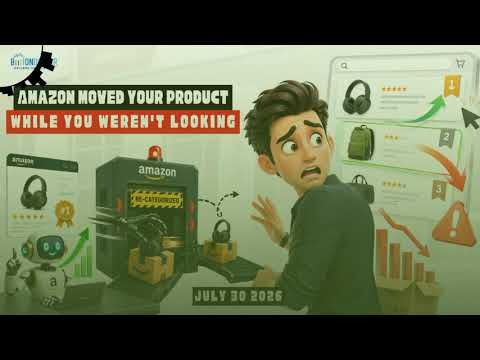
Amazon Moved Your Product While You Weren't Looking
Summary
Amazon's been stealthily re-categorizing products, dropping top-ranked items to page 80 without warning. Your listing's backend attributes—browse node, product type, and item type keyword—now crucially decide your keyword eligibility. Plus, the influencer game is shifting as 45% of brand budgets now target creators with under 20K followers due to their superior engagement rates compared to mega-influencers.
Transcript
This This is the Billiondollar Sellers podcast. Your go-to source for cutting edge strategies and success stories from the world of Amazon and e-commerce. Buckle up and get ready to take your Amazon business to new heights. Don't forget to subscribe to the Billiondoll Sellers newsletter. Welcome your host. >> Welcome your host, >> Kevin King. >> Hey everyone, welcome to the Billiondollar Sellers podcast. I'm your host, Kevin King, and today is Thursday, July 30th, 2026. We've got a big one for you today. So, let's jump right in. On today's show, I'm going to break down how Amazon's been quietly recategorizing products behind sellers backs and how one hidden setting can drop you from number one all the way to number 80 without you touching a thing. We'll also get into the popcorn pricing trick that every movie theater in America uses and most sellers ignore. Why the smart influencer money is going small right now, a free browser extension that's quietly erasing junk brand names from search, and a whole lot more. All right, first up, today's Stump Bezos question. So, Amazon now generates about 9% of UPS's revenue, and that's down from 13%. Here's the question. How many of those low yield Amazon parcels a day did UPS actually cut to make themselves more profitable? Think about it, and I'll give you the answer at the end of the show. All right, let's get into it. And I want to start with the story this whole episode is named after, cuz this one is happening to sellers right now, and most of them have no idea. So, picture this. You didn't change a single thing on your listing, but your rankings tanked anyway. You used to be number one and now you're sitting at number 80. So, what happened? Well, on last week's billiondoll Sellers Club call, catalog expert Vanessa Hung, she's the founder of online seller solutions, she explained exactly why Amazon has been silently recatgorizing products and the sellers who got moved almost never got a single notification about it. And her core message is this. In the AI era, your back-end data is your product quality. Amazon reads it, Alexa reads it, chat GPT reads it, and if it's wrong, no amount of SEO is going to save you. So, here's the one strategy from that call that every seller should act on this week, and it comes down to auditing something called your item type keyword or ITK. Now, there are three back-end attributes that control where you show up on Amazon. The first is your browse node, and that's the big category umbrella. So, think home and kitchen or grocery. That one's mostly automatic. The second is your product type, and that determines which attribute fields you're even allowed to fill in. And the third, and this is a big one, is your item type keyword, the ITK. That's the granular descriptor that decides which keywords you're even eligible to rank for. And that's where you've got the most control, and it matters the most. And Vanessa had a great analogy for this. Your browse node is the highway, your product type is the avenue, and your ITK is your street address. And Alexa, well, Alexa's the Uber driver bringing the customer right to your door. So, if you've got the wrong street address, that customer never arrives, no matter how perfect your listing SEO is. So, let's say your ITK is set to adult toothbrush. You could dump every last dollar of your PPC budget into kids toothbrush, and it just doesn't matter. You're never going to rank number one for it. It's not that you're losing the race, it's that you were never even on the track. Now, why did all of this break recently? Well, Amazon restructured their product types and their ITKs, and they stopped accepting the old flat file templates back in February of 2026. So the attribute sets are just completely different now. And that old trick of sibling borrowing where you grab attributes from an adjacent product type, that's dead. It's category specific data only. Now, and here's the kicker. Your listing copy now drives your classification. So if you write arts and crafts language, Amazon classifies you as arts and crafts, even if what you actually sell is toys. But the flip side is good news because if you fix that copy, Amazon will often recategorize you within days. No support case needed. And Amazon's not going to tell you when it moves you. Vanessa gave this example of an air mattress seller who never even noticed that their whole category had become inflatable beds. Amazon just moved on without them. So, here's what you can do about it today, and it'll take you about 15 minutes. First, check for a mismatch. Compare the category path on the front end of your product page against what's sitting in your back end. If there's a discrepancy, that's data debt you owe. Second, pull your category listing report out of Seller Central and compare it against your 2025 version. Those changed product types and ITKs explain a whole lot of mystery ranking drops. Third, run it through Vanessa's free tool. It's called flatfiletransfer.com and it tells you exactly which ITK's and category specific templates you need. And the best part, it runs locally so your data never leaves your machine. Fourth, let AI do the grunt work. Vanessa shared a clawed skill on the call that transfers your category listing report into the new templates automatically. So, what used to be hours of flat file work is now just minutes. And that one's available inside the billiondoll Sellers Club for members. And fifth, only fill in what's actually true. These new templates expose blank attributes you've never seen before. So, fill in what's relevant and never fabricate anything because Amazon's AI will replicate wrong data across the entire internet. Now, one warning here. Every child in a variation family should live on that same ITK street. and Vanessa showed a real listing where the variations were scattered across three different categories, all bleeding rank, and in a lot of cases, they weren't even sharing reviews anymore. But know the risk going in. A full backend optimization can trigger Amazon's variation policy checks. So, if you've got a technically non-compliant variation that's printing money, weigh that carefully before you go touching it. And the bigger picture here is just brutal math. If your data layer is negative, then everything you multiply on top of it goes negative, too. your PPC, your SEO, your AI agents, your gorgeous creative, all of it inherits your catalog's mistakes, and now it's automated and at scale. So, fix the street address first, then build the house. And that was just one strategy from one 76-minute call inside the club. Vanessa also covered the exact URL trick that exposes your backend ITK, her full flat file SOP, and a whole Q&A on whether keywords are dead. Club members get three calls like that every month, plus the replays, the written summaries, and the tools. So, that's what you're missing by not being in the billion-dollar sellers club. All right, let's take a quick look at some interesting stats, and this one's all about ChatGpt and Google. So, here's the first thing that jumped out at me. Chat GPT has now reached 494 million users, which sounds enormous until you realize that about 95% of them already overlap with Google's audience. So, it's not really pulling in a brand new crowd. It's mostly the same people. And the second thing, just to put the scale in perspective, Google is sitting at 3.3 billion users. And ChatGpt's entire audience works out to only about 14% of that. So, as fast as AI search is growing, Google's reach is still in a completely different league. All right, next one up, and this is a fun one. There's a $6.50 popcorn at your local movie theater that they're basically betting you'll walk right past. So, there's a pricing trick hiding in plain sight at every movie theater in America, and most sellers are just leaving money on the table by ignoring it. It's called the decoy effect, and it might be the most underused pricing psychology play in all of e-commerce. Here's the premise. You introduce a third pricing option that's positioned to make one of your other two options look like the obvious best value, and buyers predictably flock to that best value option at rates they never would have without the decoy. So, back to the theater. Small popcorn is $3. Large is $7. And then there's the medium sitting right there at $650. Now, nobody's supposed to buy that medium, and that's the whole point. The medium exists to make the large look like a no-brainer. 50 cents more for nearly double the popcorn. Large sales spike, and the decoy did its job without selling a single unit. So, how do you run this play in your own business? A few steps. First, pick your target. Which product or tier or skew do you most want customers to buy? That's your target. and everything else on the menu just exists to make it shine. Second, you build your decoy. Set it right up close to your target. Maybe a hair under, but with clearly less value, and it should not be a good deal. That's literally the whole point. The decoy is not there to actually sell anything. It's there to make your target look like an absolute steal next to it. Third, set your anchor. Your premium tier needs to be priced high enough to make the target feel like a bargain, but not so high that it triggers sticker shock. Most buyers anchor on that premium price and then pick the target as the smart middle choice. So let them feel smart. That feeling converts. And fourth, test it on Amazon or Shopify. Use a variation listing to run three tiers of the same product. So different sizes, bundles, or quantities, and just watch which tier captures the most conversions. Then you tweak your decoy pricing until that middle tier dominates. So what does this actually look like on Amazon? Say you sell garlic presses and your hero product is a two pack at $19.99. You'd set up a variation listing with three options. A single unit at $16.99, that's your decoy. The two pack at $ 199.99, that's your target. And a fourpack family bundle at $34.99, that's your anchor. See, that single at $16.99 is deliberately a bad deal because $3 more gets you double the product. And that $34.99 bundle makes the two pack feel like the sensible middle. So shoppers scan the three options, they feel clever picking the two pack, and your average order value climbs, all without touching your ad spend or your conversion rate on the listing itself. And here's a bonus. The decoy still catches the occasional buyer who only wants the one. And every one of those sales is your highest margin unit. Now on Shopify, it's the same psychology, but you get a lot more control. Say you sell a skincare serum for $39. You'd build your product page around three offers. A half-size travel bottle at $34, that's your decoy. The full size at $39. That's your target. And a three bottle 90-day routine at $99. That's your anchor. That $34 half size should make people wse. $5 less for half the product. Exactly. It exists to make the $39 full size look like the obvious move, while that $99 bundle up top resets what expensive even means on the page. And on Shopify, you can go further than Amazon let you. You can test the decoy price with an AB tool. Reorder the tiers so the target sits right in the middle visually and badge it most popular to really seal the deal. Then you just watch which tier wins in your analytics and tighten the screws from there. And by the way, Norm and I break down plays just like this one every single week over in the Marketing Misfits newsletter and it's completely free. You can find a link for that in the show notes. All right, let's talk about today's software tool of the day. And this one's a little different because it's not a tool for you. It's a tool being used on you. So, it's called Knockoff, and it's a free browser extension for Chrome, Firefox, and Safari that hides what it calls fake and junk brands from your Amazon and Etsy search results. It checks every listing against a database of more than 5,500 established brands, and then it hides, dims, or labels anything that looks like a trademark squat pseudo brand, and shoppers can pick three different strictness levels, kill the sponsored ads, and keep their own personal allow, and block lists. It covers all 23 Amazon marketplaces. It needs no account and it costs nothing. It's got 4.8 stars for more than 100,000 users with press from Fast Company, CNET, and The Verge. So, why should you care? Well, more than 100,000 shoppers and growing have now installed software whose entire job is to erase random letter brand names from search results. So, if your brand name looks like a cat walked across a keyboard, you're not just fighting for rank anymore. You're fighting to be visible at all. And with AI shopping assistants learning those same skip the junk brands instincts, this extension is really a preview of how the next generation of shoppers is going to see you or not see you. It's free over at knockoff.co. Okay, next up, and I love this one. Here's a stat that should change how you spend your external traffic budget. 94% of creator influence purchases actually happen on Amazon. So read that again. A creator posts something, their audience gets the itch, and then they go open the Amazon app and buy it right there. So, every influencer campaign, even the ones you didn't pay for, is ultimately funneling shoppers to an Amazon search bar or a product page. So, the question isn't whether creator traffic converts on Amazon, it's whether it converts on your listing or your competitors. And right now, the smart money is going small. See, the algorithm basically killed the follower count. Most of what shows up in a feed now doesn't even come from accounts people follow. So, a big following no longer guarantees views. But a nano creator with an audience that actually trusts them still drives buys. And the big brands are already going micro. And the numbers say exactly why. The Wall Street Journal reports that major brands are increasingly cutting deals with small-time creators. And e-arketers forecast for US influencer earnings this year, which is about $21 billion. Breaks down like this. Around 45% of brand influencer spend is going to creators with under 20,000 followers. And that's up from 19.5% back in 2021. And nearly 20% is going to nano influencers with under 5,000 followers, which is up from a measly 3.1% just 5 years ago. And we're talking Target, American Eagle, and SoulCycle, all working with smaller creators, some of them with as few as 500 followers. And this isn't charity, it's math. Micro influencers average a 3.2% engagement rate, while the accounts with a million plus followers average 1.1%. And those mega creators can cost up to 18 times more to partner with. So, what does this mean for you as an Amazon seller? Well, big brands going micro is actually great news for you. You can't outbid target for a celebrity, but you can absolutely outmaneuver them with 50 nano creators in your niche. So, first build a nano creator bench, not one hero deal. 10 creators with 3,000 engaged followers in your exact niche will usually outperform one 100,000 follower generalist at a fraction of the cost. And a lot of them will work for product, a discount code, or a small flat fee. Second, capture the credit and the kickback. Since about 94% of those purchases land on Amazon anyway, root every creator through Amazon attribution links. You get the conversion data and with brand registry, the brand referral bonus hands you back about 10% of the sale, which basically subsidizes the whole campaign. Third, lean on creator connections and the Amazon influencer program. See, Amazon's got its own creator marketplace, so you can dangle commission offers right in front of influencers who already do this shop posting thing for a living. and their storefronts and shoppable videos can end up right on your listing. So that's free social proof sitting there in your gallery. Fourth, chase the halo, not just the click. See, external traffic that converts well is widely believed to give your organic rank a nice little bump. And honestly, a steady drip of nano creator posts is going to beat one big viral spike that your inventory probably can't survive anyway. And fifth, negotiate like the market says you actually can. A lot of the time, small creators are getting paid in freebies, discount codes, or a $10 gift card. And honestly, more than half of full-time creators are earning below a living wage. Now, look, you don't need to go lowballing anybody, but you also don't need some 5 figure budget to get in the game. Product plus commission plus a real relationship. That goes a really long way. So, the influencer economy just repriced in your favor. The cheapest creators have the best engagement. The platforms killed the value of raw follower counts. And 94 cents of every creator influence dollar was already headed to Amazon anyway. So set up attribution, recruit small, and be the listing that traffic lands on. All right, and speaking of the marketing misfits, you got to go check out the latest episode because Norman and I sat down with an absolute e-commerce legend, Ezra Firestone. He's the founder of Smart Marketer and Zipify. So, how do the top e-commerce brands stay profitable when customer acquisition costs go up every single year? Well, Ezra breaks down the exact strategies that are working in modern e-commerce right now. He gets into why relying solely on new customer acquisition is a fast path to going out of business, how to build a brand around customer experience, and why every physical product brand has got to also operate like a product development and media company. And on top of that, Ezra shares how he leverages AI agents without losing the soul of his brand, why he thinks SAS tools aren't dying, and where the battle for checkout is heading next. You can subscribe to the Marketing Misfits newsletter. And I'll drop a link for you in the show notes. And here's something worth your time from our friends over at Atomic 1. So, you already know the blind spots in your Amazon store. The real question is whether you catch them or your P&L does. Pricing shifts hourly. Ad spend leaks. Inventory runs low while you're focused somewhere else. And none of it shows up until it's already cost you money. So, Atomic 1 built AI agents that catch this stuff before it ever hits your bottom line. One store grew net profit nearly 40% in a single quarter while their spend stayed flat. Another cut their ad waste and dropped their a cost from 67% all the way down to 53%. And these aren't dashboards you've got to go check. They watch your pricing, your ads, your inventory, and your margins around the clock. And they act on what they find. No new hires, no new tools, no overhead you got to manage. So you can get a free audit and see what's actually happening inside your store right now. And there's a link in the show notes. All right, before we wrap up, here are a few more hot picks for you. First up, Walmart is celebrating 1 million drone deliveries. Amazon will now tell you if your products are selling elsewhere. Tik Tok shop is testing an Amazon Prime style membership program. And there's an online sellers bill of rights that's just been introduced in Congress to protect seller money. And you can find the links to all of these stories in our written newsletter over at billiondollarellers.com. And here's your parting shot for today, and it comes from Oprah Winfrey. She said, "Passion is energy. Feel the power that comes from focusing on what excites you." And finally, remember that Stump Bezos question from the top of the show? How many Amazon parcels a day did UPS cut to make themselves more profitable? Well, the answer is 2 million packages a day. All right, that's all for today, folks. Have a great weekend and I'll see you again on Monday. This is Kevin King signing off from the Billiondoll Sellers podcast.
This transcript page is part of the Billion Dollar Sellers Content Hub. Explore more content →