YouTube
Amazon just killed your fake pricing
Summary
Amazon just killed your fake pricing - Date: 23rd of April 2026 Summary: Kevin King breaks down Amazon's two new pricing policy changes th...
Transcript
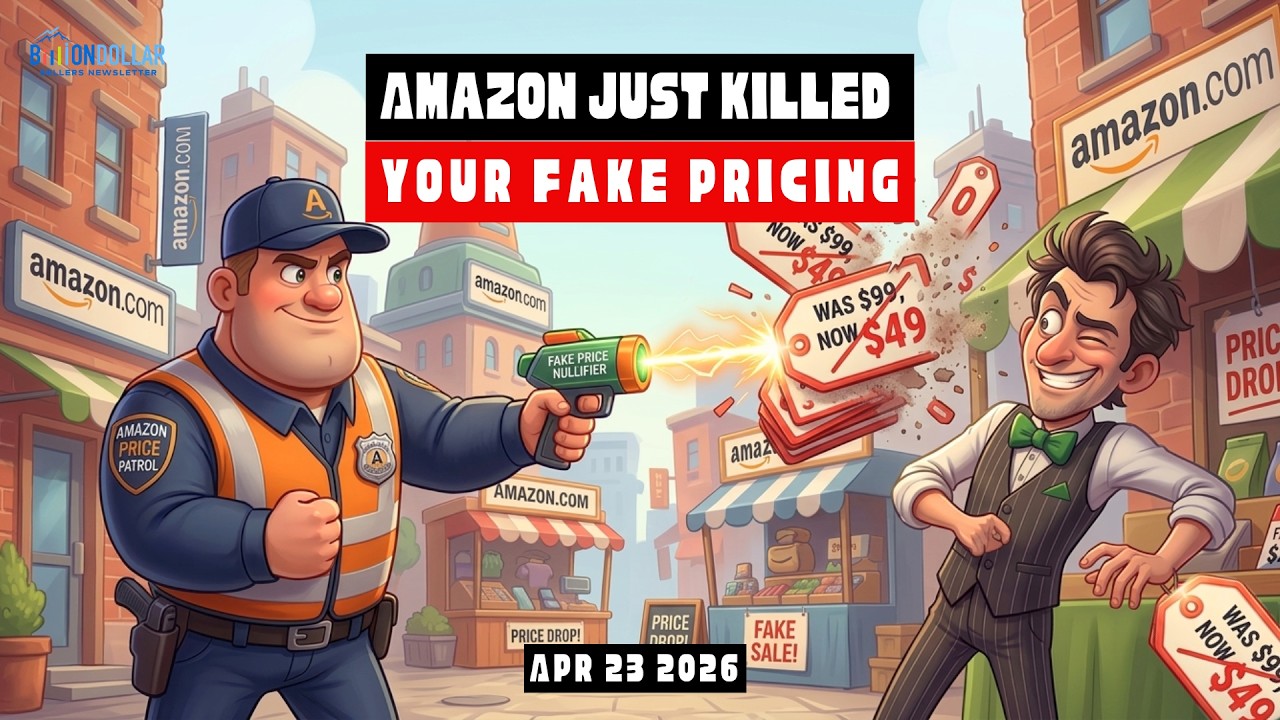
This This is the Billiondollar Sellers podcast, your go-to source for cutting edge strategies and success stories from the world of Amazon and e-commerce. Buckle up and get ready to take your Amazon business to new heights. Don't forget to subscribe to the Billiondoll Sellers Newsletter. Welcome your host. Welcome your host, Kevin King. >> Hey everyone, welcome to the Billiondollar Sellers podcast. I'm your host, Kevin King, and today is April 23rd, 2026. If you haven't already, go check out the recap video from the Ecom Mastery AI event and BDSS in Nashville. Incredible few days. Uh there's a link to that in the show notes. All right, big show today. Amazon just killed your fake strikethrough prices and there are two deadlines you need to know about. One of which is literally today. A breakdown of the five AI agent rolls that every ecom business should be building right now. a really important tip about the newer version widget that most sellers don't even know exists and a scary stat about how much of your digital ad spend might be going to fraudsters. But first, here's your Stump Bezos question for today. Meta is expected to surpass Google and ad revenue for the first time in 2026 with a 24.1% increase in ad revenue. So, the question is, how much total ad revenue is Meta expected to pull in this year? Think about that and I'll give you the answer at the end of the show. All right, let's get into the big one. Amazon just killed your fake strikethrough price. If you've ever parked a list price in seller central that your products has never actually sold for, Amazon is about to catch it. Two policy changes rolling out right now will gut the was X now Y badges that have quietly propped up conversion rates across the marketplace. Change number one is list price verification, and it's live today, April 23rd. The strikethrough number next to your price now has to be real. Amazon will only accept the list price if the product is recently sold at that price through another reputable retailer or if buyers actually purchase it as a featured offer on Amazon at that price. If neither is true, the striketh through disappears. No more picking a fantasy MSRP to inflate the apparent discount. The second change is typical price recalculation, and that goes live May 18th. Right now, the typical price is the median paid over 90 days, and it ignores promotional sales. That's how sellers run non-stop coupons while still flashing a fat save 30% badge against an untouched baseline. On May 18th, that loophole closes. If your price sits below the non-promotional median for more than half of any 90-day window, Amazon folds those promo prices into the baseline. Your typical price drops, your strikethrough shrinks, your savings badge may vanish entirely. Now, why does this hurt? The striketh through and the you save x% call out are two of the strongest conversion triggers on a product detail page. Sellers who've been manufacturing the perception of the deal are about to watch conversion rates slip without anyone touching their ad spend or creative. And there's a legal side to this too. A class action lawsuit was proposed in Washington state accusing Amazon of using madeup list prices to hype Prime Day deals. Regulators of multiple reasons are tightening rules on advertised savings. Amazon wants its discounts to look credible heading into Prime Day 2026. So, here's what to do this week. Audit every as with a list price set. When do you last actually sell at that number? If the answer is never or not in the last year, expect that strike through to go away. Map your promo frequency. If coupons or deals run on a skew more than half the time, your typical price is about to reset downward. Model what your PDP looks like without the current strike through and plan your May pricing around the new baseline. Identify your conversion dependent listings. The ones leaning hardest on the was X now Y framing are the most exposed. Consider repricing or restructuring the offer before May 18th instead of reacting after conversion drops. And watch the exclusions. Buy X get Y subscribe and save. And target coupons don't always trigger the same recalculation. Prime Day event pricing may get different treatment too. No issue your promo mechanics still protect the baseline. The bigger picture here is Amazon choosing long-term shopper trust over short-term deal theater. Sellers who built real price discipline will look sharper. Sellers who depended on optical discounts are about to find out how much of their conversion was the badge, not the product. Check your list prices today. The first deadline's already here. All right, quick break. Let's talk about your reviews because most sellers are sitting on a gold mine and not even using it. Amazon reviews are probably the most ignored asset in your business. Not because they're not valuable, but because nobody has time to use them properly. So what happens? You scroll a few pages, spot a couple patterns, make decisions based on gut, and move on. Meanwhile, all the real insights stay hidden. Inside your reviews, you already have what customers actually want, why they buy, what frustrates them, where your product is weak, and how competitors are winning. It's all there, just unstructured. There's a tool called Review Intel that solves this. that takes your Amazon reviews and turns them into full strategic analysis automatically. Customer segments and personas, jobs to be done, positioning insights, customer journey breakdown, competitive intelligence, and actual recommendations you can act on. And you can interact with it to ask things like which customer persona has the highest purchase intent or where am I losing customers in the journey? And answers based on your data. BDSN readers get an exclusive free trial. It's normally paid. Sign up using the code BDSN126. links in the show notes. All right, you got to see this one. Out of the 700 billion spent on digital marketing in 2024, a staggering $140 billion was stolen by fraudsters. If you're running digital ads, there's a high probability that 20 25% of your traffic is entirely fake generated by bots, malware, and human fraud farms. In this episode of Marketing Misfits, Rich pulls back the curtain on the dark side of PPC advertising. He shares stories of competitors using cheapbot software to drain rivals ad budgets by up to $15,000 a day. You'll learn why blindly trusting big tech platforms is costing you money, how to block fake clicks, and the settings you need to change in your ad dashboard right now. Links in the show notes. Now, here's an interesting stat for you. US e-commerce sales driven by AI platforms are expected to cross $20 billion in 2026 and top 144 billion by 2029. That's going from basically nothing to almost 9% of total retail e-commerce in just a few years. The growth rate right now is massive. And if you're not thinking about how AI platforms drive product discovery and purchasing, you're going to want to start paying attention. Quick heads up. If you want to take your Amazon PPC game to the next level with AI, there's a free 5-day challenge running April 27th through May 1st. You'll learn the exact AI powered PPC systems, plug-and-play agents, and campaign templates that Sophie Society uses to manage over $4 million a month in Amazon ad spend across more than 800 brands. He also did a library of cloud skills and copy and paste prompts ready to use right away, plus the exact AI agents and workflows that 8 figure sellers are currently running inside their brands. It's live daily from 12 to 2:45 Eastern. Link to reserve your spot is in the show notes. All right, this next section is a big one. Five AI agent roles every e-commerce operator needs. Most sellers building AI agents fail the same two ways. They stall after one mediocre attempt and decide agents aren't ready or they sprawl into disconnected tools that create more maintenance than value. The missing piece is architectural. You need an answer to which agents does my business need and how do they connect? Here's a five role framework that works. Role number one is the triage agent, the front door. This one sorts and routes every inbound signal. Pre-sale questions, post purchase issues, returns, wholesale inquiries, supplier emails. It categorizes, tags, and logs everything in structured formats. Build this one first. It's the lowest risk agent because it routes. It doesn't respond. It produces structured data that fuels every other agent and it gives you back 60 to 90 minutes a day immediately. Role number two is the intelligence agent, the analyst. It pulls from your triage data and combines it with external research, product review monitoring, competitor pricings, seasonal demand signals, audience language shifts. So instead of seeing scattered data points like sizing questions spiking while a competitor launches a sizing tool, you see one connected signal, it delivers weekly briefs you can scan in 10 minutes. Role number three is the draft agents, the writer, first drafts of product descriptions, email campaigns, social content, supplier communications, listing copy. This is the agent most sellers want to build first. Don't without triage and intelligence upstream. It writes from train data and produces generic outputs with them. It writes product page copy that addresses the actual objections customers raise and pre-sale tickets. Big difference. Role number four is the QA agent. The gatekeeper. It reviews everything before it leaves the building. Listing accuracy, compliance checks, brand consistency, factual accuracy, voice match. Most sellers skip this and become the bottleneck themselves. QA exists so you can scale your draft agent volume without quality dropping. It flags issues, sends them back to draft with revision notes, and only escalates the exceptions to you. And the fifth and final role is the operations agent, the dashboard. It monitors the other four agents, plus your business metrics, inventory velocity, return rates, campaign performance, channel profitability, plus each agent's output volume, quality scores, and error rates. This one builds last because it needs the data the first four create by running. It delivers a 5minute daily summary instead of you checking every system. Now here's why the order matters. Each agent makes the next one better. Triage creates structured data. Intelligence uses it to produce grounded briefs. Draft uses those briefs to write in your customers actual language. QA scores the drafts and operations monitors the whole system. Build them in isolation, you get sprawl. Build them in sequence, you get compounding. If you already have agents running, here's a quick audit. Map every agent to one of these five roles. Score each one as covered and connected. Covered but isolated or missing. Most sellers find the same pattern. Multiple agents in the draft role, nothing in triage, nothing in operations, all throttle, no steering. Fix it by building backward. Stand up triage first. Within 30 days, the categorized data improves your existing draft agents without touching a single prompt. Then add intelligence, QA, and operations. So this weekend, pick one. If you're starting from zero, scope your triage agent. If you already have agents, run the audit. Five rolls, one backbone, build in order. Now, let me tell you about today's featured resource. If you couldn't make it to Ecom Mastery AI and BDSS in Nashville, you can now get the full replay vault. 41 plus speakers, 3 days, every lane of e-commerce you're running right now. Amazon, Shopify, Walmart, Tik Tok Shop, retail media, AI ops, creative inventory exits, all professionally edited with crisp audio and clean cuts. Every session has searchable transcripts. Looking for the exact moment someone broke down ruthless optimized listings or the million-doll a month Tik Tok shop affiliate flywheel? Type it in and jump straight there. Every slide deck is a downloadable PDF that's all in one claim dashboard tagged by speaker, topic, and day. No Dropbox scavenger hunts. You have access through the end of 2026. Link to grab the replays is in the show notes. All right, next up, the newer version widget. This is one of those things most sellers don't even know exists, and it can make a real difference. Here's an example of a problem you might have. You launch a new, improved version of a product. The old listing is still live, still pulling traffic, still holding reviews, but when shoppers land there, they have a dead end or worse, a competitor. BDSS Dream 100 member Vanessa Hung recently broke down a case where a supplement brand had 44 ac stuck in this exact gap. Old liquid drops, new capsule versions, zero connection between them. Here's how she closed it. First, an important distinction. Variations and newer versions are not the same thing. Variations are for the same product in different sizes or colors. Same detail page, switchable options. Newer version is a separate relationship type for genuine upgrades. Same function, same intent, but improved format. Both as stay as separate listings, but Amazon adds a newer version available module on the old detail page that point shoppers to the current offer. Trying to force an upgrade into a variation is a policy risk. Use the right tool. The submission is simple. Two fields, 24 hours. No catalog restructuring, no parent child hierarchy, no rebuild. Audit your catalog for version pairs. Same core product, same function. The newer AS is a real upgrade. Confirm both as are active. same brand through brand registry, same category. Then access the newer version widget in seller central. It's not in standard catalog editing. You got to find it through help or the direct widget URL. You can also submit through seller assistant chat by giving it both as now submit each pair original as in one field and new as in the other. This way it creates a seller support case on the back end. Verify it within 24 hours that the newer version available module shows up on the old detail page. All 44 of Vanessa's cases resolved the same day. Now, here's why this matters. Sellers using the newer version widget cut loss sales during stock transitions by 20 to 30%. Click through from the old listing to the new one runs 15 to 25%. That's demand you already paid to generate reviews you already earned, rank you already built. Without the link, it evaporates every time the old as goes out of stock or a shopper lands there first. So, here's a quick audit for yourself. Have you launched a new AS in the last two years and never linked it back to the old one? That gap is open right now. Running a product road map, this belongs in every single launch checklist. Phasing out an old format, the widget is how you transfer the traffic instead of losing it. The bigger lesson is that Amazon's catalog has relationship types that aren't surfaced in the main seller central menu. Not visible doesn't mean not available. It just means you got to go looking. The system doesn't assume a connection between two asensants just because it's obvious to you. Every relationship has to be submitted explicitly. This one's based on case number 18 from Vanessa Hung and Online Seller Solutions. Her team handles these submissions for sellers who don't want to deal with Seller Central directly. Before we wrap up, a few more hot picks for you. QBC filed for bankruptcy despite $9 billion in sales. Walmart is planning more stores as fulfillment warehouses for fast delivery. Amazon is betting on a Shenzen warehouse to cut storage costs by 45%. Less than 5% of Amazon hero images are mobile ready, which is a big one if you haven't optimized yours. And Shopify is empowering sellers with a new AI playground. Links to all of those are in the show notes. And here's your parting shot for today. The graveyard is the richest place on earth because it is here that you will find all the hopes and dreams that were never fulfilled. The books that were never written, the songs that were never sung, the inventions that were never shared, the cures that were never discovered, all because someone was too afraid to take that first step. That's from Les Brown. And man, that one sits with you. Don't let your best ideas stay on the shelf. Take the step. Oh, and remember that Stump Bezos question from the beginning? Meta is expected to surpass Google in ad revenue for the first time in 2026. So, how much total ad revenue is Meta expected to pull in? The answer is $243 billion. A billion with a B. Pretty wild number. All right, that's all for today, folks. Have a great weekend and I'll see you again on Monday. This is Kevin King signing off from the Billiondollar Sellers podcast.
This transcript page is part of the Billion Dollar Sellers Content Hub. Explore more content →