YouTube
Amazon is holding sellers' money hostage
Summary
Amazon is holding sellers' money hostage - Date: March 30th, 2026 Summary: Kevin King breaks down Amazon's new DD+7 payout policy that delay...
Transcript
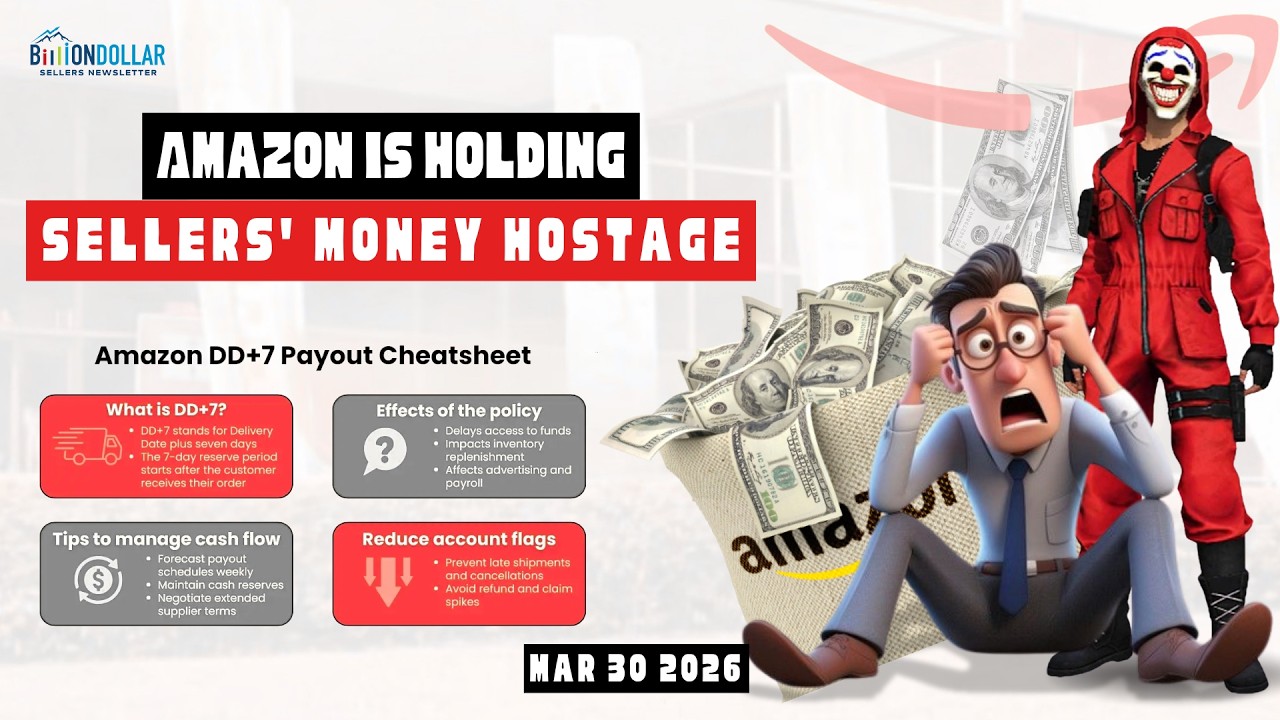
This This is the Billiondollar Sellers podcast, your go-to source for cutting edge strategies and success stories from the world of Amazon and e-commerce. Buckle up and get ready to take your Amazon business to new heights. Don't forget to subscribe to the Billiondoll Sellers Newsletter. Welcome your host. Welcome your host, Kevin King. >> Hey everyone, welcome to the Billiondoll Sellers podcast. I'm your host, Kevin King, and today is March 30th, 2026. Okay, we've got a lot to get through today. The big one is Amazon's new DD plus7 payout policy. If you haven't heard about this yet, it's basically Amazon holding your money for an extra week before they pay you out, and it's already rolling out across US accounts this month. We're also going to talk about why slapping AI designed on your products is actually costing you sales. A really cool trick to clone any brand's landing page in about 4 minutes, some big updates to product opportunity explorer, and a bunch more. So, here's your Stunt Bezos question for today. In 2025, Amazon generated $68.6 billion in advertising revenue. Now, Walmart's ad revenue actually grew faster than Amazon's percentage-wise, but to what dollar amount. Think about that and I'll give you the answer at the end of the show. All right, let's get into the big one. Amazon's DD plus7 payout policy. So, Amazon started rolling out what they're calling delivery date plus 7 or DD plus7 across US seller accounts this month. And if you sell in Europe, this already hit back in September 2025. So, some of you already know what I'm talking about. But for everybody else, here's the deal. Amazon now holds your funds for 7 days after the customer actually receives their order before those funds even become eligible for dispersement. And then you got to factor in Amazon's payout cycle and bank clearing times on top of that. So you're realistically looking at 10 to 12 days from delivery to cash in hand. Under the old system, payouts were tied to a, you know, more predictable two week cycle based on shipment, not delivery, which is a big difference. Now, seven extra days of float, that might not sound like much, right? But across thousands of orders, it stacks up fast. For high volume sellers, that's tens or even hundreds of thousands of dollars just sitting in Amazon's pocket at any given time. And if you run lean, and most of us do, that gap can mean delayed restocks, paused ad spend, or even missed payroll. And here's the hidden danger that I think a lot of people are missing right now. The cash crunches from DD plus7 can trigger this nasty domino effect. You start shipping late cuz you can't afford to restock. Orders get cancelled, refund spikes start hitting, and all of that dings your account health metrics. Amazon's automated systems, they don't care why your metrics slip. They just flag you. Worst case, you end up at a section 3 review and lose account access entirely. So, what should you be doing right now? Run a cash flow analysis layering in that 7-day delay against your current payout schedule and forecast your payout schedules weekly from here on out. Build a 10 to 14-day cash buffer if you don't already have one. Negotiate extended payment terms with your suppliers. You can also consider Amazon lending or short-term working capital, but I would avoid highinterest debt as a permanent fix. Use automation tools that track delivery confirmation so you can actually forecast when your dispersements are coming and monitor your account health dashboard weekly. Late shipment rate, order defect rate, and cancellation rate. Those are the big three to watch. And real quick, what not to do. Don't switch bank accounts. Don't manually withdraw funds. Don't try to manipulate order processes to speed things up. Amazon systems will flag it. Don't open a second seller account to try to work around the delays. That's instant suspension risk. And don't slash your ad spend overnight because you'll tank your rankings and spend weeks rebuilding momentum. Bottom line, DD plus7 isn't optional. Exemptions are basically non-existent. The sellers who come out fine are going to be the ones who adjust to their cash flow model before the squeeze hit, not after. Nurban Consulting put together a really solid breakdown on this. There's a link in the show notes if you want to read the whole thing. Here's a quick stat for you. Shopify hit $378 billion in gross merchandise volume in 2025, which puts them at 6.2% of total global e-commerce revenue. That's up from 292 billion the year before. So about 29% jump year-over-year. And if you zoom out, Shopify has been growing at a compound annual growth rate of about 18.5% since 2021 when they're at $175 billion. So they've more than doubled in 4 years. That's pretty significant for anyone thinking about where to put their off Amazon efforts. Okay, so here's one you guys see. There's a YouTube video by Matt Clark about how to clone any brand's landing page in like 4 minutes using Claw AI. And I thought this was really clever. So the idea is you find a brand that's doing $300 million a year or whatever and you reverse engineer their high converting landing page structure for your own products. Here's how it works. First, you go to a Facebook ad library, search for a top brand in your niche, and click through one of their ads to land on their actual sales page. Then, you go to Claude, use Opus model, and you paste in a prompt that says, "Create a Shopify landing page model after this URL. Use the exact layout and sections and offer structure, but swap in my product branding and content from my Shopify product page URL, and you tell it to generate a single self-contained HTML file with vanilla CSS and JavaScript." While Claude's working on that, you go prep Shopify. Go into your admin, click themes, edit theme, hit the drop down, go to pages, create a new template, hide the default page content, add a custom liquid section, save it. Then go to online store pages, create a new page, assign your new template, and save that too. The page will be blank for now. Once Cloud finish is generating the code, you copy it all, paste it into that custom liquid section in the theme editor, hit save, refresh the page, and you're done. Yeah, change the layout to full width if it looks tight. And just like that, you cloned a multi-million dollar brand's landing page structure with your own branding, no developer needed, no third party page builder fees. The key is using Facebook ad library to find pages that are already proven to convert and then letting AI handle the heavy lifting of recreating the layout. There's a link to the video in the show notes. All right, today's BDSN software tool of the day is instant. It's an AI powered no code page builder for Shopify stores. You describe what you want in plain language and the AI generates it. Landing pages, product pages, homepages, theme sections, pop-ups or cart drawers, all of it. So the core workflow is prompt based. You type something like create a landing page with a hero banner, testimonials, and features. And it generates a wireframe you can then refine in a visual drag and drop editor. It's got AB testing and card analytics built in so you can optimize without extra apps. There's a Figma to Shopify plugin that lets you paste Figma designs directly into the builder. And you can even convert sections into native Shopify liquid code. Plus, it's got AI tools for SEO like generating titles and metad descriptions, tone adjustment, grammar fixes, and a content engine called Instant Studio for generating and editing product shots. Real-time team collaboration and one-click publishing to Shopify. If you're building Shopify pages, it's worth checking out. Link in the show notes. Quick reminder, the Ecom Mastery AI event is coming up April 8th through 12th at the Grand Hyatt in Nashville. More than 500 sellers, over 100 creators, 40 plus speakers. It's where AI and e-commerce converge. Only 3 days left to grab a ticket. Links in the show notes. Okay, so this one's a nice update from Amazon. They just added saved opportunities to product opportunity explorer. Will hair posted about this on LinkedIn. So you can now save niches and asens with one click. Track them over time and access them across global marketplaces. Everything lives in a new your saved and recent views tab inside seller central. Why does this matter? Product opportunity explorer is becoming a legit research workspace now, not just a one-off lookup tool. You're getting firstparty Amazon demand data with persistence, which is something that used to require Helium 10 or Data Dive or Jungle Scout to approximate. So start saving nich issues for any SKUs or product extensions you're evaluating. Build a running short list inside the tool so your team can, you know, revisit opportunities as demand shifts instead of restarting research from scratch every single time. And the bigger signal here is Amazon keeps pulling product discovery and demand validation inside its own ecosystem. They want these decisions happening in seller central, not in third party tools. Worth paying attention to where that trend goes. All right, this next one is really interesting and I think it's going to change how some of you think about your branding. It's about labeling your products as AI designed and why that's actually killing your purchase intent. There's new research out of Shanghai University from December 2025 and they ran nine experiments across physical products like perfumes, snacks, accessories, and the pattern was consistent. When products carry an AI design label versus human design, shoppers showed up to about 29% lower purchase intent. That's a huge drop. They also perceived 75% less human involvement in the process, which made them feel disconnected from the products. But here's where it gets interesting. When the product was described as a human AI collaboration, something like our designer used AI to brainstorm color combinations, purchase intent actually rose about 3.5% above human only designs, and it beat AI only labels by almost 13%. So, the framing matters a ton. So, why do people react this way? It comes down to identity. We buy from people and brands we feel aligned with, right? A dog lover buys the grooming tool because they assume the person who designed it probably loves dogs, too. When AI is a sole designer, that connection just disappears. There's nobody on the other end to relate to. But when a human is in the loop, even partially, that sense of alignment comes back. People can still picture a real person behind the product. And here's one more twist that I thought was fascinating. This effect actually reverses for rentals. People were about 14% more willing to rent AI designed products like camping gear than human-designed ones. When you're renting, you care about utility, not identity. The desire story just matters less. So, what does this mean for your brand? If you're using AI to develop products, and you probably should be, don't lead with it. Frame AI as a tool your team uses, not as a creator. Our designer, Alex, used AI to develop this feature works. AI created delight does not. The AI did the work. Let the human take the credit. Before we wrap up, a few more hot picks for you. Amazon is moving Prime Day to June this year instead of July. Prime Day deals now cost $100 upfront, plus 1.5% of sales cap at $5,000. And there's an interesting piece about how Amazon wins on discretionary spending, while Walmart wins on necessities. Amazon just bought a robot maker to beef up their last mile delivery. Links to all those are in the show notes. And here's your parting shot for today. Your habits will hold you back more than your competitors ever will. Which is good news because you can change your habits. You can't change your competitors. Stay focused on what you can control. I love that one. It's a good reminder, especially with everything we talked about today. Oh, and remember that Stump Bezos question from the beginning? Amazon generated $68.6 billion in ad revenue in 2025. Walmart's ad revenue grew faster, but to what number? The answer is $6.4 billion. So Walmart's growing fast percentage-wise, but Amazon is still absolutely dominating in total ad dollars. I mean, it's not even close. That's all for today, folks. I'll see you again on Thursday. This is Kevin King signing off from the Billiondoll Sellers Podcast.
This transcript page is part of the Billion Dollar Sellers Content Hub. Explore more content →