YouTube
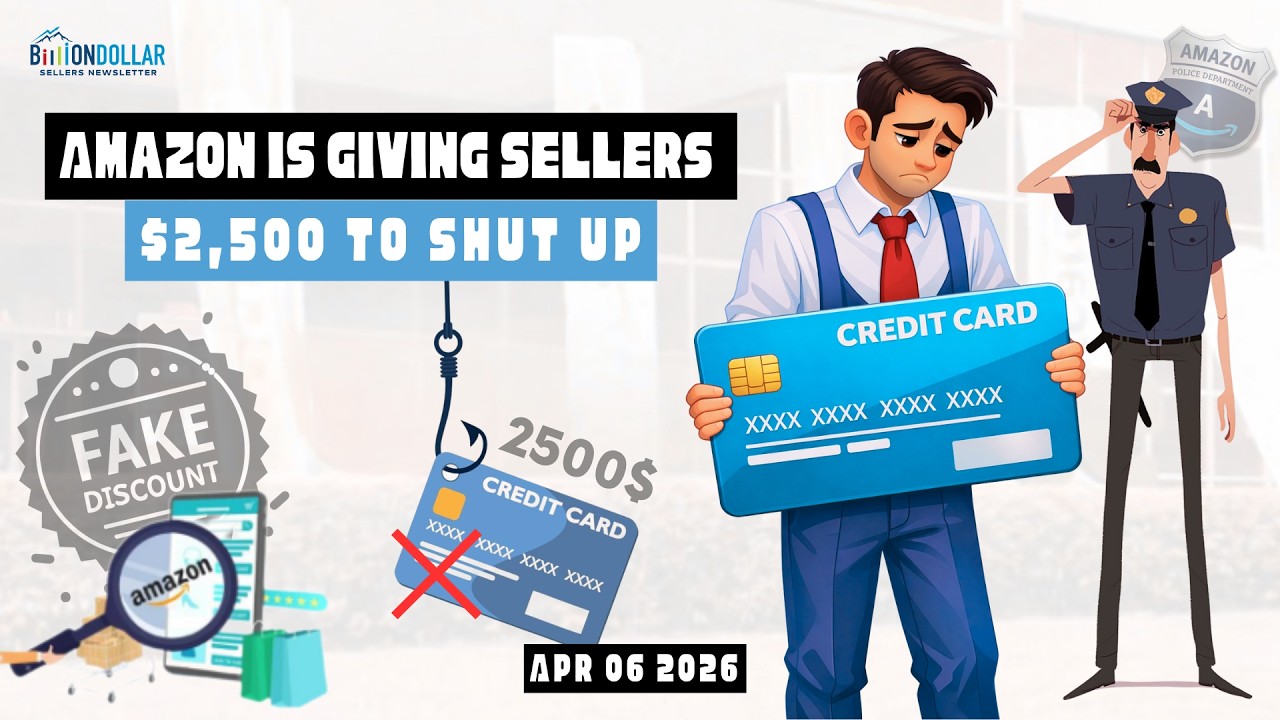
Amazon Is Giving Sellers $2,500 to Shut Up
Summary
Amazon Is Giving Sellers $2,500 to Shut Up - Date: April 6th, 2026 Summary: Kevin King breaks down Amazon's move to deduct ad costs directly fro...
Transcript
This This is the Billiondollar Sellers podcast, your go-to source for cutting edge strategies and success stories from the world of Amazon and e-commerce. Buckle up and get ready to take your Amazon business to new heights. Don't forget to subscribe to the Billiondoll Sellers Newsletter. Welcome your host. Welcome your host, Kevin King. >> Hey everyone, welcome to the Billiondollar Sellers podcast. I'm your host, Kevin King, and today is April 6th, 2026. All right, we have a packed one today. And I got to be honest, this week Amazon just went on an absolute tear, hitting sellers from like every direction. The big story is Amazon's changing how they handle your ad spend payments. They're going to start deducting ad costs directly from your seller proceeds, which means no more credit card rewards on your ad spend, and they're giving you $2,500 to shut up about it. We're also going to talk about Amazon's fake discount crackdown on strikethrough pricing, some really interesting early data on Rufus sponsor prompts, how Walmart is quietly dominating Google shopping with over 1,600 seller names, and some wild Tik Tok shop stats. But first, here's your Stump Bezos question for today. Amazon recently announced that its delivery partnership with the US Post Office is ending and 15% of all USPS shipments were on behalf of Amazon. So, the question is, how many boxes is that? How many boxes a year was Amazon shipping through the post office? Think about that and I'll give you the answer at the end of the show. All right, let's get into the big one. No more credit card points on your Amazon ad spend. So, starting April 15th, that's 10 days from now, Amazon's going to automatically deduct your ad costs from your seller proceeds before you ever see a dime. Your credit card on file just becomes a backup. It's not your payment method anymore. And this isn't optional. There's no opt out. You can't call support and say, "Hey, I want to keep using my card. It's done." And the way they announced it was classic Amazon. No press release, no blog post, just a quiet little seller central notification saying I cost will now be pulled directly from your retail proceeds. And if your proceeds don't cover it, then they'll hit your card. So, what does this actually mean for you? The credit card rewards game on Amazon ad spend is effectively over for anybody doing real volume. If you were earning, you know, 2% cash back on $50,000 a month in ad spend, that's $12,000 a year in rewards just gone. At $100,000 a month, that's $24,000 a year. At $250,000 a month, you're looking at $60,000 a year in rewards that just vanished. Now, the math on Amazon's side is staggering. Amazon made $68.6 billion in advertising revenue in 2025. That's up 22% from the year before. Even if just 30% of I was paid by credit card at roughly a 25% interchange fee, that's about 20.6 billion in card volume and around $515 million in annual interchange fees that Amazon no longer has to pay. Half a billion a year from one billing change with less than two weeks notice. That's wild. Now, this isn't happening in a vacuum, right? Remember the DD plus7 reserve policy we talked about last week? Amazon already rolled that out last month, holding your funds for 7 days after confirmed delivery, before they're even eligible for dispersement. So now Amazon holds your money longer and takes their ad from it before you get paid. Under the old system, you could charge your ad spin to a credit card with a 30-day payment window while Amazon simultaneously held your proceeds for about 30 days. That gave you roughly a 60-day working capital buffer that, you know, a lot of sellers were deliberately managing as part of their cash flow strategy. That entire float is gone now. As Steven Pope from My Amazon Guy put it, it's a double whammy. You just lost your liquidity window. And Amazon's even the first one to do this, by the way. Google started phasing out credit card payments for high-spending advertisers back in mid 2024, forcing them to switch to monthly invoicing or direct debit. Meta followed in February of this year, telling AdCal that credit card payments wouldn't be accepted anymore, and they had to transition to monthly invoicing by March 31st. The playbook's the same across all three platforms. They frame it as flexibility and better cash flow management while they pocket the 2 to 3% interchange savings. Every major ad platform is moving in this direction. Oh, and here's your consolation prize. Amazon is giving affected accounts a one time $2,500 promotional ad credit on $68.6 billion in ad revenue. That's the equivalent of tossing you a quarter while they pick your pocket. And with PPC inflation running hot right now, that $2,500 is probably just going to cover about 2 weeks of the bid increases coming this spring anyway. And while we're at it, in the same week, Amazon also dropped a 3.5% fuel and logistics search charge on FBA fulfillment fees effective April 17th. On average, that comes to about an extra 17 cents per unit for FBA shipments, though it varies by size and dimensions. Amazon cited elevated fuel and logistics costs driven by the war in Iran as the reason for the search charge. And sellers are pretty skeptical this one's ever going away. One seller on the seller central forums was like, "Has anyone ever seen a search charge go away before on Amazon, even if the problem that causes it does?" Another industry adviser called it 10 permanent. I love that word. So, let's add it all up for April 2026. April 15th, ad cost auto deducted from proceeds, credit card rewards gone. April 17th, 3.5% fuel search charge on FBA fulfillment fees. April 23rd, new list price validation rules, which I'm going to talk about in a second. Three margin hits in 8 days. Happy spring. All right, quick stats before we move on. Tik Tok shop is putting up some wild numbers. Sales from brands doing $30 million or more on the platform are up 97% year-over-year. Total transaction volume is up 80% and creators earning commissions jumped 146% with more than 16,000 creators now making six figure sales. There were 103 billion US e-commerce searches on Tik Tok in 2025, which is just a massive number. But here's the thing that really caught my eye. The top 10% of creators are now capturing 62% of all payment volume, up from 53% 2023. And the top 1% takes 21%. Up from 15%. So the money's concentrating at the top real fast. If you're going to play the Tik Tok shop creator game, you got to be in that top tier or it's probably not worth the effort. Okay, so let's talk about Amazon's fake discount crackdown. This is a big deal if you're running strikethrough pricing on your listings. Amazon just dropped two reference pricing changes that are going to gut the conversion strategy of any brand running always on promotions. First one hits April 23rd. List prices now have to be validated with real evidence. Either the product was actually purchased at that price as a featured offer on Amazon or it's listed at that price by another retailer. No more making up MSRPs. But the big one is May 18th. This is where it gets really interesting. Amazon is changing how it calculates what they call typical price, which is the was price behind your strike through. If your featured offer price sits below the non-promotional median for more than half of the last 90 days, Amazon folds all sales, including promotional ones, into the calculation. So, basically, your discount becomes your new baseline. Strike through gone. And here's the trap, and I think this is the part that's really frustrating for a lot of sellers. Amazon's own ecosystem pushes you to discount constantly. Coupons lift your ad conversion. Lightning deals spike your BSR. Subscribe and save needs aggressive pricing. every velocity lever they hand you involves cutting price and now they're saying do it too often and we'll reset your baseline to the discounted price. It's like they're handing you the tools and then punishing you for using them. Uh let me give you a quick example. So this is concrete. Say you run a 20% coupon on a $40 product for 60 out of 90 days. Today your typical price stays at $40 because Amazon excludes promo sales from that calculation. After May 18th, those days count. Your typical price drops to about $32. Your coupon still gets you the $32, but with no strikethrough, same margin hit, zero perceived savings for the customer. And there's a sneaky detail here. Price discounts that aren't tagged as promotions to customers get treated as non-promotional sales. So, silent price drops actually count against you even harder than label deals. Now, some things are excluded. Subscribe and save, tailor coupons, buy X, get Y, and peak event sales like Prime Day. Those stay out of the calculation for now. So, who wins here? Brands with real MAC pricing across channels. If your DTC site and your retail partners actually sell at your list price, Amazon can validate it. Your strike through holes. Your promos look real because they are real. Who's exposed? Anyone using always on coupons as a substitute for organic demand. If the quote unquote promotion is really just the price, you're about to lose the only thing making it look like a deal. And one more thing on this, there's a 90-day hangover. Even if you stop discounting on May 18th, it takes about 90 days of pricing at or above the non-promotional median before the standard calculation kicks back in. So, if you're planning summer promos, the math is already uncomfortable. Quick reminder, the Ecom Mastery AI event is happening April 8th through 12th at the Grand Hayatt in Nashville. 41 speakers, seven tracks covering everything from AI powered commerce to PPCs to scaling and exits. And if you can't make it in person, you can now stream it live, watch on demand, get replays, but that's limited to 200 people. So, grab it quick. Links in the show notes. Okay, so this next one is really interesting. Amazon is now selling ads inside its Rufus shopping assistant. They're calling him sponsored prompts, and the early data tells a pretty interesting story. So, here's how it works. Sponsored prompts show up as suggested questions within search results and product pages. like a shopper browsing organic cereal might see a prompt that says, "Does Brandex X offer a low sugar option?" They click it. Rufus kicks off a branded conversations and Amazon charges per click. Just like sponsored products. Now, the volume is tiny right now. Sponsored props account for less than 1% of total clicks in sponsored product campaigns. One seller doing 20 to $30 million a year on Amazon got just 88 clicks from sponsored props versus 500,000 clicks from all our other ads since January. But they're cheap, about 31 cents per click versus 50 to 70 cents for traditional Amazon ads. And the click-through rates are actually higher than standard ads when shoppers do see them. There's just not a lot of volume yet. But here's the runway. Roffus usage is up 140% year-over-year, and more than 300 million customers use it in the past year. So, you know, the traffic is building. The real value right now, I think, is the data. Amazon shows advertisers which prompts triggered their ads and which products appeared in the responses. Smart sellers are reverse engineering these prompts to understand how Rufus selects products and then updating their listings to match. One agency used the prompt data to convince their CPG clients to add new detail to their storefronts, like explaining why one version of a product costs more than another, which helps organic roofers visibility, too. That's clever. Now, there are some gotchas you need to watch out for. No sponsored prompts already include the brand name. Like, does Paladon have a lamp that's easy to use, so Amazon isn't really serving these to undecided shoppers yet. You can't see the exact Roffus response that shoppers get after they click, which is kind of a bummer. And some of the autogenerate prompts can actually backfire. One advertiser had to opt out of a prompt that asks if a certain chemical was in their product. It wasn't, but the question alone could scare buyers away. So, that's something to keep an eye on. And if you're spending on existing ad types, you're automatically enrolled in this. So go check your account. Bottom line, it's not a sales driver yet, but the CPC is dirt cheap and the prompt data is a gold mine for optimizing your listings for AI powered shopping. Definitely worth monitoring as Rufus adoption grows. All right, this last big story is a wild one. Walmart is quietly dominating Google shopping, and the way they're doing it is honestly kind of brilliant. A new study from Product R analyzed over 1 million product listings across more than 50,000 Google shopping results pages in Q1 of this year and they found that Walmart operates over 1,600 distinct seller names and Google's organic shopping carousels and no other retailers even close. So here's how it works. You've probably seen listings in Google Shopping that say something like Walmart-fere or Walmart-lux bedet. Each of those counts as a separate retailer in Google's diversity algorithm. even though every single one links back to Walmart.com. Google system looks at the seller name that's displayed, not the destination domain. So, because Walmart's marketplace sellers each get their own sub account in Google Merchant Center instead of being grouped under one umbrella, Walmart can grab multiple slots that would otherwise go to competitors. And here's why that matters so much. Google limits how many results from the same seller show up in a carousel, typically eight slots. Only about 13.7% of carousels achieve what they call perfect seller diversity. But when product rise regroups all the Walmart seller names as one entity, perfect diversity on Walmart containing carousels dropped 32%. They found one real example where eight different Walmart seller names were ranking across three carousels on a single page. That's just insane. A competitive edge here is brutal for single brand retailers. If you're a standalone DTC brand or even a big box like Target, you only get one seller name. Walmart gets hundreds. The more threepiece sellers they on board in a category, the more carousel real estate they capture. It's structurally unavailable to anyone who doesn't run a massive marketplace. Is it against the rules? Technically, no. Each seller name represents a real third party merchant. One SEO expert called it brilliant. And while notice that it hurts smaller brands who lose out due to a lack of inventory depth and this is especially significant now that Walmart pulled back from OpenAI's instant checkout citing lower conversion rates versus Walmart.com traffic and is doubling down on driving shoppers to its own sites. Organic Google Shopping visibility just became an even bigger priority for them. So if you're selling on Walmart Marketplace, your products may already be part of this strategy whether you know it or not. And if you're trying to win Google Shopping as an independent seller, understand that you're competing against a system that's structurally tilted toward the biggest marketplaces. Before we wrap up, a few more hot picks for you. There's a really good piece on why tacos as a metric is actually misleading and can trap you into bad decisions. Amazon and Walmart are moving their retail war past the buy button now, which is worth reading. Um, we mentioned a 3.5% fuel search charge. There's a deeper breakdown on that if you want the details. And Amazon just teamed up with FedEx to add 10,000 more return drop off points. Links to all those are in the show notes. And here's your parting shot for today. Procrastination is the assassination of all destinations. I love that. It's short, it's punchy, and it's painfully accurate. Especially if you've been putting off adjusting your cash flow model before all these April changes hit. Oh, and remember that Stump Bezos question from the beginning? 15% of all USPS shipments were on behalf of Amazon. How many boxes is that? The answer is 1.7 billion. 1.7 billion annual deliveries through the post office. Holy cow, that's a lot of boxes. All right, that's all for today, folks. I'll see you again on Thursday. This is Kevin King signing off from a Billiondollar Sellers podcast.
This transcript page is part of the Billion Dollar Sellers Content Hub. Explore more content →