Ecom Podcast
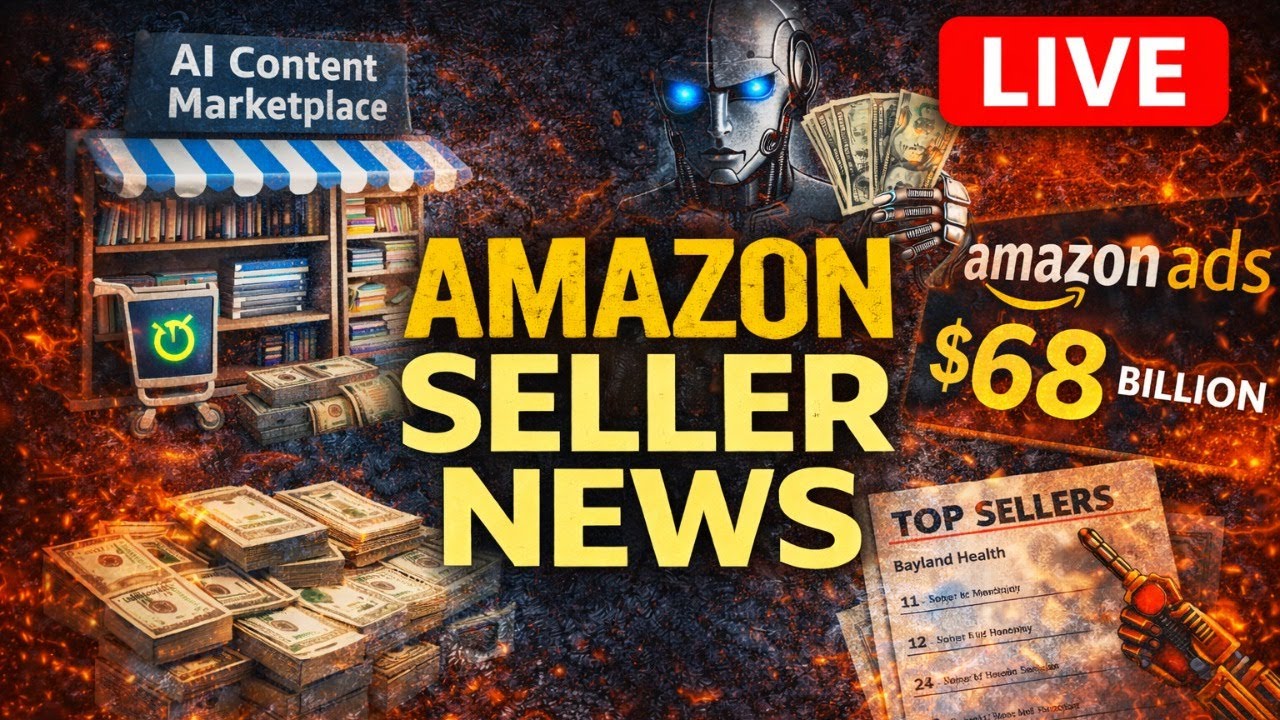
AI Content Marketplace and $68B Ad Machine
Summary
Amazon Seller School shares actionable Amazon selling tactics and market insights.
Full Content
AI Content Marketplace and $68B Ad Machine
Unknown Speaker:
Welcome, fellow entrepreneurs, to the Amazon Sellers School podcast, where we talk about Amazon and how you can use it to build an e-commerce empire, a side hustle, and anything in between. And now your host, Todd Welch.
Speaker 3:
What's going on, everybody? Welcome to another week of Amazon Seller News Live. We got Eric with us in the house, Marketplace Pros, and Danon, of course, from EcomTriage. Gentlemen, I appreciate you joining me.
Speaker 1:
Yeah, always happy to be here, man.
Speaker 3:
Yeah, the only thing missing is the cigars, as we were talking about. If we were in real life, we'd be smoking some cigars, talking Amazon, most likely.
Speaker 1:
Yep.
Speaker 3:
Good times for sure. Wives love that smell.
Speaker 1:
Yeah, yeah, exactly. Actually, that's where Eric and I were last night at one of...
Speaker 3:
Nice.
Speaker 1:
Yeah, we had a couple of other people in the e-commerce space out there. And yeah, so Eric and I, just for everyone's knowledge, every other Wednesday, Eric and I host a cigar meetup for e-commerce and entrepreneurs.
Speaker 3:
Yeah, down there in Tampa.
Speaker 1:
Tampa Clearwater. Yeah. Last night was Clearwater because it's it's only an hour from Eric and it's a super long five minutes for me.
But we have a distributor here that distributes to most of the cigar shops in the Tampa area in the southeast, actually. And then just less than a year ago, opened up a customer side. And so It's pretty slick.
They don't serve alcohol or anything like that, but you can bring your own and- Makes it better. Yeah.
Speaker 2:
And as a warehouse guy, to peek into the cigar warehouse, it's really well-organized.
Speaker 3:
Oh, nice.
Speaker 1:
It is really well-organized, yeah.
Speaker 2:
And the colors and all, I mean, it's pretty neat to see.
Speaker 1:
Yep.
Speaker 3:
Yeah, that would be fun. And it's like the whole manufacturing area in the warehouse or- No, it's fulfillment. Fulfillment. Okay. That'd be cool to check out, though.
Speaker 1:
Yeah. It's Eric's dream. When he walks into his 3PL, he wants his 3PL to look just like that.
Speaker 2:
Exactly right.
Speaker 3:
Yes. Yeah. Eric, well, you've got your little baseball glove wallets business going. When are you going to start your cigar business?
Speaker 2:
Well, don't tempt me. Don't tempt me.
Speaker 1:
It has a conversation.
Speaker 2:
We used to sell cigar cutters on Amazon, but very competitive.
Speaker 1:
Yeah.
Speaker 3:
Yeah. The never ending battle of entrepreneurs. You always have ideas and you always want to do them, but just not enough time in the day, unfortunately.
Speaker 1:
Yep. Very true.
Speaker 3:
All right. Well, I see some people rolling into the live stream. So if you're out there watching and you have any questions or comments, throw them in the chat and we'd be happy to bring them into the show. But without further ado,
let's go ahead and dive into this first article because it kind of brings one of our predictions to light here. And so Amazon is reportedly exploring content marketplace for AI licensing.
They're discussing plans to launch a marketplace where publishers can license content directly to AI companies, though the company has not formally confirmed the initiative. Now, in the past,
I was talking about how Amazon's been blocking AI from crawling their website and that I could foresee them licensing their product catalog out to these AI companies.
And lo and behold, they're going to create an entire marketplace to do that for everybody. So Amazon thinking even bigger than I was thinking, potentially. So curious what your guys' thoughts are on this.
Speaker 2:
Yeah, one of the things that came to mind for me right away, I'm a sports guy, when I read about the Super Bowl, and I'm sure it's some sort of like, maybe it's even a paid service, when I'm on ESPN and they'll say,
the cheapest Super Bowl ticket on StubHub or the cheapest World Series ticket on TickTick is $2,000 or $3,000. There's probably some, all of these sites that sell products, especially marketplace sites like StubHub,
Amazon, eBay, could license that data. In the sports card world, I know on eBay, there are a number of people that are connecting to the API of eBay and paying a fee to do that, to farm data.
And then AI would just be next level for some of that market research, let's call it, or just regular fandom on ChatGPT. And I think on the Amazon side,
it's going to be heavy on the market research rather than fandom of people wanting to know what's the range and the price of Huggies. But I think the stock market will be very interested in a lot of that data.
Speaker 3:
Yeah, for sure. It's kind of in the Wild West with AI, right? Just kind of stealing content out there to program their AI bots and things like that. The lawsuits have already started coming over some of that.
And so I think that's just going to explode. And it's going to be mandatory to have some kind of, you know, marketplace or whatever, where these AI companies can buy license to use this content included in their models.
Speaker 1:
Yeah. Another thing that comes to mind for me is artists. You know, artists absolutely abhor AI because you can feed it an artist's work and then say, do me this thing in the style of this picture. And that artist goes, that's my style.
How is that possible? And so we have to also think about that. So when you're licensing content, the art is going to be a very, very big part of that. And so arguably,
A new age of artists could arise in that they will produce art for AI to license to AI sure and make a cut on that. And the same thing with other types of content creators, you know,
where you're going to have these people that are thinking ahead of the curve and they'll go, oh, all right, if this is happening, why don't I just continue what I'm doing,
but pivot a little bit and license this stuff out and I can make money on 30,000 people, make a penny on 30,000 people rather than slogging to sell one print or something like that, you know?
And then, yeah, so, I mean, there's a lot of implications. Now, you gotta, you think further forward in terms of governments patenting, you know, trademarking, etc.
Are we going to start to see the ability for artists and content creators and, like, I can't even fathom what it would be, but where they can patent or trademark their specific style?
Speaker 3:
Yeah, it's going to be so difficult, right? Because let's say, for example, oh, that graphic that ChatGPT just made looks very much like a Van Gogh painting.
Speaker 1:
Right.
Speaker 3:
Like, okay, sure. But how do we prove that the AI stole that style from that artist? You know, that's going to be a very interesting aspect.
Speaker 2:
The tricky thing is here too, Van Gogh's in the public domain. So there's, I don't think there's any trademark or copyright, but I think even like Picasso, he didn't die very long ago. So he's not, and Andy Warhol, those guys,
but there's a lot of Warhol disciples out there too that do similar things already. But if it can be done, somebody will figure it out. I know that.
Speaker 1:
Yeah.
Speaker 3:
And it's a hard thing because, you know, for example, I could look at Picasso paintings and that could influence my paintings that I make without, you know, really consciously trying to copy his style.
But if I really liked his style, it's probably going to come through in any kind of paintings that I would do if I could paint, which I can't.
Speaker 1:
Well, I tell you what, if you had chat, let's take this a step further, right? You could have people that produce their own, like use other people's artwork to create a render that they like through AI,
print that out on canvas, then paint over it. And now it's an original painting. Right? So it's, I mean, we've basically, we've just taken kindergarten tracing to a whole new level. That's all it's at. That's what AI is good for.
Speaker 3:
Yes, yeah, for sure. Yeah, it's it's gonna be interesting because the you can put anything and everything on this kind of marketplace for licensing content.
The question is, Who's going to hold the AI companies responsible to actually pay for the license versus just like, well, the AI already figured it out because we already fed all this information, you know, before any of this mattered.
So it's going to be kind of a gray area for a long time, but you can potentially see people make some good money on a marketplace like that.
Like you said, just creating paintings and music and articles or whatever the case may be just for AI training purposes.
Speaker 1:
Yeah. Look, this is not revolutionary. It's just technologically the next step. Adobe Stock Photos has been doing this for what, maybe two decades, something like that. Yeah.
So, you know, you and like, I pay for Envato, if anyone's ever heard of that. And there's all manner of video clips and photos and graphics and graphic packs and stuff like that. This is just the next version, a quicker version.
Speaker 2:
So the thing that I think about is like these public companies like Reddit and Quora that have all the state and you're right. It has been farmed. 10 times over, probably thousands of times over now,
but as soon as they can lock it down and as soon as they figure out how to make money out of it, they will lock it down even tighter. And then all of that new data, and I think that's going to be,
the newest data is going to be always the most valuable. Anyway, it should skyrocket the value of Reddit, Facebook, with all these things that just come out right now.
Speaker 3:
Yeah. Yeah. The question is though, would a company like Reddit, Go on to a marketplace like this, you know, or are they just going to be going directly to ChatGPT or OpenAI, I should say, Perplexity and all those?
And licensing it directly to them. You know, like Reddit, as you said, the newest stuff is the most important. So if Reddit was to license to OpenAI,
they would give OpenAI some kind of direct API feed that's just constantly sending the latest posts over to them for training and adding right into the The AI models.
Speaker 1:
Yeah.
Speaker 2:
And here's what I want to know about this marketplace. The marketplace does a really nice job of figuring out what the price actually should be. And so are we going to see the prices go up right away?
Or is all this competition going to come and bring prices down and actually hurt the Reddits and Facebooks of this world? I don't know. Typically on Amazon, that's a marketplace. The price typically goes down, not the other way.
Speaker 3:
Yeah. Yeah. I mean, I think they'll start out high. People will be a little overly ambitious and think that their drawing is worth $50 or something to the AI agents when in reality is worth $5 or something like that.
Speaker 2:
Well, there'll be scarcity too at the beginning. There'll be one artist, the first artist and the first sports writer or whatever it is. Correct. If somebody can make some money, it will get flooded.
Speaker 1:
Yeah.
Speaker 2:
Then the price should come down, I think.
Speaker 3:
Yeah, and then you'll have those situations. I'm trying to think of one off the top of my head, but I don't remember the name. But you know,
you'll have a graphic designer who will make a painting and sell it to OpenAI for $10 and then OpenAI will go on to make millions off of it. You know, you'll have that.
Let's have a story come out about this poor graphic designer who licenses work away for $10 and lost millions of attention.
Speaker 1:
Let me go to the extreme here. What if you had artists that created their art, sold it through NFTs, then licensed it out? Now you've created your own marketplace on the marketplace.
Speaker 3:
Yeah, well, NFTs, I think will be, could potentially be an important part of this because that's how you prove that the work was originally yours. You know, I just watched a video recently, Gary Vaynerchuk talking about this,
that he is intentionally recording his videos and then uploading them first to the blockchain to prove that they're his videos. So then if AI generates a video with his face, he can be like,
no, that's fake because it's not in my blockchain. I didn't make that.
Speaker 1:
So that's really smart. But how do I do that? I've got hundreds of YouTube videos.
Speaker 3:
Yeah.
Speaker 1:
How do I do that?
Speaker 3:
Well, YouTube would have to incorporate it. So they would have to just automatically do that for you.
That's something that they could relatively easily program into place that if you upload a video and you prove that it's yours and you check a box to You know,
upload it to the blockchain and get a unique key back or something to prove legitimacy.
Speaker 1:
Yep. You're going to have to go through Clear on YouTube and get blockchain certified. And there's going to be a whole industry will come out of this.
Speaker 3:
Yeah, it's uh Have you seen some of the the videos that AI has made recently they are?
Speaker 1:
Unbelievable in in comparison to how they were just a year ago.
Speaker 3:
Yeah six months ago even So fast, it's just crazy. I actually seen the other day a So AI made this, do you remember the video of Will Smith eating pasta and the pasta was like all over his face, the AI?
Speaker 1:
No.
Speaker 3:
Well, that was back in 2023, but let me see if I can share this and I'll share the audio as well so you guys can actually hear it.
Speaker 1:
Okay.
Speaker 3:
But it just kind of shows how much Things have changed and how quickly things have changed. So I believe if I share the tab and then share this here with audio. All right. So this is the video.
So this is starting in 2023 and then it transitions to 2026. So just watch this. It's so crazy.
Speaker 1:
Okay. Oh, that's hot. That's hot.
Speaker 3:
We're in 2024. Uncle Phil, come try this. Now, here's today what AI can do.
Unknown Speaker:
So have you heard of Cling 3.0? I heard it can create multiple scene cuts like this with a single prompt.
Speaker 3:
All AI generated.
Unknown Speaker:
And it knows to whoever is talking. Did you know that all this audio was also generated with the same prompt? I guess I didn't, sir. Study harder, kid. Eat your spaghetti. Wow.
Speaker 3:
Isn't that crazy?
Speaker 1:
Yeah.
Speaker 3:
It's just, it's, it's amazing that it can be so easily generated just from a prompt, the audio, the cuts and everything, you know? So how long is it going to be before we're just seeing full feature films? Feature films. Yeah.
This kind of stuff, you know?
Speaker 1:
Did you see the one that Kevin King put up?
Speaker 3:
I didn't know. What was it?
Speaker 1:
I put a link to it. He's promoting his marketing events in Nashville or is it BDSS? Oh, shoot. I've forgotten. But anyhow.
Speaker 3:
Oh, yes.
Speaker 1:
Yeah. So he did a whole bunch, basically all the speakers. That are there. He created an AI video with them in it.
Speaker 3:
Let me share that again with with audio.
Speaker 1:
Yeah.
Speaker 3:
Right.
Speaker 1:
He put a song to it as well, of course.
Unknown Speaker:
Ready for this. There's a theme.
Speaker 3:
This is all AI generated. Yeah. I did see this the other day and it's really good. There's a few little like cringy parts to it.
Speaker 1:
It's a little weird.
Speaker 3:
But yeah, it's pretty amazing that you can generate the entire video and the song and everything. Some of these people I'm familiar with, their faces look a little odd to me, but it's pretty amazing, that's for sure.
But that's what I have to go with.
Speaker 2:
I want to go to Kevin's weight loss school via AI. It looks like it didn't add any pounds for this video. Kevin's looking good in that video.
Speaker 1:
They say that AI shaves off poundage. The camera adds it, but AI, it removes it.
Speaker 3:
Yeah, yeah, I think that's just natural because AI is like every human wants to be skinnier or stronger looking. So yeah, let's just do it for them. They'll like us more. Yeah, trust us.
Speaker 1:
But yeah, so that's, I mean, that's another thing that is really good is the, the panning on a scene on AI, you know, so basically that, that, and that was several scenes.
So he had to, He told me when he was here, actually, Eric, we had a cigar with him, but the day prior was sitting down with him and he said that he had to create each one of those scenes individually per person and put it all together,
which is why if you look closely, you can see a little jump. But I mean, in the world of creating this stuff, in order for me to record something like that, it would like he did it with prompts and it would take me the time to record it,
color grading, editing. Sound, etc. It really is unbelievable. There's a big place for this stuff in the world to shortcut, especially probably for entrepreneurs. If you can upload a 3D render of your product and list out all the features,
say rotate to this image or this aspect ratio or whatever, that would be huge.
Speaker 3:
Yeah, we just got to be careful because AI has gotten like almost good enough for most of this stuff. Yeah. But one thing that I just recently heard on the news about the Super Bowl,
for example, is that people were like picking out AI parts of ads. A lot of times they got it correct. Sometimes they got it wrong just because the ad was like poorly produced so they thought it was AI.
But that's something that people are catching on to and it's starting to trigger things in their mind and it decreases the value perception when people pick up on it.
Speaker 1:
Think about 3D rendering in movies. In early days, you look at some of the older movies. At the time, you're like, wow, that's amazing. And then you go and you look back, you're like, wow, that was hot trash.
But now like you don't even think twice about a scene being actually just a green screen and a fan. You know what I mean? It's like We're used to it now and Back in the days of before even YouTube. What was the name of that website?
I Can't remember but there was a there was a website that was the video website before YouTube ever came out and that's where the first viral videos were at least in for my generation and That's where the first viral videos were going.
And you started to see these extraordinary videos that people went, oh my God, look at what this thing happened, did whatever. And it was actually just 3D rendering.
Speaker 3:
Hey Amazon sellers, tired of losing money on storage and shipping fees? Well, Amazon Storage Pros is here to take the headache out of logistics.
We manage everything from inventory and creating efficient shipping plans to working with 3PLs and Amazon's AWD so that you can focus on growing your business.
Start with a free storage cost audit and discover exactly where you're overspending and how to fix it. Don't let logistics eat into your profits. Visit AmazonStoragePros.com.
That's AmazonStoragePros.com to get your free storage cost audit and start saving today. And now, back to the show. Yep. Yeah, and that Will Smith video was in three years. And it's almost perfect.
If I wasn't paying close attention and I didn't know that it was AI generated, I would just think it's a trailer for a new video or a new movie that Will Smith's coming out for.
If you really look closely, you can see some issues with Will Smith's face in some parts of it, but that's only because I'm actually looking for it. Yeah.
And I think we have to remember too right now, like in our world, AI is like really cool. We're using it for all these different things. But in the general population, AI is scary, right? Is AI going to take my job?
Is it going to trick me into believing something that's not true? And that's what's going through the general population's mind. For us marketers and Amazon people, we're like, how can we use this to do our ads and everything else better?
Speaker 1:
Yep. Well, let me just set the stage for the world. Yes. The answer is yes. It's coming for your jobs. Skynet is real. Prepare.
Speaker 3:
It is. Yeah. I was just listening to a podcast today about, I think it's called, You know how there's vibe coding, right? That's the big thing.
Now they're coming out with vibe working where you have a worker agent and you tell it the outcome that you want, maybe set a few parameters,
and then that worker agent spawns a bunch of other agents that do all the research and the work and everything and compile everything and bring back the finished product for you.
It's people are definitely going to lose their jobs in the early days from AI if they don't learn how to take advantage of it and use it.
Speaker 1:
For sure.
Speaker 3:
But at the same time, it's just going to increase the speed at which we're going to be able to do things. And so profit faster and faster and faster. And then the jobs will come back in different ways.
Speaker 1:
Yeah.
Speaker 3:
Kind of like with a computer. Right. I mean, a spreadsheet. Just exploded the ability to process data. Yeah, one person could do now what it took teams of on paper before then, you know, and so it's the same kind of thing.
It's just gonna be exponentially larger than the first computers.
Speaker 1:
Yep. Yeah, I mean we've said it forever on this podcast like prepare for that, you know, take a look at your industry and you know, you are at the forefront of this technology and you can adapt to incorporate it and if you're not well,
I mean and Honestly, I have to say I use AI daily. I have my own GPTs that I built, but I am sorely behind when it comes to agentic AI because I have not built any of my own agents.
And I don't know how to build my own AI where let's say someone can log into my website and it's referencing my own server and stuff like that.
Now, granted, I'm not in this field, but I I feel like I'm being left behind, particularly on agents. And yeah, so well, that's right now.
Speaker 3:
Right now it kind of feels like we're in, you know, the Windows 95 days of AI, right? You know, you've got the graphical user interfaces, but every once in a while,
you're like, you got to jump over to the command prompt and run some commands to get things going. It won't be very long before we're just in like the, you know, the cell phone days of AI,
where it's just like using your cell phone and it becomes as easy As that you'll have agents and you'll just click on and it'll run and it'll bring you the report or whatever it's doing. And you won't even think about it.
It's just going to happen.
Speaker 2:
And that's going to come very quickly, a lot faster than- And it's already starting with, the agents are thinking before you're thinking. I wake up in the morning and Alexa tells me, you've got an order recommendation.
It seems like it's time to order this or that. Eventually those are just going to start to get shipped for Amazon. The sites that have a balance sheet, they can suffer the up and down.
That stuff is just going to get shipped and somebody is going to make a ton of money at the beginning.
Speaker 3:
Yeah, that and you're going to log into your Gmail and it's going to say, hey, you're almost out of coffee filters. You got them on Amazon last time. They're two bucks cheaper over on Walmart.
Speaker 2:
You want me to order them for you?
Speaker 3:
Yeah, go ahead and cancel my subscription on Amazon while you're at it. We'll just go ahead and do it for you.
Speaker 1:
In order for us to get to that point though, we have to give unadulterated access to our lives.
Speaker 3:
That's the trade-off for sure.
Speaker 1:
Exactly. I was just invited to this thing called, what was it? I forget, but it was a networking thing. It said, hey,
we can take the people that you are connected with and search through all their connections and see who are good people that you should meet and be connected to. So I'm like, OK, so this is like LinkedIn with AI. All right, fine.
And then I go to create my account and it says, give access to to review and edit your entire emails like my Gmail account. I'm like. F that.
Speaker 3:
Yeah.
Speaker 1:
I'm not given access to all that data. Like there's unbelievable amounts of like sensitive company, company information, employee information, you know, in my Google Drive, in my email, etc. That's going to be the trade-off.
You open the books to your entire life and livelihood in order for the convenience of saying, hey, Telemachus, I need you to order me another bottle of scotch. I'm lonely.
Oh, well, let me tell you a little sad story while you're lonely and I order you your bottle of scotch.
Speaker 3:
Yes, and you want me to spin up a romantic bot while I'm at it.
Speaker 1:
That's right.
Speaker 3:
Yeah.
Speaker 1:
Let me tell you how great you are.
Speaker 3:
Well, Eric, you run a pretty big, you know, 3PL and warehouse selling on Amazon and stuff like that. Is there any point where you would be comfortable opening up all that data to an AI system?
Speaker 2:
So, you know, right now that answer would be no. But at some point, one of the, you know, I'm a baseball card guy, so also these baseball card content creators, these baseball card content creators, the big ones,
make more money on their content than they do selling baseball cards. And so if it was some sort of partnership where I shared the data and my customers got to have a 3PL service for free,
I'm sure if my customer said that's okay, It's a three-way partnership. But there's likely some opportunities there in the future where your data is more valuable than what you actually do.
And on Amazon, as all of us know, the margins on Amazon are single-digit margins, unless you are extremely lucky, have some sort of weird patent. But at scale, we're mid to high single-digit margins.
So if we can add Every point is so valuable. Yeah, so valuable. There's likely something there for people that are working in adjacent industries to Amazon, I think.
Speaker 3:
Yeah. And that's always the thing is the benefit has to outweigh the perceived privacy violation. Right. A lot of us have given up a lot of information on our phones because of the value that we perceive we're getting back.
I'm giving up that data. So we do it all the time. Facebook is a perfect example. We put a lot of information in there trusting Facebook with that data because we perceive the value that we get back is greater than what we're giving up.
And so AI will have to do that same thing. You know, for example, you know, thinking way out in the future, Well, maybe not that far out, but Eric, let's say for example, open AI is like, okay, open up all of your systems,
give us all of your data. We've got these robots and bots that are gonna feed off of that and run all of your systems. And then the actual robots are gonna come in and do all the packing and everything else.
And now you've got a fully autonomous warehouse running on your data. Is that enough benefit to say, okay, yeah, take all my data. I don't have to pay any more, you know, warehouse workers or whatever.
Speaker 2:
It's something that every company is going to have to look at because if I don't, somebody else will and then I'm out of business. Now, I think there's still going to be room for boutique type shops.
When you go to the fanciest restaurant in your town, you've got six waiters at your table. When you fly first class, you've got extra flight attendants, right?
People will be willing to be, will pay for white glove service, but white glove is 5% of any market. So if you want, if you want to run a big business, you've got to look at everything like that.
Speaker 3:
Yep. Yep. Yeah, definitely will not be a good day for the warehouse workers. That's for sure. So definitely don't want to laugh at that people losing their jobs, of course, but This kind of stuff is coming. It's basically inevitable.
It's kind of like trying to go back in time and stop the tractor from becoming popular.
Speaker 2:
There's a Porsche, the tractor, and the thing I always go back to, there's somebody's job used to be, his job was, or her job was the streetlights, you know, fire. Now we have lights.
And the world is a better place for it, it's a safer place for it. And nobody's saying, oh my God, I wish we had people that rode around and lit the lights with fire. In my opinion, workers will find the next job.
Speaker 3:
Yeah.
Speaker 2:
Somebody who always needs a person to do something manually. I think, record that and play that back to me 50 years from now.
Speaker 1:
Yeah. Yeah.
Speaker 3:
I think what scares people the most is that what used to be a once in a lifetime change is now like in every five to 10 year change. And so it's just going so fast.
There's no way my dad is going to learn how to utilize AI to be a better construction worker. He's just, you know, he's not going to figure that out.
So if that time ever came, I mean, he's close enough to retirement that it'd be fine for him anyways. But, you know, somebody in their fifties, for example, who's done construction his whole life,
or maybe he's a construction project manager. And now AI is going to come in and do all those projects for the company. You know, what does he do and how does he figure out his next steps in life?
Those are the kind of things that we need to figure out.
Speaker 2:
Well, I'll tell you what, Todd. I think everybody, every person that's married has got a long honeydew list of projects that a carpenter could fix in their house, right?
Speaker 3:
True.
Speaker 2:
And so as AI comes into the construction world, it will drive prices down. And now because prices have come down, I'm going to do more work at my house. I'm going to fix that stair.
I'm going to build that bar, all the things I want at my house. But it's expensive right now. I believe there's still opportunities there for the market to grow because of that.
Speaker 3:
That's a good point. Very good. AI, very awesome. Lots of cool opportunities coming and challenges as well for people. If you let the free market kind of work,
bringing down prices is a prime example that now somebody who couldn't remodel their basement now can afford it and the demand goes up and you need more people to do that kind of thing.
It's gonna be very interesting to watch, that is for sure. But let's go ahead and jump on to our next article here. I'm gonna jump to this one. All right. So this is the top Amazon third party sellers. So let me jump to that.
So top Amazon third-party sellers show revenue concentration and volatility in February. So data for February show Bayland Health is leading at $1.15 billion in revenue from a single seller. Let me bring up this graph.
It's a little bit nicer, I think, for us to look at. While several major sellers posted steep declines and growth remained concentrated among a small group of US and China based operators. So why I thought this was interesting is one,
it's kind of cool to look at some of these top sellers and try to model what they're doing or look at what they're doing. But what was really interesting, I thought, because we all know that Chinese sellers have kind of taken over Amazon.
And while that's still the case, Um, as far in terms of volume of sales, the US sellers actually still control the volume so 51% of the top sellers by country is USA, where well us is China.
Speaker 1:
I mean U.S. businesses.
Speaker 3:
Yes, U.S. registered businesses. The seller is based in the U.S., so they may be a front for a factory in China. That's a good point, Damon.
Speaker 1:
Yeah, there's an extremely large amount of Chinese companies that they have facilities here in the United States where they can create these Delaware corporations,
Wyoming corporations, I mean, Delaware and Wyoming, you can get a registered agent and go pay $1,000 through a company. Like, uh, no, I can't remember the name of the company off the top of my head,
but they will create your business, file your paperwork, be the registered agent on file and handle all tax and legal communications.
Speaker 3:
Yeah.
Speaker 1:
And you don't have to be here. And as, as a don't, I can't remember an LLC. If you're an S corp, you have to have a, a social security number. But with an LLC, you can be an international individual or corporation holding company.
Yeah, exactly.
Speaker 3:
Yeah, a lot of companies will do that just to hold their IP and stuff like that in a separate entity.
Speaker 1:
Yeah. Yeah. So, you know, that's a good, that's a good point.
Speaker 3:
So it may not be as bright of a spot as I was originally.
Speaker 1:
Just not quite as black and white, you know?
Speaker 3:
Yeah.
Speaker 2:
One of the things I would talk about with this is like, how much does it matter? Nike has been made in Asia and Vietnam forever. We consider Nike a US company. They still have a ton of employees here.
I prefer to buy made in USA, but We're not there yet, even though I wear Brooks tennis shoes, those might be made in the USA, I'm not sure. I think it still matters that the seller is US-based to contradict Damon just a little bit,
because those are still good. If I'm an Amazon reseller, which a lot of people have been listening to probably are, I have a ton of employees that help support my business right here in the United States,
even though the wrenches are made in Taiwan.
Speaker 1:
Yeah, yeah, yeah.
Speaker 2:
But as the Chinese come over, the Taiwanese come over here and open their own warehouses, I would even say that's a little bit okay.
If they're an immigrant coming here legally, going through the right channels and paying taxes and raising a family in the United States like that, that's a good thing for the United States too.
I'd love to get all the manufacturing back here, but that might be a few generations from now before we see that.
Speaker 3:
Yeah, same. I don't have any problem with a US company making their products in China necessarily. That's not the issue for me. Who has the liability in the United States?
If you're not a US-based company and the microwave that I bought from you blows up and harms my wife or something, who's liable for that? Is there a company in the United States that I can... Hold liable for that.
Speaker 1:
Yeah, definitely.
Speaker 3:
So that's a big aspect of it.
So yeah, the Chinese companies coming over, opening up warehouses and everything, now they've got everything that a U.S. company would need to have in terms of insurance and taxes and everything else that they're backing up the products that they're selling.
That's one thing I use AI all the time for, especially if I'm buying Anything for my daughter, my wife will send me something. She's like, oh, this is really nice. We should get this.
I'll take it and I'll throw it into AI and I'll copy the name of the seller and where they're from and be like, who actually owns this company and where are they from?
And they'll be like, well, this LLC is owned by this person who's from this place. And, you know, Bulgaria or something like that, I think was one of the last ones that I was looking at.
And it's nice to find out that data and make sure you know that, you know, what you're buying is most likely or more likely safe. And if it's not, there's somebody behind it. They can actually hold responsible for it.
Speaker 1:
You know, you make a really good point here is that I think that as consumers, especially as parents and new parents,
we're much more educated in the ways of like commerce and Like ingredients and stuff like that and it would be I Think it'd be a really good thing to have it easily Transparent well basically I think that companies should be transparent with everything.
Where is it manufactured? What are the ingredients you know? Etc and because it's I Like you have these Chinese companies on Amazon. If they're in China, well, cool, you can see that. But then as a consumer, I go, all right,
with the amount of experience that I've had buying from direct from Chinese companies, it has been almost all not great, you know, or bad where I bought something and it is like it is junk.
I become wary of that and so the way the Chinese companies handle that is they create this LLC in Wyoming or Delaware and now it's a U.S. company and I go, look, I'm like, oh cool, they're based in Delaware, nice.
But it's not actually transparent.
Speaker 3:
Yeah, not directly. This last product that I looked up, I forget what it was. I threw it into AI and what it did is it went out and it found the trademark,
the owner of the trademark for that brand and the owner of the trademark was different from the company so then it followed that name and figured out that this is a company that's actually registered in Bulgaria but they have this US LLC that's a holding company for these trademarks that they're selling on Amazon.
Yeah, it's nice to get that transparency and be cool to have that right inside of Amazon.
I don't know that we'll ever have that because it's not really beneficial for Amazon for people to know that and throw up that block to just hitting the buy now button.
Speaker 1:
Yeah, yeah.
Speaker 3:
It is out there. That's a benefit of AI is that you can use it to look that kind of stuff up.
Speaker 1:
Yeah.
Speaker 3:
Other interesting thing here is. So these are the growth by revenue for the top sellers. So Bailin Health went up 65 percent. While grove us decreased by 74% it's like wow that's a that hurts such a sharp decline in in one month in revenue.
Um, and I looked these guys up, um, they sell smart light essentially for living rooms and stuff like that. So I don't know if there was just some kind of big boom in,
uh, you know, December, January for these kinds of lights and now they just tank kind of thing. But, uh, it's interesting to maybe see different kinds of trends and stuff like that off of this data.
Any other thoughts on that before we move on to the next article, guys?
Speaker 2:
Yeah, I'll give you one thought on the decline, but it goes counterintuitive to those lights. When you said December and lights, I thought Christmas lights immediately, but likely those are getting ordered in October, November and returned.
Yeah. December, January. And so when you see these big decreases, I'm thinking anybody that had a big holiday season, their sales fall off because they're seasonal and you tack on returns on top of that. That makes a big difference.
Speaker 3:
Yeah, and you know, just looking at this company's website, these do look like things that probably would be a cool Christmas gift for someone, you know,
because it looks like lights that go behind your TV or light up the inside of your house and things like that.
Speaker 1:
So Phil, yeah, Phillips has been doing this for a long time.
Speaker 3:
Yeah. Yeah.
Speaker 2:
Hugh Phillips, Hugh.
Speaker 1:
That's right. Yep.
Speaker 3:
But yeah, pretty big drop, that's for sure. That would be a difficult one for inventory forecasting. That's for sure to see that kind of incline and then decline.
And if you don't get that right, you could be hurting either doing removal orders from FBA or paying a lot of storage fees. Do you guys have a big season like that with your products that you sell, Eric?
Speaker 2:
We don't know. We, we used to have more of the, the Home Depot and the Lowe's like Christmas type specials of like battery powered tools. And so, and they're expensive and we'd have a huge holiday bump.
Those companies didn't particularly like us selling on Amazon at the prices that we did. So we just sell a lot less of those today. We do have some 3PL customers that are in the collegiate ware space.
And so leading up to college football sets, June, July gets very busy for us for that, but not on Amazon. On Amazon, we have virtually no seasonality. We fall off just a little bit at the first of the year. I think it's just post Christmas.
I can't quite figure that part out, but it's just a little bit.
Speaker 1:
Okay.
Unknown Speaker:
All right.
Speaker 3:
Very good. Yeah. The, uh, in the sporting goods niche that I'm in, um, February, March and April are like the hot months. Yeah. Even over and above like November, December timeframe, November and December does good as well.
Gifting obviously, but February, March and April, people are like, summer's coming. Let me get all the summer outdoor stuff, you know, So yeah, you got to prepare and have your logistics or inventory, I should say, ready to go for that.
All right, let's jump on to the final story here. We've got about eight minutes left and we'll get back to a little bit of AI stuff here quick. So e-commerce operator test as AI agent as a chief of staff.
So Gary Wong says he replaced parts of his virtual assistance work with an AI agent for research, reporting, and daily briefings, but also ran into reliability, memory, and security issues within the first week.
So, I don't know if you guys have heard of Clawbot. Have you heard of Clawbot at all?
Speaker 2:
No.
Speaker 3:
Now it's called OpenClaw. So, I played with it a little bit as well. It's kind of cool, but kind of buggy right now because it's in like extreme beta. But what it is, is it's an AI system that you install on a computer.
And it can control the computer almost like a human. So it can use the browser, it can access the file system and everything else. So yeah, just think of the security issues with that.
If you play with it, they recommend you have like a virtual computer setup. So, you know, like I bought a VPS system. That was virtually running that I could log into with a remote desktop to play with it. And I got to do some things.
I had to start researching some products that I sell on eBay to update the bullets and titles and stuff like that. And it worked, but it kept like stopping and I'd be like, are you doing anything?
And be like, oh yeah, let me continue working on this.
Speaker 2:
Just like a real employee.
Speaker 1:
Yeah, just like a real employee.
Speaker 3:
Like, what are you doing, browsing Facebook or what's going on over there?
Speaker 1:
Sorry, I was just at the water cooler.
Speaker 3:
Yeah. And I played with it after reading Gary's post. And so he kind of ran into the same things where bugs and stuff like that.
But I just thought it was a cool thing to kind of talk about because it shows the way that AI is potentially going where it's not just in your browser, but also Installed on a computer system and acting like a physical employee would,
doing all of the tasks,
following SOPs and downloading CSV files and turning them into reports and all that kind of stuff that maybe right now you got to do manually because systems don't work together properly and now you can put in an AI agent and do all that stuff instead of a virtual employee potentially.
Speaker 2:
Did you give the agent your eBay password so it could make those changes or how would that look like?
Speaker 3:
I didn't give it to them but I had it saved in the browser so it could log in with that but I didn't give it the actual password.
Speaker 1:
That sounds, that could be like the old days of the auto up bid on eBay.
Speaker 3:
Yeah, right, exactly. And if you're going to do this kind of stuff, create separate user accounts, limit the access that the bot has. The bigger security hole that this had is to communicate with it.
You can do it through a command line interface, but most people are connecting it to either a WhatsApp messaging or Telegram or Discord or something like that. And so these are going through ports on the computer.
So if you don't have those ports locked down properly, Theoretically, if somebody else got the IP address of your computer, they could connect to that port as well.
And now they've got access to your bot and can tell it to send me all the information that Eric has on his customers.
Speaker 1:
Yeah, you know, this is quite similar. This is almost like a tool built version of When you would go to websites and it would install cookies on your browser, and then every time you were in your browser,
it would actually be functioning and scraping data. And then your browser would get really slow and you'd have to close it and clear cookies and all that stuff and restart it. But this could end up being a version like that.
Like, okay, cool, I've got my Claude bots going. And in the background, Claude bots is going, Oh, and by the way, also go take a look at, you know, go scrape this information on every user that's on the internet.
Speaker 3:
Yeah.
Speaker 1:
You know?
Speaker 3:
Yep. Yeah, you got to be careful of those kind of things for sure. And the other thing that I just thought of, you know,
we've got this AI system that could potentially do all of the actions that a virtual employee could do if you gave it access to do it. And once it gets better, I'm sure it will do it just fine.
But the other thing that you want to think of when you're working with AI is, you know, you could give it your SOP of what you're trying to do and then ask it Is there some way we could do this better?
Do you really need to be downloading all these spreadsheets and incorporating it or could the AI just connect to an API,
download it and upload it and it takes two seconds instead of manually doing it over the course of five to ten minutes?
Speaker 1:
Yeah, that's something that I seriously need to look into myself is that I use spreadsheets extensively. Like, you know, I have my spreadsheet for my events.
I've got a spreadsheet of years worth of networking data with companies and whether they've got newsletters and podcasts and communities and events and all this stuff,
all like hundreds, literally probably 10,000 plus lines of all these different people, companies, et cetera, services in the Amazon space. But in order for me to manipulate that data, it is literally like months worth of work for me.
So how do I get that and streamline that and say, go look at every one of these things and find out if they're actively doing a podcast. If yes, good, then change this field and market to yes. That would save me gargantuan amounts of time.
Speaker 2:
So we have people on our team that are like software guys and they write, if it's in Excel, Google Sheets, they're writing scripts to do that. Or they're just writing a small little, they're using Claude to write software,
little software programs to do these types of things. And that's, to me, as I was seeing what Gary had to say here about the agents, we essentially make our own little agents.
It's not one, but it's all these different little programs that do things while we sleep. I get run before an important meeting or whatever, but it's manual.
Claude writes it, but somebody still has to come up with it and hit go on said report.
Speaker 1:
Yeah. Yeah.
Speaker 3:
Yeah. The other thing too that you got to think of is whether it's worth setting it up in AI, at least right now, because I know I've found myself sometimes I'll spend like a couple hours trying to get something to work and then I'm like,
I'm just going to send this over to my VA and she'll have it done in like five minutes. Why am I spending hours trying to code this thing and smashing my head against the wall because I'm getting errors?
Maybe I'll just let my employee do this one right now. It's not that difficult. So you got to find that balance as well. Lots of cool things, but we're over the top of the hour it looks like now, so appreciate you guys coming on the show.
A lot of AI stuff. It seems like we're talking more and more about AI on this show every single week, but I don't think that's going to change anytime soon as AI just comes into everything we do nowadays.
Speaker 1:
Yeah, pretty soon it's going to be the AI version of us talking about AI and then we'll just be fishing.
Speaker 3:
Yes, yes. You know, I've actually played with that doing the podcast with an AI script.
Speaker 1:
Yeah.
Speaker 3:
So ChatGPT takes the news, creates a script and then I upload that script into another AI that replicates my voice and I've released several of those podcasts and they're pretty good.
They get a lot of views and downloads just like the normal ones. I always make sure it's clear that it's AI and not me though.
Speaker 2:
I want an AI Dana. Keep me alive, but an AI Dana would be fine.
Speaker 3:
Just have them in a separate window. He'll be over there smoking cigars.
Speaker 1:
That's right.
Speaker 3:
Every once in a while chime in with some some wisdom.
Speaker 1:
That's right. Yeah, that's that's what that was actually what Eric's in my cigar meetups originally started as was just like share wisdom, you know, Eric is is I'm gonna to. Toot your horn for you, Eric. No, I'm not gonna nevermind.
Yeah, but he's an excellent CEO and very, very, really knowledgeable when it comes to running a corporation and the finances and the investments of family and business and stuff like that. And how do you run your money?
So that your money is making you money and stuff like that. And so I've always leaned on him for advice on that. And then because I have a huge network and experience with lots of other people in the Amazon and e-com sector,
he'll say, hey, have you ever heard of this thing or that thing? And I'll say whatever I have to say. But arguably, occasionally, I also give him a few nuggets of ideas to you know, implement into his own business.
He once hired me as an international, no, no, sorry, a continental, intercontinental consultant for his company. So I went out to his facility and, um, I ended up with, what was it? Uh, eight or a 12 page report, Eric, something like that.
Speaker 3:
Yeah.
Speaker 1:
Yeah. A whole bunch of stuff for him to look into. And, uh, you know, Some of it he did. Some of it he's like, that's bullshit.
Unknown Speaker:
Too hard.
Speaker 3:
Yeah, yeah, that's the thing. It's it's it's I shouldn't say it's easy to give recommendations, but it's easier to see the problems that other people have and point out solutions,
right, than it is to implement those or make yourself implement all those solutions all the time.
Speaker 1:
Yeah, it all comes down to planning, you know, like is This is something I didn't have in mind at the time that I was doing this for Eric, but there are simple things that you can fix that will fix a lot of things and generate revenue.
And then there are things that you should fix or improve that are much more of a Like expecting a unicorn result and takes a lot of time and effort and has a really long runway, but it all comes down to like planning for reality.
You know, what's really actually going to get the thing done and then what's the plan to get there? So that was the thing that I think I missed in part is for every observation was coming up with a step-by-step plan for implementation.
Speaker 3:
That's something that AI could be really good at coming up with that step-by-step plan. It can do a ton of research for you. After you figure out these are the things that need to be fixed,
now let's throw it into AI and figure out possible ways to fix it.
Speaker 1:
Yeah. You know what, Eric? I'm going to do that. I'm going to take that plan that I wrote up and see what AI comes with.
Speaker 2:
I like that.
Speaker 1:
Yeah. And then I'll charge you like $10,000 like, Hey, listen, I built this app for you.
Speaker 3:
Yeah. Just have this chat message come in and then we'll wrap up. Syed said there are different AIs available right now with which we can create our own virtual clone for meetings.
He says one of them is high gen AI tools to create your own clone. So there you go. Next time you guys need to show up, you can just pretend to show up and the AI will answer everything for you. Yep.
Speaker 1:
But then what happens when your meeting counterpart goes, can you just like get your camera and show me where you are? And then you can be like, oh, OK. And it like goes to like a mountain range and then a beach.
Speaker 3:
Yeah. Uh huh. All right, guys, we'll go ahead and wrap it up and let you get back to your days. Eric, back to pickleball, so have fun with that.
Speaker 2:
Will do.
Speaker 3:
The benefit of being the CEO of your company, right?
Speaker 2:
That's exactly right. The world's greatest job.
Speaker 3:
All right. Have a good one, guys.
Speaker 1:
All right. See you.
Speaker 3:
Talk to you later.
Unknown Speaker:
This has been another episode of the Amazon Seller School podcast. Thanks for listening, fellow Amazon seller. And always remember, success is yours if you take it.
Speaker 3:
Hey, if you made it this far in the show, I really hope you enjoyed it and I'd like to ask you a favor. Could you head on over to Apple or Spotify or wherever you're listening to this and leave us a review?
It would be greatly appreciated and would help us continue to grow the show and offer more episodes for you. Thank you. God bless and have an awesome day.
This transcript page is part of the Billion Dollar Sellers Content Hub. Explore more content →