Ecom Podcast
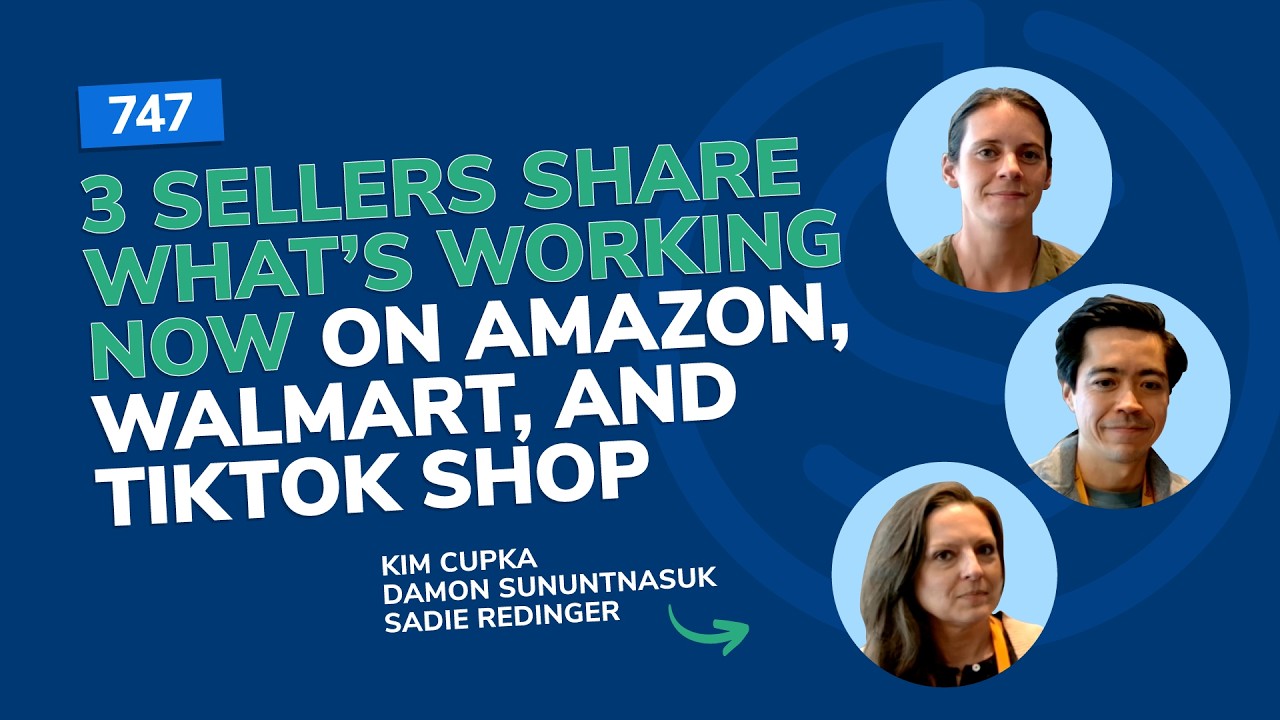
#747 - 3 Sellers Share What’s Working Now on Amazon, Walmart, and TikTok Shop
Summary
Serious Sellers shares actionable Amazon selling tactics and market insights.
Full Content
#747 - 3 Sellers Share What’s Working Now on Amazon, Walmart, and TikTok Shop
Speaker 3:
Today, we talk to three different entrepreneurs, somebody who's been selling on 1P and 3P and has products in Walmarts and Home Depot,
somebody else who has traveled the world, lived in different countries and has a multi-million dollar supplement business, and also a toy engineer who has made toys that actually get her kids to clean her house. How cool is that?
Pretty cool, I think. Hello, everybody, and welcome to another episode of the Serious Sellers Podcast by Helium 10. I am your host, Bradley Sutton, and this is the show that's a completely BS-free,
organic conversation about serious strategies for serious sellers of any level in the e-commerce world. And speaking of e-comm, we are here at e-comm mastery,
the first one In Nashville where we are interviewing different brands and sellers and I've already done a few interviews here so far with people that I've known and I'm acquainted with but now we're gonna meet somebody who I just met here.
Kim, right? Kim, I want you to introduce yourself like where are you from and like where were you raised? Did you go to university? What did you study? Like some of those basic stuff.
Speaker 1:
I'm Kim, Kim Kupka and I I grew up in Massachusetts. I went to engineering school at MIT. So that was what you do if you're a woman and you're good at math and science.
But I realized pretty quickly into my career that I wasn't a normal engineer. I actually switched into marketing and fell in love with digital marketing. So when my husband and I moved to California, I started working for startups.
I worked for startups doing media buying, growing their companies. Um, for a long time and then kind of did on and off between Growing startups and taking time off to raise a family. And then I decided to build my own Amazon business.
Speaker 3:
What year did you discover like e-commerce or the Amazon specifically? And like, how did you discover it?
Speaker 1:
So I knew e-commerce, I'd been growing Shopify brands for a while. I don't honestly, it's almost stupid that I never put together the fact that I could like,
I had almost all of the stuff between my engineering background and my marketing Current life to put my own business together, so it's almost silly, but I think it was probably 2022 when I found Amazon.
I was really opposed to the idea of going back to a nine-to-five and I started just reselling stuff. We did online arbitrage and retail arbitrage. I actually made a ton of money doing that. We flipped toothpaste from Ollie's.
And then when I had my second child, I was like, this isn't, this is so much hustle. Like this just doesn't, this doesn't scale for me with having a newborn.
And it was at that point that I actually took another nine to five and I started putting together all of the things that I had collected over the years in my life. My love of toys, I started my career at Hasbro.
My engineering background, my knowledge of Amazon and my knowledge of marketing, specifically like in the kids space, and literally just put all of those things together and cobbled together my own brand and my own business.
My business is called Quiggly. It's a kids toy brand, Montessori-ish, but like light pressure in terms of just like that framework. And We launched on Amazon in September of 2024.
We were basically out of stock for Christmas that year due to me completely not knowing what I'm doing. We still sold a ton of product regardless. It was out of stock for a month. People were still buying it for Christmas.
That's when I knew that I really had something. Last year in 2025, that was our first full year in business. We did $850,000 in revenue. Our best-selling product is a toy spray mop for kids.
If you're watching the video version, you can see it here.
Speaker 3:
So that's like a toy mop, but it looks like it's real. Does it actually function as a mop too?
Speaker 1:
Yeah, it's a toy mop for kids. It's three feet tall. It's really meant for toddlers three to five who really just want to help do the things that their parents are doing every day. When I built this product,
I contacted manufacturers that make actual mops and used parts that they had and just resized some of the things and selected different pieces and things to pull together a mop that could be adjusted to a size they had not made before.
We've since opened up our own custom tools. Now, the handle has my logo in it, but when I first started, I did not invest from a tooling perspective. It was just pulling things together in a unique way.
Speaker 3:
So, how did you land upon that original product? It sounds like, first of all, when you decided to sell on Amazon, you did have something like a direction in mind.
So then, how did you land on that product and then how did you come up with the idea of this? Are you the first of this kind? Are other people making toy mops or were you the first?
Speaker 1:
I knew I wanted to do something in toy. I have passion for that. Like I said, I started my career in toy and thinking that I was going to be an engineer making toys was actually the thing that made me be an engineer, which is funny.
I'm not the first one that made a kid's mop. Lovevery makes a kid's mop. It's part of their $120 subscription. And so when I started researching what toys I could make for my brand,
which I knew was a toy brand, that was never even a question. And I knew it was like Montessori vibes, but not heavy. So those were like the constraints. And I used Helium 10 and I was looking at queries, right? Like what we all do.
I don't even think I had started Freedom Ticket yet or anything like that. I was literally just figuring out as I went along. But I was looking and I typed in Love Every and saw what came up, right? Spray mop, duh.
People want the mop, the actual rest of the kit that Love Every sells a mop in. I've bought it. It's not as good of a kit, I think, as some of the others, but the mop is fantastic and kids are obsessed. There was searches for the mop.
Nobody made a mop that actually worked that you could buy by itself. When I made the mop, it wasn't even a guess. I knew for sure that it would sell. When I built it with my supplier, they were like, this is something that we've never done.
The MOQ is going to be 5,000 units. And I was like, absolutely. I'm all in. I know this is going to sell. It's not a guess. It wasn't a, let me order 200 units and see if it works out. It was like, no, people want this mop.
I can see people want this mop and there's nothing for them.
Speaker 3:
So that's interesting. Now, how many how many SKUs do you have now?
Speaker 1:
I have 15 ASINs.
Speaker 3:
Is it all like similar style where it's like you're taking like household things and making them toys or is it a wider variety than just this this kind of concept?
Speaker 1:
It's definitely a much more wider variety than it probably should be. I think as I think about the next year for Quigley, it's really focused in. The mop is what's worked. It does 80% of our revenue. It's a clear winner.
The other products were me kind of throwing darts at a dartboard, which is funny because in retrospect, I literally didn't need them. I was so sure about the mop. I knew the mop.
What ended up happening was I just started developing things because I actually really like developing product. I'm probably one of the few people that loves that part of the business.
I love the product that I make so much that I just started literally making whatever. All the product that we made is custom product. It's not just slap your logo on it, but I really didn't need to make any of those.
They don't have the product-market fit that The Mop has. It came from the The problem is in the initial part where I did that research and then I just started making stuff that I wanted, if that makes sense.
Speaker 3:
How many of the products did you find through Helium 10? And then what is your process in Helium 10? Are you using Blackbox? Are you just browsing Cerebro or Magnet, finding keywords instead of products first, just browsing using X-ray?
Talk about that a little bit.
Speaker 1:
Most of the products that I did launch Came from cerebro searches around love every keywords and then building out the keyword clusters around that I might have missed it to be what is what is love every is that like a brand brand like a brand of what.
It's a kids Montessori subscription toy brand.
Speaker 3:
Okay, so then you're looking for like, hey,
what are people searching for that has to do with this brand because I know I can make something similar and perhaps people are searching for this but love every doesn't even make it is that like a little bit of what you're thinking about?
Speaker 1:
Lovevery makes really nice toys, but it's only within the subscription ecosystem, so you have to sign up and pay them $120 every three months to get a box of toys delivered to you.
With my first kid, I did that and it was fantastic and I love the toys. They're wonderful quality. Fast forward five years, I'm now having a second kid. I actually already have a house full to the gills of toys.
I actually don't want six toys to show up every three weeks or three months. I want one great toy that my newborn could use or one great toy that my toddler can use. I had this idea that people were looking for stuff.
A la carte versus in a subscription. That's really been the starting place for it. The Mop is the biggest example of that,
but I have some other products that hark towards Love Every's product or Hero product in their subscription for that quarter, but done in my own brand's way.
Speaker 3:
Yeah, obviously not just, hey, let me just copy 100% what this other company is doing.
Speaker 1:
A lot of those from China too.
Speaker 3:
Yeah, exactly. When you do something like this, they're big MOQs, custom tooling, this is not that easy to just go ahead and duplicate.
Speaker 1:
I didn't start it with custom tooling.
Speaker 3:
Yes, but still, this is what you ended up with.
Speaker 1:
This is what I ended up with, with custom tooling, but I wouldn't have invested in custom tooling if the product wasn't a runaway success.
Speaker 3:
Yeah, I like it. All right. What is your launch strategy? So like, hey, you come up with a new product, whether it's a mop or maybe a toy vacuum or whatever the case is, walk me through how you get to page one and start ramping up sales.
Is it strictly through Amazon PPC? Do you have a big mailing list that you're promoting to use Reddit? I mean, there's all kinds of, there's not one way that's the right way, but we want to know the Kim way.
Speaker 1:
I would say that I do a lot of PPC, obviously Vine. Probably everybody says that, but yeah, I focus on the longest tail keywords first and build up page relevancy there. And then as that gets success, I sort of expand out.
In terms of just like strategy in general, I do have some campaigns that I'll do for launch that probably I don't keep depending on if they perform or not. But it's really just like, I don't necessarily start with campaigns that are Hey,
this is just for a launch because like if it works and it continues to work, then it continues to get money. Basically, any dollar I put in, if it prints me out $3, great. We'll just keep printing those dollars, right?
Speaker 3:
What's your favorite Helium 10 tool that you use on a regular basis?
Speaker 1:
Right now, I am building products again for my brand. We have a couple of products that are hopefully going to get on a boat in the next two weeks. Then I have products that are still very much in development. For that,
I've been leveraging Cerebro with a very similar strategy to what I did before where I'm really looking for We're going to talk about keywords that are obviously tangential to the brand that I have at this point,
but then finding those keywords and seeing if there's actually longer tail versions of those keywords that the demand is there, but it doesn't actually have a good match in a product.
So for example, I'm publicly building a product on my Instagram right now for Quigley that is a cleaning caddy set for kids.
Speaker 3:
Are you sure you're not just creating stuff? So you can exploit your kids and so that they start cleaning around like that's what I would do honestly I've actually had my kids, you know, they're adults now,
but working at my house packaging labels and stuff I'm like wait a minute like she might be on to something here. Like why is this so real? I mean, this is like a little literal thing. Like she's like doing child labor without child labor.
Is that really what's going on here?
Speaker 1:
You know what? I will say that my two kids, I have two kids. They're two and seven and they are the best product testers that you can imagine, Bradley.
They are literally out there washing my windows every day while we work on this cleaning caddy for kids. And so it's like a spray bottle and a squeegee and like a little bucket and all the stuff that they can like literally do the windows.
And my daughter, she's two, she asks to spray every day. She wants to spray the windows. So what I did was I found the keywords for like cleaning caddy and cleaning set for kids,
but there are people searching for cleaning set for kids 5 to 8. There's nothing that's existing out there. All of it's not really super functional. It's not really designed to actually work,
which by the way is something that's worked really well for Quigley is making tools for kids that actually allow them to have the responsibility and feel like they're actually helping.
And even if they mop that same spot for 20 minutes, we call that a deep clean. They made some progress there. They're using real water. I guess I was answering a question about keywords, so I'll try and pull it back to that.
But basically, find long-tail keywords, which may not have as much demand as something that we'd want to rank for eventually, but once we get the long tail,
Then we can expand out and so if people are looking for cleaning caddy for 5 to 7 or 5 to 8 year olds and there's no product that exists,
people that are looking for just cleaning set for kids probably also want that 5 to 8 year old product that doesn't exist.
Speaker 3:
Where do you live now?
Speaker 1:
That's a great question. We live in Costa Rica. So that's been one of the amazing things about having my own business and being able to set my own time. We spent most of 2025 traveling the world with my two kids. We spent most of it in Asia.
We went to Bali, Vietnam, the Philippines. We visited our vendors in China. Then we went to Europe and kind of explored Italy and France a little bit and ended up landing in Costa Rica.
And we've been there for seven months now and we live a couple blocks from the beach and it's amazing.
Speaker 3:
Does your husband work remotely or are you just supporting the whole family with this business or how's that situation?
Speaker 1:
Yeah. Our Amazon business, it covers the whole family. My husband does a lot of work taking care of the kids and then he helps with the finances, which is fantastic because if he didn't, I don't think anybody would be looking at that.
That's not my strength. And yeah, we've been able to live off of just our Amazon business. Obviously, we've had an amazing year of growth, but it's really allowed us to have the freedom to be location and Time independent.
Speaker 3:
Awesome. The last question, the future of Quigley brand. Are you wanting to build an empire to pass on to your kids when they're older? Are you going to want to exit and then retire and kick back more in Costa Rica or what's the next five,
ten years look like?
Speaker 1:
I want to build it bigger. I think there's a lot more that we can do. I think I've really fallen in love with the idea of giving kids Functional tools that they can actually use that make them feel empowered.
I know you say that I'm a child labor advocate, but if you've watched a two-year-old clean the windows and feel like they actually cleaned the windows, that's really empowering for someone that young.
I think that there's something really special about that and I really love that about what I'm doing. I know I'm selling toys for kids, but at the end of the day,
It's actually helping families and helping kids feel like they're a valuable part of their family even when they're really young.
And if I didn't have Quigley, I would be building something else because that's the only thing that I know how to do.
I think one of the things that I learned when we were traveling full-time and I wasn't putting my heart and soul into like building bigger, is that I actually need to do that for me.
And so, whether I do sell quickly someday or whether I don't, I will always be building something.
Speaker 3:
Awesome. Well, I wish you success in whatever that something is and let's meet at Ecom Mastery or some other event next year and let's see where you're at in your journey.
Speaker 1:
Amazing. I can't wait. I'll be crushing it.
Speaker 3:
I love it. Just like Hashtag crushing it right here in my shirt. All right. Next up, we've got somebody else who I just met here, so why don't you introduce yourself,
where you were born and raised, where you went to college, what you studied, just some basic stuff like that.
Unknown Speaker:
Okay, great. Thanks, Bradley. I'm Damon. Let's see. I grew up in Florida, and I went to my undergraduate in Florida, but after that, I've sort of been all over the world since about 2010, University of Florida.
That's right, Florida Gators, but I did my master's degree in England. I spent a few years bouncing around Europe and after that, moved over to East Asia where I worked there for a few years and now I live in Mexico City.
The reason why it's part of my e-commerce story is that well, When you move to a new country like Mexico, you have to find something to occupy your time. And for me, there wasn't really a local option.
And so I sort of had to manifest and manufacture my own. And that's how I started. I got really deep in the entrepreneurial space.
Speaker 3:
Obviously, moving to UK, you already spoke English growing up in Florida. Were you in Korea long enough to learn Korean? Have you been in Mexico long enough to learn Spanish?
Unknown Speaker:
In Korea, I learned just baby Korean. I could... Exactly. Good for you. That's amazing. Yeah, enough to... I joke again to get food in my mouth and get a taxi to home and tell a girl that she's pretty, but that was the extent of it.
Frankly, I came out of that career experience feeling very embarrassed about my language abilities. I lived there for two years, long enough to make really, really amazing friendships,
but With the capacity to go super deep and I felt really ashamed about that so when I went to Mexico I took a very concerted effort to learn Spanish and I enrolled in two full years of immersion language classes and People say oh,
yeah, I took high school Spanish or whatever, but I promise you And it's very different when you have to learn it properly.
Speaker 3:
Yeah, you're in Mexico, you start hearing stuff like, no mames way. It's not exactly what you learn in Spanish class.
Unknown Speaker:
Precisely, no manches.
Speaker 3:
Yes, that's the better way. I think the way I said it was a little bit vulgar. But anyways, I'll be going there soon for World Cup. So I'm excited to watch Korea play in Mexico.
Unknown Speaker:
Did you really get tickets? I recruited all my friends who We either lived in Mexico or lived in Korea to try to go together and we were not lucky.
Speaker 3:
If you need to buy two, I'm selling two, so I'm going to the South Africa-Korea game, but the one in Monterrey, but the South Korea, it's not Mexico. Who's the other team in the group?
Unknown Speaker:
I don't. In Guadalajara, it's Mexico-South Korea.
Speaker 3:
Yeah, so there's another one. South Korea is playing three games down there and I'm going to one and then the other one is Mexico that I'm not going to and there's another team and I have tickets to that one and I'm going to sell it.
So if you want those tickets, let me know and we'll say yes, yes. Okay, so now what year did you launch your first Amazon product? What was it and how did it go?
Unknown Speaker:
Oh boy, this was back in 2015. So gosh, when I moved to San Francisco, I was feeling a little bit sore about myself.
Everyone in San Francisco loves to talk about their startup and how they're changing the world by delivering a latte to your desk in three minutes or less.
I'll be honest, I felt a little left out, so that's when I started the Amazon business. I didn't launch my first product on Amazon until like January 1 of 2016, so almost a decade ago.
The first product was a super niche dietary supplement that's extracted from coconut oil. I had some really awesome research around the sort of immune-supporting aspects of it.
And yeah, that was my very first product and still my hero skewed a decade later.
Speaker 3:
When did you start using Helium 10 and what's been your favorite tools over the years?
Unknown Speaker:
We got involved with Helium 10 back in the day when it was like a two-horse race like Jungle Scout and Helium 10, remember? I still remember all your videos with the flat cap and you were just the face of the company.
You probably still are, right? I watch less training videos these days than I did back then. It's a plug-in to Chrome or any browser and it helps report back a lot of We use that for a lot of product validation and to see like,
hey, is this a market that we think can sustain interest over time, like how saturated is it, what's the average price point, et cetera. We honestly still use it to this day.
Speaker 3:
Awesome. Awesome. What's been your peak year of sales? Which year was it across all platforms and approximately how much sales was it and what platforms are you selling on today?
Unknown Speaker:
In context, I think just given the nature of the fact that we sell on dietary supplements, 2020 was our peak year in relationship to our base. We sold probably six months' worth of inventory in about two weeks' time during peak COVID times.
It was a Very exciting time but also very stressful time because when you you just no one could ever have predicted a six-month sell-through all of our supply chains got Locked up.
Our manufacturing relationships were, you know, the gears kind of came to a halt. The stay-at-home orders like really affected us in a big way. So again,
it was really exciting to sell that kind of volume but really terrifying to be out of stock for so long. The second big shifting point in our journey was like December 23,
maybe January 24 when TikTok Shop just turned on and I remember I had Just sort of playing around, enrolled in TikTok Shop, encouraged a couple of our off-TikTok influencers from Facebook or Instagram to create a TikTok account,
and it just went nuts, like Q1 of 24. That was our second big spike. We're not a very big brand right now compared to others that you probably interview and work with, but yeah, those are the two big inflection points in our career.
We were sub $1 million back in 2020, and we basically doubled that year from like a half a million to a million, and then in 24, we doubled again from like a million and a half to three.
Speaker 3:
Supplements, obviously, is one of the most competitive niches, stereotypically and typically. That's not an unfounded stereotype. How do you compete? How do you maintain market share on TikTok Shop, on Amazon,
when it's so difficult to really stand out in this kind of niche?
Unknown Speaker:
Yeah, I think Hormozy says it best when he says the riches are in the niches. And so we do try to niche down as best as possible when it comes to our ingredient selection, our selection of our target ICPs, how we position our products.
And another Hormosy adage which we've really leaned into recently is like solving the next problem, right? So let's say you have an immune support product and it solves like a superficial problem,
but maybe what's contributing to this immune issue is It's a sleep issue, right? And so maybe you introduce like a sleep supplement.
And then actually what's impacting your sleep is like a little bit of like anxiety that you might be experiencing. So you can introduce an anxiety supplement. You wouldn't use that language, of course,
but the point is you try to draw a connection like a chain from one product to the next to the next to logically uncover the next problem and therefore the next solution.
Speaker 3:
I like that. I like that. What's some quick-hitting strategies that you can give that you think is not just, hey, this is just run-of-the-mill kind of stuff, but something that maybe you're in the 1%,
2%, 3% who are actually utilizing this strategy, something unique?
Unknown Speaker:
I didn't see you at Prosper. I think you skipped it this year. Wow. Well, I gave a presentation.
Speaker 3:
I was in Korea, actually, doing Prosper.
Unknown Speaker:
Amazing. Yeah. Korea would have been my choice as well. I gave a presentation around what we're doing with AEO, so answer engine optimization, a big topic this week.
We've really leaned into a lot of the automations to help support that for us. You've probably read Dotcom Secrets, Russell Brunson, the ClickFunnels guy.
He talks a lot about having cold traffic, warm traffic, and hot traffic and developing these connected sites. He uses a funnel analogy or funnel process, but we use various websites.
We have high authority websites like bridge websites and then conversion websites where we've used N8N and various LLMs to make these automations that go out to Reddit.
Read what problems and challenges people are experiencing and talking about, so it's very topical.
Write really high authority and highly AEO-optimized blog posts and images and then automatically publish out to a series of WordPress sites that we have that sort of cover that cold, warm, and hot traffic. We've done that at scale.
We've produced several hundred high authority blogs that have been producing amazing traffic. I forget the statistics off the top of my head now, but I know that we've seen AI or LLM specific traffic more than double to our Shopify site.
Conversion rates are way up, like 66% higher compared to a more traditional search click. The AOV is higher. It's just proven what we hear in theory, which is like, you know, AI-driven traffic is more trustworthy,
stickier, has lower bounce rates, etc. And we're seeing in real time.
Speaker 3:
So for somebody who's just getting into it, You know, maybe hasn't studied it for a long time like yourself or doesn't have fancy tools.
What would be the first step in trying to start making sure that their brand gets a little bit more visibility there?
Unknown Speaker:
The easiest hack I think that we heard this week and we've actually seen it ourself is like just getting back to the fundamentals. A press release can do a lot for your visibility in LLMs.
What we saw literally overnight was adding schema to our website. So we had added the lms.txt file several months ago and didn't really see much action there.
The moment we published our schema to our Shopify site, we started showing up in all the major LLMs. It's not sexy. It's very fundamental. You just got to do the work, publish a few blogs, answer the question in the first 60 words,
be very distinct, short, crisp, modular answers, publish a few press releases a month. You know, try to get involved in Reddit a little bit. Don't be salesy.
Try to be helpful, add value, but also try to help guide the conversation towards maybe your particular product or industry or ingredient. And yeah, with time, I think it all adds up.
Speaker 3:
What's the future hold for your brand? What's the goals? Do you want to just do something and retire in either Korea or Mexico or you just want to build this up to be,
you know, the next goalie or something like some, you know, gargantuan empire? What do you, what's your why kind of like, or what's your future?
Unknown Speaker:
Look, the whole, what got me started actually was reading The 4-Hour Workweek by Tim Ferriss. And the spirit of that whole book is about producing passive income businesses.
And I'm a big believer that I would rather have a $1 million business with 50% margins versus a $100 million business with like 5% margins. The math is all the same, right? The net value at the end of the day is the same,
just the headache and the sheer scale of the complexity is very, very different. So although it feels very good to say big numbers, I try to contain myself and really try to focus on like, hey, the why, right? Make an impact.
Improve the lives of both the customers and the people that I get to work with and try my best to have a little bit more of a balance between work and life so that I can actually enjoy the time I have.
I get a lot of grief from my wife right now that I'm not always present and not always there and I'd like to do more of that.
Speaker 3:
Yes, awesome. All right. Well, thank you for sharing your story and maybe next year Ecom Mastery or maybe if I go back to Prosper, another show, love to catch up and see how you're doing with your goals.
Speaker 2:
Thanks a lot, Bradley.
Speaker 3:
Thank you. All right. Next up, we have another guest who I've never met in person before, just like the last one. So, let's get to meet her. So, please state your name. Where were you born and raised? What did you study in college?
Where did you go to college? Just some basics about you first.
Speaker 2:
So, my name is Sadie Redinger. I'm from Kansas, small-town Kansas, actually. And as soon as I turned 18, got the heck out of there. I went to school in Savannah College of Art and Design and studied costume design.
The first 13 years of my adult career, I worked in costumes in film and television. And then after that, I got tired of the hours and stress, so I decided to leave. I traveled for two years just trying to figure out life.
My partner at the time was doing Amazon FBA, so I started learning optimizations and marketing and things like that from him and was like, well, I don't I don't want to take that step yet to sell my own product,
but I actually knew somebody who was trying to get their company, well, they were on Amazon, but they were trying to better their sales. So I was like, well, it's kind of a win-win.
Let me practice on your listings and then we'll go from there. So then that's how I started getting, they did like three-month contracts with me where I would do about 10 product optimizations in that time. And then the sales went up.
So they brought me on full time. I was with them for seven years. And then back at the end of 2023, my current company reached out to me, their recruiter found me on LinkedIn and reached out, they needed a director of e-commerce.
So that's where I'm at now.
Speaker 3:
So, it sounds like you've been in like the Amazon world for 9, 10 years about?
Speaker 2:
Yeah, about 10 years.
Speaker 3:
Okay. What has been the biggest things that have changed for those of us, you know, have a long list of things for those of us who have been in the game 9, 10 years? What has affected you as far as how you operate?
Speaker 2:
I've always dealt with Vendor Central. So, both of my companies sold on or sell on Vendor Central. When I first started doing item optimizations, it was a fairly simple process.
Now, especially when you have a bunch of third-party sellers on there as well, and you're competing for that, like who's winning the contributions.
I do a lot of research and especially now going through AI and using Rufus and Cosmo to update my listings,
but then I'm not winning the contributions especially with my company now because we just started on Amazon as our company owning it and third-party sellers have been on Amazon for years before us, so they're winning that contribution.
So that's one thing and marketing, just marketing tactics. Before we started out with mainly just PPC, but then at my last company, adding in DSP and OTT and all of that, just seeing how much that has changed and grown.
I mean, I'm sure You noticed too during COVID how things changed on Amazon real quick.
Speaker 3:
What you mentioned is something that a lot more companies nowadays are going through and that's the transition from 1P to 3P. Can you talk about some of the biggest changes and differences?
A lot of the 3P sellers have no idea what is the difference and then a lot of the 1P sellers don't know what's in store for them. So what has been the biggest learning curves or biggest differences between those two models for you?
Speaker 2:
On the 1P side, it's where Amazon orders through bulk POs and then we have allowances deducted. Basically, it's what the seller fees are and FBA, that's what our allowances are.
The thing is with Seller Central, you're saying like what's going into their warehouses for the most part. I mean, I know they have their limits.
But you are guaranteeing yourself that you're going to have inventory and stock at their fulfillment centers where on the one piece side, unless you're doing direct fulfillment, which is the direct to consumer shipping,
you might not have an active listing even though the product's available, but Amazon's system is not deeming it as relevant to bring in to their fulfillment centers.
Speaker 3:
What is the gross revenue of all the Amazon brands you're currently managing now? How much, approximately, advertising spend do you have to do?
Speaker 2:
Last year, and that was really our first year selling one of our brands for a whole year, And so two of our major brands we were selling on Amazon, we closed out between 5 and 6 million for those two.
But we've been growing at 300% year over year now, especially now that we've been ramping it up. And so I always go for a 10% marketing spend to keep us there.
Speaker 3:
And for your marketing, are you using PackView now?
Speaker 2:
Yes.
Speaker 3:
Is it just for Amazon? Are you doing other kinds of retail media out there or other platforms?
Speaker 2:
With PACVIEW, no, just Amazon right now. We are getting started on Walmart Fulfillment Services and we're also on the 1P side of Walmart as well.
So we do have some Walmart Connect campaigns, but they're nothing compared to the spend that we do on Amazon.
Speaker 3:
What's your current launch strategy for a new product under one of the brands? Like, are you trying to just get new traffic, you know, using advertising? Are you marketing to a big set of your, you know,
like existing lists and existing customers to get that initial momentum? Walk me through your launch strategy.
Speaker 2:
So as far as, you know, our in-store sales are obviously our largest amount of sales for the company. So, for them, yes, they're going and talking to the buyers and things like that.
For Amazon, we've used the Born to Run program where that's the seller-generated POs on the 1P side, but if you don't sell through the inventory that you sent,
you get a chargeback of 25% off of that or you pay to get it returned back to your warehouse. We did that. It was successful to us, but along with that, we have to do a promotion and we have a marketing strategy.
With some of our other items, when we launch something new, it's kind of just growing off of something that was already there. So if we can do variations, that's really helpful.
Updating our Amazon brand store with what's new in our product line, that's another strategy that we use.
Speaker 3:
Anything unique you guys are doing on the advertising side, whether it's Because of something that Packview has or it's just your own strategies you've been doing?
Speaker 2:
Something that has been a really good return for us is using, I mean, it's through Packview, but it's Amazon's Performance Plus and Brand Plus in their marketing. So that's where their AI is choosing the targeting for you.
Our ROAS has been amazing with those two things. Also, I just started a campaign with the Share A Voice on sponsored brands. I can't tell you how that's performing just yet because I just launched it recently.
I try to have a very well-rounded marketing where we always have some auto campaigns going for keyword harvesting and things like that.
I will do single product, single keyword on items that I know have really good growth and let's own that search term. Also,
just trying to protect our brand because we are big brands in the lawn and garden category and there's a lot of competition. Really strong brand marketing as well.
Speaker 3:
Biggest learnings so far at this conference and is this something regularly that you do like go to Amazon conferences? What was your goal when you came here?
Speaker 2:
So, I've been going to the Prosper Show. I've done Amazon Unboxed for their marketing. At my last company, I would go to the Amazon conferences for the home category because that's what I was in. So, I do go to conferences.
This one was different with it being AI. I took Juana's week-long masterclass of AI mastery for Amazon and that really has done some really good things for my listings.
So I wanted to expand my knowledge in AI and see what tools I can use to better our listings and sales and just, again, just more brand exposure through it as well.
Speaker 3:
What differently did you do to your listing? What weren't you doing before that now you are?
Speaker 2:
Now I'm utilizing Claude, but with the prompts to one, get better customer demographics because a lot of what we were basing it off of is who they're seeing at trade shows, which is very different as who's buying online.
So, it's really learning who are our customers, how do we market to them, what do we need to say in our listings that's going to resonate with that person and their needs and make them feel comfortable to buy our product over a competitor.
Speaker 3:
All right. Well, it was nice to meet you. Thank you very much for coming out here and this is the first time meeting you, but maybe we've got Amazon Accelerate later on this year or Unbox. I'll see you there.
If not there, then Ecom Mastery 2027 will be in Austin and I'll see you there.
Speaker 2:
All right. Perfect.
This transcript page is part of the Billion Dollar Sellers Content Hub. Explore more content →