Ecom Podcast
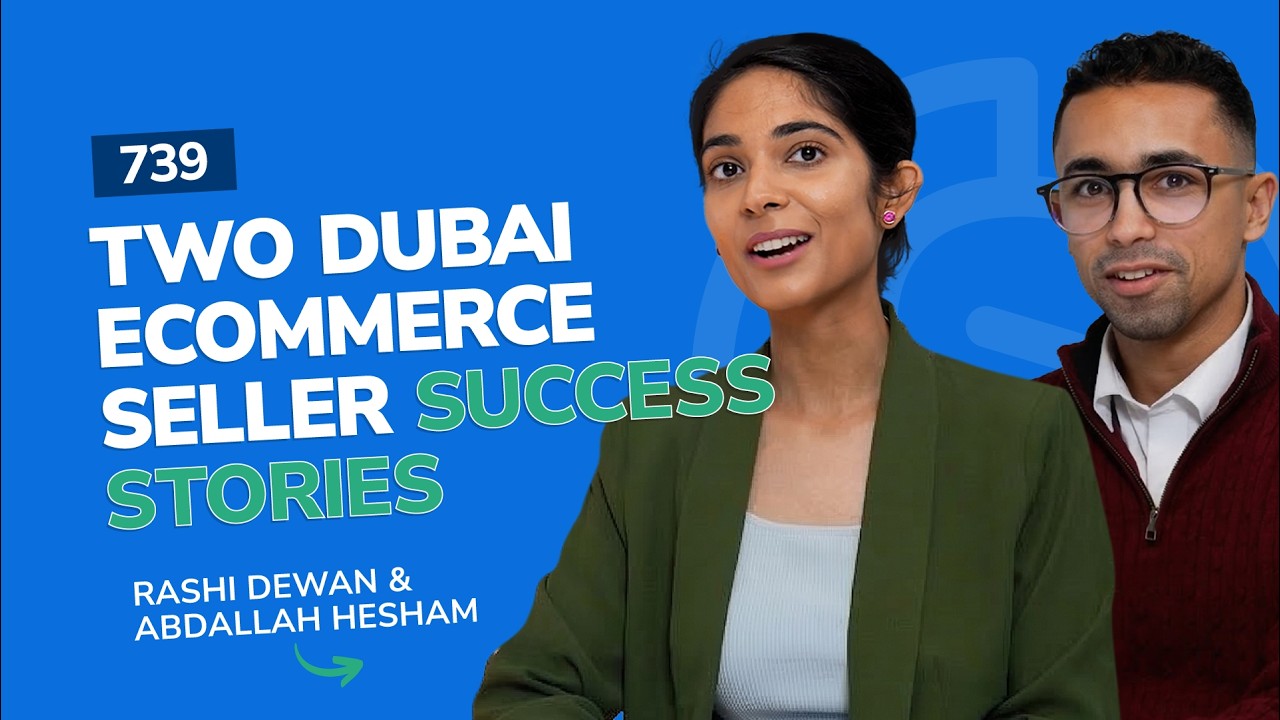
#739 - Two Dubai Ecommerce Seller Success Stories
Summary
Serious Sellers shares actionable Amazon selling tactics and market insights.
Full Content
#739 - Two Dubai Ecommerce Seller Success Stories
Speaker 2:
Today,
we talk to an entrepreneur who turned her passion into her own food product and a student of Project X who had two product failures and lost thousands of dollars before hitting it big and becoming a seven-figure seller and now he's even fulfilling his childhood dream of being a pilot.
How cool is that? Pretty cool, I think. Hello everybody and welcome to another episode of the Serious Sellers Podcast by Helium 10. I am your host Bradley Sutton and this is the show that's a completely BS-free,
organic conversation about serious strategies, serious sellers of any level in the e-commerce world. Did you know that in seconds you can find all the keywords any product on Amazon was ranking for in the last couple of years?
Or find out where any product got sales from, from brand analytics data from the last five years? Or get exclusive private trainings that used to cost $400 a month All of these plus more is available now on the Helium 10 Diamond Plus.
Upgrade with this special 20% off coupon code SSP20. No contract, you can cancel at any time. Once again, use code SSP20 to get the Helium 10 diamond plan that helps brands so much, it practically pays for itself.
We have somebody who's actually been here on the podcast before, somebody I recorded right here in Dubai. And real quick, something interesting here. First of all, shout out to Podcast Hub who helped us out here in the World F,
but look what there is right in the middle. It's because there's a collaboration, but that is a nice X, all right? Those of you who are old schoolers from Helium 10 know about Project X.
That actually has a little bit of something to do with our guest. Abdallah, thank you for coming on. Can you reintroduce yourself to the audience, just in case they didn't see your first episode?
Speaker 1:
Thank you, Bradley, for having me for the second time. It's been a pleasure. Six years ago, I was a student for Project X. I was watching Bradley and Tim Jordan doing all the messages that they shared about product research. Actually,
I believed This course or mini course has a lot of value and I tried to apply the same strategy and I found my product in 2021.
This year, 2025 or last year, I built a seven-figure business on the same method that Project X has introduced. My name is Abdallah Hesham. I'm a seven-figure Amazon seller, also a content creator in the MENA region about Amazon FBA.
I have a little side hustle. It's aviation. I'm a student pilot. So, Amazon gave me the freedom to do whatever I want.
Speaker 2:
Is that just going to be a hobby or do you actually want to be a pilot for airlines or for a company or what's your goal with that?
Speaker 1:
Actually, my childhood dream is to be a pilot. So, I want to be a commercial pilot but at the same time not to leave Amazon. So, I hope I can make it like a part-time pilot. I fly like one or two times maximum in a week.
What I like about Amazon FBA, it's 90% automated. Once you launch the business, before you launch the business, you need to talk to the suppliers, spend 12 hours a day making product research.
But once you have a good product and have the system that works, it's 90% automated. You just make the operation, inventory, PPC management and like this.
Speaker 2:
Now, you're not based here in Dubai, right? Where are you based?
Speaker 1:
Okay, I'm based in Egypt. Yeah, but I flew from Egypt to Dubai for events like this.
Speaker 2:
Okay, awesome. Now, going back to Project X, you talked about, hey, that there's, you know, some core fundamentals that you learned and that help you launch your business. What was it?
What did you learn from there that helped you launch a successful business?
Speaker 1:
Actually, before that, I watched Project X in 2021, but I started to learn about Amazon in 2020. I watched many videos in Arabic and English, and all people are talking about using software like Blackbox,
adding just numbers to get sellers. For example, I will add filter, I need a product or a seller that's making 10,000 per month and has maximum 200 reviews. So, this method I tried two times and I failed my first product.
I made a lot of sales, but I lost completely. I lost like $15,000 in USD. Then I launched a second product and I also lost like $3,000. So, I tried to know what are the reasons for my two failures. People that I watched on YouTube are saying,
to find a product that has low competition, you need low number of reviews. But then I was searching on YouTube and Project X came to me. So let's check Project X.
And what I really liked, and I know that these people, they are unique, to be honest. When you say that Tim Jordan was making product research, but not using a tool, he was doing it on Pinterest. So he is brainstorming a product,
not just following the numbers that everyone is using and getting a product that will be visible on the radar for anyone who are using Helium 10. I like to use Helium 10 for product research, but magnet tool, not the black box,
because magnet tool, let's say you go to ChatGPT, get a keyword or a niche, and then I use Magnet to start to check if there are any relevant keywords that are exactly describing a product.
So when I watched Project X, actually, this is one thing that I liked. And to be honest, this video changed my whole life, to be honest.
Speaker 2:
Awesome. So it's kind of like, of course, you know, there's nothing wrong with trying to find something that has low competition, but even going to the ones that have high competition, but maybe you have a unique angle, like shelves.
is obviously high competition, but nobody has like a coffin, you know, shelves, like looking where there might be demand for something that is not that is not possible.
And so Your number one seller, your number one success, how did you find that? Was it on Pinterest? Was it on a different website? How much have you sold of that product? Talk a little bit about that.
Speaker 1:
My first winning product, actually it was my third product to sell on Amazon and the first one to win. I did multiple product research and then I found one. But actually at this time, I had two failures.
I don't have too much information and experience, so I cannot validate if it's the right product to sell, especially after two failures. I booked a call. Anyone in the Centennial League can book a call with Tim Jordan.
It's for free and then you showcase the product and Tim Jordan will say his validation and opinion. This is the best product he has ever seen. It was 1 a.m. at his time.
He went to his wife and wake her up to see the product that Abdallah came. Actually, I was very happy about this product. Yes, I made in the first year six figures, but I lost the first two or three months.
Speaker 2:
Why?
Speaker 1:
At this time, I didn't have enough cash flow, to be honest, because I failed in my first two products. So I started to have two partners. They are Egyptian living in China.
And I know when I have to make the product images, it's very important for your conversion rate. I can spend a lot of money in images to make a higher conversion rate, but I told them, They told me no,
we have no Chinese agency that can make the images, 20 images in $50 or something. I said, okay, let's try, but let me be clear, it will not work.
So we bought 500 units of this product and we made very bad images and we launched the product and at this moment, you had two failures. I sacrificed my engineering college, dropped out of engineering to make it a success in Amazon.
I was hoping when I launched the product to make 10 units per day, 20 units. First day we got two sales. Second day, three units. The first week we sold like 30 units in seven days. It was failure because we had a very low conversion rate.
We have a good traffic and because our competitor was doing Let's say I think 150,000 each month and he has 20 variations and I only have one variation or two. So, we liquidated the other inventory.
It was 300 units and I started to tell them no, everyone will work alone. I still believe in this product because you know It's an inside feeling, you know it will work, but you have to make it right.
So I tried to optimize my listing, made a new listing, made a new images, spent like $600 on making the seven images. And I launched the product in 2021, I think in June or July.
And from June to November or December, I made like 100, my first six figures, 100K, but I was out of stock because When I launched the product for the second time in July, I made a lot of profit,
but I have to take the profit and all the cash and all the cost and put it again to supply the queue for demand. And this started from here.
Speaker 2:
Everything you've done since then, is it on the same brand? Are you starting new brands and doing completely different kinds of products? What's your strategy?
Speaker 1:
From 2021 to 2025, I have the same brand, same category, same everything, but different products for sure. But this year, I'm planning to make a new brand. Actually, I'm going to China in April for the Canton Fair.
I have a new brand to launch and my goal for this brand to make an exit in the next two or three years because it has higher competition than my old brands, but now I have experience, I have the cash flow,
so I can make in a competitive niche, but it's not too much competitive. But if I can advise anyone who wants to start on Amazon, Don't chase winning products,
chase winning categories because winning products will make you cash at the beginning but will not make a brand so you can exit from this brand. But if you are searching, let's say I'll give you an example.
Actually, this will be my talk today at my presentation. I was searching on Amazon. I picked a category. It was home and kitchen. I went to ChatGPT. Hello gave me 200 niches to start my research on Amazon brand analytics and magnet tool.
And he gave me a shower related to bathroom. So I went to magnet and I entered shower and I started to refine by title, dynasty and search volume. And I checked all the shower or all the keywords that contain shower.
I was looking for a product related to bathroom, but I saw a keyword. It's baby shower decoration. Okay. It's completely different from what I'm looking, but let's see. I talked about baby shower decoration. I put it again in magnet.
I found a product, the keyword I think we can barely wait, baby shower decoration. It has 9,000 search volume and consistent 9,000 search volume for the last year. How many sellers?
I think seven sellers only selling the set that contains balloons and tableware and everything. The highest one that has maximum highest review,
I think 70 or 100 reviews and he is making a lot of sales and also all people are offering the blue color only for boys but when I use ChatGPT, I found that 50% of the newborns in the United States are baby girls,
so I see this product has a lot of sales volume, has a real demand, and for sure there are other related keywords. Not too much competition. Yes, the product is not easy.
I have to travel to China to make it because two different products or items, you have to make it in one box.
Speaker 2:
I actually like that as a strategy. I've talked about that before. Even now, I do that with a coffin shelf where everybody copied the coffin shelf. But now, I changed the coffin shelf where now there is a coffin gift box.
Also, I have some LED spooky lights. These come from a total of three different factories. None of the people who are copying the coffin shelf are going to take that effort, oh, let's go and find another factory and let's bring it here.
So, I've done this for like two years and not one copycat because it's hard. So, if you're having two products in one, that makes it much harder for the common factory to copy.
Speaker 1:
There are six different products in one set. Six different balloons and tableware. A lot of things. So this is my goal and I see a huge momentum in this category and this will be my next or my exit in the Amazon space. Awesome.
Speaker 2:
So you've talked how you use magnets a lot, which by the way now is actually in Cerebro. So we combine magnet and Cerebro into one tool. What other tools in Helium 10 have helped you on your journey or do you use regularly?
Speaker 1:
Okay, it's quite interesting. I know it's a small tool, not a lot of people know, but it's very, very important because sometimes you want to search for a keyword, see if you are visible or not, or indexed or not, but this tool is amazing.
Actually, the keyword tracker and the rocket button that track your ranking in a very long time. Cerebro, for sure, it's a must-use. Cerebro Magnet is a must-use for me. What other tool?
Listing, Frankenstein, and I think it's now… It's called Keyword Processor now.
Speaker 2:
The hardest, formerly known as Frankenstein. Yeah, Keyword Processor. Yeah.
Speaker 1:
And the Listing Optimizer tool. These are my essential tools in Helium 10. So, how many SKUs do you sell now? Right now, I have two brands. Total SKUs like.
Speaker 2:
And is it all Amazon USA? Are you selling in other Amazon countries or another marketplace like TikTok or Walmart or anything like that?
Speaker 1:
100% U.S. marketplace. In Egypt, we have a very common quote, Egypt is the mother of the world. But I say every time in my videos, United States is the mother of the world because everything has the bad and pros and cons. But in the U.S.,
what I like there The culture of the people and the TikTok videos and social media are making people are hungry to buy new products that are literally released in the market yesterday. Let's say a Chinese factory made a pizza blanket. Okay.
No one will wake up and search on Amazon for pizza blanket. But I opened TikTok and found pizza blanket. And then, oh, I want to buy this one. So, the only marketplace in the world that people there can buy these funny and cute products,
it's the U.S.
Speaker 2:
Yeah. Interesting.
Speaker 1:
Yeah.
Speaker 2:
I don't think they're buying pizza blanket in Egypt.
Speaker 1:
Yeah.
Speaker 2:
I don't think anybody's buying blankets in Egypt. It's very hot over there. All right. So, you've talked about some unique product research strategy, like using Magnet, but just in general,
any other strategies that you're going to talk about today at the conference or something about how you manage your advertising, how you manage your keywords, anything at all you want to talk about?
Speaker 1:
Okay, I have a quite interesting advice for PPC or relaunching after Outstock. My bestseller Aisin, I ran Outstock in December because Q4. And then my stock came back in half of January. When I launched the same campaigns, I turned them on.
Let's say in December or on August, I have 10,000 impressions every day for the one campaign. I tried to boost and increase my bid, but Amazon kept me at 2,000 impressions per day.
So, let's say in August I was selling 70 units per day in this product. When I launched it one month ago, I was selling 40, 30. It's not normal. So, I was selling at price $24.99. I made my price $21.99, and this is the sale price,
not the lesser price, okay, or not your price. Sale price $21.99. And then I made a coupon for 10%, so the final price will be $99. And I made a lightning deal. It will start at 8 February. The lightning deal, I'm selling a gift item,
so my sales will be higher because of Valentine's Day, which is tomorrow. So I made a lightning deal starting from 8 February. And the lightning deal, the final price will be about 22. Okay, or 23. How?
Because lightning deals don't take the sale price into consideration. It takes the lesser price or the highest price in the listing.
Speaker 2:
So before the lightning deal started, how long before the lightning deal started did you make the sale price?
Speaker 1:
No, I actually changed the sale price in the same day that I submitted my lightning deal.
Speaker 2:
Okay, so you had the regular price $24.99. You submitted the lightning deal in advance for the feature date, and then at that time, you did the sale price. But then when the lightning deal started, it makes the sale price disappear,
and now it just shows the lightning deal or how to double it. And how about the coupon? Did that disappear also or still stay closed?
Speaker 1:
You closed it.
Speaker 2:
You set the lightning deal because you need the highest price in history for the lightning deal, but then to get some momentum before the lightning deal started, you started the… Exactly.
Speaker 1:
So, I use Cerebro and one of my favorite tools in Helium 10 is Cerebro Historical Trends because on that day when I changed my price, I see my historical I'm organic ranked. I was ranking 2,000 keywords.
And then right now I'm ranking on 500. So I got the keywords that it was generating a lot of sales for me, also using search security performance. I make an Excel sheet for these keywords and I make exact campaign.
At the same time, I lowered my sale price to increase my conversion rate. So I get a lot of momentum and organic juice. And then at starting from 8th February, I have good organic rank. And then I can raise my price using Lightning Deal,
so it will make me a higher conversion rate at higher price at ranking at many keywords.
Speaker 2:
Awesome. Awesome. All right. That's a great strategy that you guys can try if something has slowed down or like you said, you have been out of stock. So, your goals over the next year.
Let's say next year I come back to WorldF for the third time and we interview for the third time. What do you want to be able to tell me that you're now a fully licensed pilot? The other brand is already a million dollars.
Tell me, what are you going to be able to say next year?
Speaker 1:
Okay, it's very nice. First of all, I finished my PPL, private pilot license. I will finish it in two months. So, I hope to this year finish my commercial pilot license.
And also launch the second brand I told you about and have like six SKUs because if we have six SKUs in this brand, we can actually make two millions per year. A personal goal to be married this year.
Speaker 2:
Do you have a girlfriend?
Speaker 1:
Yeah.
Speaker 2:
He just has this goal. I don't know. I don't have a girlfriend yet.
Speaker 1:
Yeah.
Speaker 2:
Okay. Do you already have a proposal, a fancy proposal of mine at the Pyramid?
Speaker 1:
Yeah, actually we will make it in April in Pyramid.
Speaker 2:
There we go.
Speaker 1:
Yeah. So if you come to Egypt, you have to come and anyone watching the video, if you are in Egypt, please come to the Pyramid.
So another goal is try to make my family and my sister and my brothers I want them to have the same knowledge that I have because when you work in e-commerce or online business,
you are the 1% of the world because other people are working from 9 to 5. They don't have the mindset to make business or even they don't know that you can make money online.
So I hope this year not only change my life but change my sister and my family. Make them have like know-how or knowledge to run their own businesses so when I have 40 years old and my sister is 25 years old,
I'm not driving let's say Mercedes or Lambo or whatever and she is driving a normal car. I want all of us in the same level so this is my biggest dream in my life.
Speaker 2:
Love it, love it. All right, next up we have got another local brand and I love the name here, Nothing Silly. And it is, I can see why we had chocolates and now I'm just looking at this. I see no refined sugar, sweetened with dates.
So please introduce yourself and tell us a little bit about your Nothing Silly product.
Unknown Speaker:
Hi, everyone. My name is Rashi. I'm the founder of Nothing Silly. We manufacture 100% clean and natural snack bars. We add no preservatives, no palm oil, no refined sugar, no fake sugar to it.
So yeah, it's really 100% clean and made with ingredients you'd likely find in your own kitchen.
Speaker 2:
Awesome, awesome. Is this manufactured locally here in Dubai?
Unknown Speaker:
Yes, we manufacture in Dubai.
Speaker 2:
When did you start?
Unknown Speaker:
It's been just over a year for us.
Speaker 2:
Okay. How did you get into this kind of business?
Unknown Speaker:
I'll just give you some background about myself. I'm a huge foodie, a huge snacker. Man of late, I started becoming very serious about what I'm putting inside my body. I started reading labels.
I started asking restaurants what oil they're using, what ingredients they're using. So, I got quite serious about my health. And one day when I was quite hungry, I walked into a leading supermarket.
I thought I'll grab a snack bar because that's typically a clean option to eat in a supermarket. I spent a good 20-25 minutes. I read a lot of labels. I actually couldn't find anything.
Snack bars were full of either glucose syrup or sugar or maltodol or palm oil and that was really the trigger point for me. After that, I got home, did a lot of tests.
I think I did about 80 plus tests over 5-6 months and that's when I finally decided on the product.
Speaker 2:
Now, where did you launch? Did you start in the stores? Did you start on Amazon? Did you start on your own website?
Unknown Speaker:
For us, we started online. We built a Shopify website. We mostly started doing meta ads. The number one step for us was the website.
Speaker 2:
How did you do in your first month of sales?
Unknown Speaker:
Very low. I think I did eight orders and those were also my friends and family. So the eight people I knew in Dubai ordered from me. So the first month was really slow.
Speaker 2:
How did you not let that discourage you?
Unknown Speaker:
I think I really, really believed in the product. I would say that when I taste a product, I do regard myself as a good taster. I know what a good tasting product is. It looks like I'm very proud of the brand name.
I think Nothing Silly really tells you from the name itself that we put Nothing Silly in it. So I really believed in the brand. I really believed in the product. And we actually didn't do any marketing in the first month.
So yeah, I felt that it's basically because of the lack of marketing.
Speaker 2:
Okay. At what point did you launch on Amazon?
Unknown Speaker:
May last year.
Speaker 2:
How did that work out? Better than the eight sales in one month? Yes.
Unknown Speaker:
The first month was not as bad as the first month on my own website, but it's a slow journey. Amazon, however, I absolutely love Amazon. I think they've supported a small brand quite well in terms of the tools, the ad tools that they have.
It's quite helpful. We managed to grow more than 50% every month on Amazon. I think Amazon's algorithm also favors brands that taste good, where the reviews are good, etc. So overall we were quite happy with Amazon.
Speaker 2:
Are you just here in Amazon UAE or any other Amazon marketplaces?
Unknown Speaker:
So far just UAE. Helium 10? Yes, I have used it for two months in the beginning when I was trying to look for keywords for the product.
Speaker 2:
What's an interesting keyword you found that of what somebody would search to find something like this?
Unknown Speaker:
I didn't expect dark chocolate to be a strong keyword for us because we're a snack bar. I expected protein bar, snack bar, energy bar, healthy snacks, but dark chocolate was actually one that is really converting for our product.
Speaker 2:
Excellent, excellent. See, I didn't know she was going to say that, but it shows you, you never know what Helium 10 might My show you what's the what's the future for for you and this brand like what's it? What's your goals? Are you planning?
Are you trying to expand to offline first or you want to expand to other Amazon? Marketplaces in other countries. So what's your goals?
Unknown Speaker:
So, for the immediate few years, I would say one to three years, we do want to get our foothills stronger in the online space in the UAE itself. So, we're focusing more strongly on Amazon.
We're focusing on the local competitor of Amazon, which is Noon. We're very strongly focusing on QuickCommerce. We haven't been able to log that in yet. But that's mainly the focus.
Once we believe that we have hit a number and we have saturated online, that's when we would look at offline.
Speaker 2:
For those other marketplaces, how would you fulfill those orders? Do you have to ship yourself or can you actually use like your Amazon FBA inventory to ship to like Noon or the other ones?
Unknown Speaker:
It's a mix of both currently to Amazon. We pack and we deliver ourselves. We send to the Amazon warehouse where Amazon FBA and then Amazon does the delivery.
But for the other B2B vendors, we are planning to work with a fulfillment partner here locally in Dubai. We would be sending our inventory to them and they would be doing the packing and the fulfillment for us.
Speaker 2:
Of those three you mentioned, is Amazon the biggest here in this market?
Unknown Speaker:
For me, yes. Currently, they are the biggest, but that's because Amazon is pretty much the only one I am working with. The others are all very small players right now.
Speaker 2:
What would be the first country you expand to? Would it be Saudi since it's so close to here and connected to the UAE market? Are you going to try and go to Europe or where do you want to go?
Unknown Speaker:
So Saudi and UK are the two I was looking at. Saudi mostly because it just feels like a natural next step. I do see a lot of my friends who are in similar businesses in the UAE expand to Saudi and things are doing well for them.
In the UK, because I moved here from the UK, I'm aware of the market. And I did see a gap on Amazon in UK for this product as well. So these two are the main countries on my mind right now.
Speaker 2:
Do you have a day job or are you dedicating yourself 100% to this business?
Unknown Speaker:
More than 100%. It takes quite a few hours every day, 14-15 hours of work to build something like that. You can't do it half-assed with a job.
Speaker 2:
They say entrepreneurs are the only ones who, to stop working from 8 to 5, they'll work 16 hours a day so they can work for themselves. What's your biggest win and your biggest loss since you've started this business?
Unknown Speaker:
I think I have a recency bias. Recently, we cracked a deal with not a very big but a fairly big nine-store supermarket here locally called Organic Foods and Cafe. They have a premium sort of a customer base. So I think that was a win for us.
It also gave us one foot into the offline space to test how it actually works for us. In terms of one loss, I think it's been quite challenging for me as a new business owner,
one-year-old business, to get into the quick commerce space, which is Noon Minutes here. Noon Minutes, Kareem Quick, etc. They do have a big share of online grocery business in the UAE, but as a small new business,
it's very hard to get into their warehouses.
Speaker 1:
Awesome.
Speaker 2:
I wish you all the best of success with the Nothing silly brand. That's a great lesson in cool branding, guys. Nothing silly is something that you can remember for sure. And maybe next year or when I come back,
you can tell us about how you've doubled in size since this podcast.
Unknown Speaker:
Thank you so much. Very kind of you to have me over. Thank you so much.
Speaker 2:
All right, guys. Hopefully you enjoyed these episodes here or these guests that we've had here at World F in Dubai. Great community here of sellers in this region. Don't just take this episode and say, oh,
that was nice and inspiring to hear about the food brand and persevering to hear about this product research. Put into practice what you learned. Try and get into brick and mortar, into retail stores. Think about what's your passion.
Can you make a business out of your passion if there's demand for it, like our second guest? And can you use the Project X strategies that were from back in 2020? But still working just as good today to launch a new brand.
So thank you guys very much and we'll see you in the next episode.
This transcript page is part of the Billion Dollar Sellers Content Hub. Explore more content →