Ecom Podcast
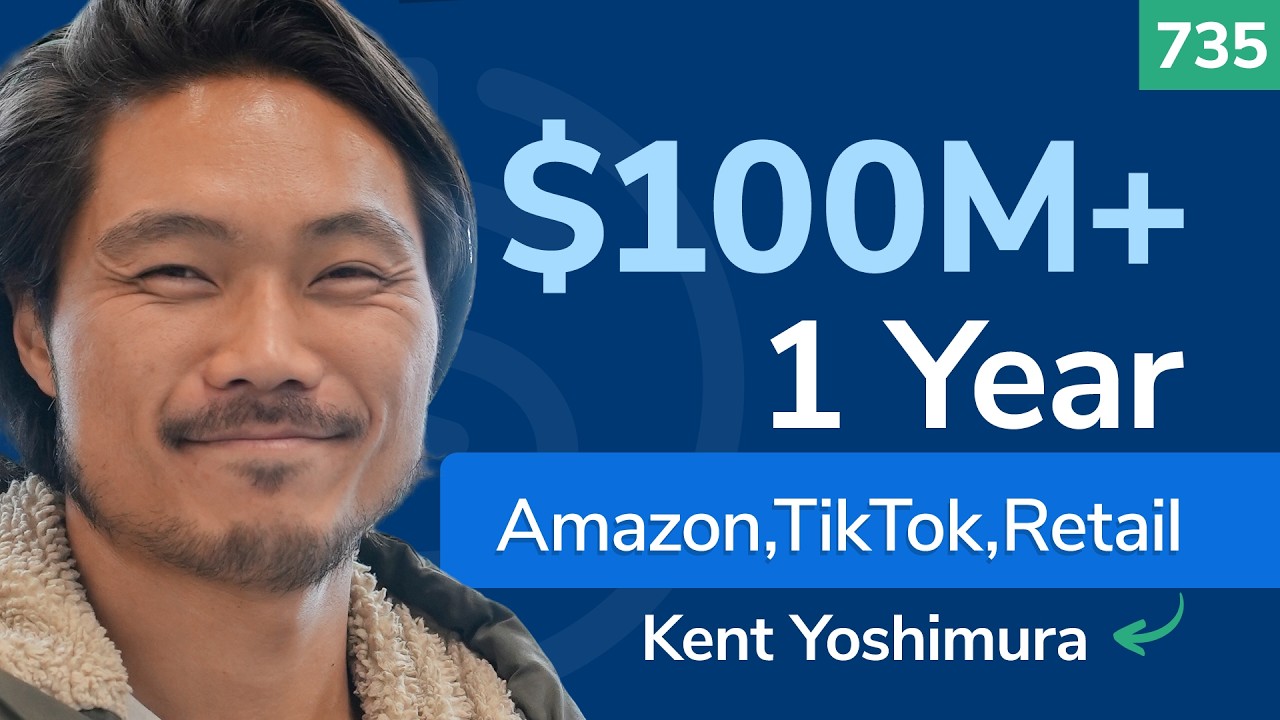
#735 - The 9 Figure NeuroGum Story
Summary
Serious Sellers shares actionable Amazon selling tactics and market insights.
Full Content
#735 - The 9 Figure NeuroGum Story
Speaker 2:
You've seen this brand maybe on Shark Tank or maybe you've heard Joe Rogan talk about them all the time on his show. They even outsell 5-hour energy drink in CVS stores nationwide. Who am I talking about? NeuroGum. Today,
we talked to the founder of this iconic brand about how he went from mixing powders in his college dorm room to now a 9-figure company. How cool is that? Pretty cool, I think.
Hello, everybody, and welcome to another episode of the Serious Sellers Podcast by Helium 10. I am your host, Bradley Sutton, and this is a show that's a completely BS-free,
organic conversation about serious strategies for serious sellers of any level in the e-commerce world. So we're here in Miami. I'm very honored. Special guest I've been a fan of for years. And so this is my first time meeting him.
Kent, welcome to the show. So awesome. Like, I remember finding out when you guys use Helium 10. I don't even know how I figured it out, really. I think I was just looking through our database or or maybe somebody in your team,
maybe Jonathan, like I had posted something somewhere about Helium 10. I was like, oh, my God, NeuroGum, which I can't live without, uses Helium 10. That is so cool.
And I think I told you recently a story of how I remember Mina back in the day in eCommerce house parties and stuff that we used to have and networking events.
He would always put out these mints and gums on the tables there and be hyping it up. And just now I'm realizing that was NeuroGum that he was putting way back then.
Speaker 1:
That's a good friend. I love it.
Speaker 2:
I'm a fan. A lot of you guys are fans out there of the brand and of Kent too, but maybe some of you, you're hearing about it for the first time. So let's go all the way back to the beginning. Where were you born and raised?
Speaker 1:
I was born and raised in Nagoya, Japan, but was raised in Los Angeles, California.
Speaker 2:
Okay. So moved out here when you were young?
Speaker 1:
Moved out here when I was three months old. Wow. I was literally in Japan only because my dad was on a business trip. And my mom didn't want to be by herself in America, so I was like, all right.
And then my dad actually left on a business trip the day I was born, so he wasn't even there.
Speaker 2:
Oh my goodness.
Speaker 1:
No, it was good, you know, like I think the healthcare system is maybe a little bit more comfortable there.
Speaker 2:
Yeah, okay.
Speaker 1:
I was born in a nice hospital out there.
Speaker 2:
Nice. Growing up in California, did you ever have an idea about what you wanted to be when you grew up?
Speaker 1:
Man, so I saw myself as wanting to be an artist, even when I was younger. And that was a big part of my life, you know, prior to NeuroGum. But then I got into martial arts. I thought I wanted to be a professional fighter.
So that's like a whole nother just I'm so glad I didn't go down that path. Your parents are right about some things when they're younger. One of the things they definitely didn't want me to do was getting punched in the head for a living.
Speaker 2:
That was before people knew about the whole CT, whatever the football players get.
Speaker 1:
It was romanticized, right? You're talking about the Bruce Lee's of the world, especially when I was growing up. I think I romanticized martial arts so much that I was trying to look for a career in it,
and in some ways, subconsciously, it did shape me into developing NeuroGum and coming here.
Speaker 2:
Yeah, we're definitely going to find out about that. Now, before you started that, I think it was during your college years. Where did you end up going to college?
Speaker 1:
UC San Diego.
Speaker 2:
San Diego in the house. He was questioning why I'm a Dodgers fan when I'm from San Diego, but hey, sometimes it happens that way.
Speaker 1:
I had a little identity crisis.
Speaker 2:
It's all right. Now, what was your major there?
Speaker 1:
Neuroscience.
Speaker 2:
Neuroscience. Okay. When you start a major, usually you have something in mind, like about a career path. You study engineering. Hey, I want to be a civil engineer. Where did you think you were going to take that?
Speaker 1:
Well, so it was cognitive science with the emphasis on neuroscience. So it was very specific. You know, to me, I was really fascinated. And some of the early classes I took at UC San Diego were around abnormal psychology.
It was around neural networks, which are obviously very popular now because of AI. But during that time, it was more of an assessment on how conditionally your brain works to make decisions and how you can use systems to make decisions.
It was the thing that I got fascinated in immediately when I was taking my general ed courses at UC San Diego. I felt like I could have done a career in the sciences of some sort, but going less so into like the surgical, like a neuros,
less the doctor side and more so the abnormal psychology. How can I look at the impact of the brain across the entire body, the physiology and How we are, in fact, controlled by, you know, this thing that is stuck in our skulls.
And diving more into that. That stuff's just fascinating. And it still fascinates me.
Speaker 2:
Yeah, yeah. I mean, the word biohacking and stuff like that didn't even exist, I don't think much, you know, 20, you know, 10, 20 or 20 years ago, maybe. And it's now it's like, it's amazing to see what people are doing.
Now, it was during these years at UCSD is where you first came up with the idea for NeuroGum, right?
Speaker 1:
It was, yeah. My, uh, Sophomore year, around that time when I was getting deeper into clinical research, understanding the world of nootropics and biohacking, becoming one of the early, I guess,
adopters of that biohacking phenomenon that now is really big. But you're talking about like 15 years ago at this point now. The notion of supplementation to have cognitive benefits were only limited to purely energy.
So how do you take, you know, just a solely caffeine or how do you take the combination of like a taurine or things in No Explode. We're talking about like three workouts to just jack you up.
But obviously, there's many detrimental effects that come out of taking things like that. So, you know, leveraging what I was learning in school, albeit it was only a few short years,
I wanted to figure out What combination of supplements could have worked for me? And then I discovered nootropics.
Speaker 2:
And it wasn't in, and we're not talking about you're already making mints and gums in your dorm room there. What form was your, I picture this like, like a secret lab in his dorm with a medic, you know, scientist experiments.
Speaker 1:
We call it like the Scarface. The fact that there wasn't enough deep clinical research behind any of those ingredients, though, that were like, Justifiable for long-term use led me down the path of,
okay, what's a much more convenient and approachable supplement stack that could be used?
Speaker 2:
What was the motivation? Was it just for fun, like this is a hobby to experiment with biohacking, or was there other motivations there?
Speaker 1:
Yeah, I mean, my days were spent training every single day. I was still pushing to become a professional fighter. I was fighting in Thailand since I was in high school.
In Pattaya Stadium, I was training at Seiyo Tong, training four, five, six hours a day at times. I was traveling to Japan, training with the Judo Olympic team out there, with the Imperial Guards out there as well.
Judo was a really big part of my life during that time. I'm Asian. I still want to do well in school. When I was looking for supplements that would balance this life I wanted to live with physical training,
while maintaining some higher level of mental capacity, there was nothing in the marketplace that allowed me to do that, which led me down the path of, again, nootropics.
Speaker 2:
At what point, if you can remember, was there ever a click in your head? Obviously, you were doing it for yourself originally, just for your own goals, but were you like,
This could potentially be a career or this could be something that actually makes money or that I can commercialize.
Speaker 1:
It's funny because I didn't realize that until my co-founder got in a really bad snowboarding accident that left him paralyzed from the waist down. He was an athlete also. He was a captain of his cross-country and track team.
Incredibly fast runner, obviously, because of that. Took his team to nationals. But his sophomore year, he got in a snowboarding accident that left him paralyzed from the waist down.
And the supplements that I was mixing happened to help him a lot in getting back into the rhythm of life, finishing school on time. And there was a moment in all of that,
and then I started getting the supplements and using my friends as guinea pigs. But there was a moment in time where I realized like, wow, if this is so effective for me, And it's so effective for the people close to me,
it must be useful for people beyond this small circle that has tried this stuff. And with anything entrepreneurship-oriented, I think that's a catalyst to be like, okay,
I need to spread the gospel of what I created because I think it will help more people.
Speaker 2:
And then so what was your first journey into eCommerce? Was it on Amazon? Did you start a website or just start like local network Craigslist or what did you do?
Speaker 1:
I learned how to use Wix.com, which was actually pretty easy at the time also. But well, I learned HTML first. And I tried to code a website with HTML and CSS. And made the worst website of all time. So that was one.
And then I went into Wix.com and I eventually landed on WordPress and then now we use Shopify, which is the best. It beats all. I think it literally took all those other companies out, but our first foray into selling anywhere,
I guess, was on Indiegogo, which was a Kickstarter. It was a crowdfunding site.
Speaker 2:
What year about are we talking about now?
Speaker 1:
This is 2015. We started our business officially in 2013, but we weren't really doing anything. That was when we were just doing R&D and setting stuff up. Yeah, 2015, launched on Indiegogo.
At that time, I was already one of the biggest contributors on Reddit, rnootropics,
and I posted about the fact that we invented this gum that has these ingredients that help you stay energized and focused with your favorite nootropic sac of natural caffeine and L-theanine, and it just blew up.
And in like, literally in three days, we like doubled our goal. And Time Magazine wrote about us. Dr. Oz called me while I was at like a dinner. And or his producer called me and was like, we want you on the show.
And It just it was basically just it conditioned us to be like, okay, this is this is something real, you know, it was a that that was like a true catalyst to understand that if If people are willing to buy this thing,
then there's a capacity to scale it.
Speaker 2:
Now, before you got on Shark Tank, which was another step in your journey there, what had you accomplished? Were you already on Amazon? Was it only the website? What kind of sales were you doing at that point?
Speaker 1:
Yeah. The first few years, everything was operating out of my apartment. The first shipment of three pallets of gum was just sitting in my living room. Our one employee was my roommate, who's now our COO.
He used to work at Hulu, so he would bring snacks from Hulu to feed us. It was really bootstrapped. That was the first, I guess, two, three years of the business. We were selling on our website.
Very quickly we went to sell on Amazon knowing that that was a massive, the biggest selling platform right online that allowed us to reach a bigger audience in a much more accessible way.
And then our next foray into after that was going to be, okay, how do we get on retail and other platforms?
Speaker 2:
Nice, nice. What year was Shark Tank? Shark Tank was 2020. So we filmed in 2019 and aired in 2020. And was the goal like trying to potentially, you know, just get more funding because it was hard to, you know, capital and things like that?
Speaker 1:
Yeah, I mean, we were definitely trying to get a deal. You know, understanding that with that Indiegogo moment at the very beginning was a catalyst into one stage of the business.
And then, you know, we have little things like we have these PR wins. We went on like a show with T-Pain. We have podcast mentions. That was like another stepping stone.
And then Shark Tank was obviously another big boost, but in creating a brand new category, because this idea of energy gum and functional gum and mints, it doesn't exist. It exists now, and we're obviously the leader in it,
but to educate people on this entirely new category took so much PR,
took so much Attention that needed to be put into that category itself that we realized Shark Tank could be another good milestone slash stepping stone to educate consumers.
Speaker 2:
At what point did you guys discover Helium 10? And do you remember, was it you? Was it somebody else?
Speaker 1:
Oh yeah, it was definitely me. If you grew up in the 2015 to the 2020s of e-commerce, you used Jungle Scout and you used Helium 10. And if you didn't, you're falling behind.
Because Amazon didn't share, I mean, there's like black hat ways to do things, obviously, but like Amazon's not sharing anything with you.
Speaker 2:
People now, hey, you Amazon sellers nowadays, you don't know how spoiled you are with some of this stuff that Amazon gives. Back in those days, they were tight-lipped completely.
Speaker 1:
They were tight-lipped. Back in those days, like the only way you could get access to information was through platforms like Helium 10. So I think we've been like a diamond customer for like eight years or something now.
Speaker 2:
I love it. Now, right before this offline, you were telling me about a funny story. You discovered some keywords with Helium 10,
but you actually applied this to something not even to do with Amazon that ended up being a huge revenue booster. Can you talk about that in a PG or PG-13 way?
Speaker 1:
We would expect people to find us through Caffeine and Gov and whatever. Even on the more fringe side, I guess you could We'll look at nootropics, which maybe not that many people know what the word means,
but sexual enhancement happened to be a very popular keyword for us that we wouldn't have known about without Helium 10. What did that mean for you?
It allowed us to dictate how some of our consumers were potentially using our product or what ecosystem that ...would have been using our product, we could target and be a little bit more nuanced in the way we market to certain people.
Speaker 2:
Yeah. If Helium 10 were to go away, what would your team miss the most? Like, what's the part they'll be like, what are we going to do now? Like, which aspect would you think?
Speaker 1:
Gosh, I mean, I'd be annoyed because I won't be able to do the reverse ASIN research and all that stuff, all the black box things, you know? Like, I mean, even with Cerebro, if we're doing Even brute, I was telling you this,
like even brute labor wouldn't accomplish what a platform like Helium 10 can do.
Speaker 2:
What's the biggest year of sales for you? Every year, was 2025 your biggest? And approximately how much are we talking about across everything? Really rough.
Speaker 1:
Yeah, pretty big. More or less nine figures.
Speaker 2:
Very nice, very nice. Now, what aspect of that is like? Is Amazon your biggest online channel? Are we talking 50-50 brick and mortar versus online?
Speaker 1:
Yeah, Amazon is probably about 35% to 40% of our business. So, it's the majority of our business in that sense, right? Retail this year is going to be an ever-expanding force. Again, I keep using the word dictated by,
but our decisions that we make in retail We are truly dictated by what our learnings are on our website and Amazon. And then obviously we have our website, which is more of a brand platform than anything now,
but it is the communication point. It is the data points, all those things that Amazon necessarily can't share, but we are able to apply to our marketing.
Speaker 2:
Amazon being your biggest online channel, what's your second biggest online channel?
Speaker 1:
Our website, then TikTok, then retail. But I mean, this year it's going to be probably Amazon, retail, TikTok, our website.
Speaker 2:
You're a very successful brand. It hasn't always been wonderful, I bet. What was one of the biggest disasters that you've had to deal with or catastrophes or like something unplanned for you? Like, oh my goodness, what are we going to do?
And then how did you overcome whatever happened?
Speaker 1:
I have so many of those, by the way.
Speaker 2:
Everybody does. Everybody does.
Speaker 1:
So, one, we got our first order in from CVS, our first chance at retail. You know, a big PO. Teams high-fiving each other. A historic polar vortex swings through the Midwest. All trucks are stopped.
Our inventory is literally frozen at the distribution center as CVS is calling us, yelling at us, asking where their product is.
Unknown Speaker:
They're like, we gave you a chance. Where's our product now?
Speaker 1:
We found one truck, literally, that was willing to drive through the snowstorm somehow, and that guy delivered to CVS just in the nick of time, and then now we're one of CVS's best-selling products.
Speaker 2:
Love it. Love it.
Speaker 1:
So that's one. And then there's the one that pops up on TikTok from time to time, and there's a really nice redemption story that's going to Air in February. But after Shark Tank aired, we got sued by a very,
very wealthy person that owned another company with the same name as us, although they operate in totally different categories. And so it was a frivolous lawsuit through and through. But this person was worth $300 million from a divorce.
And she was like, I'm going to spend all my money to take you guys down. She just absolutely hated us.
Speaker 2:
What's her name, Karen? Oh, sorry.
Speaker 1:
Ryan, so when we went on Shark Tank, Daniel Lubetzky, the founder of Kind Bar, was like, I love you guys. If you need anything, like I'm not going to invest now because I don't take supplements,
but you guys can hit me up at any point and I can help you. So literally a month later, Ryan slid into his DMs and he was like, Daniel, I know you said we could reach out to you if you need anything. We would love your help right now.
Daniel came in. Literally went to this lady and was like, look, I'm worth 10 times more than what you're worth. And if you're going to fight these guys, you're effectively going to be fighting me because I'm going to back their lawsuit.
And she backed away and the business is still running.
Speaker 2:
Your network is your net worth.
Speaker 1:
That's right.
Speaker 2:
Absolutely. All right. Flip side. The most amazing things that happened to you, I would assume the Joe Rogan, you know, so talk a little bit about that since we didn't get into that.
And was there another something that was just like a surprise that just amazing that worked out great for you guys?
Speaker 1:
Gosh, I mean, Of all the bad things, the thing is I'm a fairly optimistic, positive person. Even that time I was in the hospital taking experimental drugs, I don't even look at that as hard times or bad times.
I just see it as a chapter in our company's history. Yeah, I mean, Joe Rogan talking.
Speaker 2:
How do you... Completely organically.
Speaker 1:
Completely organically. I mean, that's like a dream for any company to wish for, you know, and he's done it like 40 plus times now. He absolutely just like loves our product, like actually organically.
Speaker 2:
Did you ever find out how he discovered it, just from a store or online?
Speaker 1:
So one of our friends, John Beer, one of the coolest guys in the world. I sent him a bunch of product and then a year passed and we didn't think he ever received it or anything.
But lo and behold, one day right after Shark Tank, Joe Rogan starts talking about us. My phone starts blowing up.
Speaker 2:
So it's not just random guys. Even those kind of random things might happen, there is still a reason why that happened. If they had never done that, that situation might not have happened.
Speaker 1:
Yeah, exactly. We're still effectively seeding and constantly making sure your product shows up in front of people. So that was an incredible moment.
Even early on when my Reddit, our nootropics postings leading into Indiegogo getting funded as quickly as it did, then Dr. Oz's team reaching out to me, and then us winning LA Tech Fair to continue our funding,
and then T-Pain's team reaching out to us. So we did a TV show with T-Pain. And I'm like, even more recently, you know, Steve Aoki FaceTime Dave Grumman, who's they say the king of Miami, he owns Live Night Club, and Komodo and Poppy Steak.
He's best friends with Kim Kardashian. He seeded it out to all of his friends. Kim Kardashian posted about us Ivanka Trump posted about us like, wow, it's crazy that when you do take those opportunities to one,
you know, I'm not obviously I'm going to say we have a great product, but if you have a great product, you know, and you put it in front of people, like They'll talk about it. Love it. And that network is your network.
It continues to expand.
Speaker 2:
Love it. On TikTok, what's your team strategy? Like, are you trying to make a profit on that channel as well? Or are you mainly using TikTok to, hey, let's break even. But knowing that is really giving a boost to our website.
It's giving a boost to our Amazon. It's getting our name out there. How do you guys tackle that?
Speaker 1:
So a lot of people talk about this halo effect from TikTok. And yeah, there's an undeniable halo effect when you start putting your name everywhere. But To us, at the size of the company we're at,
the impact of the halo is actually not as significant as a lot of people think it is. We try to run TikTok profitably. I think all good businesses, similar to what Warren Buffett says, have to run profitably to be a good business.
And, um, sustainably. And for us, the big goal for TikTok is even as a discount platform,
are there capabilities of leveraging the social commerce aspect of TikTok to provide profitable brand building systems that amplify everything else in the business? Um, and that to, to break down that convoluted string of words,
How do we focus more on brand on that platform than bottom of funnel tactics? Because the bottom of funnel tactics are not driving the halo as much anymore.
Speaker 2:
What percentage of your sales on TikTok Shop is generated by creators as opposed to your own content? Just roughly, would you say it's a big chunk? Is it 50-50? Is it like your stuff goes viral?
Speaker 1:
I mean, that's so hard to say. It's so hard to say. I mean, obviously, the creators in the affiliate ecosystem, we'd be nothing without them, which is why we treat them so well. We incentivize them well.
But at the same time, when you're talking about The creator is incentivized to make a sale to make money, but they are not necessarily incentivized to push the brand principles and your brand values out. So you have to mix your own content,
which is the owner of your brand values, and couple it with the effective bottom-up funnel techniques that our affiliates use, because that together is what amplifies into other channels.
Speaker 2:
What makes a good creator for you? Like, how do you search? You know, like, of course, you know, a lot of people are hitting you up and say, hey, I love free samples.
And you guys probably search, you know, maybe using Helium 10 or other features to try and find out what are you looking for? Like, what makes somebody a good potential?
Because whatever you say is like similar to, you know, every brand, of course, is different, but I'm sure there's some general principles you can talk about.
Speaker 1:
Every category has These like celebrity creators, more or less. And these creators typically tend to follow the tactics that the biggest players within your space already do.
So if there's a creator that's, you know, making content that's, you know, if we're selling this, this snake plan, and everything is around detoxifying the room, because it sucks up pollution better.
All the creators will typically tend to follow what that creator pushes. And if you could identify who those major influencers, quote unquote, are even in the affiliate space,
you have a leg up on everyone else to be able to acquire more creators. The way we use our Discord, the way we use our communication platforms,
and how we talk to our creators is all around What are the talking points that are effectively working to drive either conversions or impressions,
and how are you slightly modifying it across your entire creator network to find that next hook, that next talking point that could help expand beyond that? What a lot of people do is they feed talking points to their creators,
and everyone's talking about the exact same thing, and after a certain point, that just completely decays. You should be constantly spanning the edges of what your affiliates are communicating and finding what's working,
what's not, so you could keep discovering the next new thing.
Speaker 2:
Now, at what point did you guys start going after celebrities as far as endorsements? You know, Steve Aoki and others. Again, with the thought in mind that, hey,
there's brands out there who might be in your position that you were maybe three, four years ago, but they're looking ahead. When should a brand start looking at going to that next level of almost like an influencer creator?
When does it make sense?
Speaker 1:
That's a hard question to answer only because If you don't do it in a genuine way, it's going to come across as you just slapping a celebrity onto your brand, which a lot of people are attaching onto.
I think consumers are a lot more intelligent now. For us, Steve Aoki made sense because when we first started the business, he literally was taking NeuroGum in a plastic bag.
Speaker 2:
He all did some shady stuff back in the day. Powders in the room from Russia and plastic bags.
Speaker 1:
But you know, he believed in us enough to take this sketchy, you know, this sketchy tablet for a bag. And then a few years later, he reached out and was like, I need more of that NeuroGum. Where is it? And then he ended up investing in us.
So he had a genuine interest. He was an actual user of the product. He exemplified our brand values perfectly. And him being a part of our brand allowed us to get other celebrity partners like we're in Miami,
like Dave Grumman, you know, to hop on board, Andrew Schultz, Mitchell Hooper, and so on and so forth. But I think, again,
if you don't come back to your brand values and understand what celebrity really exemplifies what your brand is supposed to represent, then you're just slapping someone onto a bag with the hopes of winning eyeballs or impressions.
Speaker 2:
That makes sense. Now, you've been in marketing before, so I'm going to make you, for the next two minutes, you're a Helium 10 marketer. If you were to talk to a brand out there who's maybe a seven-figure brand,
they're pretty successful already, Shopify, Amazon, and they're like, hey, I'm doing pretty good now. I've never used Helium 10. Do I need Helium 10? Why would I need to use Helium 10 to get even better when I'm already crushing it?
Speaker 1:
So, I think there's two categories of people that hit the seven-figure mark and can never break into the eight-figure mark. It's actually a lot of entrepreneurs.
I could talk about the nuances of the keyword research and what product categories and everything you could go into. I think the value of Helium 10, yes, there's this expansive capacity,
but there's also this brand defensibility capacity that it has that a lot of people don't necessarily ... I don't think they take advantage enough of it. If you're winning a keyword or a category or whatever it is,
how are you truly owning it and then finding expansion points So that your brand strengthens rather than you becoming someone that's just launching a bunch of new products and becoming another Amazon seller.
And if you use Helium 10 in the right way, like what categories are running, what keywords are really, are the consumers attracted to and what keywords that the consumers are attracted to is your base consumer, right?
Like you get deeper and deeper. That allows you to not just strengthen the LTV of your base, but also incrementally find this new audience that will be as strong as your base audience.
Because with new customers, especially in eCommerce, you could acquire them with a high CAC, but they'll come and go. But a true consumer, like our LTV is in the hundreds, a true consumer that stays on,
those are the people that are truly building exponential value in your business.
Speaker 2:
You have a few hours a week, guys. I think we need to put them on payroll a little bit here. I'm sure we have some room. We'd love to have you on the team. You have reached a stage of your business that many entrepreneurs can only dream of.
What keeps you motivated even though you've achieved so much? How do you wake up and say, hey, I need to go harder instead of just, you know what, it's time for me to just kick back in the Maldives and just rake in profits here?
Speaker 1:
Business is endless. Building a brand is endless. Similar to what I just said, that core consumer group that we could constantly expand, it's all about the brand building. Where are we targeting them? What fun things can we even do?
That's where I think entrepreneurship is truly one of the best things anyone could get into. I think I was saying earlier, but growing up, I did art. I painted murals. Art was a really big part of my career at one point.
The ultimate creation that you could possibly do that's never finished is building a business because there's always something more that you can build on.
Speaker 2:
I like it. Now, you're obviously very fit and healthy and that's something I talk about too. I had a heart attack a few years ago at an early age and I wasn't taking care of myself.
I was dead for 15 minutes and it was obviously an ordeal and I feel like a lot of entrepreneurs out there sometimes They get into, you know, just so into their business because, you know, like you,
you can see the passion that he has for his business. You guys have that, too. But sometimes we neglect our mental and physical health. You know, so you mentioned a couple of things, hobbies, you know, be it art.
But how do you attack that aspect of things where you can, like, make time for mind and body? And what are the things that you do to make sure you do that?
Speaker 1:
The superficial answer is Neuro as a product is a representation of mind and body. So unless I'm looking the part as the CEO of someone that represents that, I'm doing a bad job and I'm probably not the best representation of the brand.
So that's very, again, like when I say superficial more as like how people perceive us, I have to represent that, right? I also do think, so I was working all the time. I was never sleeping.
If you talk to people who knew me in my early days at Neuro, they would say I was like a ball of stress. It was very unhealthy. The second I started finding that balance and understanding that we Busyness does not equal work sometimes.
It's very easy to stay busy, but what's difficult is finding true impact in that work that you do in any set of time. And when I started taking care of my body,
when I started finding balance between the limited hours I have to work and the limited hours I have to maintain my physical prowess, That's when everything started doing better. And hopefully people realize that before it's too late.
Speaker 2:
Yep. Good thing I did too.
Unknown Speaker:
It was too late for me.
Speaker 2:
All right. What's the future hold for you and your brand?
Speaker 1:
Neuro is, man, there's so many things. But in my heart of hearts, we're already outselling five-hour energy at CVS, right, in unit velocity and revenue. Wow. And on Amazon also.
But Why can't we overtake how people think about consuming supplements and energy as a whole? These are massive, total addressable markets, but if we could transform the way in a much more accessible, simple, functional,
and effective way that people can really look at their health and have it in their pocket and improve their energy levels or their sleep or their stress levels, I think Neuro has a long way to go to be able to be a mainstay,
a true mainstay in people's lives.
Speaker 2:
I love it. I love it. It's kind of like day one still, even though he already hit that nine-figure mark, but just shows the potential here. So guys, I hope you enjoyed this episode and are inspired.
And don't forget, just go to your CVS, Amazon, NeuroGum is everywhere. I need another one. Hey, Kevin, in the background here, can I grab one really quick? We'll do a little Joe Rogan moment here. There you go. Thank you very much.
Well, you heard about those sites. No, we're not going to put that in the episode. But guys, NeuroGum, make sure to get it. I do not like coffee myself.
And before this was around, I don't know what I was doing because I work crazy hours sometimes too. So this is great. So make sure to get some NeuroGum. Support Kent and his amazing team. Thank you so much.
Speaker 1:
Thanks, man.
This transcript page is part of the Billion Dollar Sellers Content Hub. Explore more content →