Ecom Podcast
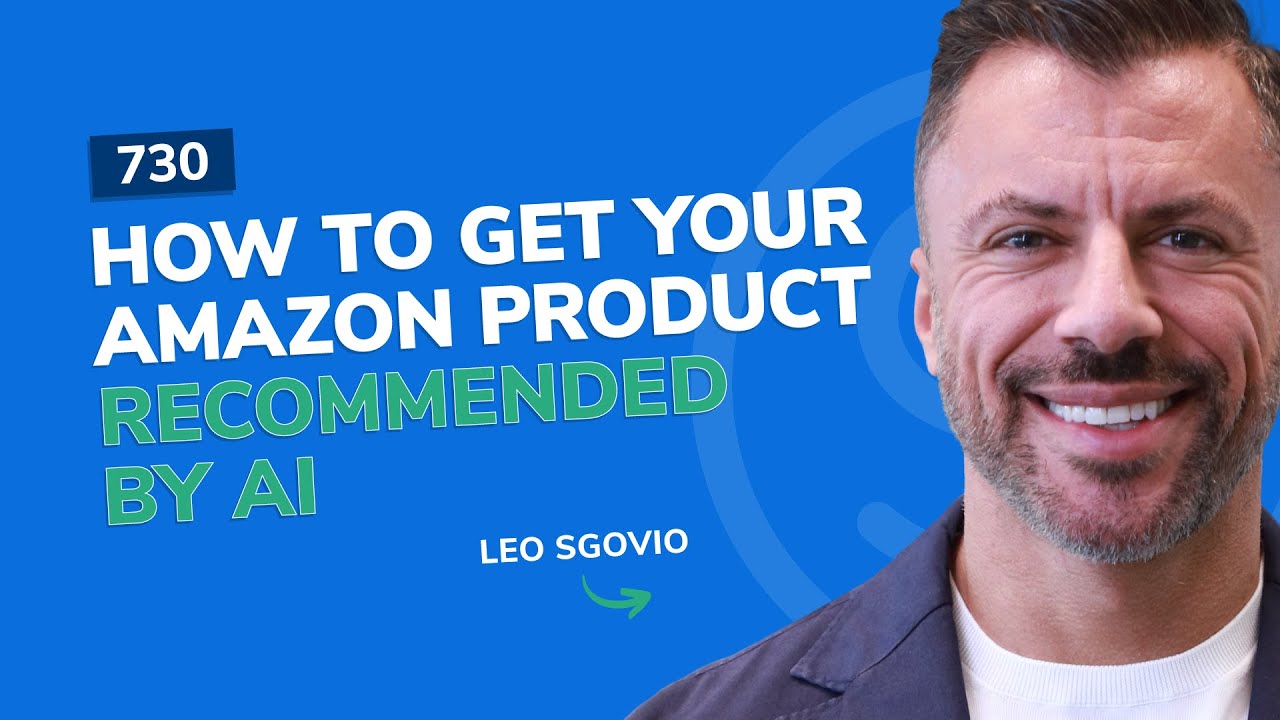
#730 - How to Get Your Amazon Product Recommended By AI
Summary
"Leo shares how leveraging AI to recommend Amazon products led to a successful launch in a competitive niche, despite previous setbacks like his $7 million brand going to zero, illustrating the power of strategic pivoting and AI-driven marketing."
Full Content
#730 - How to Get Your Amazon Product Recommended By AI
Speaker 2:
Today we talk to Leo who sold tens of millions of dollars online. We're going to talk about some of his losses, like how his once $7 million a year brand went to zero,
but also his victories, including how he had a super successful launch in a very competitive niche last year in 2025. How cool is that? Pretty cool, I think.
Hello everybody and welcome to another episode of the Serious Sellers Podcast by Helium 10. I am your host, Bradley Sutton, and this is the show that's a completely BS-free,
organic conversation about serious strategies for serious sellers of any level in the e-commerce world. And we've got somebody today that you might know as an expert, maybe a service provider, a software creator, a guru, if you will.
Some people don't like that word. But we're going to learn about our guest today, Leo, from a different aspect, and that's as a brand owner, because that's what we do here on the Serious Sellers Podcast now is we talk to brands.
And the reason why Leo is so successful doing those other things is because he has been a seller for years himself. So Leo, excited to kind of like Talk to you at a little bit of different angle today.
Speaker 1:
Thanks for having me today, Bradley. I appreciate it as always and thanks everyone for tuning in. So happy to be here.
Speaker 2:
Awesome, awesome. Where were you born and raised?
Speaker 1:
I was born in Italy actually and grew up there until when I was 23 years old.
Speaker 2:
Did you go to university in Italy?
Speaker 1:
I did, yes. I did go to university there.
Speaker 2:
What did you study?
Speaker 1:
Mechanical engineering.
Speaker 2:
No wonder why you have a technical mind.
Speaker 1:
Exactly. I've always been passionate about this. I think I said this story before but when I was a kid, my parents gave me this radio as a gift and I just took it apart. My mom was so upset.
I just wanted to understand what was inside the radio. I put it back together. It still works but yeah, that's my kind of like inner… Curiosity, you know, about all this tech stuff.
Speaker 2:
Did you ever work in that field or is that the time when you graduated that you actually already moved out of the country?
Speaker 1:
I did mechanical engineering because back in Italy, I think this still works today the same way, but teachers, they try to identify what you're good at when you're mid-school, so between 13 and 12 or 15.
And so they ask you, hey, what do you like to do? And at the time, I was really good with AutoCAD. Do you know AutoCAD? Like building stuff. And so they're like, Oh, I think you you'd be really good in the mechanical fields.
And that would be a very good full time position for you. So they just project into this full time nine to five job. And so I went to this, to the school. To learn that, but I think what I learned the most was not actually after,
it was during the breaks, the summer breaks. I went to work with some family members, you know, like fixing car parts or like doing gardening. And my uncle was an electrician. So I did that. And I still do that today.
Sometimes my like, that's my hobby. I like electrical and just fix stuff. So yeah, that's how I learned.
Speaker 2:
Now, when What was the first thing that you sold online, like about what year, what platform was it?
Speaker 1:
Oh, I think it was 2003 or 2002, probably. It was shoes from China. At the time, there was this chat. Do you remember AOL days? I think they had a chat which allowed me to connect with some Chinese suppliers at the time.
And I found a supplier that was selling shoes. And so I used to import the shoes from China to Italy and sell it just in my town. But I made good money at the time. I even bought my first car with the money I was making selling shoes.
Everybody was buying shoes from me.
Speaker 2:
Sourcing from China before Alibaba was even a thought yet.
Speaker 1:
Yeah, yeah, yeah, yeah. That's what I was doing. And I can still remember what I used to, like what was the The website, I don't think there was a website at the time. It was just live chat and then I was sending money via PayPal at the time.
But eBay was my first online sale. After I was doing well locally, I started selling on eBay as well. And yeah, that was how I got passionate about this industry.
Speaker 2:
So now 20 years of selling, over 20 years of selling online. What was your first serious private label Amazon brand, would you say? 2010 sometime in there?
Speaker 1:
It was end of 2015. Okay. Yes.
Speaker 2:
What was that first product that you sold?
Speaker 1:
It was skincare.
Speaker 2:
Skincare, okay.
Speaker 1:
Yeah. I started the skincare line in Canada. That was a really tough way, I would say, to start. It was kind of easy at the time because in Canada it wasn't competitive. But I'm a perfectionist. I always like to build things that look good,
whether it's a software or anything that I really put my hands on. I want it to look great. My mistake at the time was to launch this brand that was unconventional. I was trying to source bottles from China that were different, like square,
more like perfume bottles instead of just sourcing any glass bottle and put a label on it like most of my competitors at the time did and my successful friends as well.
And so that kind of backfired on me a little because I was trying to just become this luxury skincare brand. At the time, Amazon was so easy. I didn't need to do that. So yeah, that was my first thing.
But there is one thing that I don't think you know. Before what really got me passionate more in the early days, I used to have this Santa site.
I bought a domain that was right to center and I used to make quite a bit of money and employ my family during Christmas. This was in Italy. I used to live already in Canada at the time.
So I opened this website in Italy and what I was doing, I had this script. It was on PHP at the time. So kids used to come to the website. It's all organic traffic because I was always doing SEO at the time.
So I was able to rank this on the first page of Google for write to Santa, write a letter to Santa, all these kind of keywords. And so, kids were coming to the website and there was a simple form,
you know, what would you like to get from Santa this year? What's your name? Where are you from? And then the script would automatically generate a response from Santa. It's like, hey, John, you are on the good kids list, right? And so,
the way I made money the first year was just by I'm putting a bunch of Google AdSense ads on the page. So, because of Norad Santa Tracker, which basically was there in some of the keywords,
Google used to place ads related to GPS trackers, which were really high CPC ads. And so my check at the end of the month was like 3-4K from Google Ads.
The next year, I took it a step further so people now could order a physical letter from Santa. So I had my parents, basically my aunt owns this printing shop in Italy.
Speaker 2:
This is before AI and chatbots where you could have automatic responses. You actually had to have people writing.
Speaker 1:
Yeah, for sure. So I got, you know, these kids were choosing from different templates. It was like parents, obviously, choosing from different templates. My parents were printing the letters.
And my brother was actually putting the stamp with wax. So, real nice letters, burning with the flame all around to make it look like these authentic letters. Yeah, that was also good. I made a huge mistake one year.
I forgot to renew the domain and Chinese bought it and I lost that. I lost that. My parents loved it. They really loved during Christmas time doing this.
Speaker 2:
That's a true entrepreneurial mindset right there for sure. Now, what was your biggest year of sales, would you say, since you started that first product in 2015? 2019. During COVID? Was that during COVID or right before COVID?
Speaker 1:
It was just before COVID.
Speaker 2:
Okay. Just before COVID. And what did you hit? What figure?
Speaker 1:
At the time, I think we were doing $7 million or so. That was Canada.
Speaker 2:
$7 million in Canada?
Speaker 1:
Yeah, because we had a really good line.
Speaker 2:
That's crazy. That's like $60 million in US.
Speaker 1:
Well, you know, made in Canada. It worked really well because Canadians, they're very proud of promoting or buying from Canadian brands.
But then what happened to me was that during that year when COVID hit, the same lab that I was making my products with, they started manufacturing hand sanitizer.
And so one day I wake up and my listing was just getting a bunch of one-star reviews. And I'm like, what's going on here?
And so what happened was they probably made my formulation in the same funnels that they were using for hand sanitizer and some alcohol. When in my formula and so people were getting like irritation on their skin. So I bought it myself.
I thought it was just Chinese. I bought it myself and I had the same reaction on my face. And I got so demotivated that I basically stopped selling that brand in Canada.
After, you know, my so from my six, seven million to zero, because the Asian just, you know, started dying. Yeah, we went from 54.6, 4.7 to all the way to four. And so you get really, you know, it was kind of depressing at the time.
Yeah, that COVID in like, the whole thing was just they couldn't get the actual bottles from China. So a few things didn't go the right way. And that's when we got into games after.
Speaker 2:
Okay. And then so Was that your first entry into Amazon USA and you were just exclusive Canada before?
Speaker 1:
Yes. Yes, it was in Canada. I also worked with a couple of other friends as a partner in the supplement space. At the time,
we did very well also with supplements in US and one of the biggest actually day was during COVID for one of these supplement that was about immune support. We were one of the only ones being able to sell immune support capsules,
because we had partnered also with the manufacturer. And so we were probably one of the few always in stock. Everybody was selling out. So that was also a very good journey where I learned a lot about supplements.
But I would say after that, some of the biggest days are actually happening now with our games. So I'm very happy to have gotten into this niche.
Speaker 2:
You launched a couple, one or two products this year even, right?
Speaker 1:
We did, yes.
Speaker 2:
How did those go?
Speaker 1:
They did extremely well. Actually, we were surprised. My business partner messaged me the other day. It's like, oh, we're crashing it this year. And I think, yeah, like we were going heavy again next year with five more products.
But the reason that I think we were doing very well in this niche is that we kind of understood how to be profitable and how to kind of differentiate ourselves in this industry.
And so I'm happy because you can target also different type of personas in that niche, like you can sell it to parents, you can sell it to relatives, grandparents looking for buying gifts for their grandchildren.
So yeah, that's pretty much what I've been involved with selling on Amazon.
Speaker 2:
Interesting now yesterday you actually spoke as an expert at our one of our elite workshops and we're not going to go too much into detail about what you talked about that's for elite members but.
Can you talk a little bit about the very interesting part that you were presenting about how you can start ranking in AI results easily as Amazon sellers?
Because that's one of the things that you're doing for your own brand that you're selling is, hey, I'm not just relying on Amazon advertising or Amazon SEO, but I want to pick up traffic outside.
And so that's probably one of the reasons because somebody out there might be thinking, How in the world can you launch games or card games or something like that? Isn't that saturated?
Some of these saturated niches you can still get into when you combine these unique strategies. So just talk briefly about how you're able to bring some AI and other SEO traffic to your Amazon listing.
Speaker 1:
I think because of my SEO background, it becomes very easy to me to optimize my website when we do launch a product. The very first thing I do before we even come up with a brand name, I check if the domain is available.
If the domain is available, we go with that brand. I want to make sure that the website is set up and obviously optimized for search engines. Now today, the game has changed a little.
So you have to optimize for generative engines such as GEO-targeted tactics or Gemini. So yesterday, I showed also here that by uploading certain type of files to your domain,
you allow generative engines to crawl your website and understand what your product is about to award your products. And so that's the number one thing.
I even built a GPT where you can just give it an ASIN and this GPT will generate for you, I think it's five or six different files. The specification file, which is normally a PDF file.
If you sell supplements, it just prints a label with all the nutritional facts or the schema markup language. And there is an LLMS.txt, which is there's a lot of controversy today in our industry.
Today we're going to talk about the effectiveness of this file. But anyway, that's step number one, right? So you optimize your website so that this generative AI engines can actually understand and read.
Step number two, you now need to also have some sort of mentions outside. The best probably source today is Reddit. If you can get your brand featured on Wikipedia, which there are some paid services out there that allow you to do so,
you can do that. And that's extremely powerful. Press releases. We noticed that press releases are by far right now, probably the easiest and the most effective way to get you positioned or visible in the AI overview on Google.
And so because you guys see on Google right now, what happened is that once you see the overview, most likely people don't go and click anywhere else. What we found is that especially in the physical product niche,
being there is very effective because people normally will go and look for your brand or product on Amazon after. So, you know, when people ask me sometimes, Leo, I can't figure out how this competitor is getting sales.
That's what I like to explain like you have to look at everywhere else. And today I'm sharing some of the stuff with your team as well. But yeah, like we try to be present from day one across different engines.
And right now, You know, ranking on ChatGPT or Gemini, it's like 1995 on Google. You know, you have a few links, you have a few mentions, you're basically number one. And so, yeah, that's my strategy so far.
Now you can get obviously more advanced, but in a nutshell, that's what we do.
Speaker 2:
Alright, so shameless plug. If you guys want to get more details about that, you need to join the elite training. Leo is heading up a lot of our elite trainings now. So if you guys are Helium 10 members, go to h10.me forward slash elite.
You'll learn a lot more of his strategies. But again, we're not here to just talk about elite. We're talking about what you do as a brand. And there's always going to be new,
if you want to call it hacks or new evergreen strategies like optimizing for What was the acronym that you used yesterday? Is it AEO or GEO?
Speaker 1:
AEO. Some people call it GEO, Generative Engine Optimization. Some call it AEO, End-User Engine Optimization.
Speaker 2:
These acronyms, two years ago, did not exist. Like if you said GEO, people would say, oh, GEO targeting, or it might have meant something else. AEO, who knows what people might have thought you were talking about.
But there's always going to be completely new things that you need to start focusing on. But at the same time, A lot of the fundamentals of running a brand on Amazon are the same or are consistent.
Like you still got to be running your advertising on Amazon. You still have to optimize for Amazon SEO. You still have to do keyword research. You still have to find the product.
And so thinking about some of the bread and butter things or some of the stuff that you've been doing for like 10 years,
especially in Helium 10, like what kind of Helium 10 tools are you and your team still using to manage your Amazon brands?
Speaker 1:
Well, it was like, for example, black box, they always come in the especially when you know, the initial phase where we're trying to understand what's going on, where is the market that is our competition?
What are some product opportunities? That's how also we found For Serious Sales Stories, the product for Natalie, right? And so that's kind of like step number one. Then with Cerebro, I always look at, I always monitor all my competitors.
I try to understand, put alerts, set up alerts, like whenever a new keyword, you know, is coming up that my competitors are ranking for, that we are not, just flag it so that we can go and tackle the keyword, put it,
you know, add it to our PPC campaigns. Right now you guys have a lot of new tools for TikTok, which we also sell on. We're still like kind of early on, but I'm going to explore more of those. But I would say these are the main tools.
I'm not too much involved in my business when it comes to PPC. I just come up with like an overall strategy. So, but my team does use also the PPC tools, but myself, I like more to,
I spend a lot of time, you know, like with this SEO background, I try to spend a lot of time on the actual research. And right now you guys have implemented also the query performance data, and which is by the way,
also one of my favorite because it's very powerful and it allows me to really dive deep into what's going on at the market level. So these are the tools that I personally spend most of my time with.
Speaker 2:
You mentioned TikTok. What other platforms other than Amazon USA are you on? I assume you're on TikTok shop. Are you on a Walmart? Do you have a Shopify? What do you want?
Speaker 1:
So, Bradley, right now, and this is kind of an advice that I typically give also, we try to not spread ourselves too thin, right? Because I think there is still a huge potential to maximize the Amazon sales.
And, you know, going to like multi-channel, it sounds great, sounds fun. TikTok is different because TikTok is a demand kind of like generation platform.
So I think being there is very important for like this during the discovery phase of your product, but everywhere else, you know,
we try to Just go in if we believe or I believe that we have maximized or exhausted a specific market challenge. In this case, it's Amazon, which when we talked yesterday, we spoke to Josh Hadley.
Everyone in our industry thinks Amazon is still probably the most profitable marketplace out there. So right now, I don't think we are, especially with this new brand, ready to go across different marketplaces.
One thing that we are doing is going into Target this year, like this 2026. And I think it's also because I saw- The online marketplace? No, in retail.
Speaker 2:
How did you, did you find a buyer or how did you get a broker?
Speaker 1:
Yes, I did find a buyer. They liked our product. They liked the branding. And so we're hoping now to get in with, you know, even the most recent game.
But I think being there in Target in retail locations is going to give us a lot more credibility from a brand perspective. And that's how I saw one of our competitors selling 70,000 units during Q4 versus us that sold about 15,000 units.
So if we want to get to that level, I mean, they have 10,000, no, 15,000 reviews. And so that also makes a big difference. But I think the retail footprint is one thing that plays a big role.
Speaker 2:
Absolutely. Absolutely. What about the flip side? What's like the biggest win, like a big surprise you had or an incredible Black Friday or a crazy Prime Day or something went viral that you had no idea that would happen?
What's the biggest win you've taken in the last five years, would you say?
Speaker 1:
Well, this is basically happening as we speak. We are beating Black Friday and Cyber Monday sales every day this week. And that is because of a very Started and strategized pricing strategy that we have implemented this year,
but also I started in September to plan for this, but I did not expect, even with the new product launch, we were very late this year. I think we started launching like early November, mid-November.
We sold almost 3,000 units of the new product and we did it without giveaways. So no giveaways, no ranking strategy, just purely PPC. I read this from a friend before and he's like, yeah, you know,
I did $2 million in Canada in the past year and a half just with PPC, never spent the dollars on giveaways. So I did the same thing. And I think this is probably one of the biggest wins because I can now do this again.
Without necessarily stressing too much about this, you know, how do I find, you know, people to do search fund and buy or so that's why I think the opportunity on Amazon is still there is still big is just about the strategy.
And people need to understand that. Yes, I had a call with someone they launched this protein powder. On Amazon and two months later, I think they have a great product.
But two months later, they got attacked, they got a bunch of one-star reviews, and now they're like a four average rating. So they really want my help. And you know, what I kept saying to them at the beginning,
you need to know before you launch your product, you need to know how to play this game on Amazon. It's not longer 2015. So people say, Oh, you know, it's too late. I don't think it's too late.
I just think you need to know more than ever how this platform works and prepare yourself with the right weapons, with the right tools, with the right knowledge. And then you'll make money.
Speaker 2:
Yeah. Yeah, for sure. Now, one thing you're doing for the elite members is every month you have like you give some of your own strategies on a training. I assume some of these are based on your own experience for your own brand.
Can you give one of the strategies that you gave last month to the elite members that was based on something you're doing with your brand?
Speaker 1:
One thing that I saw is that, for example, in the supplement space,
there are a lot of supplement sellers right now or more like advanced sellers that are using outside traffic to funnels or to specific landing pages and eventually drive traffic to their Amazon PDP page.
One way I found it is through the Facebook ad library. So you can see if you search for just the keyword Amazon, and then you look at the past, for example, 30 days of active ads, because you want to see which ads are actually active.
But you also want to see how many of those have been running for a while. So if an ad has been running for three months, you know, they're making money with it.
When you start doing this, you see a lot of Amazon supplement brands that are actually driving traffic from Facebook ads to these landing pages. They're kind of gray, sketchy, which are fake advertorial pages.
So you see men's health or women's health. This guy actually even bought the domain amazon-something.com. So they're trying to really deceive the buyer, the user,
thinking that they're on the Amazon site and that it's kind of like a landing page provided by Amazon. But these type of strategies are working extremely well.
And you can see that when you look at these brands, they're selling 1000 units, 2000 units a day. It's insane, the volume. That can just come from Amazon alone. They have to be driving some sort of external traffic.
So that was, I think, one other thing. And it's very easy for anyone to investigate with the right tools. You don't need any spy tool. You just need the Facebook ad library. And if you do this right, even with the Amazon attribution links,
you can then pass that conversion data back to Facebook, which helps you find more qualified leads or qualified customers. That's my purchase your product. So I thought that was pretty good.
Speaker 2:
Okay. Now, you know, the way I've the easy way that everybody here should be optimizing their listings for things like Rufus is like,
hey, it's just looking at the questions that that Rufus asked on your listing on your competitor's listing. That's easy. I hope everybody's doing that now.
What's something more advanced about how you can prepare your listings a little bit more for for newer a eyes that are coming out on amazon be at rufus be at other things what else.
One sellers get that basic sound what should they be thinking about as far as like the next generation of what's coming for optimizing for amazon.
Speaker 1:
I think if we look at what Amazon is trying to do with Rufus right now, they're really trying to put Rufus in front of every single piece of real estate where customers are probably interacting the most with because they want Rufus to.
Speaker 2:
I've seen it come up now even though I don't click on it. I just search a keyword and the whole thing comes up even.
Speaker 1:
Yeah.
Speaker 2:
Yeah. In your face.
Speaker 1:
I suppose from Andrew they now put it in the cart like you know when you're about to check out which I think is a bad idea but So one thing I shared last week with you guys is that at the very minimum,
you should be asking what are people asking about your competitors before purchasing the product so you could optimize the listing. But you know, when it comes to overall AI optimization, On Amazon itself, in order obviously for,
you know, first of all, that Amazon is blocking all these generative engines from scraping their website. So you are technically as an Amazon seller kind of limited. In the way you could optimize your site because of that, right?
So the SEO team at Amazon is in control. You know, if your Amazon page is not ranking on Google, it's not your fault. It's because the Amazon team chose to put an index or whatever directive in the source code.
And so there is not really much you can do, but you can still try to kind of like not, I want to say the word, I want to use the word hijacking, but getting to the GPT recommendation by optimizing,
for example, your site and submitting your feed to OpenAI so that your products can actually be featured on OpenAI. And then You could probably also get the links going back to Amazon.
So try to kind of like anticipate the market or be innovative that way. But at the very minimum,
What we did see between the press releases and Reddit is that if you try to post content about your products on all these subreddits that are talking about your niche,
you'll see within a week or so that your products are starting to be recommended within generative AI engines. And so once you do get some sort of visibility there and you get free traffic, Obviously, it's a win.
So it's hard to predict where 30 days from now, things will be and how things will change. But what I'm doing today is doing more PRs because I saw that the AI overview is actually showing that.
And so targeting certain keywords with the PR is working extremely well today. You usually in the PR put some keywords, sorry, some links going to Amazon, to your website.
If you have, you know, other things or your listing is also on Costco or Amazon, you're like points also over there. And I don't know if you wanted to touch on the Nano Banana.
Last week was a really good training with Jay where we went through generating like 40 different variations of your listing images with Spark, GenSpark.
So first we went through AI Studio, which is better because it doesn't create images with a watermark. But then after we had this prompt, we just went through GenSpark and they created 40 different images for your listing.
Speaker 2:
And this is like maybe split test to see things that work.
Speaker 1:
Exactly. So you can run continuous split tests. You can see if the conversion rate increases or decreases. You can get your images for like holiday kind of background.
So you can optimize as you go for different occasions without needing a team.
Speaker 2:
Speaking of images the last thing before we close this episode I want to ask you about you are one of the first people that I know in the space years ago talking about.
Let's talk about metadata in images and how Amazon will pick up what an image is and then look at the file names potentially or metadata. What are you doing in 2026 as far as this goes?
Are you still making sure all of your images and what you upload to A plus content and stuff has metadata? And if so, how are you determining what to put in there?
Speaker 1:
Yeah, so my process is this. Once we have the kind of like master list of keywords, we try to use these keywords on the listing and on the images. I assume that, you know, the engines right now that crawl, these are separate,
and then they put everything together in the backend. So if my recent test shows that this is two days ago, Rufus doesn't necessarily read the text on the image, but Cosmo does, right? And the A9 does.
And so right now, what I do is take all these keywords, And place them across all my images. And the reason I discovered this, that's why I spoke about three years ago on the importance of keywords on the images,
is that I was working on a client project and we found out that one of his competitors was actually ranking for a specific keyword because his keyword was on the main banner of the first module of the A plus content.
So when we did that, we started ranking on Amazon for the keywords that we were targeting, but also Google picked up the image. And that is because of the metadata that I added to the image through Photoshop.
Now, some people say, well, it's not very important. In my opinion, it's better to be safe than sorry, right? So do it. If you have that extra five minutes, just do it. It doesn't hurt to over-optimize than under-optimize.
And so if you do right now even search for some keywords on Google Images, you'll notice that some products show, some don't. And typically the ones that do show are the ones that contain keywords on the image.
So I try to redistribute all my keywords also in the seven, eight images in the A plus content. And this way I'm pretty much covered from an SEO perspective.
Speaker 2:
All right, guys. We could probably go on and on here. That's how much knowledge Leo has, as you can see. But hey,
if you want to ask Leo questions directly once a month and be in the Facebook group with him and also have one-on-one calls with me, make sure to join the Helium 10 Elite Program.
You're going to get this kind of information every single month. Imagine having this much of information every month from Leo. Go to h10.me forward slash elites, just $99 A month, guys, if you already have Helium 10.
So Leo, thank you very much for sharing your seller story, your scale story, if you will.
And we look forward to having you in the elite program and also coming back and talking about how maybe hopefully your card games and stuff blew up in 2026. I appreciate it, Bradley.
Speaker 1:
It's always a pleasure to be here as your guest, but also part of the elite training program as well. And I look forward to meeting you guys.
This transcript page is part of the Billion Dollar Sellers Content Hub. Explore more content →