Ecom Podcast
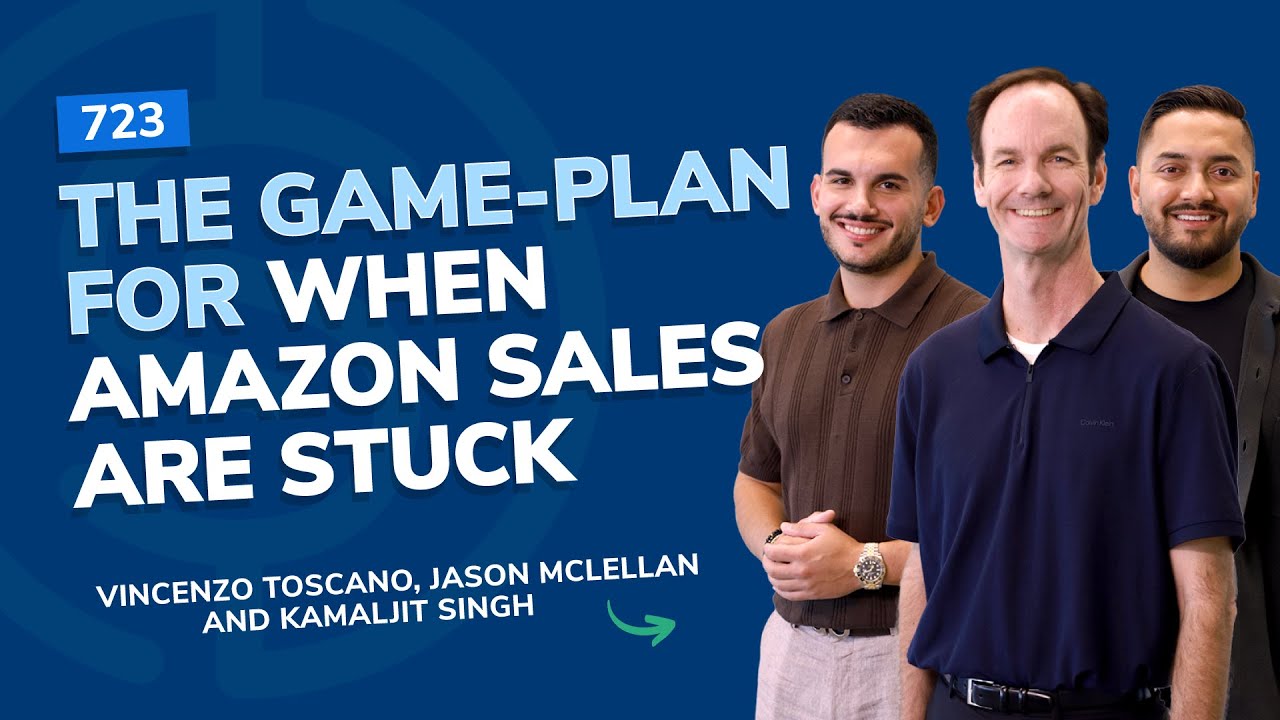
#723 - The Game-plan For When Amazon Sales Are Stuck
Summary
"Stuck Amazon sales are tackled by focusing on creative strategies, PPC, and analytics, with experts sharing how they doubled sales for the InMotion Hemp brand, even causing stockouts—an actionable blueprint for rejuvenating plateaued businesses by 2026."
Full Content
#723 - The Game-plan For When Amazon Sales Are Stuck
Speaker 3:
Has your Amazon business plateaued or even decreased lately? What's it going to take in 2026 to get back to growth? Today, we talked to three expert mentors to talk about what you can do in the areas of advertising,
creative, and analytics, including how they already increased the brand so much that he ran out of stock last week. How cool is that? Pretty cool, I think.
Hello, everybody, and welcome to another episode of the Serious Sellers Podcast by Helium 10. I'm your host, Bradley Sutton, and this is the show that is our Ask Me Anything and special training that we have with three expert guests.
Today, we're going to be talking about some general strategies that apply to anybody, whatever level you're at, whatever part of the world you're in,
about what it's going to take to win in 2026 and what existing brands out there can do to get out of the rut. Like those who have plateaued, how do you increase your sales?
We're going to talk about that because we're going to talk about exact strategies that these mentors have done for an existing brand that the overall goal is to increase next year the sales by 2x.
But in the small amount of time that they've worked on this account, They have increased the sales so much. So at this time, I'm going to go ahead and invite our mentors up and we're going to meet them one by one.
And I'm going to be asking them questions about what we did with the series, about what the plans are for a brand. And remember, this is not just hypotheticals we're talking about. We have been showing you through a video series,
a real brand called InMotion Hemp that you can find on Amazon. One of their products is still in stock. The main one is not in stock because again, the sales increased so much. He ran out of stock.
But we're going to talk about, hey, what are the steps that have to be taken for those of you who have decreasing sales, decreasing profitability, plateaued? Anybody out there like that? Does that describe any of you?
Let me know in the comments. Those of you currently selling on Amazon and or TikTok shop, maybe Walmart, maybe 2020, 2021, your sales were going like this, like the old Helium 10 logo.
But then the last year or so, sales have either been going down or maybe plateaued. Does that apply to any of you out there who are listening live or are listening or watching to this on the replay?
If so, stick around because we're going to have some things that you can check out in order to help you. But who's going to be helping us with this? Let's go ahead and meet our mentors. First up, It's like the Brady Bunch. We've got Kamal.
Kamal, why don't you go ahead and unmute yourself and introduce yourself.
Speaker 1:
Hey, Bradley. Hey, everyone. Super excited to be here and great to meet the gang once again. Saw everybody at Helium 10 office for a Skilled Stories episode. But yes, my name is Kamal. I'm the founder and CEO of AMZ One Step.
And what we do is we help Amazon brand with creatives, better CTR, CBR. That's pretty much our bread and butter. And that's exactly what we did with I'm with David from Scale Stories, episode number four.
So excited to talk about that as well.
Speaker 3:
Awesome.
Speaker 4:
Awesome.
Speaker 3:
Welcome Kamal. Vincenzo.
Speaker 4:
Yeah. Hello, Bradley. Pleasure to be here and same. Happy to see the team. So a brief introduction about myself. So my name is Vincenzo Toscano, founder and CEO of Becamsi. We are a full service agency specialized in scaling brands and Amazon.
And we do everything essentially under the sun when it comes to scaling brands on Amazon. So PPC, DSP, listing optimization, brand creative, international expansion, specifically for scale stories. We specialize on the PPC side of things.
There were a lot of things that we found for David and a lot of things that were changing. And I'm very excited to discuss in more depth how people can leverage this, especially in 2026. Awesome. Awesome.
Speaker 3:
And last, Jason.
Speaker 2:
Hi, everyone. My name is Jason McLellan. I am one of the co-founders and Chief Strategy Officer for Prime Team Agency, like my fellows, full service agency. We specialize in Amazon, Walmart, TikTok, and social influencers.
We've all been in the game for a long time. It was an absolute pleasure working on this project with David and his brand. We saw amazing results,
amazing things still in the pipeline on it that he's working on and that we continue to work on with him. So just looking forward to the discussion here. Always love to talk to Amazon and TalkShop.
Speaker 4:
Awesome, awesome, awesome.
Speaker 3:
All right. Let's go ahead and going to Kamal, the first thing I want to ask you when you met David and his InMotion brand, what was the biggest glaring hole that you can remember where you're like,
How is this guy already a six-figure seller and he doesn't have this? Man, this is really going to help him out. Do you remember anything?
Speaker 1:
Yeah, there's a few things that stand out from the competition because we worked on his listing even before the episode, if you remember. So the images that we saw before the episode,
I don't think he was using any lifestyle images or infographic images and he was not calling out his top pain points or the target audience and also his unique formula. I don't think it was mentioned in the images anywhere.
So that was one of the things that stood out for me. I'm like, oh man, we need to change that. And when we did, he saw an increase in the conversion right away. I think he posted that on LinkedIn as well.
And the second thing which stood out, I think David I had no idea about the brand story, the storefront. I think those were not optimized at all and he was not doing any testing on his creatives that he had.
So, these are the two things that really stood out for me and I'm like, okay, these are the low-hanging fruits that we're going to have to focus on.
And, you know, and we've been running some experiments in the background already and the results have been already, you know, really, really good.
Speaker 3:
You actually had the first look out of anybody here in this group on the brand, your company, Amesy One Step, and got started with like just a phase one of the new images. And it wasn't like His images were absolutely terrible.
They didn't have a white background or it was blurry or something like that, or he only had one image. Obviously, there are some people like that out there.
It was professionally done, but professionally done maybe five, six years ago and hadn't been refreshed. Just that one move where it was only phase one just to like test out what would happen in changing the A plus content,
changing the main image. These things had a profound impact on his click-through rate. And his one hero product, which by itself is a six-figure product per year,
sells about 30, 20, 20, 20, or at the time it was selling about 15 to 20 units a day. The click-through rate increased. I have the data in the episode and also it's on my LinkedIn like back when I first found this,
but I forgot what it was, but it went from like 12% to 18%. And so that might seem like, okay, well, 6% click-through rate, numerical click-through rate increase, like, is that really going to have an effect?
But with the conversion rate staying the same or getting better also in the click-through rate, just going from 12 to 18, we had done the math that that one move, which wasn't even final,
like we're still working on the images, was going to increase his sales. On that product, over a year, by $20,000. This just gives you an idea about what we are going to hopefully be able to do with this brand, the very first move we did.
For those of you who have been selling on Amazon for three, four years, even two years, have you looked to see how the industry has matured, has changed customer behavior? It might be time to update your images.
Now with AI and things, It's something that you can perhaps do a little bit more often than before. We're like, okay, I'll do that every five, six years because that's all I can afford.
Studio session might cost $2,000 or something like that. You're like, you can't be paying that every two months or six months or something just to keep up with the The time is right, but now you can see what kind of big effect it has.
Vincenzo, what about you on like the advertising side? Do you remember anything that he wasn't doing or something that didn't look great? And again, I know there are sellers out there who have bad images.
Like I said, there are sellers out there who maybe aren't even doing any advertising or have just some like no strategies, have an auto cam. I mean, this guy was not that light. Like he had something,
but what was the big Let's talk a little bit about what kind of improvement you think that he could have made.
Speaker 4:
Yeah, so I would say the first one that automatically caught my eye was the fact that he was leveraging a lot of other campaigns. That's usually kind of a red flag for me because, of course,
other campaigns are good for exploration and discovering potential keywords that you might not find by using Helium 10 or Brand Analytics.
But at the end of the day, they're usually not campaigns, the type of campaigns that are built for scale. And what I found with David, he had a lot of keywords on his auto campaigns that they were consistently essentially making sales,
right? They were consistently converting. He had actually very good acos. But some of those campaigns were also spending a lot of money on keywords and listings at the same time that they were not profitable. And on top of that,
there was no proactiveness when it comes to negating some of these keywords and also making sure the keywords were moving to exact match campaigns.
So I would say the first thing that essentially was done in terms of action is identifying that and make sure we went into isolation to make sure that we could double down on what is working and essentially remove the rest. Yeah.
Speaker 3:
Yeah, yeah, that was definitely a big one there and, and you know, He had a hemp based product. So in the past, he wasn't or he didn't qualify for whatever reason of Amazon for things like,
you know, sponsored brand campaign, sponsored display, you know, video campaigns, because that's under sponsored brand. But we found that he does qualify now. And so that was something that he could get into.
And so, again, this is an established brand. This is already a six figure seller. Some people might think, OK, I'm successful. There's no more room for increase, but no, there is definitely room for increase. Let's bring Jason to the stage.
Jason, what about you? Maybe on the SEO side or operations side, like things about his listening. I remember there's a couple of things you noticed right away as soon as you saw his listening.
Speaker 2:
It was funny. I even had subsequent talkings with at least one listener from the episode, and we got a really good one on virtual bundles, and I'll come back to that one.
The really thing that really stood out to me was Just kind of taking a dig in and looking at repeat rates, really understanding the customer lifetime value from that and making sure that we're aligning a strategy.
Then kind of taking a deeper dive in through Product Opportunity Explorer, kind of seeing what were those 95,
96% of keywords that are driving sales for the product niche in which he operates on and then further kind of looking at what those competitors were in that niche.
A couple of days ago, I was talking to a listener who was just asking more about virtual bundles. I think that was really interesting looking at how we can, as we discussed,
take up more free space and education of what other whatever products you have to offer and educating the consumer on that and trying to do incremental sales. Because the bottom line is like, what are we trying to do?
We're trying to scale more sales and that was just a quick damn dirty way to do it.
Speaker 3:
Yeah. Yeah, absolutely. So this is, again, a brand that was doing well, but we were like, it can do better. And I bet that might describe a lot of you out there. You know, some of you might be like, no, I'm not doing well at all.
And my sales are just tanked. And that's fine. But if you're already doing six figures, you're already doing seven figures, odds are there's still room for improvement if you're open to listen to it.
And this brand owner, David, definitely was. And he opened up his account and was able to take constructive criticism on it. So that was very important. Let's talk about some more of the plan going forward.
Like Kamal said, we're in Slack every day talking about this brand. Kamal, what are some of the things that we are working on and that we are going to work on as the month or so goes on?
Speaker 1:
Okay, so there's a lot in the pipeline. The first thing that I'm doing right now, I'm running some experiments on his main image. And the first week, 45% additional sales that we saw.
So I'm going to let it run for the next four to eight weeks. I saw significant evidence that the new main image is better. And we're going to keep doing that because I do have some other ideas because on his main image,
for example, there's many options that we can call out. It's made in USA. I think that's a big feature. We can call that out. It has a dual functioning formula. We can call that out as well. We can talk about fast pain relief.
We can call that out. So we don't know which call out would be the most stickiest and which will have the highest click-through rate. So we're going to have to do Three or four rounds of main image testing. That is one thing we're working on.
A second thing I'm working on with Vincenzo very closely, he's got really, really good ideas for his advertising. So he gave me a bunch of keywords and he's like, Hey Kamal, we need to create five or six different videos.
These are the high search volume keywords and each hook should be directly You know, relevant to the keyword that people are searching for.
For example, if somebody is searching for joint pain relief, the hook, the first couple of seconds or three, five seconds should be somebody applying the cream on the joint, right? So that's one thing we're working on.
And obviously, we are short on time. And a lot of those videos, those video ads that we're reading for David, they are very AI focused. So we're creating a lot of videos with AI. That's the second thing in the pipeline.
Third thing what we did is we added a brand story to his store and we were hoping for premium A-plus contents to be unlocked because if your brand story is applied to all the essence and we duplicate the regular A-plus content five different times,
the premium A-plus content gets unlocked. So I tried that. It did not work. And I'm suspecting that his brand story is not applied to all the essence. I don't have the full permissions for his account.
I'm going to have to check back with David and redo that. So these are the three things that are in the pipeline. And once that is done, we're also going to optimize his secondary images. I think we did that a few months ago.
I think we can still do a lot better. There's still some room, even like 1% or 2%. Increase would be a huge when you look at the 12 months window. I speak with so many Amazon sellers.
When we do the experiments with them, like, hey, you saw an additional $1,000 increase in four weeks. And they're like, oh man, I don't see the excitement.
It's $1,000. But if you multiply that with 12, it's like a $12,000 extra revenue in a year. And when we're running the experiment, it's only live for 50% of the time. It's not live 100% of the time.
So if you think about it, it could be $24,000 impact. So every small improvement that we see, when you multiply with at least minimum 12 months, that's when you see the real impact.
So these are the things that I have in pipeline for David and working very closely with Sanju.
Speaker 3:
And you're actually going to actually before I say this, I've noticed a lot of people in the chat hadn't even heard of the scale story. So a lot of this stuff, guys, we actually show the brand. We show some of the steps, step by step,
both during the main episode and during our breakout episodes where we get into the weeds on it. So just go to YouTube right now to bookmark it. Don't watch it now. If you want to pause this, if you're watching this on a replay or something,
but go to YouTube, type in Helium 10 scale stories. And this is episode four. We're here with David and InMotion. There's four episodes that we have brought out. Now, staying with you for a second, Kamal,
you're actually going to be seeing a lot throughout this series because you're helping some of our other contestants, I guess we can call it. And so another one of the episodes was a brand called Essential Candy,
like this functional hard candy where it helps your digestion. There's one that helps you sleep and stuff. And you're showing them a blueprint. They've got a lot of products. They're not like David.
David has one hero product and they've got about 12 products. And they're all similar packaging. So like, what's the main thing that you're doing there? We haven't filmed this part yet.
We'll film a recap episode that will go up later on the podcast. But what was the main thing, your main like, attack on that project?
Speaker 1:
I think that listing had... Anything we could do was going to improve his sales because most of his images, they were like... We didn't have infographics. The main image wasn't optimized. The lifestyle images were not optimized.
So we started with the image stack first. So what we did again, like we normally do, created three or four different types of main images. I had different callouts. And I'm working with Leo, who's The mentor from episode number three.
So we're talking about some Rufus optimization as well. How can we generate images which are also Rufus and Cosmos optimized? So we're adding some main keywords there in the main images.
We're handling those objections in a very strategic way. But obviously, Black Friday is coming. We don't have that much time. But we're going to push the standard images. They're still a lot better than his previous ones.
But once the Black Friday is done, Leo and me, we're going to focus on having that copy dialed in so that we can also track in the roof to see if it stands out or not,
if the product does get recommended in the roof, those questions or not. So that listing was a when I first saw that, I was like, okay, man, I need to be in the episode number three because I saw this huge potential.
Then I found out that I'm in the episode number four. But their listing, I think, I'm looking at easily double, triple revenue just from optimizing their listings.
And with Dean, I think he's very particular about having what he wants to show. He's like, hey, Kamal, I think this is against my brand guidelines. Kamal, I think we should avoid this type of text. But Which we totally respect that.
But if we could test out all those strategies, having those words and the way we want to change the product packaging, because the main image is the prime real estate. It's the entrance to your So, why not just decorate that a little bit?
We could show some... Like I said, they're also made in the USA. They have organic ingredients. There's so many... We could do any rendering packaging. So, there's a lot of stuff we can do. So, we're working on being with that too.
So, I think no matter which listing you have, whether your listing is optimized or you're starting out with one image,
There's always a room to grow because you're spending tens of thousands of dollars on ads every single month and you better be testing your creatives at least once every six months.
Speaker 3:
Yeah. And we're doing another one. We're not going to talk about it now because we haven't even started this,
but the original Scale Stories was called Project X and there was something called a Coffin Shelf and we're relaunching that with a new listing and a brand new Makeup Coffin Shelf. Believe it or not, there's a big market for that.
And Kamal is going to be working on some images there. So we're going to show you how to start from scratch on a listing. Vincenzo, when somebody like David has never done sponsored brand video, sponsored display ads,
the kind of things you need brand registry for, and this question applies to what we're literally in the process of doing with David. How do they approach it?
Is it just a matter of, hey, let me look what ASINs we're converting in auto campaigns, in product targeting campaigns, move those to display campaigns.
What words we're creating or we're converting for, you know, keyword campaigns, move those to like sponsor brand. Is that as easy as it is or there's a little bit more that you need to do when you get started?
Speaker 4:
Yeah, so I would say the first thing you have to understand is before you launch anything with sponsored brands and sponsored display, you have to validate first of all, which are the keywords and the aces you are converting into, right?
And this is a mistake I see a lot of people doing. They might launch the PPC campaigns and they try to play with all the different tools that Amazon gives you when it comes to advertising.
But the reality is that each of them have a different function throughout the whole lifetime of a product, right?
So the thing that I usually recommend is to start with sponsored products and give it at least one to two months to validate which are the keywords that you're converting the most.
And also the AC, in this case, the competitors, where you're converting the most. And once you validate that, that's where I'm going to proceed into launching sponsored brands.
Because not only by then you're going to have a pretty good understanding of which are the keywords and the competitors you should be advertising on,
But more importantly, you're going to understand what the content, specifically on sponsored brand,
which is heavily reliant on content, has to essentially convey through the communication of what you put on the image to convert that into a sale. That's why I've been working with Kamaljit to essentially reverse engineer that,
because by now we have a lot of data on the reviews. We have also a lot of data on the campaigns in terms of which are the kiosks people are typing.
In the search bar, and we reverse engineer what are some of the emotions we have to trigger on that video, on that banner, to essentially convey the client into thinking a product is better than the competition,
but more importantly, is going to solve an issue that nobody else right now is solving into this specific niche. So that's the thing I usually recommend in terms of a plan of action.
And just to double down, On Sponsored Display, it's good that you mentioned that. I think for all of the people right now watching this live,
I think Sponsored Display I feel is such an underutilized type of advertising as well on today's age. Because if you have a product like David, that is a product that you buy on a recurring basis,
like on a monthly basis or every two weeks and so on, Sponsored Display can be your best friend when it comes to that. I actually was amazed to see when I was reviewing his account that he has zero retargeting when it comes to advertising.
And that is actually such a wasted opportunity because this is a product that if you like and you're constantly suffering from pain and you need to buy on a recurring basis, If you don't reengage with the client,
most likely the client might buy another pain relief product because they have a better price point or they are doing aggressive strategies when it comes to advertising and you're just losing Essentially,
that's second sale, which is where most people actually make money in the lifetime value of a consumer. So, I think sponsor display is something that a lot of people should focus more, especially if your product is of that nature.
And more importantly, not only for retargeting, but also attacking other competitors. Like, I feel sponsor display video campaigns The ones that appear under the bullet points are so powerful.
If you do an amazing video that click in three seconds while your product is there, we're stealing so much traffic from our competitors with those kind of campaigns. So I think it's that.
Spend some time, validate your keywords, understand the pain points, use those pain points into content, and use the content to essentially exploit the loopholes that your competition is leveraging when it comes to advertising.
Speaker 3:
Keeping with you, Vincenzo, something brand new from Unboxed recently, obviously, is a new form of advertising sponsored product. Have you started working with it at all?
And what is going to be your strategy there for, this is new to everybody. It's not just new. I mean, David's obviously never done it, but it's new to the whole entire world. What's going to be your strategy?
We don't know what's going to work, what's not going to work, but how are you going to tackle this?
Speaker 4:
Yeah, it's very early to really say what's going to happen with those type of ads because you just mentioned it was pretty much released one to two weeks ago. So we're still experimenting, but that's a clear signal where Amazon is headed.
In terms of the type of advertising, they're putting a lot of emphasis on giving more placements when it comes to video.
I think this is because they clearly are seeing how people is converting better when it comes to video if you do a good piece of content. But more importantly, if you see the whole agenda of even in box,
you see how Amazon is also heading to the direction of shifting from keyword-based advertising to essentially audience-based advertising, which is what Amazon Marketing Cloud is being all about.
So I think It's in a new releases for Amazon such as this. It's just something that people should start using as an indicator that you need to understand your audience better than ever now.
Because if you don't understand your audience in the first place, how are you going to maximize this video placement? Because those videos are going to be generic. You're not going to convey the emotion that you need to convey.
Most importantly, you're going to burn your money in advertising. So I would say now is the time You use all the tools Amazon gives you, essentially, and also with Helium 10, Reverse Engineer, what people are saying in the reviews,
Reverse Engineer, your niche, Reverse Engineer, which are the keywords people are going for, and use that as your foundation to create your avatar. And then you're going to use the avatar, essentially, to create a content that can speak,
essentially, the language of the consumer and maximize your conversion when it comes to advertising.
Speaker 3:
Alright, switching over to Jason now. One of the things we implemented, but you noticed some things about his LTV. He had some pretty darn good LTV on returning customers. And so if somebody has a product that can or is subscribe and save,
What are some of the things that you were doing for David or just in general that somebody could use in order to either help them easier or to get that LTV up for a customer?
Speaker 2:
That's a great question. I think there's a wide variety of things you can do. I mean, the immediate first comes to my mind is really focusing on what is that advertising strategy.
Start analyzing how you're allocating your advertising dollars. Look at what your percentage of spend is, the percentage of sales, percentage of repeat rate. Take a look at what your CAC is and your CPCs. Very data-centric on it.
Speaker 3:
Explain what CAC is.
Speaker 2:
Cost of acquisition. How much is it costing you to acquire that new-to-brand customer? Depending on where you are in your life cycle. I can figure like on social media advertising, what lever you have the ability to pull.
I think as Vincenzo was talking about sponsored display is, you know, it's kind of the poor man's DSP at this point.
And what's really incredible about that ad asset type is now they're kind of We're taking the cookie jar down on that and allowing you to actually look at click-through, not just Amazon attribution, which is really wide on that.
So you can actually get a really good view into actually how well SDs are actually performing. And as Vincenzo said, everything is becoming audience-based. You've got audience-based on Amazon advertising site.
You've got audience-based on Amazon seller central site. Different data sets overlap just because there's some core demographics on them,
but really starting to understand those audiences and understand those audiences that are buying those high repeat rates, starting to then really lean into them more, understanding customer sentiment on those high repeat rates,
trying to push them a little bit more, resonate a little bit more. InMotion is David's brand. How do you get broader reach and more customers? There are some simple things you can do. You want to definitely be outside the Amazon system.
Amazon Creator Connections is like.
Unknown Speaker:
an immediate easy pull.
Speaker 2:
It still takes a lot of work but the easiest to scale, gets broader reach, educates more, and as Amazon continues to develop that platform, it's been evolving. Just look at how far it's come in the last It's been around four years,
I think, and how far it's evolved from there. You can get really great Amazon attribution on it. That's the key. If you're trying to push off Amazon,
how do you judge that Amazon attribution and you can specifically be targeting those products that you have a higher repeat rate? If you're going to have a higher repeat rate,
you're pushing them statistically of a higher statistical chance that that consumer is going to come back, he's going to purchase it, We're gonna probably also push it and subscribe and save.
So also start using subscribe and save messaging. You can use subscribe and save messaging in compliant, low-key terms on your brand store, in your A-plus content. You just kind of want to drill it in, seep it in,
especially once we're going to audience-based on both sides. You can start targeting those audiences who have a high propensity to buy your products. You can start targeting those who are not in subscribe and save.
And then there's always DSP. You go up that one extra level and you really create these really fine tunes and you have this full funnel approach of acquisition to retention to subscribe and save.
And you're moving along that funnel and just keep pushing it.
Speaker 3:
Yeah, I mean, there's and again, David was had subscribing safe, you know, so it's not like, you know, he was just completely noob about it. There's definitely some things he was a pretty newbie about.
You saw some of those quotes from the like some of the TikTok videos we had where he's like, What's a brand story? I didn't even know I had a storefront and things like that.
But he was doing subscribers, but then Jason found that he didn't have a coupon for an incentive to get subscribers. So no matter even if you're doing a lot of the basics, there's probably something you can tweak.
We have a question for Kamal here. This is from Kathy. She said, I think someone mentioned If the product is made in the U.S. or perhaps even designed in the U.S., could this be part of an image?
I mean, obviously, I think anybody would understand that that's something that could be part of a lifestyle image, but probably her question is about maybe on a main image. Actually, David's product is made in the U.S. What am I saying?
David's product, Essential Candy, we just happen to have two different people who had products made in the U.S. What can and cannot be done on the main image?
Speaker 1:
Okay, I think that's a really good question. So when we say that add this to your main image, we're not saying that add it on as a graphic or as an infographic or as it on the white portion of the image. So that's a big no-no.
That image will not be accepted. So just to be clear, when we say you can add callouts on your main images, we say that you can add it on the product packaging. And we don't say that just Photoshop is technology packaging. We're like,
take the actual AI file of your packaging and actually embed Made in the USA on that file so that it looks very real and the bots cannot really catch it.
So any changes that you're doing on the product packaging should actually be done in the actual Photoshop file. That's like a really good... That's like an Amazon-proof way of getting this passed through the suppression test. That's one way.
Or you can also use some sort of hang tags and make sure those hang tags, they're looking like actual tags. They're not floating or they're not blending in with the white background. Or you can just engrave it in somewhere.
You can just maybe use something, maybe a prop on the side of the product and engrave or embed something on the prop. So you have to be very smart about when you're adding the callouts. You don't want to mess with the product itself.
So you try to find out what are the other areas that I have to play around where I can add these callouts in the main images. So absolutely don't put anything on the white background.
Make sure they don't look like it's floating on the image or otherwise your image will not be accepted.
Speaker 2:
Can I ask something in here? If you see such a great increase in conversion rate, what are your thoughts on actually then changing your packaging to fully incorporate that?
Speaker 1:
Absolutely. Amazon is your main engine. If it's the main driving revenue factor, then it's a great test because you're optimizing for the Amazon click-through rate and conversion rate. So if you do crack the code on the actual design,
you can actually Change the entire packaging in the next shipment. That's absolutely a great idea. But if you're also selling in the retail or other marketplaces,
then it's a question that you want to make sure that is your packaging also optimized for the retail shelf? Is your product packaging also optimized for other platforms? So that's where you have to think about it.
But otherwise, if Amazon is your main channel, this is a great testing Playground where you can just test a lot of ideas, find a winning package design, and then go ahead with that. I always give the example of RxPAR.
Have you seen that product packaging? It says 2 cashews, 2 eggs, 5 nuts, and no BS. So I think that it's perfectly optimized for Amazon. And this is something you're absolutely right. If Amazon is your main engine, feel free to do that.
Speaker 2:
The reason I brought that up, I just want to tee it up for you. When I was running the Vitacup brand before going to the agency side, I can't tell you how many times we tested out new concepts of packaging on Amazon,
got conversion, made changes to packaging. I think it's a great point on We're going to talk about shelf space, digital versus retail, how everything's going to be, because we are running both in traditional retail,
brick and mortar, and on Amazon. But actually, Kamal, some of the learnings we were able to take and then actually make it to our retail versions of packaging that we were able to do as well.
Speaker 4:
I think to add on that as well, just as a side note, we're even reaching the point when it comes to packaging that we are also making the packaging ruthless proof. So for example,
we have instances where let's say we're launching a water bottle and we want this water bottle to only be focused on people do hiking. Then we're making sure on the front side of the packaging, like you can see from an element perspective,
either a mountain, somebody hiking, everything, because now Rufus picked that up with the processing on the image. And we have seen that also helping us when it comes to essential recommendation.
We're now doing some case studies looking to publish around this. But yeah, so that's something to keep in mind, especially because the main image is such a big contributor when it comes to that.
Use that real estate not only for conversion, which of course should be intense, so using bright colors and right click to rate, but how you use that space on the packaging to put an image or an element, the roof is going to pick it up,
relate your product to a niche that you want to be highlighted for.
Speaker 2:
Well, I think that's just important overall. That's customer sentiment, which is so hard. You want to get to what is driving that consumer's wants, needs and desires. How is it resonating with them?
Why are they wanting to engage with your We're a product over other products. We did talk about this and I forgot to bring this up. We did talk about this in InMotion.
Especially, it's so key when designing not just the hero image but also carrying that story. Because what we're doing is like you're always working on borrowed time.
I'm always begging the consumer for five more seconds of their time because time is precious. And so it's storytelling to you why this product from the hero image to the secondary images to the A plus content,
why they want to engage because it's going to solve something or it's the fit for their need.
And sometimes where you can really start getting into the customer sentiment is really understanding behind all of their Reoccurring reviews and sentiment, like what is he really trying to drive at?
You know, saving time, taste, convenience, just working simply is just working as it is promised on the listing. I can't, I like thinking over the decades of how there's such a disparity there.
Like people promise the world and then you get something that is this cheap and And they bought the cheapest item, had the best bells and whistles on the listing content that they thought, and it just was so off.
Speaker 4:
Yeah, of course. The closer you are to the customer sentiment, also that's going to improve your reviews because if you are delivering the most accurate product to their needs,
which they're asking on Rufus, for example, now the probability of five-star reviews is higher than what it used to be. So it's a win-win on all fronts.
Speaker 2:
Exactly.
Speaker 3:
I've got a question I can answer here from YouTube. Top Fine Review says, is Atomic, which is now called Helium 10 ads, available for platinum? What are some strategies to maximize spend? So it's called Helium 10 ads.
Now it is available for platinum, but I would only recommend it if you're like maybe advertising spend at the platinum level is above like maybe $10,000,
$15,000 a month because the part of ads that is available at platinum is our AI advertising. It's really designed for larger spenders.
For the rules-based where you can just control everything on your own, that's available at diamond and above. And at no extra cost. So I would highly recommend that. And then the strategies, we've got plenty of them,
but it's just making sure that you set up your rules for your keyword harvesting, your negative matching, your pause targets in order to maximize that spend that you are making, that you're not wasting.
All right, we're going to close this episode with top strategy for everybody, kind of like in what you guys deal with. So Kamal, top strategy as far as Images or A plus contents, videos, something like that,
that anybody out there who's watching should be implementing for 2026. Okay.
Speaker 1:
So experiment your image sequence. It doesn't cost you anything. It doesn't cost any time. Just test out different sequence. You know, sometimes, you know, moving your fifth image to the second one could help you increase in conversion. Okay.
That's number one. Second thing, if you're a product founder, Take a picture with your product. It doesn't really have to be professional. Take a picture with your product.
If you're a couple, if you're a family-owned business, take a picture with the family, with your product, with your cell phone. Enhance it with AI. For example, we had one brand with the chicken supplement and we showed them with AI,
like all the chickens in the background. Just do these two things. It doesn't cost you any money. It doesn't cost you any time and you'll see significant improvement in your sales.
Speaker 3:
Vincenzo, advertising.
Speaker 4:
So the first one would be Amazon Marketing Cloud. Make sure you leverage that because most of the brands we work with are doing it and most of the competition. So you're going to be left behind if you don't.
Second thing, have a look at your placements, understand how you convert top of the search, rest of the search, and product pages, and make sure you optimize based on conversion.
And the third thing that I would say is also very, very important, especially in Q4, make sure you have defense strategies for your brand. That means defending your branded terms, defending your agency.
If you have multiple ones, cross-sell each other, and make sure you don't leave the backdoor open, because if you're already bringing so much traffic into your listing, Most likely, if you're not defending under the buy box,
under the bullet points, top of the images, at the bottom, you're going to lose that traffic. So those are some of the main three strategies I would say people should leverage to maximize their business.
Speaker 2:
I would say, and I'm going to go back to Product Operating Explorer, it's the free tool everyone can use to do a quick double check. Find your product niche that your product or products exist in.
Look at how much click share you have, how you're weighing against. Look at the keywords you need to be targeting. Figure out, you can pull into Helium 10, do it all the time, love doing it with Cerebro,
how you're ranking against those keywords, both from a organic and a sponsored. And then also look at customer sentiment, the reviews, like how and address them in your content.
And if you have high enough velocity on your own, you can run through product properties, you can explore your own product and look at the negative reviews and seeing what people don't like and address them.
When we were running VitaCup, we did some great product improvement on taste profile and one of them, I can remember that by reading the reviews. It's a free tool for everyone. It kind of equalizes the playing field.
No one has any secret sauce out of it that you don't. It's just taking that knowledge and leveraging it from there.
Speaker 4:
Awesome.
Speaker 3:
All right. Well, mentors, thank you so much for all the time and effort you've dedicated during our filming and then off hours. For a couple of months now, we've been in Slack.
Again, everybody, go to YouTube, type in Helium 10 Scale Stories, watch this series, get motivated and apply what you learn, what we talked about today, what you learn in scale stories to your own businesses.
Don't just be doing this for edutainment. That's a fake word there, but education and entertainment together. Sure, it is entertaining to watch this stuff, but actually apply it. Then it's actually going to mean something. That's what we want.
I know I speak on behalf of the mentors. We don't want you just looking at these guys' good looks here on the show. We want you actually applying what you learn from them. So thank you again, Vincenzo, Kamal, Jason for everything.
And we'll see everybody else in the next episode.
Speaker 4:
Bye now.
This transcript page is part of the Billion Dollar Sellers Content Hub. Explore more content →