Ecom Podcast
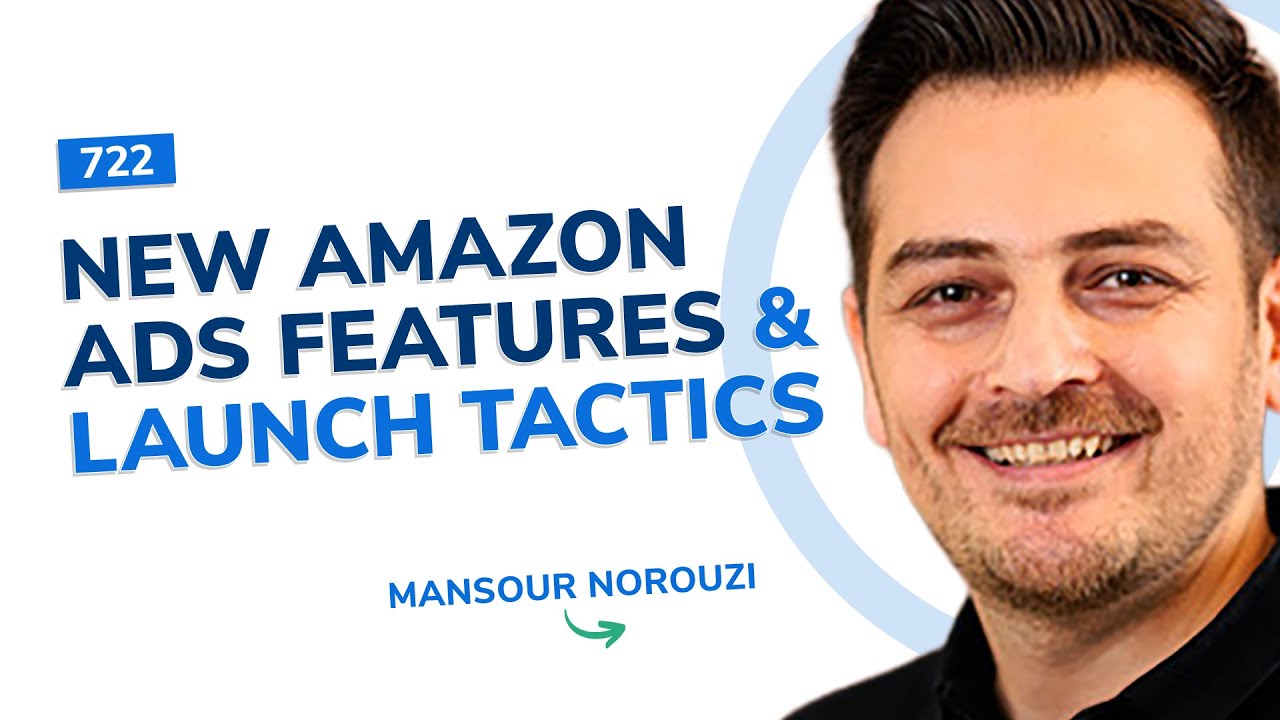
#722 - New Amazon Ads Features & Launch Tactics
Summary
"Discover new Amazon ad features like sponsored product video to boost visibility and learn how Helium 10's Black Friday deal can save you 35% on advanced tools to optimize your product launches, helping sellers like Mansour hit over $1 million in revenue."
Full Content
#722 - New Amazon Ads Features & Launch Tactics
Speaker 1:
Today, Mansour is going to help us with strategies on search query performance, new Amazon ads features like sponsored product video, AMC tips, product launch tips, and more. How cool is that? Pretty cool, I think.
You ever had FOMO when we talk about all these money-making features and tools that Helium 10 has? Or maybe you're a platinum subscriber,
you want to level up to get the advanced historical Cerebro feature or the advertising things that we have on the diamond plan? Well, this is a deal you've been waiting for. For Black Friday all the way through Cyber Monday this whole week,
you can save 35% off up to 12 months of platinum. You don't have to pay for the full year in advance. You can just do it month to month or 12 months, 35% off upgrading from platinum to diamond. Biggest deal of the year.
Now, the extra money you guys are going to make by using the tools that Helium 10 has, more than what's going to make up for what you pay on the subscription. So if you don't have an account yet, you want to sign up to Platinum,
make sure to go to h10.me forward slash Black Friday. Same link. If you already have a platinum account, you want to sign up for the diamond account, h10.me forward slash Black Friday to save 35% off up to one year. And you know what?
As an added bonus, anybody who signs up for the diamond plan on this deal and then you mentioned to customer service this podcast or that you heard about this from Bradley,
I'm going to hook you up with my personal sourcing agent that I use to get all of my Amazon and TikTok shop products in China. So what are you waiting for? H10.me forward slash Black Friday.
Hello, everybody, and welcome to another episode of the Serious Sellers Podcast by Helium 10. I'm your host, Bradley Sutton, and this is the show.
It's a completely BS-free, unscripted, and unrehearsed organic conversation about serious strategies for serious sellers of any level in the e-commerce world. Are you in Toronto still?
Speaker 2:
I'm in Toronto, yes.
Speaker 1:
Yes, and like always, some people don't know this, but sometimes I'm very intentional with what I wear. Today, I knew somebody from Toronto was coming on the show, so I am making sure to wear my Dodgers hat and some Dodgers colors here.
Too soon, I know. I'm not sure if Mansour is a fan or not, but hey, it was one of the best World Series ever regardless. I don't think Toronto fans might not feel completely the same, but those who,
you know, even if the city here was ready to go on fire for the last game and it didn't happen. Yes, yes. That was a crazy, crazy year. I was actually in Japan when it was happening and I was coming on wee hours of the morning and stuff,
you know, trying to watch it. But wow, I've been a Dodgers fan for a long time, so I can gloat. We had a while there before, five years ago, where we didn't have a championship for a while. But anyways, we're not here to talk about baseball.
Mansour has been on the podcast before, so we're not going to go too much into his backstory. But if you guys want to go check his story out, You can do so the first time he was on the podcast was episode 433 and the next one was 584.
So you can probably hit up those. The short link would be h10.me forward slash 433 or forward slash 584. You can listen about his history and how he got into e-commerce and what he's been doing. So first of all, let's just catch up.
We're just talking right now how you're both kind of like an agency slash service provider. You work for one. How has the selling side been going for you?
Speaker 2:
If you remember, I do supplements. I sell supplements only in Canada. It has been pretty good. Now I have six products, 12 SKUs. I passed 1 million revenue, trailing 12 months, 1 million revenue a few months back.
Now aiming to get to 2 million in trailing 12 months. So it seems like it's going good, but it's very competitive. Supplement is crazy. It's crazy, the cost per clicks, the competition.
And pretty much I would say two of my products bringing 80% of my revenue. It is fun. I love I realized that it's so challenging and I love problem solving.
And the CPG branding thing, it's kind of I find this I realize that it's my passion because of all the challenges that it has. It's good. Sometimes up, sometimes down.
Speaker 1:
Do you own a TikTok shop too?
Speaker 2:
In Canada, we don't have a TikTok shop. We can't wait for it to come, but yes, we don't have access to TikTok.
Speaker 1:
I didn't know. I don't know what. I knew it was in Mexico. For some reason, I thought it was in Canada, but I didn't realize that it's not there yet. Okay.
Speaker 2:
And then- Just because of the legislation, we have TikTok, but not the TikTok shop yet.
Speaker 1:
Have you thought about Hey, you know, hey, Leron, can I borrow your social security number as an employee so I can launch my TikTok shop in USA or is your supplement specifically or actually your supplement is on Amazon USA, right?
It is not necessarily for Canada. OK, well, have you thought about like, you know, getting somebody to your friend relative to help you to get into TikTok shop USA?
Speaker 2:
Not really, because the growth and the scale that I could get, I have that opportunity on Amazon Canada. And my thinking is that If I can scale and get to the goal I want in Amazon just at CA,
why I should add another channel at the moment that I'm pushing all these products. And the main thing is that the cashflow as well, I don't want to bring any investors or anything.
So I'm trying to just fund it myself and with the cashflow that business has to launch and grow. That's why I don't want to bring any other channel. Otherwise, I would maybe go, if I want to go to the US,
amazon.com would be my first choice and then TikTok shop. But if we have the TikTok shop in Canada, definitely I will expand there.
Speaker 1:
Awesome. Supplements, as you said, one of the most competitive niches. This isn't something you've had for 10 years. Obviously, the people like Goalie and stuff like that who started way, way long time ago, they've been dominating for years.
It doesn't matter the competition now because they're the OGs. How were you able to break into this such a competitive field in the last couple of years?
Speaker 2:
Yeah, interesting. Actually, it has been almost a year and nine, 10 months. I started last January, end of January 2024. That's a great question because what I realized is that the customers on Amazon are very,
very open to try new brands, to try the same product from new brands. And a few things that I noticed, one, pricing.
If you are compatible with the market, And your pricing and usually my approach when I get to any product is that any category, I go with a lower price for many reasons.
One of them being, I want to get all of my review strategy at the beginning is just wine. I don't do anything else. No friends, no services, just wine program. I start with that. And for the wine program, I try to have a lower price.
So they are kind of less critical of the product. And my experience has been great. All these I get like four or five stars. There has been a situation for one star, but not many. That is one.
The second is that As you know, when you have a new product, low reviews, you need to incentivize your customers to purchase. So that's another thing that I start with a very low price and then push with advertising.
And my only strategy for ranking is only advertising. I don't use anything else. But I have realized that the way I enter to the market for this product is pretty much unlimited ad spend. So I spend as much as I need to rank for the product.
I launched a new product a month ago. For the launch of that product, at some point at the maximum amount, I went to $2,000 per spin for just one product. For one product, I'm spending per day. It was a lot, but it was pretty good.
And that category had a very high demand. So I would say pricing Amazing listings with, of course, SEO and overall good gallery images with A-plus content. And also, good branding.
When customers see your products, they feel like, okay, this is a real brand. It's not just a random seller just selling one product. That is also very important. I started with one. Now I have six. So I need to build more.
So I show that, okay, this is a real brand with a good catalog.
Speaker 1:
You mentioned launching only with PPC advertising. That's my strategy as well. Obviously, gone are the days of some of the other stuff we used to do, which became against terms of service, giveaways and stuff like that.
What is your strategy there? How much do you budget? Are you using the low price to try and get 50% off, like a big discount, big coupon, bidding top of search, crazy high budgets? What's your strategy there?
And are there any new things that maybe you haven't done? Because whether you've launched something in the last two, three months or not, like for example, the Vine pre-release update that happened, talk a little bit about that topic.
Speaker 2:
Let's start with wine breweries. I wanted to test it for my latest product. Then I changed my mind. I want to get the sales volume from wine as well, but I made a mistake because 30 for this product that's now selling like 60,
70 per day to get to the volume I want. I'm like, oh, that was a mistake. I should have done the pre-release. So depending on the product, if a product is very niche and 30 number of wine orders that come could impact your ranking,
could generate that sales volume for you to help with the ranking, I would not do the pre-release. Other than that, if you need a lot of sales per day, 30 is nothing. I would definitely go for the pre-release. That is one.
In terms of the pricing that you mentioned, for supplement, what I do is that I look at the price per count because it's per capsule. You can see what's the pricing of the capsules.
I try to be maybe, I would say at the beginning, 20% lower than everyone else in the market. So it is very noticeable for the customers when they see their pricing and it's very interesting that they don't like Pretty much they don't care.
If your branding is good, they will purchase from you. And it's not sustainable if you keep in that pricing. That's the issue. So I start with that up to a month. I won't say there is any deadline.
Sometimes in three weeks, I get to the rankings that I want and everything is stable. I start going back up to the same price after competition. Sometimes, even after a week, I see that sales are coming up.
I try slowly getting higher up, like $1 or $2, not drastically, just to see what happens to my conversion rate. If I see I'm still getting sales, I keep it there, and after, again, five days, I bring it up, even during my lunch.
So I play a bit with the price to see if I can make it so I can increase it so I can lose less money. That's about the pricing part. At some point, It has happened for some of my products that when I launch and rank,
I go even above the average of the market because based on what I'm seeing from the market and how sales coming up. In terms of the budget, for me, I realized that I don't set a budget. I just spend like for the first three, four days,
I keep it open to see how much I have the potential to spend. In my case, the good thing is that I take the profit from other products and I'm okay with being brink even for the whole business if I see potential to rank.
So in 3-4 days, if I see the conversion rate is very, very good, that is the point that I'm like, okay, I'm going to go all in. No limit, nothing. I just want to rank this because the conversion is amazing. I have that momentum.
Let's just push and go for it. Now I could do it, but for my first, second, third product, this wasn't possible because otherwise, you're going to go drastically negative profit.
So now that I have other five products that are profitable for any new launch, I could push it more and go on limited budget. But this new product that I launched, I would say this is the highest demand across all of my category.
So if I want to spend anything I'm spending for other five products, there is a potential to spend for just one product because it's a very high demand product.
And now after Black Friday, Cyber Monday, I think it has been yet three weeks after Black Friday, Cyber Monday, I'm planning to go back down to profitability.
Speaker 1:
Okay. All right. Excellent. A couple of weeks ago, we were at Unboxed. You weren't. I didn't see you there, but I was at Unboxed. You were there live tweeting.
You were on LinkedIn live tweeting a lot of the announcements, but let's talk about some of those announcements. There's Creative Studio. There's Sponsored Product Video. There's more things with AMC, more things with AI.
If I were to ask you what is the number one thing that was released at Unboxed that It's not just exciting, not just like hype, but you're like, hey, this is actually going to result in, if used correctly, in some serious, you know,
serious changes to people's accounts or bottom line. What would you say that would be the number one thing?
Speaker 2:
Definitely sponsored product videos. Now you could add up to five videos. They are not new ad types. It's your current sponsored product ad types, the current campaigns that you have in your campaign.
If you go there, click in your ad group, inside the ads, there is a new tab for products. Inside the products, there is a new tab that says videos.
So, for each video, for each product that you're advertising inside that campaign, you could add up to five videos.
Speaker 1:
So, do you have to start a new campaign for this or your existing sponsored product campaigns, now you just add it to that same?
Speaker 2:
Exactly. Existing product, existing campaigns. You don't need to add any new products. If you go to your campaign manager, all of your sponsored products have that feature now inside the ads. So the goal of Amazon is this.
The way they explain this is that they want you to show your customers your futures in these videos. So the way I think about this is I created this for one of our clients that they sell ankle brace.
And my approach was that I went to Product Opportunity Explorer to the ankle brace niche. And I saw what are the futures that customers are looking for? What are the questions that they have? What is important for them?
So one of them was, for instance, We had a video, I asked the client, here are the videos I want from you. And interestingly, they had the whole video for video on what I asked them to cut them in short videos and send it to me.
So the first video for me was Adjustable Ankle Brace. You add a title as a feature, you add this title, Adjustable Fit, and you add your video. And next one was great support or whatever. I don't remember.
So for these ones, I added all the videos up to four, I added four, you could add up to five. My recommendation is, before getting to recommendation, is that now when you search on Amazon,
the same sponsored product that shows up, above that you can see that, oh, there is a video and there are like carousel videos below that you can click and you can see the whole video on top.
It is very difficult for Amazon to search and see it. I see impressions and also the client send me a video that he's seen it. I have searched. I wasn't able to find it anywhere. I'm not seeing it.
The client showed me a video that it was live and I see impression coming up. My recommendation is that Try to focus on short videos. Don't go with like 15 seconds for each video. The way it plays is that it's auto-play.
So the first video is playing, then it finishes, goes to the next one. So Amazon says at least it should be 7 seconds. And I would say 7 to 10 seconds is good enough because you want to show all those features.
And by the way, customers could click and see them. I read from the documents, Amazon is mentioning that in the future, they will add the capability of bid adjustment, the same way that we have bid multiplier for top of search.
There will be a tab in the bid adjustments. For these videos, you say, okay, increase for this video, increase the adjustments for 30%, 100%. So that is, I would say it's very, very impactful in the customer's decision and drastically,
it's going to drastically increase click-through rate.
Speaker 1:
Okay. Interesting. Interesting. Now, four years ago, if this was released, Which might be the reason why it was not released four years ago. I don't think it would have made much of a buzz because people were like, all right, come on.
How am I going to make 15 videos per product or all these videos? I don't have the money and the time to do that. But now, thanks to something else that Amazon released and unboxed or at least enhanced, the Creative Studio.
You could potentially start rolling out a bunch of these videos without even paying because it's free. Have you started playing with Creative Studio much? If so, can you let people know how they should be using it to get the most out of it?
Speaker 2:
Yes. I created, interestingly for the same brand, I created a video. It is good. But still, I'm not sure how many of the videos you could create because these videos that you want to create for the sponsored product ads,
you want to be very specific that the customer is using the product and some features of the product. Now, the question is that can you get that creative agents to be that detail of using the products or not?
Other than that, no, you might want to just show with some simple video just features that it's not in use. It's just saying that with some takes that, okay, this is, for instance, it's a coffee maker. You don't want anyone to be using it.
Just showing that, okay, this has this feature. For this ankle brace, I created a video. I was surprised and impressed because compared to the last version, it has become much better in terms of what it could create.
You give the ASIN and it shows the product in a lifestyle. A human is using it. It has become very, very good and I'm sure you could easily. There are many cases that you can create videos and if not,
you just need to change your view of how that product is being used to make sure that it doesn't mess up. The use case, other than that, I agree with you. I think you can easily just jump using creative agent, create those videos or VO3.
I actually, I was trying something today, a massage gun. And it was a different strategy. I saw an X and I was using it. That was saying, this person said that they would nano banana. They create the first shot. And create the last shot.
For the first shot, this was a massage gun. I said, put this massage gun in a house in a couch. So it put it. It was great and it was the exact product.
And I created another shot for the end that there is this female sitting on the couch and using this massage gun. It created that. Now I ask you, Farida, I want you to make a video. Here's the first shot. Here's the last shot. It was very good.
When you go with these shots and tell them what to do, it was actually a very great video. I would test that as well. And the product was actual product. It didn't change the product because I provided the image of the product as well.
Speaker 1:
We'll go back and talk about all these subjects, but I just want to hit another subject at least to hop into it. Something you've been passionate about in the past is a lot of Amazon cool data points that they release,
like Opportunity Explorer. And search query performance, now you can use that in Helium 10 where you can just look at all 12 months of search query performance and instantly find, hey, what were the keywords that have converted for me?
Or where did I have better conversion rates? And this is, newer sellers might take this stuff for granted, but people don't understand like five years ago, how many of our firstborns we would have been able to,
we would have given up in order to get this information. And now it's just Amazon providing it for free. But as far as Amazon data points that have come out or been enhanced over time,
What are some of the changes in the last year or two since the last time you've been on the podcast that you are actively using and or you think people out there are under using because they either don't know it exists or they're not using it in the right way?
Speaker 2:
There is one that Amazon recently launched is, oh God, what's the name? The Profit. The economic of the products, this is this table, this is this dashboard that shows everything about your product. It is under the reports.
I don't remember the exact name of the report, but that's pretty good because the interesting part about that is that you could even make a collection of different products and it shows you every single thing. How much is your promotion?
What's your FBA cost? What is even estimated, it does the forecast showing you for the next six months what is going to happen. That is actually where it is really interesting for me to see what Amazon shows me as their forecast.
I won't say I'm daily on that dashboard, but once a week, I just check it out to see what's happening to get some input on that. The other thing is that custom analytics. It is a report that you can drag and drop. You can create reports.
That is very, very good. I think people underestimate that. There are some great reports that you can create and Amazon gives you like 80 or up to 100 metrics that you can add there. Unfortunately, Amazon advertising is not one of them.
It's just everything from Seller Central. I'm sure they will bring Amazon advertising. And in terms of what being underutilized, I would say still search query performance, because even two weeks ago, I was thinking that.
This search query performance gives away everything that is going on in keyword level for your products, how you could improve, if you are declining, why it is declining, it's improving, why it is improving, what are the opportunities.
So I would say search query performance is one of them. Everyone knows about it, but still I think there are rooms, like not everyone uses that correctly. If you want to go to Amazon site, Amazon Marketing Cloud,
and they have added now the audience site, you have the AI agent that creates the audience for you, apart from the templates on a draft. And now they have agent for creating the query for the insights.
On a side note, actually, Bradley, I wanted to mention something. I've noticed that some people still in the industry, they are misinterpreting the data. In AMC, for everyone to know, AMC gives only data related to your category and brand.
There is nothing related to the other categories. So AMC is the interaction of the customers with your brand. A few of the things I see on LinkedIn or webinars people talk about is that,
oh, you can query customers who purchased your competitor's product and create audience around that. No, with AMC, you can't do that. Anything in interaction with your product.
And finally, about the report from Unboxed, there is one more report for Amazon that is awesome. It is the reports. We have a new dashboard. It's called Reports. Then you go there.
You could go off to 15-month bank and get daily data of your Amazon advertising. You know, for instance, for search term, it couldn't go up more than 60 days. But now with this complex reporting, there are so many metrics.
Amazon brought this from BSV. Because it combined the dashboard. So you could go granular, you could combine all the ad types instead of going just downloading from sponsored product specific, the predefined reports.
Amazon gives you one dashboard and says, okay, just add all the metrics, any time period that you want. That's actually very, very strong.
Speaker 1:
Okay, yeah, that was one of the ones maybe that flew under the radar, maybe didn't get as much press as some of the more sexy releases. Regardless of the year,
something that's always top of mind for Amazon sellers is profitability and rising cost and fulfillment and FBA fees are going up in 2026 and advertising costs rarely have ever gone down.
If anything, cost per click goes up and everybody always has to deal with one or the other or multiple things. For you and your business, for your clients, what do you see as working on this world of increasing cost?
How can you stay ahead outside of just raising prices? Because there's a limit to how much you can just do that.
Speaker 2:
That's a great question because I deal with this as well. And I have noticed something that people might talk less about. And it's in contrary to everything that people talk about is like, for instance,
for the events like Black Friday, Cyber Monday. One thing that I would suggest if you have a brand that you have a great visibility, you have a good organic ranking, and when you are running deals, By default,
don't think you have to increase your ad spend. And actually, I would say, either keep it there or even try Test reducing your ad spend. And my thought around this, because I tried this with my own brand and it's working.
And my thought behind this is that if you have visibility, if you are organically ranking, you don't need to push your ads on the top. Customers will see your deals. And since you are organically there, they will purchase.
Yes, everyone is running deal, but you are ranking organically. You have a great discount.
Don't think that you have to push ads because what I see from these events is the balance of how much you are spending on ads and how much you are giving deals. If you are giving 20% discount and increasing your ad spend,
the chance of you becoming negative or going very, very low in profit is very high. So my suggestion is that test and see experiments with lowering ad spend for the deals.
And sometimes I have noticed that with these good products, since Amazon favors them, even when you lower bid, you still show up in the premium placement. So that's another thing that I do. I lower the bid.
I go actually against everyone else that they are increasing the bids, they are increasing the budget for my product. And I would say it is product by product, right? If your product It's not ranking or it's a new product.
You need to put your deals in front of the customers. You have to push that. But if you have a good positioning, you don't need to do that. I have seen this times and times and I would really recommend you experimenting with that.
Then, going after all these low-hanging fruits, going back to Amazon, just talking about Amazon advertising, all these long-term keywords that you could generate, making sure you are covering all those keywords.
Sometimes your own shopper is just trying to, what's that, cross-sell your products to the existing customers and increasing your lifetime value, getting the customers to purchase more and more.
And of course, I think external traffic, Bradley, is one of the best ones because it's going to help you to bring customers who directly come purchase from you.
So that awareness outside Amazon is going to help you to kind of not just pay per play, it's just bringing the customers that they call Amazon to purchase from you. So all those external efforts can help with all these costs.
Speaker 1:
What I don't think we talked about enough here on the podcast is pricing. There's different aspects of pricing. How much do you experiment with your own pricing, finding the right price point? And then what's your discount strategy?
We just had Black Friday, Cyber Weekend, and there's key shopping dates. You might just want to discount your product just because you know that Rufus now can auto-purchase products for people.
There's some people who might add your stuff to the cart and say, hey, only buy it if it lowers in price or something. So all these reasons that somebody might want to experiment with pricing.
So first of all, what is your general pricing strategy? And if you change it, second of all, what do you do now that everything almost is more expensive as far as discounting goes? Because deals are so expensive.
Price discounts cost $250 if you're doing it on a special week. Coupons, the whole pricing structure changed. What are you using and not using as far as that goes?
Speaker 2:
That's a great question because we had this discussion around Black Friday, Cyber Monday, comparing We're going to talk about the running deals versus the price discount.
Because with both of them, you could get the badge for the Black Friday, Cyber Monday. Now, what's the difference? With the deals, you have to pay $1,000 per ASIN, one parent ASIN.
With the price discount, you could run the same deal, but pay $250, add all of your products. Now, for anyone hearing, the main difference is that price discount is only for Prime members. The deal is for everyone.
Now the question becomes is that if we move toward price discount, how many of these customers we will use? From the latest data I saw, it seems like 70% of the purchasers, 70 to 80% of the purchases are Prime members.
Now, if you go with the price discount, you are going to lose that 70%. I would say the way I look at it is that doing something hybrid, Meaning,
for your hero products that bring in $1,000 of sales and $1,000 for this might not make sense and you want to make sure you are visible, you are visible to all members, go around the deals.
But for slow moving products, products that $1,000 is a very, very drastic number, I would try running price discount instead of the Instead of the deal. So that's one thing that I don't know if you have talked about that.
That's one strategy that I think it should be hybrid and using both of these to make sure that you're saving. Other than that, $1, 000 for each parent is a lot of money for many sellers.
Speaker 1:
Yep. All right. Before we get into your last strategy, how can people find you on the interwebs, you know, follow you around there and maybe reach out to you if they have more questions about what you or your company does?
Speaker 2:
LinkedIn is the best place to reach out to me. I'm active posting there and you could message me on LinkedIn.
Speaker 1:
Awesome. Awesome. You have a last 30 or 60 second strategy you'd like to share?
Speaker 2:
I would say it's not necessarily strategy. It's something that I always follow and it's that first principle.
Thinking that I've realized many times with all these advanced tools, the managers, brands, they try to make everything complicated. But the way I think about is that at the end of the day, the basics are the same.
Instead of getting lost in all these shiny objects and trying to focus your 80% of your time to all these shiny objects that they comment,
You've got to 80% focus on the basic stuff and then use 20% of your time to spend on all these new features, experiment with anything coming on.
And even for your discount, for instance, the question you're asking me about discount, for me, it's very simple. I'm going to go to the basic in terms of financial. What's my profit? How much I'm spending, what percentage if I give,
let's say it doesn't bring any extra sales, how much I could give and still be profitable. So for me, it's very simple calculation and the way I look at it is that the worst scenario case for me is if I want to experiment for pricing.
I don't want to lose money. If I want to break even, what is that percentage and how much I'm spending, how much I could give the discount, just to experiment to get to that number that is making sense in terms of discount.
Sometimes you've got to go slowly up and see what happens. Maybe if you go $1, $2, $3 up higher, gradually, you will not see a drop in sales.
Speaker 1:
I had just mentioned that you're one of the last solo experts who are going to be on the podcast that we're recording remotely. In a few weeks, there's going to be a podcast format change between SSP and AM, PM.
What that is, you guys will have to tune in to find out, but historic moment here. He's the last expert. So happy for you to join us here and we'll be definitely seeing you in the future on one of our podcasts.
We'll definitely have you back, but thank you so much for adding your expertise and really appreciate you coming on the show with us.
Speaker 2:
Thank you for having me.
This transcript page is part of the Billion Dollar Sellers Content Hub. Explore more content →