Ecom Podcast
5 Ways Search Query Data Boosts Sales
Summary
"Leverage Amazon's search query performance data to boost sales by tracking true search volume and conversion rates, allowing you to identify market share changes and optimize PPC and organic strategies monthly for better results."
Full Content
5 Ways Search Query Data Boosts Sales
Speaker 2:
The way to scale on Amazon is not jumping to whatever is new and flashy and then not using it again in three months. What is the way to grow on Amazon is finding the activities that you can do consistently,
that real people who live inside Amazon, who work to grow sales on a daily basis, full time. I want to go see what those people are doing and learn from them. My friends, today on the show, we are doing just that.
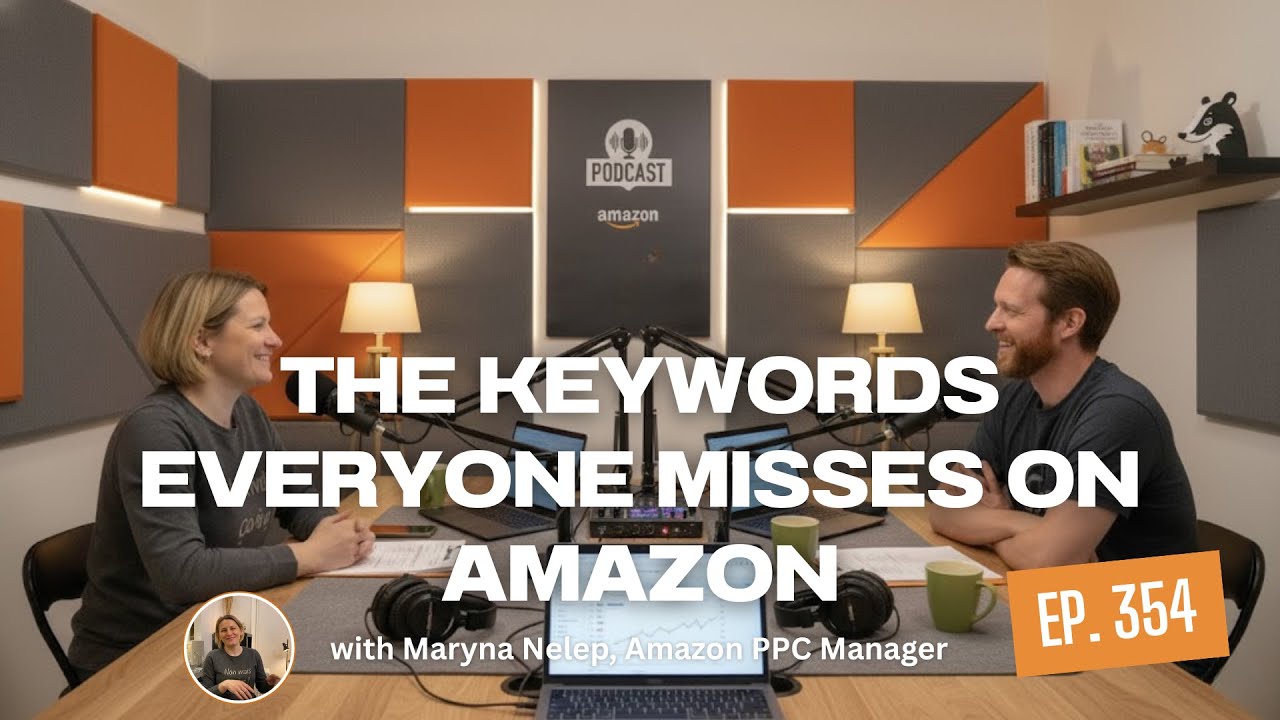
We are bringing Maryna from the Ad Badger team. Let's talk about some of the ways that when we're helping our customers. With growing their revenues and profits on Amazon, what is an activity that she does almost every time?
And we found that activity that she does on a monthly basis for all of these people, if not more frequently. And that is search query performance reporting, search query data.
If you're unfamiliar with search query data, or maybe you know about search query data, but you know you should be using it more,
this episode's for you because we're going to break down five ways that Maryna analyzes this For our customers on a regular basis, and it is really insightful. It's a quick way to understand, once you get this data,
what to do with it and what to look for. We're going to be analyzing things like, number one, combine your data. That's what we have here on screen.
This is a little spreadsheet that we use internally here at Ad Badger, where we've got the search query. And if you're unfamiliar with it, I'll give you a quick one minute overview.
What a search query is and what the search query report gives you from Amazon, unfortunately this is just sellers only, but what this gives you is true search volume directly from Amazon.
It is the only place on the internet where you can get search volume over time for Amazon searches directly from Amazon, which is incredible. Then for your brand or for your product, it will tell you of those searches,
of these impressions, of how many orders there were for this search, how many did you get? And what was your percentage share of that? So it is the only way that Amazon will give you your combined PPC and organic conversion rate,
share of purchases per search query. So you can do so many things with this data. You can know if you're losing market share, if you're gaining market share on a per search keyword basis. It's incredible. Let's dig in.
I thank Maryna so much for her first appearance on The PPC Den podcast. Give it up to Maryna. Thank you so much for selecting these five use cases in which you can use search query data.
So my friends, in the tech world, a new phone comes out, they review it, all the YouTubers review the new phone. But the real reviews, the ones that actually matter for like a cell phone are like,
Using this phone six months later, 12 months later, how does it hold up? My friends, search query data has held up and it's held up in a big way.
We're going to be sharing things today that I don't think you've heard of when it comes to search query data. Just really practical. Go and do this stuff. Make your PPC better. Make your organic sales better. Gain that market share.
Have a good one. Thank you so much, Maryna. Let's jump to the episode. So on a typical month, how many times do you use search query data?
Speaker 1:
It depends on the brand size actually, but usually I do it once a month because, well, sometimes it can be week over week if the brand is big and I have to be more precise on the keywords. But usually it's once a month.
The data, like the storage of the data more efficiently, I don't know. And I have more data for analysis.
Speaker 2:
So why do you think that the search query performance data is such a powerful tool?
Speaker 1:
Well, Amazon has plenty of reports inside, but actually other reports, they just give an imagination of how a campaign is performing and different keywords performing products and so on. But they don't show the real customer's voice.
So we just see the statistics for those keywords we put into the advertising and that's it. But people can think absolutely differently. And we don't know about that looking at like usual reports. And search query gives us that possibility.
Speaker 2:
And I think it's really interesting. You know, you said the customer voice and I think it is the best tool in the world. For telling you market demand, so like it tells you who's searching what,
and it tells you how many times it's being searched. It's telling you the top thousand searches for your product scored by Amazon. And it's all first party data,
meaning you could look at it and know that there's a lot of validity to it because it's coming from Amazon, like directly from the horse's mouth.
And it'll tell you if Searches are going up for your product or searches are going down for your product. So I love search query data. We've talked about it many times on this show,
but it was so important to talk to someone who's actually using it on a regular basis to uncover insight. So we have five examples of using search query data that I hope inspires people to use this information a little bit more.
Maryna, walk us through the first one. Finding hidden gem keywords.
Speaker 1:
So this is actually not like a canonical search query performance report. We adjusted it for ourselves, adding here some conditional formatting.
So we highlighted the numbers, for example, for brands CTR and CVR, which are way higher than market average. And that helps us to see the future clearer and it is more understandable for us. There is an interesting story behind this.
This shot, actually, the client asked us to promote the handkerchiefs, the handkerchiefs. And we did an amazing job collecting the semantic core and creating campaigns. So we launched all we could and we thought we did a good job.
While we didn't check the search query performance and found that people Names our product differently. So they don't call it handkerchiefs, they call it rags. And this keyword, any of this keyword, we never met in other reports.
So we checked search term report on a weekly basis and we didn't meet this keyword anywhere. So we decided to dive deeper into this cluster. And found that this cluster is pretty huge.
So you see our market impressions are really high for those keywords. So we included this cluster into our campaign structure and got 15% in sales increase in a week.
Without this tool, we couldn't, we couldn't, this report even didn't come to my mind that people can call it regs, you know.
Speaker 2:
And it's funny because you can find new keywords in a lot of places. You can use a keyword research tool, you can use a search term report, but using it for, using the search query data for new hidden gem keywords is actually,
this is the first time I think I've really heard this. So basically what we're looking at here is you put like a filter in the first column, I suppose for every single search query with the word like rag in it, like sweat rag for it.
There's actually a ton of impressions here, like tens of thousands of impressions. So this is incredible. You know, I was just talking to someone and they told me like, oh man, I know I should be looking at search query data.
But, you know, I haven't done it in, you know, a year. And this is like an incredible reason to dig into here. So once you found these terms that were sort of outside of the normal scope of keywords,
after doing all the research, analyzing search terms, When you found these, did you take all of them and just put them in a manual exact match campaign? Were you selective about this?
What was your decision-making process on moving from this data, where it's like, oh, there's a whole bunch of terms involving sweat rag that I didn't think of. What's your process of incorporating them? Are you putting them in the listing?
Are you putting them in PPC campaigns?
Speaker 1:
I always follow the data, so I don't come up with anything. So when I look at the data for those keywords, I see that some of them have high CTR. That means people react to them very well, but they have very low brand impressions, actually.
So like for keyword is market impression is almost two thousands. But our brand impressions are just 50. But it is the high CVR, 4%, compared to average market CTR, which is 1.58. So it's a huge difference.
And in my opinion, this keyword deserves to be in my advertising campaign.
Speaker 2:
So you're looking at how good the click-through rate is for the brand, how good the conversion rate is for the brand, and then you'll lead with that to put those inside your PPC campaigns.
Speaker 1:
Yeah, and I put those keywords in separate campaigns. Pretty clustered and comprehensive ad structures within Badger. So we put one cluster keywords in one campaign. So we know how this cluster performs actually for this particular product.
I did the same for those keywords. I put them into exact campaign and looking at my high CTR, I increased the placement, top of search placement by 25% just to check. If it converts better there.
When I saw keywords which perform, I added those keywords into phrase campaign just to find different variations of those as a test. And, you know, it brought me some new keywords. So altogether gave me 15% sales increase. So it's not bad.
Speaker 2:
Awesome. I love it. So this is how you can find hidden gem keywords inside your search query report. Let's jump to our second slide here. Alrighty, Maryna.
On the next one, we have labeled low impression share, but high click-through rate and high conversion rate. And basically what we're looking at here is low impression share.
So you're referring to the brand itself, the product itself as low impression share. But these terms have high click-through rate and high conversion rate. We've got a bunch of green CTRs and a bunch of green CVRs, right?
A bunch of green click-through rate, a bunch of green conversion rate. We've labeled these because it's doing better than the market click-through rate and the market conversion rate.
However, when I look at the impressions here, it's really, really low. This is another interesting combination of finding low impression share, but high click-through rate, high CVR.
And there's some spreadsheet work, data manipulation that you had to do to find this, but it's incredible information. Tell us why it's incredible information.
Speaker 1:
This slide shows us that we have pretty convertible keywords with high market impressions, but low brand impressions. And that means for us that we are underperforming on our PPC for those keywords, probably.
So that's the signal for us to go and investigate where those keywords are advertised. Do we have them in our ad structure in general? And probably if they are somewhere in, I don't know, the bottom of older campaign or somewhere else,
it's a signal for us just to move those keywords into their own campaigns and give them more air to breathe so they can perform well for us and that can give us more profit.
Speaker 2:
And when you put them in their own campaign, you're doing it as an exact match sponsor products.
Speaker 1:
I love exact match actually. This is the core of my ad structure. So I do very thorough work collecting the semantic core. So yes, when I see the interesting search query, I put it into exact first.
If it performs well, I can extend it up to phrase. Just to check different long tails for this keyword.
Speaker 2:
There's actually an interesting thing that people might not notice here. But in this little spreadsheet that we have internally here at Ad Badger, what we have is like men's undershirts for sweat.
You can see like it's got trends up, trending down. But for a lot of these, it's just a singular number. People might not know this, but with a search query report,
the same Search query is not necessarily found every single week for a particular product. So I think that's just an interesting call out that I wanted to highlight here that we do a lot of downloading of search query data.
We store it so that we can look at it and manipulate it. And one thing that I don't think people are aware of is that like the same query isn't found every single week.
And that makes it Even more important to collect the data stored over time because search queries might go in and out of your report. Like maybe, I mean, we're talking about like the brand got one click for this.
So it's possible that it like falls off next week, comes back in two weeks. But by storing the information in a database, you're able to query it and like use it and pull information out.
Because if we were just looking at one singular report, we might have missed some of these. So this is like the combination of many search query reports, which just makes data so rich. You know,
that's why we store Search term data inside our databases so people can use their search term data for years on end and find really cool trends. So this is awesome. So low impression share, high click-through rate, high conversion rate.
Go find these, put them in your PPC campaigns. Awesome. Thank you, Maryna. Let's jump to our third one. Okay. On our third slide, we have high impression share, but low click-through rate. How do we think about this kind of search query?
Speaker 1:
So those keywords, search queries, you see that we have pretty high brand impressions and they are compared to the market impressions.
They have high brand impression share, very nice conversion rate, higher than market average, but low CTR. What does that mean?
That means that when people, the customer, they request this query and they see our thumbnail of the product on the result page, they don't react on that. They don't understand if it's relevant to their request.
Maybe they don't like the price, maybe they don't like the image, maybe title. Maybe there is no this keyword in the title and that means that we have to add it there. So there is a room for improvement in thumbnail direction action.
So that's probably there. Or second way how we can translate this image. Now we can be shown somewhere in the bottom of the first page or somewhere on the second page.
As you know, Amazon counts an impression if your product appears somewhere on the page, but not necessarily customer sees it. So that can be, it can be somewhere in the very bottom.
People don't see you, but impressions are high in this case. So that's a signal for you to go to the advertising campaigns, check for those Search queries and find where they are advertised and if they're advertised at all.
And so if they are in good places in the ad structure, that means that there is a problem with the thumbnail. So I have to work on that more.
Speaker 2:
Ryan, there's so many fixes you can do there. You can do a PICFU test. You can simply just look at your image compared to everyone else's and think about what you're missing. It's possible people aren't clicking for price-based reasons.
Maybe the star rating or reviews isn't high enough. So there's lots of good considerations here. And I love it. So this is the third way here. High impression share, low click-through rate.
Let's jump to the fourth use case for search query data. RAD Marina, we've got a big sheet here. And at the top of it, we've got high impression share and click-through rate, but low conversion rate. Uh, let's talk about this.
Speaker 1:
Even listing preparedness. So some listings don't have even bullet points. They don't have good images or videos, insights, which explain how this product should be used. They can be buy box absent on the listing.
So that's a signal to go and check your buy box percentage. And that can be price. So when you know that on the listing there is a A place for competitors advertising.
People can see their offers with better price, for example, and buy from them. So you pay for attracting those clients, but competitors win from that. And that's not good.
So you have to analyze who is advertised on your listings, compare your prices, your offers to those competitors, and find the gaps you have to fill. That's the main.
Speaker 2:
Amazing. And let's jump to our last point here. This one comes up a lot in conversations that I have with people, which is, you know, am I pacing with market growth? And unfortunately, we're looking at a keyword highlighted here,
where if you look at our little sheet here, the search volume is up. However, this particular brand, this particular product is losing impression share, losing click share, and losing purchase share. Ouch.
And this is like a big search query too. This is a big keyword. There are lots of orders for this in a singular week and we are just sort of like going, you know, we're losing market share.
And I just wanted to highlight, this is so powerful to know, right? When you look at your PPC campaigns, you see performance for the PPC. When you look at organic ranking, you see your position moving up and down.
This is really the most accurate report that actually tells you, are you getting more purchases for a particular keyword or fewer for a keyword right next to the search volume for that keyword?
Because it's telling you your purchase percentage, you know that it's not like, oh, I have more orders this week. Did I gain market share or lose it? I have fewer orders this week. Did I gain market share or lose it?
This tells you if there were more searches, more purchases for this keyword, and did you pace with that? Did you grab more market share or lose market share? So this one's really cool. Losing market share with a search volume. is increasing.
You know, the best marketers know how to be strategic and technical. So this is sort of giving you a more strategic edge, isn't it? So how does this help me understand?
If I notice this combination where search volume up But market share down, what does this mean for this product and what can we do about it?
Speaker 1:
As you read the search query itself, it tells us sweat rags for men. And that's exactly that cluster that we missed in this case. So now we include it, but it's a previous report.
So yeah, that means we underpay for this keyword in our advertising. In our case, we didn't pay for it at all. And now the situation is different, but also the situation should be another signal.
It should be a signal to go to the brand analytics, to the top search report and check who takes the lion's share of the market for this particular search query.
So if those competitors are super strong compared to us, like they're old and you know, And they take about 70 or 80% of the market.
So it doesn't make any sense to waste money for this keyword because it will be too expensive for us and probably we won't increase our market share for this keyword.
So it's better to go and to find something more affordable, more cheap for us.
Speaker 2:
Amazing. So there's a different approach for sort of every bucket of Keywords, right? If you were to give people the first thing to do, like out of these five,
right, we had finding hidden gems and finding hidden gems were just simply words that we weren't even aware of. Low impression share, but high click-through rate, high conversion rate. High impression share, but low click-through rate.
High impression share and click-through rate, but low conversion rate, and then losing market share, but search volumes increasing. This is a lot of good stuff to do, right?
If you could give people just one thing to do with their search query data today, which one of these would it be?
Speaker 1:
I would suggest collecting the data from today. Download the search query reports each week or month, depends on the Print size and collect this data somewhere in the table.
You can see clear trends and make more thoughtful decisions based on that data.
Speaker 2:
Yeah, then once you combine multi-week or multi-month data, you'll be able to run analysis like this, where you can see the changes in search volume, the changes in your particular share of sales for all this stuff.
In the Amazon world, there's a lot of hype around something new, and it's very rare to come back and revisit, was this actually worth it? Was this an enduring component of our digital marketing? I just talked to someone who said, man,
this particular thing The PPC Den was so hyped up in our industry and now I don't think anyone uses it anymore because it was just pure hype as opposed to like things that actually endure over time.
So this is absolutely one of those things that has endured over time. And Maryna, I thank you so much for coming on and sharing your analytical brain with us, your strategic brain, your technical brain.
Surely you've made the people out there in Badger Nation a little bit better. Optimizers of their campaigns. Final thoughts on search query. Do you think you'll be using it in 12 months from now?
What do you think is going to continue to endure?
Speaker 1:
Oh, if Amazon lets us do that, yeah, for sure.
Speaker 2:
For sure. Well, thank you so much, Marina. Have a good one, and I'll see everyone else next week here on the PBC Den Podcast.
Unknown Speaker:
I've launched campaigns and picked keywords. I've got my bids, set placements too. Now bad music, I've made a few. I've had my share of rocky roads, but I've come through. Oh yeah, I'm a creepy citizen, my friend. Who are the PPC dead?
We're talking about Amazon. No time for medicals, cause we've fixed the game.
This transcript page is part of the Billion Dollar Sellers Content Hub. Explore more content →