Ecom Podcast
5 Hidden Issues Killing Your Ad Performance
Summary
PPC Den shares actionable Amazon selling tactics and market insights.
Full Content
5 Hidden Issues Killing Your Ad Performance
Speaker 2:
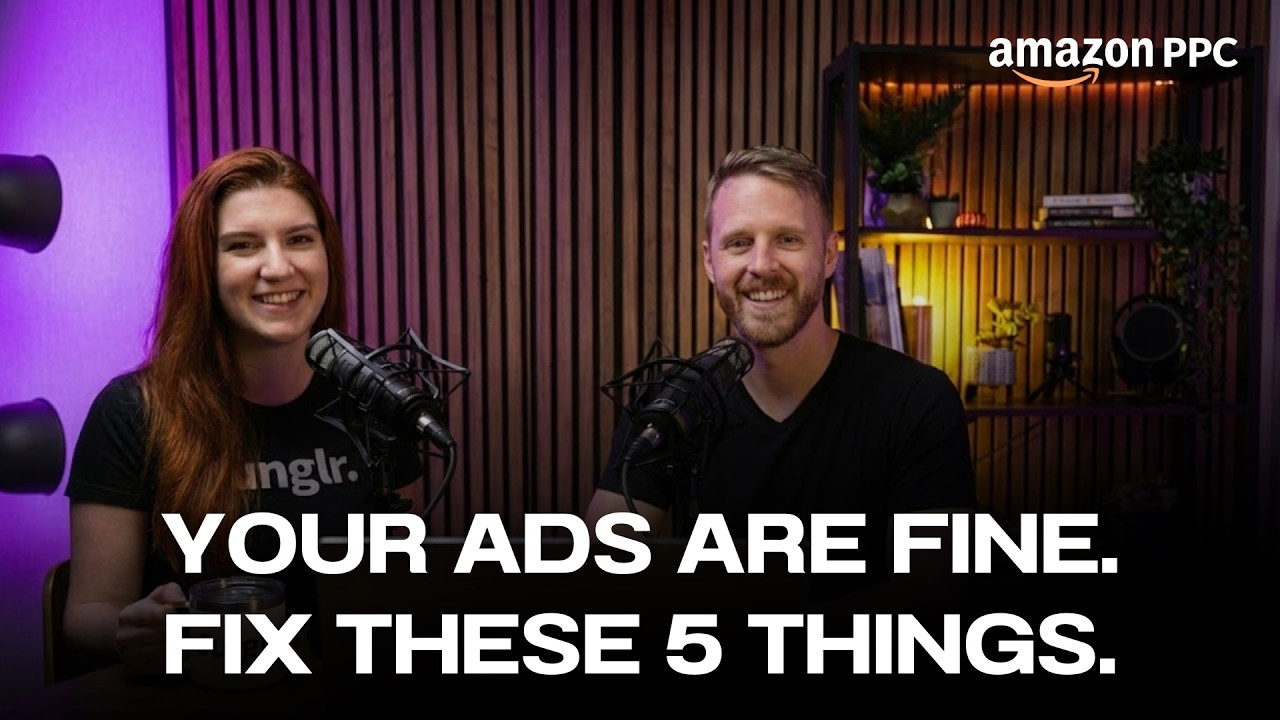
Elizabeth, before we get started, I want you to caption this image that I'm about to put on screen for you. Oh, I didn't tell you I was going to do this.
Speaker 1:
Putting me on the spot. All right, let's go.
Speaker 2:
Yes, I didn't. I didn't tell you I was going to do this, but here we go. The thing that I would like to share with you is this picture. I love this picture of us. Could you just could you caption this image?
Speaker 1:
I would say leaving it all in the field. That is the face and the body posture of someone who has been hard at work for hours and hours.
Speaker 2:
It's probably six hours of Amazon marketing material.
Speaker 1:
Yes.
Speaker 2:
And I'll be honest, I don't even think I ever saw it.
Speaker 1:
Well, it was a lot of footage to sift through. Like, I mean, we covered a lot.
Unknown Speaker:
We covered a lot.
Speaker 2:
It was great. And yeah, I actually don't know if we ever even released it.
Speaker 1:
Bits and pieces. I know snippets were released.
Speaker 2:
But anyway, thank you so much for coming back on the show. It's always so fun to create content about Amazon marketing and PPC with you. How are things going over at Jungler?
Speaker 1:
They are going well. They're going well. I always seem to like at the end of the year somehow gain momentum and then that's just a continuation in January. So that's kind of where we're at now. And so yeah, going good.
I'm happy with where we are. Also unhappy with where we are because there's always more to do. So it's but it's I think that's kind of I don't know, agency life, business life.
Speaker 2:
The treadmill never stops.
Speaker 1:
Yes.
Speaker 2:
Especially in this industry. It's always changing.
Speaker 1:
It does.
Speaker 2:
And I think one thing that has changed over time. So if you are a marketer on Amazon, specialized and focused in on Amazon advertising, there are countless times where you are looking at your ad account and something might happen.
Performance is worse. And I think over the years, This has changed specifically of like what non-PPC issues are influencing PPC performance that a PPC marketer should begin to pay attention to,
check, monitor, so that when these things happen that influence PPC performance. This is a common theme and we've actually talked about this before on the show, which is like we had a flow chart of like if your sales are down,
Before you start mashing your PPC with a sledgehammer, go and check this, go and check that. And that list has now grown of non-PPC issues that influence PPC. We're going to talk about some today.
And the reason this came up for you was because I asked you like some recent client calls, what came up on these calls? And a lot of it you mentioned were these non-PPC issues influencing, you know, entire business on Amazon, not just PPC.
But of course, PPC is always under the microscope first, because it's dollars out the door. And it's usually so yeah. So talk to me about that. Like what came up for the sellers? Like how did you discover these issues?
Speaker 1:
Yeah, I think discovering these issues is probably something that would be very helpful because I feel like a lot of, you know, other other people who might be managing ads, if that's part of it,
be it a brand manager, maybe at an agency or freelancer. But then also I think business owners, this is a helpful exercise as well. So we've developed a report back last year,
and then we've really just been discovering more and more use cases for these reports. And so what we call them is we call them a push-pull report, which basically means like, where do we need to push? Where do we need to pull back?
And then we're also using it as like a diagnostic tool. And so for context, we manage a lot of brands with very large catalogs and oftentimes like...
Speaker 2:
Give me a number.
Speaker 1:
20,000, 50,000 SKUs plus. A lot of variations as well, which adds additional complexity into that. One of the things we're going to touch on is like some issues that,
you know, can potentially come up that not many people realize when it comes to, you know, some issues within the catalog for variations.
And so in sort of managing these really large complex accounts with a lot of diversification in terms of strategy, profit margins, you know, I've always maintained that if you had one or two,
maybe three products in an account, you could have everything completely dialed in like to a tee. And then as the catalog grows, you kind of have, you have your top sellers, which are like, say, the one or two,
then you got kind of this messy middle, and then you have laggards. And depending on, you know, kind of how good each product is doing, just depends on the kind of like the segments of the account.
But the question is, like, how do you push forward When everything is complex, how do you make sure that you're managing towards something? And so what we've really leaned into this last year is really a good flow diagnostic.
And it starts with Mondays, a full assessment across every single account, every single product. And that's really been a core driver of a lot of the impacts. And then it has surfaced a lot of these issues. So what does that even look like?
That looks like us, again, generating a push pull report. We're looking at month to date. We're looking at performance metrics across every single parent as well as every single child because we know where our benchmarks need to be.
We're also looking at every single week we have goals for the month, and then we're pacing where the performance month to date is against those goals. So question is, are we going to hit goals? How is every single product performing?
Again, that's done weekly because that's quite an intense analysis. And then obviously we check the accounts throughout the week as well. We have a specific cadence for checking. But what this is service, we're also looking at month to date.
So we're looking at it versus, you know, kind of past performance. We're looking at this versus same date last year, where sales, you know, because sometimes there's, we're coming off a Q4, let's be honest, most brands Q1 are not Q4s.
And then we're looking at last year's as well. And then we're looking at a 7 over 7 date. So we're just saying, okay, where are we on pace? What does it look like seven over seven day?
And then in a lot of times when you're looking at like week over week changes, oftentimes things get flagged, rightfully so, right? Sales went down. Performance went down. Total A cost went up. We're looking for trends.
To us, a trend is a three-day increase, decrease, depending on the number. We found about a three-day to be a good indication of a trend because sometimes you'll have a one-day weirdness. And so we're kind of ingesting all these things.
And then obviously, if something goes up like total A cost, well, we need to troubleshoot that. And so what we keep uncovering because we're doing this, you know, sort of really intense,
deep analysis weekly, again, across every single account and every single product is we're uncovering things that are not ads related. So as we go through all of these, like, you still need to adjust advertising.
And I'm here to talk about the root cause for these things. Buy box issues, inventory issues, catalog issues. It's not like you just throw up your hands and go, ah, well, it's not an ad. Performance is still not where it needs to be.
We still need to adjust. A lot of why these things are happening are not necessarily advertising. So advertising needs to be adjusted to, again, kind of help put our metrics back on track of where they need to be.
But it's not as if we made major changes or launched a bunch of campaigns or didn't add negatives and what we were supposed to. It's not like there's a lot of bleeding in the account.
It's just that there's extenuating circumstances that are outside of our control. And what we're finding is that we are flagging these issues more often than clients are in their own accounts.
Again, it should technically be completely outside the scope of work. But again, because we're so in the weeds in terms of troubleshooting and identifying root causes, We're finding that like, we're again, so when you're asking me like,
what are just coming up on client calls? It's like, we're constantly again, proactively flagging all these issues. And then it's like, okay, so how do we strategize around these issues? Right?
Because again, we're not throwing up our hands and saying, Oh, you know, we did everything we could, we're adjusting for it. But that's kind of the context of what we're going to be talking about.
Speaker 2:
So I've got a couple questions. You mentioned that every Monday products are scanned, performance is scanned. What is the date range of that Monday check-in? Is it the previous Sunday to Saturday?
What is the actual date range for weekly analysis? I feel like sometimes people actually don't know.
Speaker 1:
That's a fantastic call out because even if we did pull yesterday's data, Amazon doesn't update the total or the account conversion rate, so unit session percentage.
And sessions, those have a, I believe in most accounts, it's like a two-day lag. So if we're looking at it Monday, then yes, you know, we're looking at it from eliminating those two days.
Speaker 2:
Just wanted to ask that because that does come up periodically. Like I know some people do their sort of weekly polls on Tuesdays for the previous Sunday to Saturday as well.
So they're like, They wait Sunday, they wait Monday, and then they look at stuff on Tuesday. I would say my thought on that is Amazon is funky. The way that data settles is strange and unexpected, I would say. There's a degree of variability.
And not only that, but if you look at performance for previous Sunday to Saturday, today, and then you look at it again next week, those numbers will change. So I think there's a degree of variability.
But as long as you are as consistent as you can be, you can try to account for some of that variability.
Speaker 1:
For context, because I think maybe this would be helpful. This analysis that I'm talking about on Monday that's uncovering these root causes, that's a Like you said, we're looking at seven day over seven day.
We're looking at month to date versus prior period versus same day last year. Again, to say like, are we on track? And then what has happened recently? That's what's built into like this more deep dive evaluation.
But for context, the relatively speaking, you can be pretty confident that like yesterday's data has been like, okay, updated in terms of total sales. Ad spend, clicks, and orders, roughly, again, you have some backdating there.
So throughout the week, what we're doing is we are still evaluating the account, looking at again, still month to date, but then we're also looking at for potential negative trends as well, which again, is like a three.
So that's even like a recent three day period to say, Because that's very common, right? Maybe like if total cost goes up, I want to know about it as absolutely freaking soon as I can, right?
So I'm not saying that this is the only date range to evaluate. I'm saying when trying to spot these specific issues that we're going to be talking about, looking at these data points are helpful.
Speaker 2:
So I guess like we've got a couple different issues here. Inventory issues, catalog issues, pricing issues, return rate and buy box issues. We're going to do a quick scan here, but I'm really curious to hear how you think about all these.
Let's start with inventory issues. You know, Amazon is so momentum based and I actually will still bang this from the rooftop.
I actually still think there's a percentage of companies on Amazon that don't realize how much Amazon algorithmically doesn't want you to stock out, doesn't want you to kill your momentum, doesn't want you even to be, you know,
they want you to be in an ideal range, a Goldilocks zone of inventory. And I'll meet a lot of sellers that will have inventory issues. And it's almost like, well, you know what, you know, What can we do about it? This is my issue, right?
It doesn't impact my sales type thing. It takes a lot of time and nudging because it's not so apparent that if you're not in this Goldilocks zone of inventory, Amazon doesn't like that.
There's a penalty for doing that on the algorithmic side. Number one, how do you spot this? What is the actual metric you're looking? So, what are we looking at on that monthly thing? I take it you have a list of all these products.
What's the thing that you are adding to this spreadsheet or this dashboard that you're looking at?
Speaker 1:
Yes, we're looking at days of coverage. And so, days of coverage is going to be how much checked in FBA inventory we have. Now, we also have ways to, again, sometimes check-in times take a little bit longer. There's inbound that are coming.
So, we do take that into account. When we're looking at these things, what we have found is that I used to think it was roughly 30 days. And then now in doing evaluations, we've come to see like somewhere between 40 and 50 days.
So we'll say like, hey, roughly 45 is a good, you know, kind of like middle. Of days of coverage is kind of the sweet spot and where we will want to be. And so how you look at days of coverage is like, what is my FBA inventory?
And then what is my average daily sales rate? And then you just divide, you know, FBA and, you know, available inventory by that, and then you get your days of coverage. So what we'll do is, and again, we'll run that as we evaluate sales,
because what we found is that If your days of coverage wanes, especially if you get under 30 again, I recommend a 45, but if you get under 30, you will see impact on your conversion rates is the one thing we found,
which is interesting because I thought it would be on the traffic and there is a slight marginal decrease on the traffic, but I've found that the major effect is the conversion rates.
I still, I firmly believe this, that if there is one thing you can do as a brand owner to help grow and stabilize your account, it would be Getting your logistics in line. Especially for your best performers.
Like, if you did nothing before the top half of your catalog that drives the majority of your business, worked on nothing else but nailing down your logistics, You would be in a much better position.
Speaker 2:
Speaking of, I want to jump to in this related issue. So just sort of capping that one list of inventory, sort of like I've seen other dashboards where it's like all the products, you know, average daily sales, amount of inventory,
which gives you how many days left of inventory or weeks left of inventory. Pop that into a spreadsheet, monitor and track that and see where, you know, You're good and where you're bad.
Related to logistics and checking to see if your ship times are good is, of course, buy box issues. Buy box issues can happen for a variety of reasons, even when you're the only seller.
And when I say buy box, I think I incorporate if there's other sellers of the product, if there's shipping time issues, as well as a result of things that you mentioned, have seen that influence conversion rates.
So like the first time I ever heard of this was a presentation I was watching and the person was saying they had very little inventory in California. So even though they were prime, their shipping times were really slow in California.
As such, their actual return rate was really high for products and their reviews were bad for people getting it late in California. Ultimately,
they realized this became a logistics issue and how do I fix this and spread out my inventory better and they had to tweak some settings. So I think buy box issues are really interesting.
I've been learning more and more about buy box issues. Recently, and how they can vary from different states and different zip codes. So I've been learning a lot about this.
So Is this another thing that gets evaluated in a Monday check for you? And specifically, what are you looking at?
Speaker 1:
Yeah. And for clarity's sake, I think it's helpful to know that the trigger for looking at these things are declines in performance. It's normally declines in sales, increases in Total ACoS, I think, are the two biggest triggers.
If we have an increase in ACoS, yes, that's something that's important. But Total ACoS relates more to the profitability of the account, decons and profitability, because we do check the profitability of all of our clients as well.
We have a tool that, you know, kind of takes into account COGS and things like that. So it's looking at business metrics, things that are really important.
And then if there's a decline in any of those or if they haven't increased the way that we thought they should, let's say we invested more in ad spend last week. We're going to talk a little bit about sales. Total sales didn't follow.
Total A cost is elevated. We need to go in and say, okay, where are we moving? And then what are the things that are not headed in the right direction on a product level? And then when you're troubleshooting the product level,
one of the things that you might troubleshoot would be again, inventory or buy box. It is helpful, I found, to track BuyBox across an entire account. Let's say that you are a brand manager who you're managing more than just the advertising.
You need to know BuyBox on every single product. But when it comes from an advertising perspective, yes, It's helpful to know we don't have buy box on some of that bottom half of the catalog,
but to be honest, it doesn't impact the performance we can get as much. So what we have come to realize is that although we could potentially run audits and surface issues across the entire catalog,
We would prefer to simply flag and surface the issues that are creating the biggest impact so then clients don't have to go through and sift. We kind of like can pre-sift things and then those are what we include in our call outs.
Speaker 2:
When you think of your business in general, I think this is a question for any either seller or service provider, which is, is there ever a world where you think, like, would you define yourself as a Amazon advertising agency?
Speaker 1:
Yes.
Speaker 2:
Should an Amazon advertising agency have, potentially it's a partner or a contractor, or maybe it becomes this big of an issue that one team member is dedicated to it internally. I'm always so curious on this, where is the scope of work?
The way that I experience this is a seller will come to my company and then list these problems and We fix like 20% of them and like they need other solutions. So I'm always like conflicted for what an agency scope of work should be.
What are your thoughts on that? Like how have you evolved these thoughts? Because like the evolution is like maybe years ago didn't look at them and now we're at least surfacing them, sharing them because it's influencing PPC performance.
Is the evolution you think like 12 months from now, do you think you have Sofiia Podash is someone that audits people's inventory performance type thing. What are your thoughts on that? This is like a side question.
Speaker 1:
Sofiia Podash Yeah, that's a good question. So I don't see a world in which we build out a solution that fixes those things, mainly because I think It's quite easy for us from an agency perspective to say, hey, we are an advertising agency.
There is a world in which you surface listing issues that I think that's the main one is, you know, you surface SEO, potential SEO issues. And then all of a sudden, now, at that point, it's still a bunch of questions on,
okay, what would you recommend for this? What would you recommend for that? Do you guys have any experience with this? Those conversations, we like to be as helpful as possible,
but that's quite easy to cut that off at the conversation level. If it becomes well outside of scope with simply a, Hey, here's what we've surfaced. Here's what we understand. This is kind of outside our scope of work.
And to be honest, outside of the scope of expertise that I feel comfortable fully giving you the answers to that. Here's let's surface. And that, you know, kind of brings the conversation back into, Hey, we're managing ads for you, right?
For us, it's. Partnering with brands, that's a big piece of who we've identified we work best with is someone who either some of our partners have agencies that fill in those gaps.
And so what we do is we do our best to have those conversations. Behind the scenes, integrate well with the other agencies. The way that we would do that is, okay, let's say we have buy box things where we're noticing inventory things.
Hey, what is your process for flagging this? How do we just make sure that we're not doing overwork? We don't want to surface things of the kind. I'm not trying to make anyone else look bad.
I'm just saying like, hey, here's the things that we've noticed. Can I just okay then integrate with another agency partner and then we can work together to help solve these issues without the client having to be,
you know, kind of caught up playing telephone or oftentimes they have somebody who is internal. Who does those things? And then we can then, of course, have the conversation directly with the brand.
Speaker 2:
You mentioned pricing just now, too. I think pricing is an interesting one, too, which, of course, influences PPC. And typically, like the PPC marketer who's looking at PPC performance, you versus the competition,
you know, looking at the search result page and like seeing who ranks for this stuff. The PPC marketer usually finds a trend and like where pricing should be or where it shouldn't be.
And I think I've heard more and more agencies like have these conversations with their clients because it is almost like it's such a big factor.
Like when you search a keyword, what's the pricing of the top 20 products and like where does this particular product fit in? Is pricing something that you look at on a proactive basis or reactive basis? When does this come up for you guys?
Speaker 1:
Yeah, and I think it's because we're strictly advertising in terms of, again, scope of work. We would look at it on a reactive basis.
We tow the line because we do have a team who is comfortable Giving some recommendations in terms of pricing. And we do actually have a whole pricing SOP that we send clients. Now, again, we're not the foremost experts on pricing.
What I did is I have some friends in the space who run a really fantastic repricing tool that a lot of our clients have used to great success. And it's worked really, really well with what we do personally.
And so the tool is called AZSellerKit. I highly recommend them if you're looking for a repricing tool. So it's not that increasing pricing or decreasing pricing is necessarily a bad thing.
It's just what does that do to your sales velocity if it goes up or maintains? Fantastic, right? But if so, let's say you decrease the price.
Some sellers will do this with sometimes you decrease the price and the sales velocity doesn't get any higher. You don't increase in conversion rate. All you're doing is giving up profits at that point. You want to see some acceleration.
Well, because the pricing has decreased. That means your sales are decreasing because you're making less per order, which means even if we're maintaining what we're doing on the advertising side in terms of spend,
your A-cost is going to go up and your total A-cost is going to go up. And again, because we have a constant, consistent,
and actually proactive flagging system for the metrics that we need to keep an eagle eye on in terms of the advertising performance, we will be able to catch those things very quickly. And then, of course, surface those things.
Two problems I see. One, not being strategic with the pricing. Um, not understanding how sales velocity plays into market share, because that's a huge one. If you increase your price, but your sales velocity decrease, your rankings will drop.
And I've seen that with other repricers or maybe clients just kind of making snap judgments like, oh, I'm just going to raise the price of dollar and let's see what happens, right? There's not really any strategy behind it.
Sales velocity decreased. Organic ranking decreases. Everything kind of slows. Numbers get worse. We say, okay, now we need to fix it. So let's lower the price back down to where it be.
But at that point, you have less market share and now we got to play catch up. So if you are constantly dropping, increasing, slowing velocity and then dropping, you're going to have to constantly play catch up to regain the market share.
If you just say it steady, kept it where it needed to be, you would actually probably come out better in the long run.
Speaker 2:
Shifting gears now to catalog issues. Is this referring to parent variations? This is always such a thorn in so many sellers' sides. How does this get surfaced typically? When does this come up in conversations?
Speaker 1:
The most recent one that I can think of is there's one client who is just going through a catalog cleanup. And actually what we have found is if when a client is going through a catalog cleanup,
be it in-house or be it with another agency, we've been realizing that it's Really, really, I would say beneficial but almost necessary to have really good coordination with the catalog team and I'll tell you why.
So, what happens when there's a parent child relationship. We are seeing child ASINs on the same parentage show up more than once in search. People are flagging that it is happening, but it's not happening a lot.
So typically what happens is when you have one parent ASIN in your advertising, Typically speaking, one of the child agents is eligible to show on like a specific search page. Now you can have a show more than once,
like you can get the video spot and you can get the sponsored product spot and you can get the headline spot. So there's more places that can show up on a search page. But let's say you have 20 different variations.
You're not going to have all 20 of those show up in grid. In a typical sponsored product ad where if a parentage gets split, it's no longer part of a parentage.
You are now eligible to have that, you know, sort of split variation show in search. So what happens is you start getting spent. More spend because you have more than one child ASIN.
Now, we have one brand who some of this happened to, but their products are much higher price. So although things, you know, kind of increased, They have a higher price point. So the click rate isn't as high.
So the impact on performance, well, it did happen. We did need to adjust for it was less versus another brand we were working with, and they have low price points. And there's this like high velocity.
And we have to be very careful about how we're adjusting for that. Because cost per clicks are high, it's a little bit more competitive, lots of Chinese sellers, and all of a sudden, like spend went up.
Speaker 2:
Yeah, being a good PPC marketer is being a good detective. And the last thing here is just return rate. So I think in anyone's weekly pulse, you need to have a list of all the products, how many Total sales, did it have?
And one of those metrics that should get scanned on a regular basis is, of course, return rate. So, yes, an absolutely important one that could, you know, Amazon doesn't want people to buy things and have them be returned.
That wasn't a positive experience for the consumer. So these are things that PPC marketers should be paying attention to. You know, a long time ago, all of these things used to be called like retail readiness,
like, you know, having All these conditions in place. So I think it's almost like expanded in some ways. And one of them is having a healthy return rate, like similar kind of story, like performance is changing.
Speaker 1:
Yeah.
Speaker 2:
One of the metrics that gets analyzed is return rate. I see this sometimes on people's like skew economics report or like, hey, they're just checking their like P&L for each product.
That's when I typically see this pop up and then people can prioritize from there.
Speaker 1:
This is a sneaky one. Um, and this is one that you might not see in if you're looking at advertising performance because totally costs and a cause or spend or total sales. Those are not going to be affected by return rate.
What is going to be affected is the profitability. So for context, we work with a lot of clothing brands. Return rate is notoriously horrible there. A lot of like, say, consumer electronics or other things like you,
you can end up with like a sneaky return rate here. And so what this absolutely does affect is the profitability. And so what we were realizing in working with especially a lot of our clothing brands,
So what I wanted to say is there were a lot of times because they said we have we have these reports where. We pull them up so they're proactively in terms of client facing, and then we found a lot of uses for them internally as well.
And so one of these is, again, a report where we're looking at every single time we get on a client call, we're looking at the entire catalog and the performance of them.
And then one of the things that we're pulling in is, again, the inventory, but then a lot of other metrics in terms of profitability. And so we've also found a lot of benefit in pulling in return rates for these items as well,
because I can't tell you how many times we have looked at specific products, be it new launches, be it existing products, and thought, oh, There's a lot of potential here in terms of the advertising performance and sales and,
you know, the conversion rate. This looks fantastic. And then when you factor in the return rates, you realize even on the performance metrics, again, advertising, a cost, total a cost, you're like, heck yes, double down, sell more, right?
We were constantly running into these areas of the account where we realized, you know, actually, even though in looking at these other numbers outside of profitability, we should be doubling down.
From a business economics standpoint, it just doesn't make sense to do that because the return rate is too high. And there's a possibility if we double down, we're actually going to end up losing the brand more money.
So again, it's kind of like one of those sneaky ones that You would only really find again, if you're factoring in profits into ad strategy.
Speaker 2:
Would you say in 2026, that's a must to do?
Speaker 1:
I would say yes, because margins and profits are there. There's so many things that are eating away at that. And so I think the more visibility you can get into why that is happening, return rates being one of them.
And again, it's so easy for that to creep up. We're going to be talking about in large catalogs and more complex brands. Again, it's not that we shouldn't be adjusting advertising.
If you're running out of inventory, you need to lower what you're doing on the advertising side. If you don't have the buy box, you have a limited, like your ads are just going to auto shut off.
Your sponsored brand ads are going to keep running. Maybe you're making sales for your competitors. You got to keep on top of that. Return rates, again, you need to be careful with where you're pushing.
Catalog issues, okay, spend has increased. Where is this happening? How do we get a hold of that? So there's still things that you need to adjust on the advertising side.
But what you need to recognize is that you're adjusting for outside factors. And so, again, in the instance of Buy Box going down and that causing a sales decrease,
there's nothing I can do from an advertising perspective To help increase sales now, things that we do to try and sort of, you know, navigate those things would be okay.
So if there's an inventory issue of sales have gone down because of that, I can't push any harder on that item. I can find other items in the catalog to potentially see if we can reallocate budgets to,
to see if we maybe kind of smooth out some of that gap because there's now freed up ad spend. Buybox issues, same thing, right? Is there anything else in the account that I can push on? Return rates, okay.
I gotta decrease these or just maybe maintain status quo. Is there other things that have better profitability I can push on? So there's still moves you can make in an account.
There's still adjustments that you can do, but recognize that you're kind of trying to make up for factors that are completely outside of your control.
Speaker 2:
The evolving role of PPC management on Amazon, looking at non-PPC issues that do influence PPC so that you can incorporate them, work around them, and not misattribute PPC performance.
So Elizabeth, I thank you so much for coming back on The PPC Den podcast. It's always a pleasure. And I do think this is the continued evolution of what it means to be managing marketing campaigns on Amazon. Thank you so much.
If someone wanted to get in touch with you, how could they go ahead and do that?
Speaker 1:
Absolutely. So the best place to just see... Kind of where our brains at, what we're working on. I would definitely be LinkedIn. I think we put out the most content there, although we're working on getting better at YouTube this year.
And then if you're interested in like, okay, so I know I have all these issues in my account. What does it look like to work with you? The best place would be on our website, which is junglerjunglr.com.
Speaker 2:
Amazing. Thank you so much, Elizabeth, for coming back on the show and everyone else. I'll see you next week here on The PPC Den Podcast.
Unknown Speaker:
I've picked keywords. I've got my bids. Set placements too. I've made mistakes. I've made a few. I've had my share of rankings. Hello. The PPC Den, my friends. And we'll keep up the music. To all the PPC Den, we're talking about Amazon.
No time for medicals, cause we'll fix the game.
This transcript page is part of the Billion Dollar Sellers Content Hub. Explore more content →