Ecom Podcast
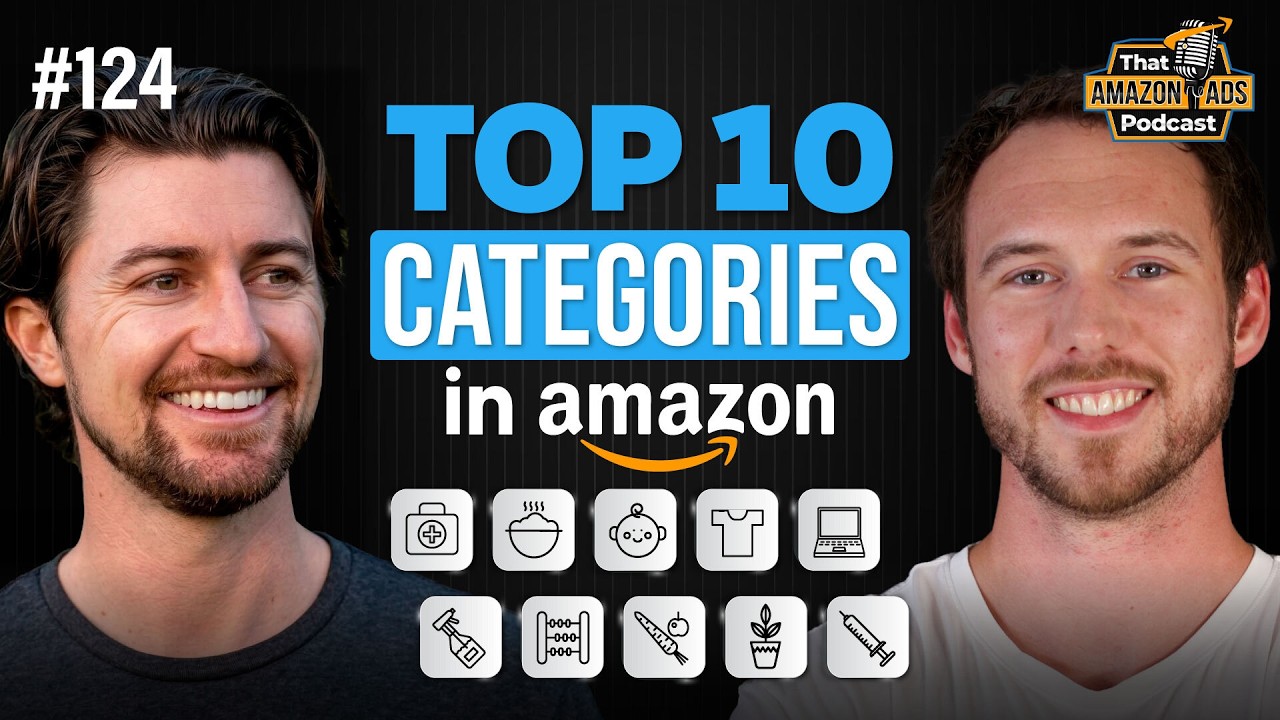
#124 - How To Grow Sales In The Top 10 Amazon Categories
Summary
That Amazon Ads Podcast shares actionable Amazon selling tactics and market insights.
Full Content
#124 - How To Grow Sales In The Top 10 Amazon Categories
Speaker 1:
Welcome back to another episode of That Amazon Ads Podcast, where we are picking up where we left off on our last episode, talking about different Amazon categories, niches, and how you can optimize your account to succeed in each one.
Let's dive in. Alexa, play That Amazon Ads Podcast.
Unknown Speaker:
Which one would you like to hear?
Speaker 1:
The best one.
Unknown Speaker:
Okay, now playing that Amazon ads podcast. These gentlemen are completely changing the game.
Speaker 2:
After listening to that Amazon ads podcast, my ads are finally profitable.
Unknown Speaker:
I also heard they're pretty cute.
Speaker 2:
Alright, 10 categories. We're going to break each one of them down. We're going to tell you the metrics that actually matter, the ones you really need to watch closely in each of these different categories.
Now, we picked the biggest categories, the most prevalent, the Today, we're going to be talking about the biggest sellers, the ones that a lot of you are probably selling in.
The broader category is not necessarily like the really niche subsections of each category, but we chose these just based on volume, popularity, the number of brands within each, the overall volume within each category.
We chose supplements. Obviously, there's a ton of people selling supplements. We've got things like beauty, apparel,
and each one of these is going to have a different mechanism that you really need to understand In terms of how that purchase journey happens and after that purchase journey,
what are some of those key KPIs that you need to understand and be tracking really closely to understand whether your advertising performance is actually being effective? Each one is very different.
Speaker 1:
Yeah, we originally had a list of 50 categories and we were gonna try to make this, you know, a bunch of episodes or We just decided to cut it down, combine these smaller categories into higher levels.
And so this should cover most people, probably 80% of our listeners should fall into one of these categories. So Andrew is the king of supplements. So Andrew, walk us through this one.
Speaker 2:
Yeah, can't you tell? No, I'm just kidding. Haven't worked out in nine months.
Speaker 1:
I meant in marketing them, not using them.
Speaker 2:
Darn, I thought you were giving me a good compliment.
Speaker 1:
No.
Speaker 2:
Supplements is something I know very well. I work with a client in this. So the LTV is really the king. We talked about this on a couple of the other previous episodes where you really need to understand that repeat purchase journey,
understand repeat purchase rates, and what one new customer actually means to repeat value for your business. So if you acquire one customer, what do they actually do after they purchase one time? Do they purchase again and again and again?
You need to understand that. That long term value of a customer. So then you can understand how much you can actually afford to acquire and be aggressive and go after new customers on on a longer time frame.
So you can be more strategic about that. Also within supplements, there's a lot of line extensions. You know, you're building out new product lines, new product verticals and understanding the cross purchase analysis.
Like if somebody comes in and they they buy whey protein, you need to understand like what's the next most likely product that they're most likely going to purchase. Is it a creatine?
Is it a You know, it's not a vegan protein, you know, if it's if they're buying a whey protein. So like you need to understand the relationship between those different products. And then finally subscribe and save. Minimal.
I think subscribe and saves are usually utilized by customers who are just trying to get a quick deal and then they cancel them pretty quickly in the supplement space. But it is something that you can track and monitor to understand.
You should see naturally as your product grows, your subscribe and save subscriptions grow over time as well.
Speaker 1:
Yeah. And when you're looking at like total sales, tacos, conversion rates, when you're trying to combine the advertising performance with the organic and total sales,
it's important to note that like the ad sales If you just look at total ad sales, that includes cross sales. So that's not going to be super accurate for looking at just like that actual Ads,
sales, performance, or the organic sales is going to be incorrectly calculated as well. And if you try to measure how much of your total sales are coming from ads, it's going to be completely miscalculated because of the cross sales.
And if you look at only same skew sales, that's going to be incorrect too because someone clicks on the four ounce and they end up buying the eight ounce. And you're not counting that towards that ad, like that's a mistake.
So when measuring these, you really want to create product groups at the highest level that kind of accounts for all the possible cross purchases that would make sense.
So if you have like, let's say a chocolate protein powder, three different size variations of it, and then a vanilla protein powder, three different size variations of it, and they're from two different paranasens,
it would probably make sense to combine them because one might click on your protein, buy the vanilla. So you want to have high level groupings to analyze the true impact of tacos and everything. Moving on to grocery and CPG.
Andrew, I actually haven't really worked with many CPG brands. We were working with Insulted for a bit. Do you want to take this one or should I go?
Speaker 2:
I mean, I can't really weigh on it too much either. I think the orange juice account at the agency we were at was my only exposure to any sort of like grocery shopping type stuff. So yeah, not too familiar with it either.
But what I can say is it's going to be very similar to supplements where you need to understand lifetime value, repeat purchase rates, the The competitor landscape within grocery and CPG is a lot more competitive,
very commoditized, and it's a lot more difficult to stand out without a lot of really good marketing and key messaging. You know, when I'm going to Walmart and I want, I was telling Stephen before this,
I want some Uncrustables because I eat these little Uncrustables like a child. I don't care if it's the actual Uncrustables. I just want the peanut butter and jelly.
So like, you know, less brand loyalty within these spaces sometimes, depending on what it is. But ultimately, it's a little different than supplements because Supplements are, you know, you're more health conscious,
you want to make sure that what you're putting in your body is like super, you know, good for you. And it's more intentional, whereas, you know,
sometimes you're just buying food and you don't you don't really care as much about which brand or which this or that it is, you just want to kind of get the thing.
Speaker 1:
Costco has a phenomenal crustable alternative that has like strawberry jam. It's delicious. Brand loyalty is going to be much lower for these, like for snacks.
When people are just, you know, they're going on a trip or hike and they just kind of want like trail mix or whatever, you know, you're not going to have a ton of brand loyalty there.
So it's kind of tough because on the one hand, yes, LTV is king. If you have a product that's really good, that differentiates you from the competition, then you're going to get that brand loyalty.
But For a lot of other more like generic snacks, like if you're just selling like apples or oranges, orange juice, whatever, right? It's kind of all the same. People aren't going to care that much.
I don't have a lot of loyalty to any milk brands. I love drinking milk, but I'm just going to buy whatever milk is, you know, the best at that price.
Speaker 2:
One other thing, too, on grocery is like platform diversification, like the retailers getting into retail for grocery is probably going to be like the biggest gateway to extreme growth for any sort of brand operating in this space.
So understanding your platform dynamics, different, you know, Amazon's not necessarily native and known for grocery. I mean, it's growing and it's big. Yeah, for sure.
But there's also a lot of other competitors that are more local Walmarts and Costco's and all this type of stuff getting into those retail stores for CPG is going to be The biggest growth that you're going to see,
obviously, easier said than done.
Speaker 1:
One final thing that I'll say here is sample packs are extremely important for this category, variety packs. When we were working, if any of you guys saw our video working with Insulted, we were doing a case study trying to grow this brand.
You might have noticed we stopped making those videos. That was because we were unfortunately fired from the client, even though we were doing it for free. But I think we had some disagreements with how to grow the advertising account.
And one of the things that we were really trying to push for was their best selling product was a variety pack.
But their variety pack was intentionally a small sample just so that customers could see which flavor they like the best and then commit to only ever buying larger versions of one flavor.
And we were saying people like variety, they would rather have a larger pack of variety. And that, you know, they didn't like that idea or whatever. So they never implemented that. And I'm not sure where they're at now.
We don't have access to the account. But I know that's a huge thing. And I did recently buy from Element, which is, you know, another brand. That they were competing against. And it was not because I'm like, it's not out of spite or anything.
I just like, I wanted some electrolytes. And Element did have a large version of variety packs, like 30, 36 packets in one thing for a very affordable price. Like, those are huge, right?
I don't want to buy, like, if you buy something small, it's a high cost per unit count. If you buy something big, you're getting a better cost per unit count. But if it's all one flavor, Then you're stuck, right?
So people want that variety with a lot of these CPG things. That's absolutely huge for driving those sales. All right, moving on to beauty.
Speaker 2:
The beauty category. I am not actively participating in the beauty category.
Speaker 1:
You're not beautiful, we know.
Speaker 2:
Very often. I'm not that beautiful. I do wear makeup. The beauty category, social proof is going to be absolutely king. Like any beauty brands, any up and coming brands like, I don't know,
Hayley Bieber's brand that just sold for like billions of dollars. It's all really built on the back of influencer and social proof.
Like once you build up that social proof or you're associated with XYZ influencer or such and such person is promoting your product like that, you can really see sales start to ramp up.
And just having that credibility and authority and social proof behind your product is going to be what allows you to exceed. Like conversion rate is going to be extremely important in the beauty category.
People are loyal to the products that they buy. They use them constantly. And once they find something they like, they usually stick with it.
Speaker 1:
Pet supplies are really interesting. Because these categories you can have like food and snacks, which have that repeat purchase, and then you can have other things just like dog toys, dog collars, etc.
But one thing to keep in mind is the brand loyalty. There's kind of two elements to it. For the most part, there is a lot of brand loyalty within the space because people care a lot about their animals. Sometimes even more than themselves.
I might not care all the time what I put in my body, but I'm really protective of what goes in my dog's body. So you're gonna have that where the pet owners, extremely loyal. And if you can establish a good brand of like a toy or whatever,
you will keep them forever buying from you. And especially with dog toys, because they are destructible, the LTV is gonna be a little bit harder to calculate.
Because it's not like a subscription or a supplement that's like, you know, every 30 days they need a new one. But like if you have a great dog toy or chew or whatever and the dog loves it,
destroys it, you're going to buy more from that same brand. But one thing that I have noticed is that the sizing guides and I keep losing my cursor here. Sizing guides are massive.
Like to me, this is so many times I don't buy something because it's like, you know, if it's not super clear on if this is going to fit my dog, it'll just say like small, medium, large.
And I'm like, okay, well, my dog's kind of, I don't know, she's like, kind of like in between a medium and a large. She's like 70 pounds. And so I'll buy a dog bed and it's like way too small for her, even though it was like a large dog bed.
I guess she was like an extra large. So it's like it's not clear at all. So like give dimensions, give dog like as many specifications as you can.
Speaker 2:
Dog weights like breeds and stuff like that might be useful. Yeah.
Speaker 1:
All that kind of stuff.
Speaker 2:
And that's going to lead to needing to understand your returns, your return rate, and how that impacts things. Like if people are constantly returning stuff because they don't understand how big it is, like that's happened to me a lot.
I'll buy a harness or whatever, put it on them, doesn't fit, got to send it back, buy a different one. Like that's something you got to watch too.
Speaker 1:
Yeah. I did also buy a harness that was like, I bought like a medium or large and it was like way too small. So I don't know what's wrong with these people, but like everything's too small. So don't do that. All right. Kitchen and home goods.
Andrew, you were managing a brand here for a little bit. What, uh, what did you learn?
Speaker 2:
Yeah, it's, it's really price sensitive. Number one, it's very competitive. There's a lot of knockoffs. People don't really care about the brand of their kitchen scale or their, Uh, spatula, like it's, there's less brand loyalty there.
And so it's become a race to the bottom in a lot of cases and a lot of categories and being able to stand out is going to be driven by a lot of content segmentation or differentiation,
having good videos, product demos, you know, think like, you know, demonstrating your product in a kitchen and things like that. That's going to be a little more compelling, uh, showing the actual utility of the product,
how it is different, how it changes things. First is the way that somebody else is currently doing it with the normal kitchen appliance. So having more content around it to kind of show differentiation and show innovation of your product.
And then that's going to help naturally flow to good reviews, positive momentum for you, which has been really key in the brand that I worked with.
Really sensitive to number one, bad reviews, like they would get hit with bad reviews here and there. And it was really, could be detrimental to their BSR. And this is kind of the case for like most categories,
but I noticed that a lot within the kitchen and home goods category was like, once you hit like a certain threshold within each of these different subcategories of a BSR,
like your, your sales really hit a dramatic lift between, you know, like 12 and 10, like there's a big, big jump. And it kind of exponentially grows from there. But that's what I've seen just in my experience. But anything else to add here?
Speaker 1:
The one thing that I will add here is something coming from the show Mad Men, which is great. And I think especially applicable to the kitchen home goods category,
which is a lot more connected to an actual lifestyle that people are living because it's it's your home. And I think it was like season one or episode one even of this show,
but famous scene, Don Draper says, advertising is based on one thing, happiness. And do you know what happiness is? It's the smell of a new car. It's freedom from fear.
It's billboard on the side of the road that screams with assurance, whatever you're doing is okay. And the idea here is like, when it comes to home improvements, home goods,
things in the kitchen, How the foods you're making, whatever, like you're selling that lifestyle, not just the product itself. And this is just where that type of marketing goes a really long way.
And that's where, you know, like we said on that first bullet point there, video ads or anything video related is going to be absolutely massive product demos as well. If it's a if it's a particularly newer product.
All right, Andrew, number six, apparel. It's a big one. What do you got?
Speaker 2:
Big one, for sure. One of the biggest things you're going to need to watch, just as we were talking about with return rates, is return rates. So apparel, people buy stuff that doesn't fit them all the time.
I work with an apparel brand, they get tons of returns. So understanding at what rate people are returning things is going to be super important for understanding what the true ACoS is of your product.
There's probably a lot of times where people return a product and don't actually buy the next size that they actually need, or maybe they get it, they didn't realize, they realized they didn't actually want that one,
they buy a different one. So You're going to have to understand what your true ACoS is after you factor in all of the returns. So give it a little time to allow those returns to happen.
Understand the window between when people are purchasing and when people are returning. That's going to be super important. On the content piece, just same thing with the dogs, like having a size guide,
having sizing dimensions of like things like the swim brand that I work with, this has been huge for them. Originally,
they weren't really doing a whole lot or that was really inconsistent where they had size guides and things in their imagery. They added that across their full catalog and it's made a huge difference.
You can see it in the reviews of people like just the difference in contrast between those two. That's been important.
Speaker 1:
It's also just like everybody's fear when buying clothes online is obviously number one, does it fit? And number two, is this going to shrink even in stores?
Like you're buying something like, man, is this going to like, how much is this going to shrink, you know? So, I mean, what you really need is like when you have real humans modeling the clothes,
The best clothing like merchandise brands have this but like they'll have like a little legend kind of in the corner that gives that models dimensions like what's their height, what's their weight, what's their waist size, chest size,
like that's super helpful so you can compare that against like your own sizing and just make sure it fits. And then, yeah, like some indicators like does it tend to run a little large, run a little tight?
You know, Amazon has started doing that with customer reviews saying like, you know, true to size versus runs a little big, runs a little small. And then maybe some indicators around like, you know,
if it's going to shrink even a little bit, you know, just going to give people some extra confidence there and reduce those return rates. Toys and games. If you didn't know, Andrew is a huge video gamer. All the time.
That's his video game den downstairs. Only sometimes he's working.
Speaker 2:
Yeah, that's, that's for sure. I actually, uh, I bought a gaming console once and it's just sitting in that, that basket. I've played it once. So, um, yeah, not much of a gamer me, but, um, I used to play with toys and games,
um, and I advertised them once at a, at a agency. And the biggest thing that I took away from it was how important Q4 was. It represented, 60% or more of the total revenue on the year in a lot of cases.
So really important to make sure you're maximizing the impact of that period of time and understanding how that seasonal trend works and different seasonality,
brands, whatever, they're gonna have different things, different time periods, but knowing when to start that push, when to pull back, like where are those key pockets of opportunity where You need to kind of like have a strategy,
a lead-in strategy that's like getting more awareness out. You're, you know, getting detailed page views and retargeting and all that type of stuff leading into events and leading into Q4.
Like there's definitely a lot more strategy that can be deployed there around those key seasonal events to really maximize it and make sure that you're driving conversion at the right time,
understanding when to drive awareness, when to drive conversion.
Speaker 1:
And if you're a larger toy brand that is able to run DSP and things like that, one of the key metrics you'd want to look at too is add to lists. It's not necessarily people purchasing, but it's adding to lists.
So like they're shopping around on Amazon trying to get ideas, they add you to a list. That could be a baby registry or just like a wishlist for Q4 or whatever. So those are all really good things to keep an eye on.
And share of voice becomes super, super important here because of course, everybody's sales goes up in the category in Q4. But to really measure if you're growing, you want to be seeing How are you doing relative to your peers?
And trying to keep tabs on that. And like Andrew said, a lot of that building and planning comes in Q2, Q3. You can't just start in October, November and say, now it's time to ramp.
You really got to be playing the long game on this because Q4 is probably going to make up like half of your total annual sales, maybe even more. So number eight, sports and fitness. Andrew, I'll let you go again.
Unknown Speaker:
Yeah.
Speaker 2:
I haven't worked with any sports and fitness brands too much, but it's going to follow a very similar trend to supplements. You get that really big pop in Q1, everybody's, you know, getting back on their fitness grind.
So need to start building that awareness and things like that in November, December. I actually don't really do that too much with the brands that we work with. We're kind of pulling back November, December.
Despite the January pickup, because usually what we're seeing is like, actually, the first two weeks of January are pretty soft. And then it's like, then it starts to kind of pick up. So people are kind of getting into the groove of things.
And then also, just I've seen it happening over time, just influencers, like how important that is to this space. You know, drawing attention to certain products, services, things like that. It's all very much influencer driven.
Fitness influencers are all over the place. They're popping up every day. So having a lot of collaborations with those influencers,
getting endorsements to create that trust with different people is going to be important and actually showing results. So like, you know, the before and after type stuff can be important or just like, what problem is this solving?
You know, problem solution driven is going to be really key for this industry, in my opinion.
Speaker 1:
Yep, absolutely. Going on to number nine, electronics and tech. This one can be a very difficult and intense category. But with this, you're going to have really expensive higher AOV products as well as significantly cheaper products.
But almost all the time, it's almost always going to be a race to the bottom in pricing. Even for like the larger bulk here, like massive HD flat screen TVs,
Even those spaces are very commoditized and everyone's just trying to go cheaper and cheaper. So for these, the biggest things are just going to be that review velocity.
So just trying to get those reviews up there as best as you can, differentiating yourself from the competition. But when it comes to things just like, you know, an iPhone case or phone cases in general, you know, Good luck. You know,
like you just got to have the best price and the most sales and the most reviews to really rank on those. But otherwise, getting very specific with your keywords is going to be your best friend. So specifically, iPhone 16 case clear.
As an example, but I would not say like if you are selling premium electronics, really high end like you're selling at a premium to your competitors because of,
you know, you know, you do something different that makes it more expensive and you're trying to sell that. Amazon is just not the best place for trying to sell premium products anymore.
You're going to want to drive that traffic to your homepage and go D to C. On Amazon, and especially in the electronics category, it's just pricing that matters. For example, Andrew and I, this week, we both bought $6,000 laptops from Apple.
We'll maybe show you guys once they arrive in a few weeks why we bought these laptops and what we're planning on doing with them in the Amazon space. It's pretty exciting stuff.
We could have bought that from Amazon, but we didn't want to do that because it's a $6,000 purchase and Apple knows this. So they've invested a ton of time and resources into making a very nice shopping experience.
So it just feels luxurious and like just the whole user interaction is just scrolling through and seeing everything like there's so much more that you can own in terms of your in-store experience when it's on your website.
So this kind of actually goes outside of tech. We probably should have had another And we're going to be talking about a category here of just ultra premium products, you know?
Speaker 2:
Yeah.
Speaker 1:
Yeah.
Speaker 2:
It's a lot of good points there. And you mentioned it like Amazon's not necessarily the best place to drive that traffic. It's also not the best place to convey the differentiation of a premium price point product.
Like there's no, there's videos, but like how often are you actually watching those videos all the way through and really engaged as much as you are,
like when you're scrolling on Instagram or Facebook or whatever, You're likely to be more engaged. You're able to communicate the value and the differentiation of a more premium product through other mediums.
And you can still capture that on Amazon. Good to be present and maybe even a little brand defense there just to make for a good experience if they do come there.
But otherwise, I mean, yeah, it's going to really stem from the messaging off platform. And then if you're selling something like an iPhone case,
it's going to be about timing and speed and also just like access to information and knowing the specs of the new iPhone that's about to come out.
Like there's different distributors or different partnerships and stuff where like they get that information way ahead of everybody else and they're able to like start producing the iPhone 18 case like before other people.
And so there's different competitive advantages, right? So one of theirs is just like that access to information can be a lot quicker. So good luck trying to compete with that.
Speaker 1:
All right. Our 10th and final category is the tools and home improvement space. So Yeah, this one, tool buyers, I work with two different brands currently. They're in the tools at home improvement space.
And I have seen that there is a lot of brand loyalty that happens there. And there's kind of two different categories. If you're someone that sells tools, tool belts, tool accessories, and you have a whole, what would I say?
Like, I don't know, catalog of things that can like, link with each other or connect with each other or work together like that is massive. And if you don't have that, start building that.
Build like a system that can integrate with itself, you know, so that if you have like, like Apple does this, for example, if you have an iPhone and a MacBook,
they can like interact with each other and you can easily just like pass notes from one to the other that makes it so that like,
you're never gonna Get an iPhone and a PC or like a MacBook and like an Android phone because you like how they can interact with each other. So the best brands in the tool space are doing that.
And then if it's things just like furniture and ceiling fans, tables, whatever, like all that other kind of stuff, that one's really tough because those are going to start leading into those higher end products,
which like you can see what we just said on that previous section about How to really handle those and how to handle the customer experience there. But in general, what you're really going to want to make sure you lean into,
though, are these videos and demos. There's way too many videos out there that I see that are AI generated. On this stuff. And that's just like impossible to know if this how it's actually going to look in my house.
You know, it's like, is today I get the sizing dimensions, right? You know, most of the time it doesn't. So things are always gonna look a little bit different. So people want to see real world examples.
And yeah, those are the main two items for me. Andrew, anything else you want to add here?
Speaker 2:
I just want to reiterate, like what you mentioned around line extensions and compatibility across products, like just giving an example for tools like a DeWalt brand, they sell a drill, they sell drill bits, they sell drill batteries,
they sell all kinds of different accessories and drill things that go to go to the drill. So like, there's so many different revenue opportunities by having those different extensions to your product line.
And that compatibility across them is obviously super important. But the cool thing about this category anyway, is like It's very brand loyal. And once people find something they like, they stick to it.
And so having those additional tools and extending the line to really grow the brand is really going to be the path forward. But that's all I had on this one.
Speaker 1:
All right. In conclusion, the bottom line, different categories have different metrics. So each of these has different KPIs for what you're really trying to pay attention to. Sometimes it's conversion rates, sometimes it's LTV, but Really,
we probably should have talked a bit more about campaign structure as well on these. We do have a full episode on that, but yeah,
we probably could have also explained a little bit more about how to do that for these different categories too. So if you want that, let us know in the comments. But Andrew, what are these other two points and wrap us out.
Speaker 2:
Yeah, you really just got to understand your own category, understand your customer and the purchasing behavior within your market, and then make sure you're matching your advertising strategy to that customer journey,
looking to fill the gaps and make sure you're operating across the full funnel in terms of how your customer is actually finding you and purchasing from you.
Speaker 1:
And if you guys want us to do more of these PowerPoint presentations, let us know and we'll start doing those more. It was actually pretty easy to do with some secret tools we just discovered.
And we'll see you guys next time on that Amazon ads podcast.
This transcript page is part of the Billion Dollar Sellers Content Hub. Explore more content →