Ecom Podcast
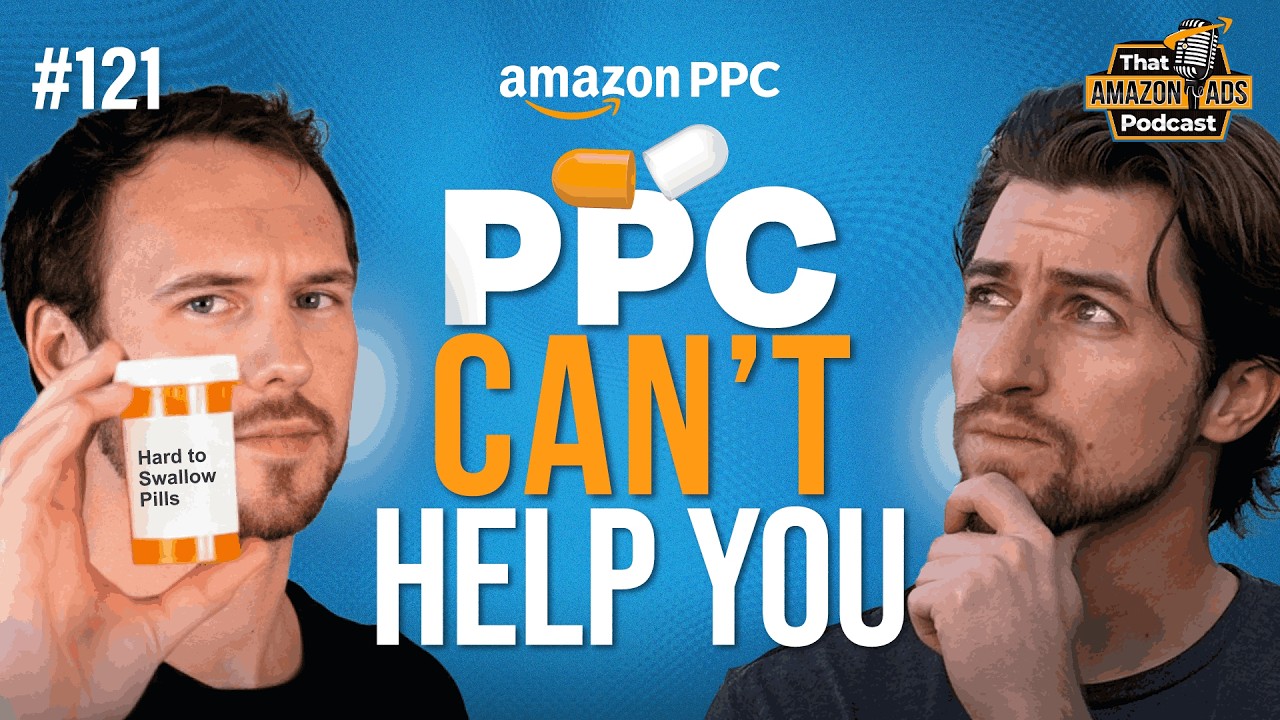
#121 - Hard to Swallow Pills: PPC Can't Grow Your Sales | Amazon PPC 2026
Summary
"Amazon PPC has a natural growth ceiling; once you optimize for efficiency, focus on external factors like product quality and market trends to sustain growth, as drastic performance shifts are only possible during the transition from inefficient to efficient campaigns."
Full Content
#121 - Hard to Swallow Pills: PPC Can't Grow Your Sales | Amazon PPC 2026
Speaker 1:
So you perfected your campaign structure, you optimized bids and placements, now what do you do?
Speaker 2:
What is the secret PPC strategy that can double your Amazon sales again?
Speaker 1:
What is the hack that unlocks consistent month-over-month and year-over-year growth?
Speaker 2:
Spoiler alert, there isn't one. Enjoy these hard-to-swallow pills today on That Amazon Ads Podcast. Alexa, play That Amazon Ads Podcast.
Unknown Speaker:
Which one would you like to hear?
Speaker 2:
The best one.
Unknown Speaker:
Okay, now playing That Amazon Ads Podcast. These gentlemen are completely changing the game.
Speaker 1:
After listening to That Amazon Ads Podcast, my ads are finally profitable.
Unknown Speaker:
I also heard they're pretty cute.
Speaker 2:
Well, after taking a couple months off from podcasting, we're kicking off 2026 with a brand new podcast episode. And today we have a special spotlight, special sponsor. So, Andrew, who is behind this podcast today?
Speaker 1:
Yeah, this episode is brought to you by Equate cold and flu medicine. Cold and flu season got you down, definitely got me down. This is the only thing getting me through this podcast episode.
So make sure you pick up your bottle of Equate cold and flu this season.
Speaker 2:
You're gonna take a swig for the camera?
Speaker 1:
Yep. I've been taking shots all day at work. You know, I got this little shot glass on my desk. It's great.
Speaker 2:
Andrew's been out sick for a couple of weeks, so we're powering through today's episodes. If you're sniffling. That's what it is. But we've been putting off podcasting for too long.
So we don't want to hold you guys, keep you guys waiting anymore. Hopefully you've been enjoying the masterclass episodes. But today we've got a topic that over the past couple of months,
this has been coming up with me so many times with the brands that I'm managing, with customers that are using AdLabs, questions that we're getting. And I just figured this is a very important message, note, lesson, whatever.
That people need to know and understand, which is essentially there is a point which you can get to with your advertising in which your advertising can't help you anymore.
Like there is a natural sort of ceiling or limit to how much your PPC can actually do for you and To make it its most simple version of like, what can PPC do for you? There are two versions of the health of your advertising.
There is inefficient campaigns or inefficient ads. And efficient ads. And everything that we've we're sharing on this podcast is basically how can you go from inefficient to efficient advertising.
But once you get to efficient advertising, the rest of this episode is going to talk about like, what are the next steps at that point. But Andrew, in terms of Inefficiency versus efficiency. What are you typically seeing there?
What can people expect when they're making that move in that transition?
Speaker 1:
Whenever you're going from an inefficient account, trying to work it down towards its efficient operating levels,
you're going to see a lot bigger swings in performance and more drastic adjustments to your profits and your revenues because the impact that those fundamental adjustments make are much greater than what you can likely achieve with like the smaller incremental changes that come once you are efficient.
There's a lot of other outside factors that kind of play into whether or not your product is going to continue to grow that are out of your control.
You can certainly do things to maintain the profitability of your business to keep things moving in the right direction. But ultimately,
there's going to be some things that limit and kind of plateau your growth if you're if you're not able to navigate them effectively.
Speaker 2:
Absolutely. Yeah. And you have probably heard, especially if you're a longtime follower of the podcast, you've heard Andrew and I say over and over and over again, That when we're auditing a new account,
taking on a new brand, we guarantee That our services will pay for themselves. And, you know, especially when we're working at larger agencies, we would be taking on large brands that are spending, you know, half a million dollars a month.
And part of our pitch is like, hey, we're going to charge you 8% of ad spend. It's going to be a hefty fee.
But we guarantee you that within 30 days, you're going to be net more profitable enough to pay for the cost of services and beyond that. And, you know, hearing that made people excited, made us that we could close.
And we always hit that guarantee. We also have the same guarantee with AdLabs that when you are signing up for AdLabs, you know, which is significantly less expensive compared to managed services, that we're guaranteeing within,
realistically, it's within like one or two weeks, you're going to hit that, but definitely within a month, the software is going to pay for itself through performance gains.
So either reducing wasted ad spend or improving sales or just increasing efficiency and profitability overall. And it's so easy to hit that because 90 to 95% of the time when we're auditing an account or onboarding new user,
we're seeing that the campaigns are extremely inefficient. So the lowest hanging fruits usually are just like, hey, you're not increasing for top search at all. Here's a bunch of missed sales opportunity. Let's do that.
Hey, you're also having tons of keywords we spend in no sales or whatever that like you're not, you know, people are able to identify spend in those sales. They don't know how to fix it efficiently.
So we have a way to manage the bids to control that or high cost keywords or whatever. So we can cut out the gains, boost the sales, throw some day parting on that's usually a really low hanging fruit as well.
And then boom, magically, within like a couple of weeks or within a month, Performance gains are like through the roof. Sales up, A cost and talk goes down, profitability through the roof, overnight media success. Everybody's stoked.
You know, you have a new client, new brand, whatever. They're stoked. They're like, wow, this is so much better than the last guy, the last agency or when I was doing it myself, whatever. Everyone's excited. You're going to month two.
Yeah, we're still doing good month three. Great. But the total profitability is like, you know, higher for those three months compared to the previous three months, but they're not growing anymore, right?
Like you hit you hit that immediate win that quick win. Everything's better. But now you're kind of like, you know, stagnating a little bit. So That is all the context for this.
So Andrew, once people get there, let's talk about why is it that those profits start kind of stagnating once you've optimized everything like your keywords, your bids, etc.
What is it that essentially allows those or prevents PPC from further growing the sales and the profits in an account?
Speaker 1:
Yeah, so there's like I mentioned before, there are a bunch of different outside factors that are going to play into whether that Product continues to grow.
One of them is very important is just is the overall category demand the overall category traffic continuing to grow because if you're you know, like a Rising tide lifts all ships. The search volume in the category, if it's going up,
the sales volume and velocity of your product is likely going to continue to go up. So you got to be really mindful of the market that you're in and whether or not the demand is increasing. And are you gaining more market share?
Is there additional market share to actually be gained for you? Are you already number one in your category? Maybe there's not a whole lot of additional upside for you to begin with.
And if you're not, A lot of people aren't going to be number one. We can talk probably next week a lot about deserved rank, like your product may not actually deserve to be ranked number one.
And so you got to kind of weigh out those different factors and see how much upside potential you really have still in the market,
given your positioning, pricing, all these different factors that are going to weigh into ultimately capturing more of the overall market. Yeah,
a lot of things that competitors can do and things like that that are going to weigh into whether or not your sales keep growing.
But traffic and kind of market dynamics are really the two that I see kind of plateauing people or putting a cap and a ceiling in place on products.
Speaker 2:
So the reason why we're making a full episode about this point is because I have been seeing this question a lot lately where You know, maybe the brands that I'm managing or different people that I've been consulting with and working with,
they have optimized their campaigns and they're wondering what do they do now. And it's also important to define what we mean by optimized. If you think about it, really, all your advertising is, is selecting keywords.
So one part of PPC management is like you want good keywords, relevant keywords, keywords that are driving sales. And then part two is you want to control the bids. There's a lot of stuff that goes into that,
but you're just trying to maximize the total sales volume and profitability within the bid ranges of what you can afford. So once you have properly optimized, meaning you have a good list of keywords,
all the top core keywords that actually matter to you, and you have all your bids, placements, audiences, modifiers, all this kind of stuff dialed in.
Once that's done, the sales from month over month, let's just say they don't grow or worse, they decline. And everyone's always kind of wondering like, what am I supposed to do?
They're all expecting that there's some other secret PPC strategy or hack that they don't know that like, oh, I got to get more complex. I got to split things out into single keyword campaigns or whatever it is.
But really, in reality, Once your campaigns are optimized, that is the end of what PPC can achieve for you. So that's why we're saying within those first 30 days, you can see these drastic results and you think, wow, PPC is a miracle.
It isn't. It was just. mismanaged before. Once it's managed properly, all the rest of that sales growth is going to come from outside of your PPC and advertising.
So one of these brands that I have is consistently growing at sales month over month, year over year. And when I dive into the analysis of where that's coming from, because I'm not like,
it's not like, oh, the more frequently optimized bids, the more the sales grow. That's not how it works, right? I'm always reviewing the keywords and the bids and all this kind of stuff, making sure it's all good and dialed in.
Where that sales growth is coming from is from the category itself. There is increasing search traffic, increasing demand for this product or for this category. So that's the biggest thing that's going to cause your sales to grow.
If the category is declining, as Andrew said, like a sinking tide lowers all boats, then there's just, you know, nothing you can do, no matter, it doesn't matter what you do with the PPC, like you can't overcome that.
And then the second thing that Andrew was saying was really just what is the market share. So, you know, Let's just say the sales category is staying, the category sales are staying flat in terms of like total search demand, total traffic.
If that's staying flat, then the only way in which you're gonna be able to like increase your sales is by stealing more sales from customers.
And in that case, it's basically increasing in bestsellers ranking and working your way towards being number one. If you're already number one in the category, already won number one bestseller, there's not much more that you can do.
within Amazon search. Like you could perhaps expand outwards and look at more upper funnel tactics trying to increase demand for your product outside of just the already inbound demand.
And if you're not number one, maybe you can't actually be number one. Like you have to kind of seriously look at the number one top seller and just consider, can I beat this person on the three primary things that really matter,
which is just like the quality of the product itself. Uh, the number of reviews and ratings and all that, and then the price. Like if you can't beat them on those three things, then you're probably never going to be number one.
But if there's other people, maybe you're number 10, right? And you can't be number one, but like, Oh, I can beat numbers nine through seven. All right. Now you've got a goal to work towards, you know,
if you genuinely have a better product than those other people, then you can definitely work towards capture more of that market share and moving your way up.
But you just, you have to come to grips with where you are relative to the other products. Is your product actually better than theirs? Can you actually take more market share? And a lot of times the answer is no,
because you're already at the top or their product is simply just better. And, you know, you're just subject to the actual search volume levels.
Speaker 1:
Yeah, there is so much there. I mean, that's since my mind's going in a bunch of different directions. I don't want to spoil a lot of the stuff we have planned for next week's episode. But yeah, that's very well said.
And I think that the The crux of this is I noticed a lot of people get into Amazon, they start with just a product. There's no real strategy behind the product, the positioning, the pricing.
Is there a competitive advantage that they're actually going to have or a competitive moat against these other listings and stuff?
And a lot of people don't actually think that through enough and they start with a product and that's all they have. And what really you should be thinking about is launching a product and then how do you expand upon that first product?
Is it expanding via line extensions, additional variations? Is it other complimentary products or kind of adjacent categories and additional products there? That's really the only way you're going to continue to actually build the brand.
Otherwise, you're going to Get out, compete, outcompeted or outperformed by companies who are actually building brand off platform and building a full catalog of products.
They don't just have one standalone product that's then available to the whims of the market and what other competitors are able to do or Chinese sellers coming in and undercutting pricing.
You got to be able to stomach some of those adjustments on certain products and by having more volume of products like that, those adjustments will kind of balance each other out over time, or at least that's what I've seen.
And a lot of the sellers that don't find success is when they're just like, I'm going to try this one product. And try to scale it and it's going to be the full business, but that can work for so long.
And then eventually it starts to deteriorate, profits deteriorate, it gets become saturated and you have to like expand. Otherwise you are going to get crushed. So that's at least what I've seen in this.
Speaker 2:
A lot of times at risk of sounding like a broken record, I'm just going to say it one more time for the people in the back. But PPC does not grow your sales. And it's going to you're going to you're going to say I'm crazy.
I'm going to add some nuance to that and some caveats. If you weren't running any ads at all, then, yes, turning on ads is obviously going to grow your sales. Right. Or if you were missing a ton of keywords and you add in those keywords.
Yes, that's going to that's going to grow your sales. But once that's done, Once you've added the keywords, you've got the coverage, you're running PPC at full capacity, it's not going to grow your sales anymore.
You can't routinely do something that's incrementally adding value. It's not like there's a weekly task or monthly task. If you just do this enough times and do this with a high enough frequency for a long enough time,
it's going to grow your sales. PPC doesn't work that way. Once you have the coverage in the search page for those keywords, that's the end of it. You can't grow sales anymore beyond that.
You just make sure your ad is there and if it's there, you're done. So where that sales growth is going to come from, like Andrew was saying, primarily is going to come through expanding the catalog.
That's where we have always seen the best brands that have the best long-term growth. It is always coming from catalog expansion. And the brands that don't expand are always the ones that, you know,
decline year over year and eventually go out of business. So that's ultimately what it comes down to next week. Next week's episode is going to be on the product lifecycle. So we'll talk more about that next week.
You know, if you have a new product that's launching, yeah, PPC is going to help you grow that product. You're going to be climbing in BSR. But then once that product has essentially reached maturity, PPC can't help you anymore,
unless if it was inefficient and you're taking over management and you're making everything to be efficient. That's the biggest opportunity for PPC. Like you can just move from inefficient to efficient once it's that efficient.
There's nothing you can do there but just simply maintain, which is just like routine optimizations, some tweaks here and there. But it's not going to be a core part of the strategy that's continually growing your sales.
Speaker 1:
Very well said. Kicking off 2026 with a bang. We're excited. We're back and we're going to be here to stay. So make sure you like and subscribe. Check every piece of content that we're putting out every week. Stephen, any final thoughts?
Speaker 2:
Get better soon, Andrew.
Speaker 1:
All right. We'll see you next week.
Speaker 2:
Comment, get well soon. If you want to see Andrew again next week, otherwise, He might die and you'll never see him again.
Speaker 1:
It's possible.
Speaker 2:
Hope you guys had a great time. Talk to you next week on That Amazon Ads Podcast.
This transcript page is part of the Billion Dollar Sellers Content Hub. Explore more content →